




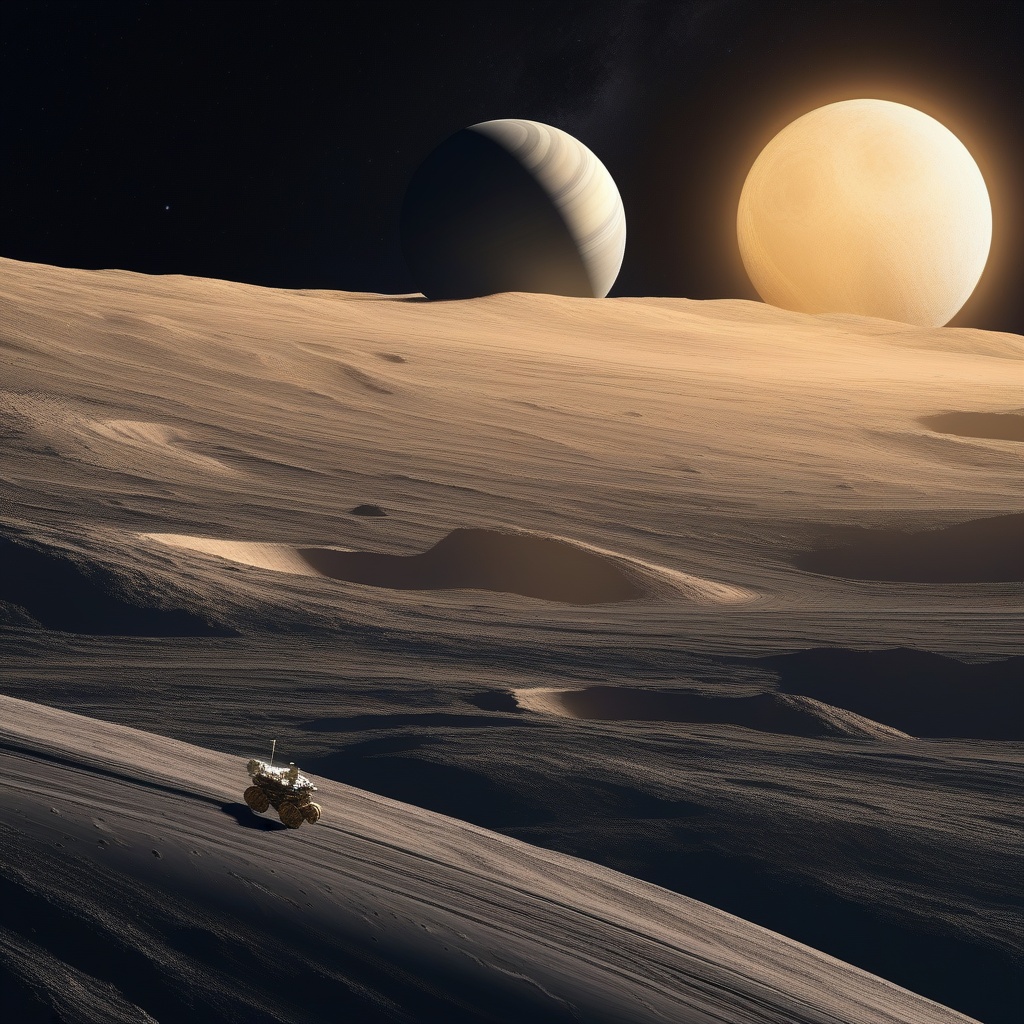
Titan Fly‑by Highlights and Huygens Preparations
On the morning of 26 October, the Cassini‑Huygens mission will execute its closest ever approach to Saturn’s largest moon, Titan. At 18:44 Central European Summer Time, the spacecraft will glide only 1,200 kilometres above the moon’s dense, haze‑laden surface, skirting the edge of the upper atmosphere while barreling through space at 6 km per second (about 21,800 km per hour). This tight pass will give Cassini unprecedented access to Titan’s geology and atmosphere, providing data that will shape the next chapter of the mission. The exact outcome of the fly‑by will be confirmed when the first images and radar readings arrive at Mission Control on 27 October at 03:30 CEST. The results will be vital for ESA’s Huygens team, who will use the new observations to refine their atmospheric entry and descent models ahead of the probe’s scheduled release on 25 December. The Huygens descent, which will occur in mid‑January 2005, will rely on these refined models to ensure that the probe can survive the harsh, uncharted environment of Titan’s lower atmosphere and surface. In the days following the close encounter, Cassini will also carry out a brief pass over Tethys, one of Saturn’s icy moons. At about 12:30 CEST on 28 October, Cassini will travel 246,000 km from Tethys, passing at a speed of 13.8 km/s. The spacecraft’s narrow‑angle camera will capture surface features down to roughly 1.4 km, adding valuable context to the broader picture of Saturn’s moon system. Returning to Titan, the fly‑by will dramatically alter Cassini’s orbit around Saturn. Prior to the encounter, the orbiter’s period was roughly four months; after the maneuver, the period will shrink to 48 days. This change sets the stage for the next close Titan fly‑by on 13 December 2004, and it will also reposition Cassini for the final Huygens probe release on 25 December. The new orbit will provide Cassini with a shorter and more frequent window of opportunity to study Titan’s dynamic environment. Scientists on the ground anticipate a wealth of data from Cassini’s imaging and radar instruments. Although Titan will fill the field of view of Cassini’s narrow‑angle camera at closest approach, the instrument’s ability to penetrate the methane‑rich haze could still reveal surface details down to 100 metres. The Visual Infrared and Mapping Spectrometer (VIMS) is expected to deliver multi‑colour images at 1–2 km resolution, offering insights into the composition of the moon’s icy crust and the distribution of organic compounds. The radar sounder, meanwhile, will map subsurface layers and help determine the thickness of the polar lakes and the overall structure of the moon’s crust. In addition to imaging, Cassini’s magnetometer will record interactions between Titan’s atmosphere and Saturn’s magnetosphere, shedding light on the moon’s magnetic environment and its impact on the broader ring system. All of this information is critical for ESA’s Huygens Mission Manager, Jean‑Pierre Lebreton, who highlighted the importance of the close‑up data. “This first close‑up look at Titan should enable us to find out just how precisely our atmospheric models fit with the real situation,” he said, adding that the team is eager to discover the true nature of the surface where Huygens will eventually land. The Huygens probe itself remains dormant during the fly‑by, but the knowledge gained now will inform its landing strategy. When the probe eventually touches down on the sun‑lit face of Titan, the touchdown site will be roughly at 167 ° E, 10.7 ° S, a location that Cassini will have already imaged from the air. These images will be critical for verifying the landing site’s suitability and will guide the descent trajectory. Even before the touchdown, the data gathered will help scientists understand Titan’s atmospheric chemistry and dynamics. The close encounter is more than a routine milestone; it is a pivot point that will affect the trajectory of the mission, the safety of the Huygens probe, and the breadth of our knowledge about a moon that sits at the edge of planetary habitability. Cassini’s instruments will continue to collect data on Titan’s surface features, cloud systems, and seasonal changes, while also monitoring the interaction of Titan’s atmosphere with Saturn’s magnetic field. The mission’s extended timeline, with a new orbit period of 48 days, ensures that Cassini will maintain a tight window for future Titan encounters, enabling a deeper, more comprehensive exploration of the moon’s complex environment. In the weeks to come, the scientific community will be watching the data streams from Cassini with anticipation, knowing that each new image and spectrum brings us closer to answering fundamental questions about the chemistry, geology, and potential habitability of Titan. The combination of Cassini’s close fly‑by, the refined atmospheric models for Huygens, and the detailed mapping of Tethys creates a robust framework for the next phase of exploration. By pushing the limits of proximity and precision, the mission is poised to unlock new chapters in our understanding of Saturn’s moons and the wider solar system.








No comments yet. Be the first to comment!