




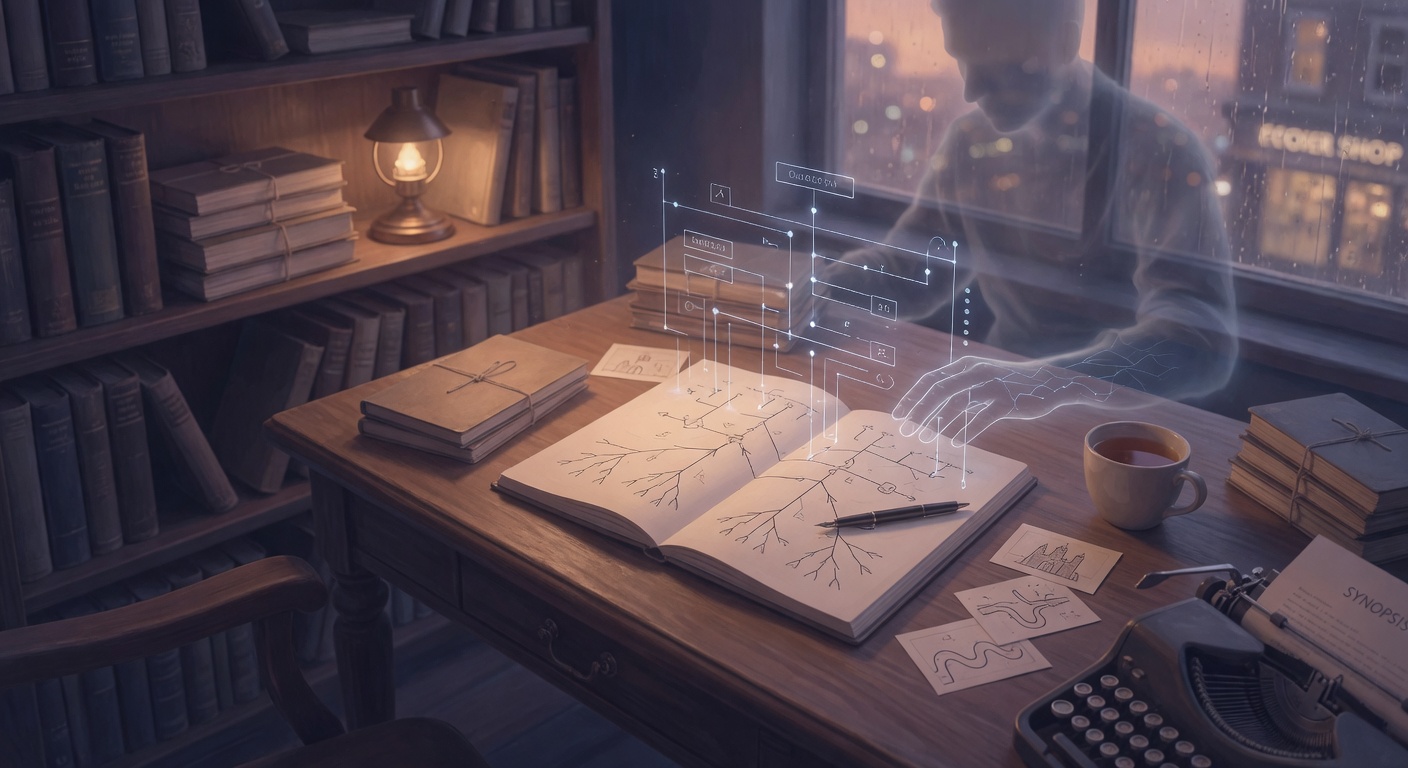
Why Your Synopsis Fails Before the First Sentence
Most synopsis problems start long before you open a blank document. They start in your head, where the novel lives in full color - every subplot, every emotional undercurrent, every carefully planted piece of foresight - and the synopsis asks you to flatten all of that into two pages. Writers who struggle with this task usually aren't bad writers. They're writers who haven't separated the structural skeleton of their story from the flesh they've spent months building. That separation is exactly where AI can help, and it's worth understanding why before you open a chat window.
A synopsis is not a summary of your feelings about the book. It's not a back-cover tease, and it's not a chapter-by-chapter report. A synopsis is a forward-moving argument: character wants something, obstacles appear, choices are made, consequences follow, everything lands somewhere that feels earned. Literary agents read synopses to check story logic, not prose style. They want to see that the cause-and-effect chain holds together, that the protagonist actually drives the action, and that the ending pays off what the opening promised. If you understand this, you understand why a structured outline - built before you write a single synopsis sentence - is the most useful thing you can create.
Here's where most AI-assisted writers make a mistake. They paste their manuscript into a chat model and ask it to write the synopsis. The AI produces something technically coherent and completely lifeless, because it's working from text, not from the living logic of the story the way you understand it. The better approach is to use AI to help you build a skeleton first - a structured outline of your story's core beats - and then use that skeleton as the scaffolding for your own prose. You stay in control of the voice. The AI helps you see the architecture.
This approach also forces you to articulate things you may have been avoiding. What exactly does your protagonist want? Not thematically - concretely. What decision do they make at the midpoint that changes the direction of the story? What do they lose that they can't get back? When you have to answer these questions in plain language, in a structured format, the gaps in your story logic become visible. That's uncomfortable, but it's the kind of discomfort that saves you from sending out a synopsis that quietly confuses an agent without you knowing why.
For poets and essayists, the word "synopsis" might feel foreign, but the same underlying skill applies. A lyric essay needs a structural argument, even if it's associative. A poetry collection needs a manuscript arc - an emotional or thematic journey from the first poem to the last. The techniques here translate: you're still building a skeleton that shows how the pieces move and why the ending is the right ending. The prompts in this article are written with fiction in mind, but each one includes notes on how to bend it toward other forms.
Prompts and Workflow for Building Your Structural Outline
The workflow has three stages. First, you extract the raw material - the bones of your story as you currently understand them. Second, you ask the AI to organize and pressure-test that material, looking for logic gaps and weak causal links. Third, you write the synopsis yourself, using the outline as a guide, and then use AI for targeted revision. Each stage has its own prompt, and the prompts are written to be specific enough that the AI can't wander into vague literary praise or generic storytelling advice.
Before you run the first prompt, write out a rough paragraph about your story in plain, unpolished language. Don't try to make it good. Just say who the main character is, what they want, what stops them, and how it ends. That rough paragraph is your input. The AI isn't inventing your story - it's reorganizing what you already know into a structure you can use.
Use the first prompt at the very beginning of your synopsis session, before you've written anything formal. It's designed to produce a structured outline in a specific format, not a prose summary. This keeps the AI from slipping into summary mode, which produces polished-sounding output that's actually harder to revise.
Once you have your structured outline back, read it carefully before you do anything else. The [NEEDS CLARIFICATION] flags are valuable. They're not the AI telling you your story is bad - they're structural questions that your synopsis will have to answer. If the Crisis Point is flagged, it often means the protagonist's lowest moment isn't clearly distinct from the general rising tension, which is a common structural issue and also the most common reason synopses feel flat.
The second prompt is for pressure-testing the causal logic - the "and therefore / but then" chain that separates a plot from a sequence of events. This is where memoir and lyric essay writers will find the most to adapt. In memoir, the causal chain is often emotional or psychological rather than external. You can adjust the prompt by changing "protagonist" to "narrator" and asking the AI to track shifts in understanding rather than plot events.
For poets working on collection manuscripts, this same prompt can be adapted by replacing "five-part outline" with "sequence of poem titles and one-line descriptions," and asking the AI to trace thematic or tonal progression instead of causal plot logic. The question shifts from "why does this happen" to "why does this poem follow that one," which is surprisingly illuminating when you're mid-arrangement and can't see the whole arc anymore.
The third prompt in this stage is a voice-check. After you've written a draft of your synopsis using the outline, you'll want to make sure the agent-facing version reads in a consistent narrative voice - present tense, third person for most fiction, with the protagonist's interiority shown through action and choice rather than told through adjectives. This prompt is also useful for revising a synopsis that feels technically correct but emotionally inert.
Exercises for Genre Adaptation and Honest AI Use
The prompts above are starting points, not scripts. The most useful thing you can do is treat them as templates with adjustable parameters. Every bracket in those prompts is a decision point. "Literary fiction" in the voice-check prompt can become "psychological thriller" or "climate fiction" or "second-person memoir." The five-part structure can become a three-act structure or a hero's journey or a braided-essay structure with three interweaving threads. The more specific you are about your form and genre when you run the prompt, the more useful the output will be.
Here's a concrete example. A historical fiction writer will often have a problem the standard synopsis structure doesn't address: the weight of real events that the protagonist has to navigate. The inciting incident in a story set during a real war or political crisis isn't something your protagonist causes - it's something that happens to them. That changes the causal logic. You can adapt the pressure-testing prompt by adding a line: "Note that the inciting incident is a historical event outside the protagonist's control. Focus the causal analysis on how the protagonist's responses and decisions drive each subsequent transition." That one addition changes the quality of the output dramatically.
For prose poets or hybrid essayists, the synopsis exercise is really a manuscript-architecture exercise. Use the first prompt but replace the five structural labels with ones that match your form: Opening Image or Situation, First Associative Turn, Central Complication or Contradiction, Deepening, Closing Movement. The AI doesn't know your form intuitively, so you have to name it. When you do, the output becomes genuinely useful instead of forcing your lyric essay into a three-act thriller shape.
A word on what AI won't do well here, and it's worth saying plainly rather than as a footnote. AI will not tell you whether your story is moving. It will not catch thematic contradictions that live below the surface of the plot. It will not know when a character's decision doesn't ring true because it runs against something established forty pages earlier. It will confidently fill in gaps with plausible-sounding story logic that isn't actually your logic. This is why every outline the AI produces needs to be read against what you know your story to be, not accepted as a diagnosis. Use it the way you'd use a smart reader who hasn't read the manuscript - someone who can help you see the shape, but who needs you to catch anything they've misunderstood.
The last exercise is the most useful one for writers who are stuck mid-synopsis and can't figure out why. Write your synopsis in bullet points, one bullet per beat, without worrying about transitions. Run the pressure-testing prompt on those bullets instead of a formatted outline. The AI's logic-gap flags will almost always point you toward the same two or three places where your story's engine stalls - where you were relying on coincidence, or where a character acts out of plot necessity rather than their own consistent psychology. Fixing those gaps in the outline before you write the prose synopsis saves you from rewriting the synopsis three times after getting vague rejections. That alone is worth the hour.





No comments yet. Be the first to comment!