




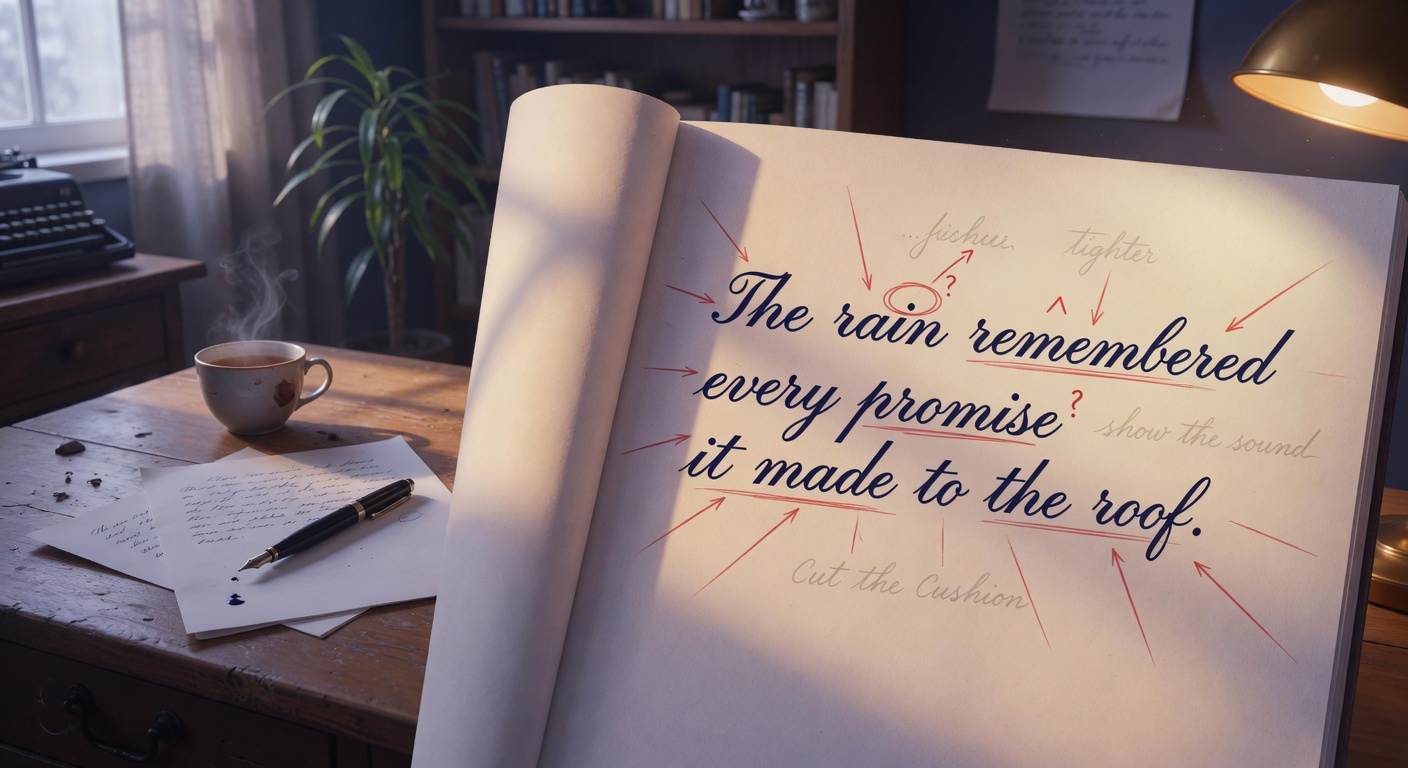
Many writers reach a point where a draft feels almost right, yet individual sentences still blur the intended meaning. The fix often lies in small, targeted adjustments rather than wholesale rewrites. Sentence-level prompts give an AI model a narrow job: examine one line or short passage, flag what slows clarity, and offer a tighter alternative that keeps the original intent. Because the scope stays limited, the suggestions remain easier to judge against your own ear.
These prompts work best after you have a complete scene or stanza on the page. Feed the AI only the sentence or two under review, plus a brief note about the surrounding context. The model then returns options rather than commands, so you stay in control of tone and rhythm. Over time the process trains your own eye to spot the same issues without assistance.
Prompts for Revising Sentence Clarity
Use this prompt when a descriptive sentence has accumulated too many modifiers and the main action disappears.
Try this prompt on passages where abstract language replaces concrete detail, common in early memoir drafts.
Poets often need help tightening syntax without losing line breaks or sonic patterns. This prompt respects those constraints.
Adapt these prompts across genres by swapping the role description. For fiction, emphasize narrative momentum; for poetry, add instructions about meter or assonance; for memoir, ask the model to respect the reflective distance of the narrator. The output shape stays the same, but the constraints shift slightly to match the form.
Prompts for Dialogue and Character Voice
Apply this prompt when two characters speak but their voices blend together on the page.
Use the next prompt on internal monologue that has drifted into explanation rather than lived thought.
Essayists and memoir writers sometimes need help turning a flat statement into a voice that feels lived.
Genre adaptation here means adjusting the voice cues. Fiction prompts can request regional diction or age-appropriate vocabulary. Poetry versions might ask for compression that still carries subtext. Memoir prompts benefit from instructions that protect the reflective tone of hindsight rather than immediate action. In every case, read the suggestions aloud before accepting them; the model lacks your lived sense of how the words should land.
Workflow for Repeated Use
A steady workflow keeps these prompts from becoming scattered experiments. Begin by printing or highlighting the sentences you suspect need work. Run one prompt at a time on a single sentence rather than an entire page. After the model returns options, set them beside your original and read both versions in context. Only keep changes that still sound like you.
Track patterns over several sessions. If the same issue, such as passive constructions or stacked adjectives, appears repeatedly, create a short custom prompt that targets only that habit. Save the prompt in a note file so you can reuse it without retyping. The goal is not to outsource judgment but to speed up the mechanical part of clarity editing.
Remember that AI output remains a suggestion. Fact-check any historical or technical detail it inserts, and compare its rhythm choices against the rest of your piece. Personal voice emerges from the decisions you make after seeing the alternatives, not from accepting the first polished line the model offers.





No comments yet. Be the first to comment!