




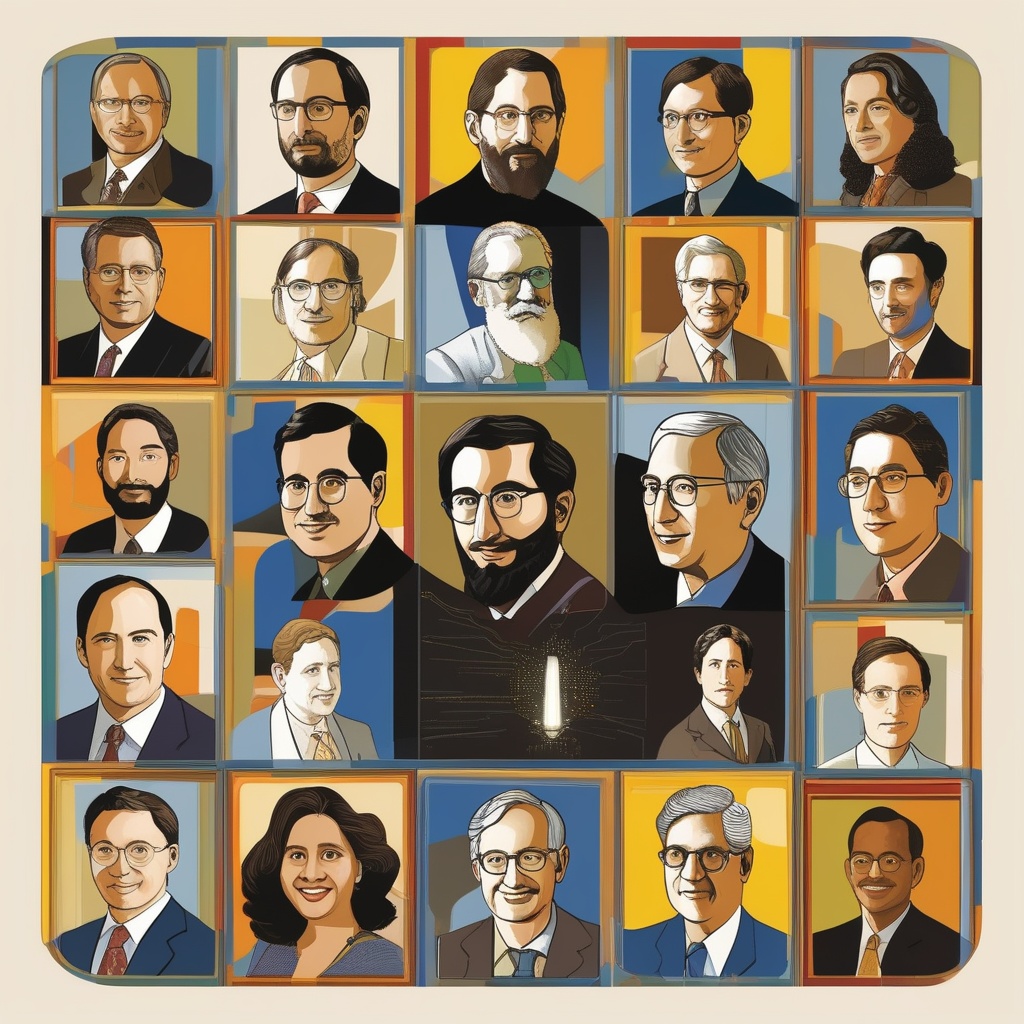
Celebrating the Legacy of Marconi Fellows
In 2004, the Marconi Foundation at Columbia University honored two of the most influential minds in the digital age: Sergey Brin and Larry Page. The award, a tribute to Guglielmo Marconi's pioneering work in wireless communications, recognizes individuals who have reshaped how we interact with information. Brin and Page, then fresh Stanford graduates, launched a search engine that would redefine the web.
John Jay Iselin, president of the Foundation, highlighted the transformative nature of their invention. He noted that Google had turned the chaotic web into a navigable system, turning the way people retrieve data from a haphazard effort into a streamlined, searchable resource. This shift, he said, has become a foundational part of modern life.
The Marconi Foundation has a storied history, having selected only 32 pioneers since 1975. The cohort includes the likes of Robert Metcalfe, the architect behind Ethernet, and Robert Gallager, who advanced error‑correcting codes that underpin today’s wireless networks. These individuals, along with Tim Berners‑Lee, the World Wide Web inventor, set the stage for a new era of communication.
Tim Berners‑Lee, a 2002 Marconi Fellow, offered a compelling reflection on Google’s impact: “Google held a mirror up to us, reflecting the myriad little actions of linking as a set of concepts which society has discussed and sought.” His words capture the way Google made the invisible architecture of the web visible and usable.
Francesco Paresce Marconi, the grandson of Guglielmo and Foundation chairman, emphasized the search engine’s role in bringing order to an unprecedented volume of information. He praised Brin and Page for crafting a tool that could handle hundreds of millions of queries each day, delivering precise results almost instantaneously to users across the globe.
Brin echoed this sentiment in his own words. “On behalf of Google, Larry and I are honored to be recipients of the Marconi Fellowships,” he said. “This award affirms the value of Google's mission, to organize the world's information and make it widely accessible and useful.” His statement underscored a shared vision: harnessing technology to serve humanity’s thirst for knowledge.
Tracing the origins of Google takes us back to 1995, when Brin and Page began experimenting with a new way of ranking search results. Their algorithm, later known as PageRank, weighed the importance of web pages based on the number and quality of links pointing to them. This simple yet powerful idea turned the web from a chaotic maze into a structured, searchable index.
Beyond the academic sphere, Google’s search engine became an everyday tool. Students tapped it for quick homework solutions; business professionals analyzed competitors; homemakers found fresh recipes; and shoppers scoured for deals. The platform’s versatility stemmed from its ability to turn raw data into actionable insights for anyone with an internet connection.
Darcy Gerbarg, the Foundation’s executive director, celebrated the 30th anniversary of the Marconi Foundation and noted how Brin and Page’s work exemplified the convergence of science, business, and technology. She called their achievement a milestone in what she terms the “telecommunications revolution of the Marconi Century.” The phrase emphasizes how the foundation’s focus has evolved from radio waves to digital networks.
The award ceremony took place on October 8, 2004, in Bologna, Italy. Brin and Page received a $100,000 honorarium, a tradition that encourages Fellows to contribute back to the foundation. Both founders pledged to donate their entire honorarium to the Fellows Fund, a gesture that reinforced their commitment to nurturing future innovators.
As the Marconi Foundation looks ahead, the inclusion of figures like Brin and Page signals a broadening of the fellowship’s scope. The foundation now embraces digital pioneers whose work reshapes global communication infrastructure. Their collective achievements weave a narrative that stretches from Marconi’s early wireless experiments to Google’s modern search architecture.
The Significance of Google’s Contribution to Information Organization
Google’s influence extends far beyond its search engine. The platform’s core philosophy - organizing information to make it universally accessible - has rippled through countless sectors. From education to e-commerce, the ease of finding reliable data has accelerated innovation and democratized knowledge.
At the heart of Google’s success lies its data‑driven approach. By continuously crawling the web, the company builds an ever‑expanding index. Advanced algorithms then parse and rank this content, allowing users to find relevant results in milliseconds. This efficiency stems from the early work of Brin and Page, whose algorithmic ingenuity set the standard for modern search technologies.
Another pivotal aspect is the emphasis on user experience. Google’s clean interface, minimalistic design, and lightning‑fast response times have become benchmarks for other tech companies. The focus on delivering precise answers quickly transformed how people perceive the internet - not as a maze of hyperlinks but as a curated library at their fingertips.
Beyond searching, Google’s ecosystem expanded into domains like email (Gmail), cloud storage (Google Drive), and mapping (Google Maps). Each of these services leverages the foundational principles of data organization and accessibility. Gmail’s smart filtering and search capabilities mirror the same indexing logic that powers the web search, while Google Maps organizes geographic information for real‑time navigation.
Google’s commitment to open standards also fostered a thriving developer community. The launch of the Google APIs and the Android operating system, for instance, empowered third‑party developers to create applications that integrate seamlessly with Google’s infrastructure. This openness accelerated the adoption of mobile and web technologies worldwide.
Privacy and security, however, have been contentious topics. While Google’s data collection practices have raised concerns, the company has introduced robust privacy settings and transparency reports to address user anxieties. These measures illustrate the ongoing challenge of balancing innovation with user trust.
In the educational sphere, Google has reshaped learning environments. Tools like Google Scholar and Google Books provide students with instant access to scholarly articles and reference materials. The platform’s integration with Google Classroom and Docs further streamlines collaboration, allowing educators and students to share resources and complete assignments in real time.
The economic impact is equally significant. Google’s advertising model, which relies on precise targeting and data analytics, has spurred a new digital advertising economy. Small businesses now reach niche audiences through affordable, data‑powered campaigns. The ripple effect has cultivated a vibrant digital marketplace, generating revenue streams for countless entrepreneurs.
On a global scale, Google’s infrastructure - its vast network of servers and data centers - supports billions of users daily. The company’s investment in renewable energy and sustainable data centers reflects a broader commitment to reducing its carbon footprint. By integrating eco‑friendly practices, Google demonstrates how technology leaders can balance growth with environmental responsibility.
In retrospect, Brin and Page’s 2004 fellowship recognition serves as a milestone that encapsulates Google’s journey from a simple search engine to a multifaceted platform shaping information ecosystems. Their work continues to influence how data is collected, processed, and shared, leaving an enduring legacy that aligns with the Marconi Foundation’s mission to honor those who propel communication forward.








No comments yet. Be the first to comment!