

Category Positioning Prompts: AI Prompts That Pinpoint Your Novel's Shelf Placement Before You Query
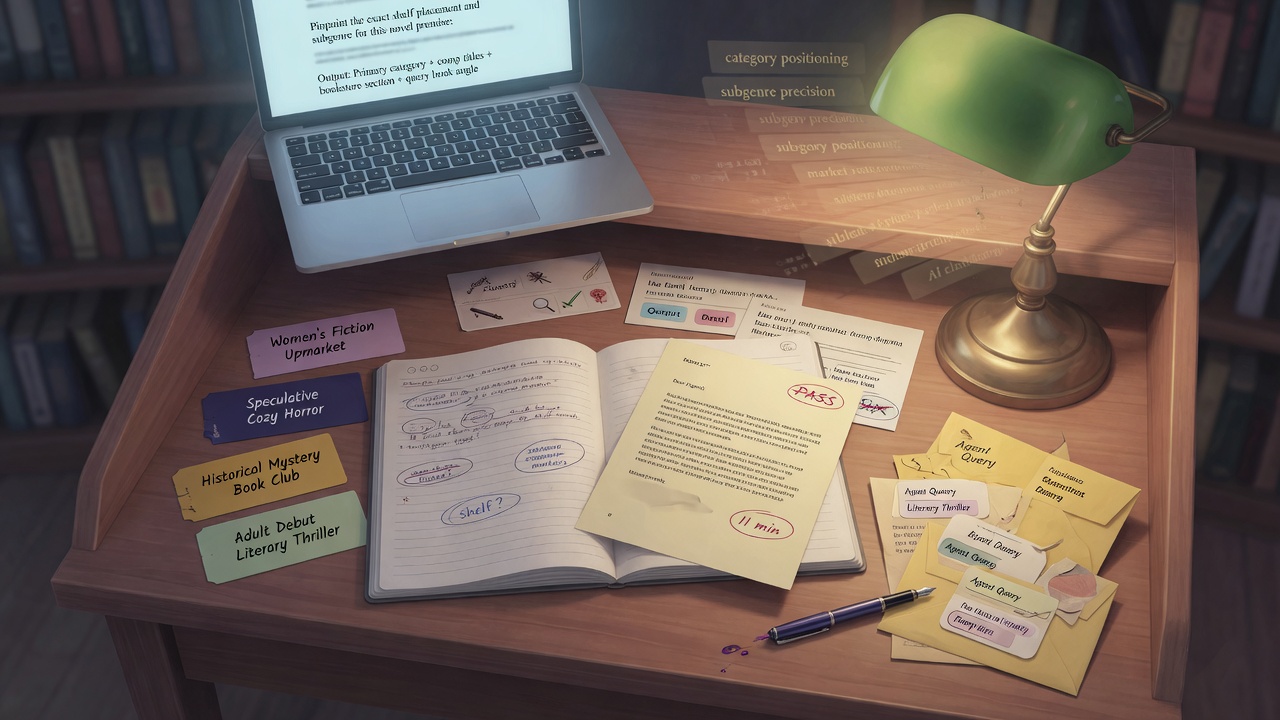
Every experienced query reader has a version of this story: a manuscript arrives with genuine craft, a compelling voice, maybe even a fresh premise — and it gets a form rejection in eleven minutes. Not because the writing failed. Because the writer couldn't say, in one clean phrase, what shelf the book belongs on. Agents aren't being lazy or cruel when they pass fast on unclear category framing. They're doing triage. They rep specific categories, pitch to specific editors who buy specific things, and a query that reads "it's kind of a thriller but also literary and there's romance and maybe some fantasy elements" tells them the book will be just as hard to sell as it was to describe.
This isn't a marketing problem you solve after the book is done. It's a diagnostic problem you solve by looking clearly at what you actually wrote, then translating that into the specific, slightly clinical language agents use when they build their manuscript wishlists. AI is well suited to this particular task — not because it understands your book's soul, but because it's good at pattern-matching your content against the taxonomy of an industry that runs on precise labels. Used well, it can pull you out of "it's kind of everything" and into "upmarket book club fiction with a splash of speculative conceit, comp Kaliane Bradley meets Emily St. John Mandel" — the kind of sentence that gets a full request instead of a form pass.
Why "It's Kind of Everything" Reads as a Red Flag
Vague category framing usually comes from a true place: your book probably does blend things. Most good novels do. The problem isn't the blend — it's presenting the blend as an unresolved question rather than a deliberate choice. Agents read "genre-bending" and "hard to categorize" as code for "the writer hasn't figured out who buys this book," which then reads as "neither have I, so I'll pass." Precision does the opposite work. When you tell an agent your book is romantasy with a slow-burn enemies-to-lovers arc and a fully realized political system, rather than "fantasy with romance in it," you're demonstrating that you understand the market you're entering — that you know romantasy readers expect the romance to carry equal narrative weight to the world-building, not sit as a subplot. That specificity is itself a credibility signal, separate from the quality of your prose. The trouble is that most writers are too close to their own manuscript to categorize it cleanly. You know every thread you wove in; you don't know which threads a genre reader would consider load-bearing versus decorative. This is where a structured AI pass earns its keep — not to invent a category for you, but to reflect back what's actually on the page in the industry's own vocabulary.
Prompt 1: Generate a Ranked List of Precise Category Labels
Start broad, then force ranking. The goal isn't a single answer — it's seeing your options laid out with the reasoning exposed, so you can evaluate whether the AI's read matches your intent or reveals a mismatch you hadn't noticed.
I'm going to describe key scenes, tropes, and structural elements from my novel. Based on this information, generate a ranked list of 3-5 precise subgenre/category labels that could describe this book for query purposes. For each label: - Name the specific category/subgenre as it would appear in an agent's MSWL or a BookScan comp search (not a vague genre umbrella) - Explain which specific scenes, tropes, or craft choices support this label - Note what a reader expecting this category would demand from the book that I may or may not be delivering - Rate how strong a fit this is on a 1-10 scale, with reasoning Here's my manuscript information: - Genre elements present: [list — e.g., "secondary world magic system, romantic subplot between protagonist and rival commander, political intrigue, war as backdrop"] - Point of view and tense: [e.g., "first person present, single POV"] - Tone: [e.g., "wry, fast-paced, some humor undercutting high stakes"] - Ending type: [e.g., "romantic resolution is central to the climax" or "romantic subplot resolves but isn't the emotional climax"] - Comparable books I've considered: [list 2-3, even tentatively] - Word count: [your count] After the ranked list, tell me which category has the strongest structural support in what I've described, and which is the weakest fit despite surface similarities.
Pay attention to where the AI's confidence is high versus hedged. If it consistently qualifies one label with "but this would require the romance to resolve the plot, not just the character arc" — that's a diagnostic, not a technicality. It's telling you what your ending is currently doing versus what the category promises.
Prompt 2: Diagnose Category Drift Chapter by Chapter
Category drift happens when a manuscript starts in one lane and, chapter by chapter, accumulates elements that pull it toward a different shelf — often because those elements were fun to write, not because they served the book's core promise. A subplot that starts as flavor becomes a parallel plot. A side character's arc balloons until it rivals the protagonist's. This prompt asks AI to flag the drift by walking through your manuscript's actual structure rather than your summary of it.
I want you to help me diagnose "category drift" in my manuscript — places where the book's content pulls toward a different shelf category than my intended one. My intended category: [state it precisely — e.g., "upmarket women's fiction, book club oriented, not romance-forward"] Here is a chapter-by-chapter summary of my manuscript (or paste in summaries for each chapter/section): [insert your chapter-by-chapter breakdown — even 1-3 sentences per chapter is enough] For each chapter, flag: - Whether the content matches, is neutral to, or pulls away from my intended category - If it pulls away, name which alternate category it's pulling toward (e.g., "this chapter's pacing and stakes read more like commercial thriller than upmarket fiction") - Whether the drift is concentrated in a specific arc, character, or structural section, or scattered throughout Then give me a summary: is this book consistently in its intended lane with isolated drift I could revise or cut, or is the drift substantial enough that I should reconsider which category actually fits the book as written?
This is the prompt that saves you from querying the book you meant to write instead of the book you actually wrote. It's common to discover that your back third has drifted hard into thriller pacing because you needed to raise stakes for the climax, even though your query describes something quieter. Agents will notice that mismatch the moment they read your sample pages against your pitch, and the resulting confusion reads as inconsistency in craft, even when it's really just inconsistency in category self-awareness.
Prompt 3: Map Load-Bearing Elements Versus Flavor Details
Genre-blend confusion often comes down to not knowing which elements of your book are structural — meaning the plot cannot resolve without them — and which are texture that could be dialed up or down without changing what the book fundamentally is. This distinction matters enormously for category precision, because agents and readers forgive flavor easily but feel betrayed when load-bearing elements are undersold or oversold in the pitch.
Help me distinguish "load-bearing" elements from "flavor" elements in my manuscript, specifically for the purpose of category positioning. A load-bearing element is one that, if removed, would require me to rewrite the plot or ending — it's structurally necessary to how the story resolves. A flavor element is present, adds tone or texture, and may be genuinely important to the reading experience, but the plot could resolve without fundamentally changing if it were reduced or removed. Here are the genre-relevant elements in my manuscript: [list everything that could plausibly signal a genre or subgenre — e.g., "the murder mystery the protagonist investigates," "the slow-burn romance with her partner," "the magic system that explains how the murder was committed," "the small-town setting and ensemble cast," "the humor in the dialogue"] For each element, tell me: - Load-bearing or flavor, with reasoning - If load-bearing, which category that element obligates me to (i.e., what promise it makes to readers of that category) - If flavor, whether it's currently being oversold in a way that could create mismatched expectations (for example, if my query leads with a flavor element as though it were the point of the book) Finally, tell me what category is implied by my full set of load-bearing elements alone, stripped of flavor.
This prompt tends to surface an uncomfortable but useful realization: many writers pitch their book by its most interesting flavor element rather than its actual load-bearing plot engine. If your mystery only resolves because of the magic system's internal logic, that's fantasy-mystery, not "mystery with some magical flavor" — and pitching it as the latter will land you with agents who don't rep speculative plot mechanics and will feel misled by chapter three.
Prompt 4: Translate Your Category Into Query-Ready, MSWL-Matched Language
Once you've settled on a category through the diagnostic work above, the final task is translation — turning your internal understanding into the exact register agents use publicly. Agents write MSWL posts and Twitter/X wishlist threads in a particular shorthand, and matching that shorthand (without copying anyone's specific post) makes your query immediately legible.
I've determined that my manuscript's category is: [state your finalized category and subgenre precisely, based on your diagnostic work above] Help me translate this into query-ready language that mirrors how literary agents typically phrase category descriptions in their manuscript wishlist (MSWL) posts and query guidelines. Here's what I need: 1. A one-line category statement I could use in a query letter's opening or closing (e.g., "This is an 85,000-word upmarket book club novel...") 2. Three alternate phrasings of that same statement, varying formality and emphasis, so I can match tone to different agents' stated preferences 3. A list of 5-8 keywords/phrases commonly used in MSWL posts for this category, so I can scan agent wishlists for genuine matches rather than guessing 4. A brief note on any category label I should avoid using, even if technically accurate, because it's become overused, is currently oversaturated in submissions, or tends to signal something other than what I mean My manuscript details: [word count, POV, key hook, comp titles]
The keyword list from this prompt becomes your actual research tool — something to search against MSWL.com, agent Twitter/X threads, and publisher's Marketplace deal announcements, rather than a static answer you take at face value.
Cross-Checking Before You Finalize
None of this replaces verification against the real, current market. AI's category knowledge has a training cutoff and no visibility into which agents are actively building their lists this quarter, which categories are oversaturated in slush right now, or which comp titles have actually hit BookScan numbers recently enough to mean something. Treat every AI-generated category label and comp title as a hypothesis, not a conclusion. Before finalizing your query, cross-check the AI's suggested category against a handful of current, individual agent MSWL posts — not aggregated lists, but actual recent statements from agents you're targeting. Confirm your comp titles were published within the last three to five years and, ideally, that you can find some indication of their sales performance rather than just critical buzz. Category positioning is ultimately a market question, and the market moves faster than any model's training data. AI is exceptional at helping you see your own manuscript clearly and translate that clarity into the industry's language — but the final confirmation that your shelf placement is correct has to come from looking at where books are actually being shelved, sold, and requested right now.

No comments yet. Be the first to comment!