
Why Your AI-Assisted Villain Is Probably Boring (And How to Tell)
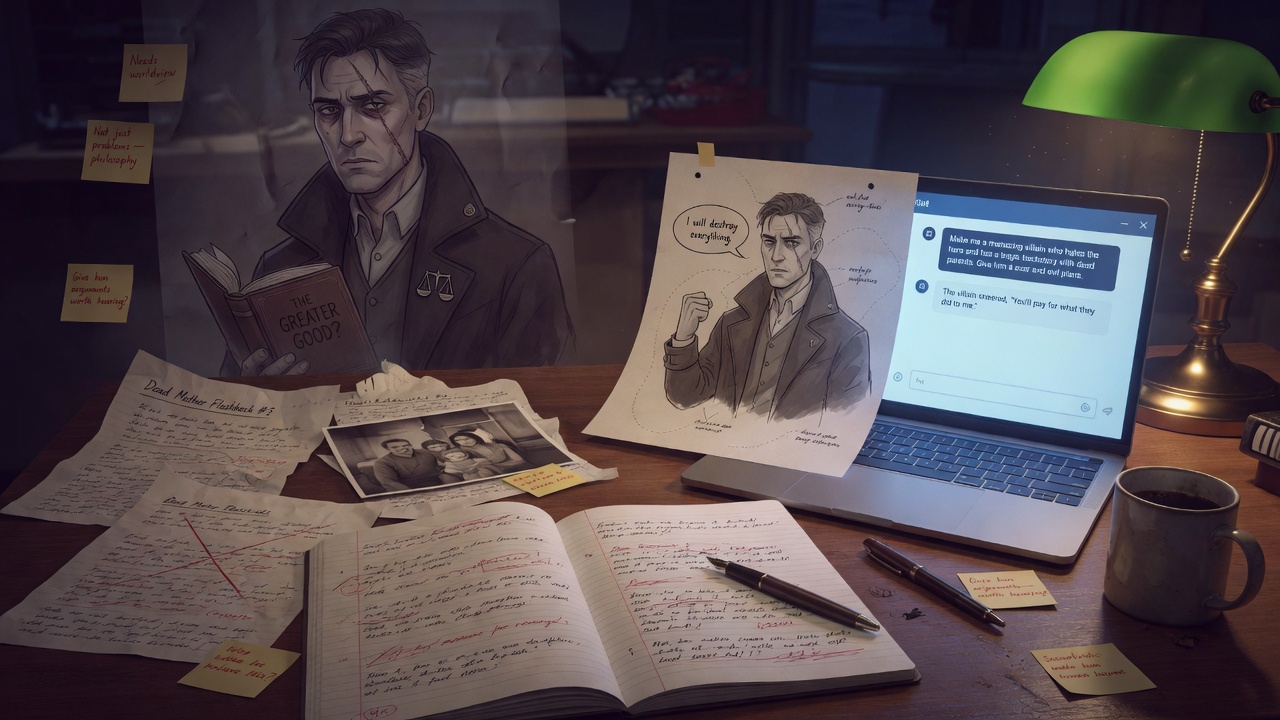
When novelists first bring AI into their drafting process, the results for antagonists follow a predictable pattern. The villain arrives in chapter three with a scar, a grudge, and a goal that amounts to "cause problems for the protagonist." Their dialogue exists to threaten. Their scenes exist to complicate. Their motivation—when it surfaces at all—is buried in a flashback about a dead parent or a perceived betrayal that reads more like a plot receipt than a genuine wound. They are, in the oldest critical sense, an obstacle wearing a face.
This happens because of how most writers prompt for villains. They describe function—"write a scene where the antagonist confronts the hero"—without first establishing philosophy. The AI, working from the most statistically common patterns in published fiction, produces the most statistically common result: a character who opposes the protagonist because the story requires opposition. The villain becomes a weather system. They are not wrong about anything. They are simply in the way.
There are three reliable symptoms of the obstacle villain in a manuscript. First, mustache-twirling dialogue: the antagonist says things no person with an actual worldview would say, because their lines function as pure menace delivery rather than as the speech acts of someone who believes they are correct. Second, motivation that appears only in backstory: the character's internal logic never surfaces in present-tense decisions, so they seem to be driven by history rather than by a coherent ongoing philosophy. Third—and this is the diagnostic test that matters most—there is no scene in the manuscript where a careful reader could plausibly argue the antagonist has a point. If your villain is never right about anything, they are not a character. They are a plot device with a name.
The fix is not to make your antagonist sympathetic in the soft sense—not to give them a rescue cat or a moving origin story. The fix is to give them a worldview: a set of beliefs about how the world works, what it owes people, and what is worth destroying to protect. That worldview should be coherent enough to argue with. It should make the protagonist's own values feel contestable rather than self-evident. And it should generate behavior that is internally consistent even when it is monstrous.
AI can help you build this. But you have to ask it the right questions.
The Mirror Test: Mapping Philosophical Parallels
The most durable antagonists in fiction are not simply opposed to the protagonist. They are structurally parallel to them—people who started from similar premises and arrived at opposite conclusions, or who share the same core value but disagree catastrophically about what that value requires. Javert and Valjean both believe in justice; they have simply arrived at irreconcilable definitions of what justice demands. Roy Batty and Deckard both want to survive; the question is which survival the story is permitted to endorse.
Before you can build this kind of ideological friction, you need to map your protagonist's values explicitly. This sounds obvious and is almost never done. Most writers know what their protagonist wants (plot goal) and what they fear (stakes). Far fewer have articulated what their protagonist fundamentally believes about people, about fairness, about what the world owes the individual. That unstated belief system is what your antagonist needs to mirror, invert, or take to a logical extreme.
Use AI to excavate this in both directions simultaneously:
I'm developing the antagonist for a novel. Before I describe the villain, I need to map my protagonist's implicit belief system so I can build an antagonist whose worldview creates genuine philosophical friction. My protagonist is Here is what I know about them: - Core want: [what they're trying to achieve in the plot] - Core fear: [what they're most afraid of losing or becoming] - Key behaviors: [2-3 decisions they make that reveal character] - Stated values: [things they explicitly claim to believe] Based on this, please do the following: 1. Identify the 2-3 deepest unstated beliefs underlying this character's behavior—the assumptions about human nature, fairness, or how the world works that their actions reveal even when they don't articulate them. 2. For each belief, generate an antagonist position that is the structural mirror image: not a simple negation, but a worldview that starts from a similar premise and arrives at an opposite or irreconcilable conclusion. 3. Describe how a person who genuinely held the antagonist's mirrored worldview would make decisions, speak, and prioritize. What would they be willing to do that the protagonist would not? What would they refuse to do that the protagonist would consider basic decency? 4. Identify the one scene type where the antagonist's worldview would produce behavior a reader might actually find compelling or defensible.
The goal of this exercise is not to make your antagonist a debate partner. It is to ensure that when they appear on the page, they are not simply blocking the protagonist's path—they are implicitly challenging the protagonist's assumptions about why the path is worth walking.
Excavating Internal Logic: The Steelman Prompts
Steelmanning is a rhetorical practice borrowed from philosophy: rather than engaging with the weakest version of an opposing argument, you construct the strongest possible version before you challenge it. Applied to fiction, steelmanning your antagonist means forcing yourself—or your AI—to articulate their position in the most coherent, reasonable terms possible before you let your protagonist win the argument.
Most AI-generated villain backstories fail this test because they are constructed to justify behavior the reader is meant to condemn. The character was wronged, so now they wrong others. The logic is circular and produces a villain who is, ultimately, just a victim with more power. Steelmanning requires something harder: building a villain whose worldview would be internally coherent even if the inciting wound had never occurred. They should believe what they believe not merely because they were hurt, but because the world, examined honestly, could look the way they say it does.
I need to build a genuinely coherent internal logic for my antagonist. The goal is not to make them sympathetic or redeemable—it is to make their worldview something a thoughtful person could take seriously before rejecting. Here is what I currently know about my antagonist, - What they want: [plot goal] - What they're doing to get it: [primary methods/actions in the story] - Their backstory motivation: [the wound or grievance I've established] Please do the following: 1. Steelman their position: articulate their worldview as if you were a philosopher sympathetic to their conclusions. What is the strongest version of their argument about how the world works? What observations about human behavior, history, or power would support their position? 2. Identify the core value at the center of their worldview—something that is not inherently evil but has been pursued to a point the protagonist (and reader) cannot follow. Examples might include: order, loyalty, survival, justice, protection, truth. 3. Show how their methods follow logically from their core value. What would they say to someone who questioned whether their methods were justified? Write 3-4 sentences of dialogue in their voice that express this logic without resorting to villain-speak or threats. 4. Identify one position they hold that your protagonist might secretly agree with, even if they would never admit it. This should be a point of uncomfortable overlap, not a sympathetic bond. 5. Now, and only after completing 1-4: identify where the worldview breaks down—the flaw or blind spot that makes it ultimately destructive. This should be a philosophical flaw, not just a character flaw or backstory wound.
The uncomfortable overlap in step four is critical. Nothing creates genuine ideological friction faster than a protagonist who, in a quiet moment, cannot entirely dismiss what the antagonist said. That discomfort is not a moral concession to the villain's actions. It is the engine of thematic complexity.
Pressure-Testing Scenes You've Already Written
Even when writers have done the philosophical work in their notes, antagonist scenes frequently drift into inconsistency during drafting. The villain says whatever the scene needs them to say. They make decisions that are dramatically convenient rather than characterologically inevitable. This produces the second major obstacle villain symptom: a character whose behavior in the room does not match the worldview attributed to them in the outline.
AI is useful here not as a generator but as an auditor. Once you have established your antagonist's worldview—either through the prompts above or through your own development work—you can use it to pressure-test scenes for internal consistency.
I need you to audit an antagonist scene for internal consistency. I'll give you the character's established worldview, then the scene, and I need an honest assessment of where the character's behavior matches or breaks from their own logic. ANTAGONIST WORLDVIEW SUMMARY: [Paste a 150-300 word description of their core beliefs, central value, and the philosophical position you've established for them. Include the one position where they and the protagonist uncomfortably overlap.] SCENE TO AUDIT: [Paste the drafted scene, or a detailed description of what happens in it] Please assess the following: 1. Line-by-line dialogue check: which lines of the antagonist's dialogue are consistent with their established worldview, and which lines exist primarily to serve plot or to signal villainy to the reader? For inconsistent lines, suggest an alternative that preserves the dramatic function while staying true to the character's philosophy. 2. Decision audit: does the antagonist's primary decision or action in this scene follow from their worldview, or does it follow from plot convenience? If it's the latter, what decision would someone with this worldview more plausibly make? 3. Missed opportunity check: is there a moment in this scene where the antagonist could make a point the protagonist cannot immediately refute? If so, where, and what might that point be? 4. Register check: does the antagonist's emotional register in this scene match someone who genuinely believes they are right, or does it read as someone performing villainy? What would change if they were fully convinced of their own correctness?
The Devil's Advocate Stress Test
The final prompt is the hardest to use well because it requires the novelist to sit with genuine discomfort. After you have built your antagonist's worldview and audited your scenes for consistency, you need to find out whether the antagonist has been given enough argumentative ground to actually threaten the protagonist's position—not physically, but philosophically.
I need to stress-test whether my antagonist's worldview creates real ideological friction or whether my protagonist can dismiss it too easily. Here is a summary of my protagonist's core beliefs: [150-200 words on what the protagonist fundamentally believes about people, fairness, the world, and what is worth fighting for] Here is a summary of my antagonist's worldview: [150-200 words on what the antagonist fundamentally believes, using the steelmanned version developed in earlier work] Please do the following: 1. Devil's advocate argument: argue the antagonist's position as forcefully as possible against the protagonist's worldview. Use evidence from how the world actually works—history, human behavior, observable patterns—to support the antagonist's claims. Do not soften this. The goal is to find the places where the antagonist might actually be right. 2. Identify the 2-3 points in this argument that the protagonist cannot defeat through plot events alone—places where the antagonist's position can only be answered through the protagonist changing, sacrificing something, or accepting a genuine cost. 3. Suggest one scene, not currently in my outline, where the antagonist makes their strongest argument and the protagonist has no immediate answer. What would that scene look like? What is at stake for each character in that moment? 4. Finally: if a reader finished this novel and found themselves unable to fully dismiss the antagonist's position, what would they be unable to dismiss, and why? Is that the intended thematic ambiguity, or does it indicate the antagonist's worldview needs to be more carefully bounded?
What This Work Actually Produces
None of this is primarily about making your antagonist complex in the workshop-approved sense. It is about ensuring that your story's central conflict is doing philosophical work, not just dramatic work. When an antagonist has a worldview worth arguing with, several things happen simultaneously in the manuscript.
- The protagonist's values become costs rather than defaults. They are choosing something at the expense of something else, and the antagonist makes that cost visible.
- Scenes between them carry weight that does not depend entirely on physical or plot stakes. The reader is tracking an argument, not just a chase.
- The thematic material of the novel—whatever you are actually writing about—gets pressure-tested rather than merely illustrated. Your novel earns its conclusions.
- The antagonist remains a character after the book ends. Readers think about them. They argue about them. They occasionally, uncomfortably, wonder if they were wrong.
AI-assisted drafting defaults to obstacle villains because obstacles are easier to generate than philosophies. The prompts above are designed to interrupt that default by forcing the drafting process to treat the antagonist as a person with a coherent account of the world before treating them as a plot function. The scenes you write after doing this work will not feel like encounters between a hero and a menace. They will feel like encounters between two people who disagree about something that genuinely matters—which is, in the end, what conflict in serious fiction is supposed to feel like.

No comments yet. Be the first to comment!