

Filter Word Excavation: AI Prompts That Cut the Perception Verbs Distancing Readers From Your Scenes
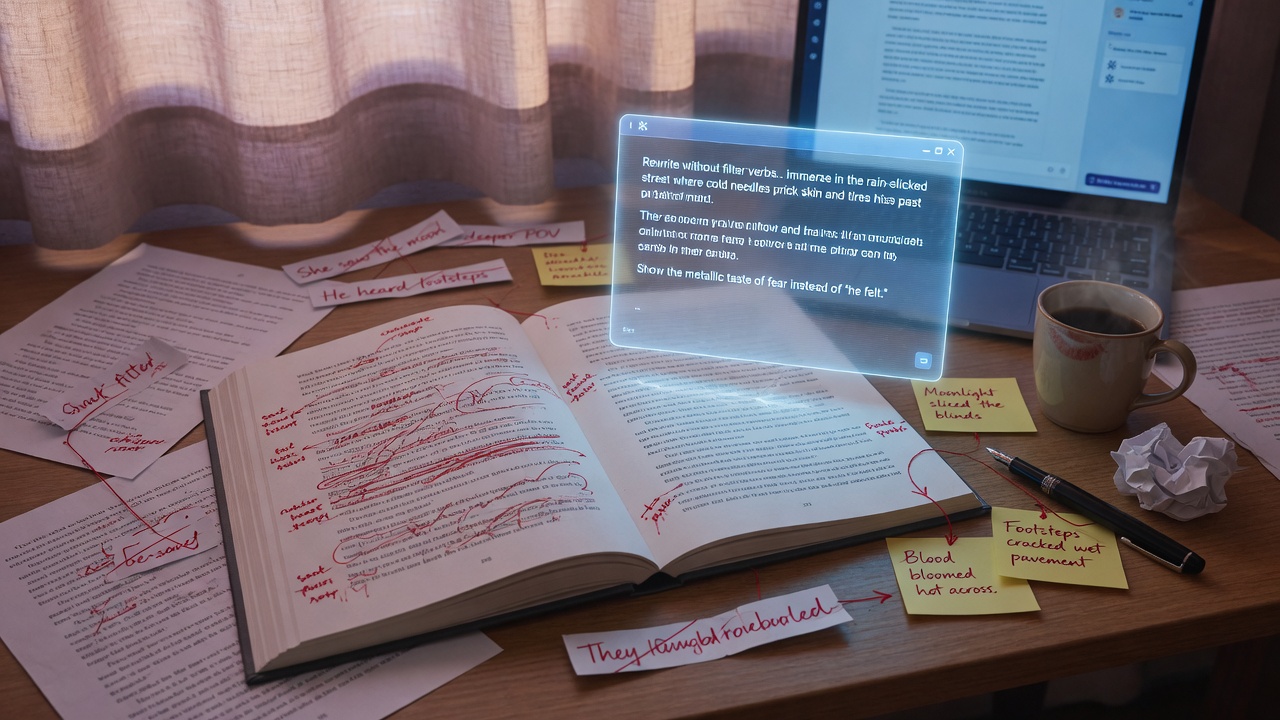
Every novelist who's been through a serious revision pass has heard the advice: cut your filter words. Saw, felt, heard, noticed, realized, wondered, seemed. These perception verbs sit between your reader and the moment, narrating the character's experience of experiencing something instead of just letting the experience happen on the page. "She felt the cold seep into her boots" is one small step removed from "The cold seeped into her boots." That step is often unnecessary. Sometimes it's exactly what the scene needs.
The problem with most filter word advice is that it treats the fix as mechanical — run a search, highlight the verbs, cut on sight. That works fine for a blog post about writing tighter sentences. It works less well for an actual manuscript, where filter words aren't uniformly bad. They're a dial, not a switch. Understanding that dial is what separates a competent revision pass from a robotic one.
Filter Words Aren't a Bug — They're a Distance Control
Psychic distance is the felt gap between reader and character consciousness. At the closest end, the reader is inside the character's head with no narrator visible at all — pure sensation, pure thought, no scaffolding. At the far end, there's a narrator summarizing what happened from outside, editorializing, filtering. Filter words are one of several tools (along with tense, pronoun choice, and sentence rhythm) that a writer uses to move along that spectrum.
The habitual overuse problem happens when a writer defaults to filtering out of unconscious habit, not narrative choice. If every single sensory beat in your book runs through "she noticed," "he heard," "she realized," you've flattened your psychic distance into one uniform, slightly removed register — even in scenes that call for the reader to be plunged directly into the character's body and thoughts. That's the failure mode worth hunting.
But there are legitimate uses. A narrator who says "she thought she saw something move" is doing something different than one who says "something moved." The filtered version signals unreliable perception — maybe nothing moved at all, maybe the character is exhausted or paranoid or lying to themselves. Delayed realization works the same way: "It took her a full minute to realize the phone had stopped ringing" does narrative work that "The phone had stopped ringing" doesn't — it tells us something about the character's state of shock or distraction in that minute. A detached, clinical narrator (noir, certain literary styles, unreliable first-person) might filter constantly and correctly, because distance is the point.
So the actual editing task isn't "remove filter words." It's "find every filter word, decide whether it's doing a job, and cut the ones that are just habit." That's a judgment call, and it's exactly the kind of pattern-recognition-plus-decision task AI is useful for — not because it can make the final call for you, but because it can surface the candidates fast enough that you spend your editing time deciding, not searching.
Prompt 1: Catalog Every Instance With Context
Before you can make judgment calls, you need the full inventory. Manually scanning a chapter for six or seven filter verbs is tedious and your eye starts skipping instances after the first few pages. Feed the chapter to AI and have it do the sorting.
Read the attached chapter and identify every instance of filter words and phrases that create narrative distance between the reader and the point-of-view character's direct experience. Include but don't limit yourself to: saw, heard, felt, noticed, realized, wondered, watched, smelled, tasted, seemed, appeared, thought, knew, recognized, remembered. For each instance, give me: 1. The full sentence it appears in, plus one sentence of surrounding context 2. The specific filter word/phrase used 3. Which POV character the sentence belongs to (if the chapter has multiple POV sections) 4. A rough tag for what kind of moment it is: physical sensation, visual observation, emotional realization, cognitive process (wondering/thinking), or memory Then give me two summary tables: - Filter word frequency, sorted from most to least common - Filter word count by POV character, if applicable, so I can see whether one character's sections are more heavily filtered than another's Don't rewrite anything yet. I want the raw inventory first.
The POV breakdown matters more than it looks like it should. If you're writing multiple POV characters, it's common for one of them to accumulate far more filter words than the others simply because you wrote their sections in a different mood, or earlier in your drafting process, before you'd settled into their voice. That imbalance is worth knowing about before you start cutting, because it might point to a bigger consistency issue than filter words alone.
Prompt 2: Rewrite to Drop the Filter, Then Compare
Once you have the inventory, the next step is seeing what the sentence looks like without the filter — not as a theoretical exercise but as an actual side-by-side comparison you can react to. This is where AI earns its place in the process, because generating ten quick unfiltered rewrites yourself is slow, and slow work tempts you to skip the comparison and just guess.
Using the filter word inventory from the previous step, take the top 15 instances (prioritize the emotional-realization and physical-sensation tags first) and rewrite each flagged sentence to remove the filter word, putting the reader directly into the sensation, observation, or thought without narrating the character's act of perceiving it. For each one, show: - ORIGINAL: [sentence with filter word] - REWRITE: [same moment, unfiltered] - DISTANCE SHIFT: one line noting whether the rewrite meaningfully changes the psychic distance or whether it's essentially a synonym swap with no real gain Do not change the meaning of the sentence, the information conveyed, or the tone — only the presence of the filtering verb. If a clean unfiltered rewrite would require restructuring the whole paragraph rather than just the sentence, tell me that instead of forcing an awkward fix, and suggest what the restructure would need to accomplish.
The "distance shift" column is the part people skip and shouldn't. Some filter word cuts genuinely tighten the prose and pull the reader closer. Others are cosmetic — swapping "she felt a chill" for "a chill ran through her" doesn't change the reader's proximity to the character at all, it's just a different sentence shape. AI flagging that distinction for you means you're not wasting revision time on changes that don't actually move the needle. You're free to reject rewrites that lose something — a rhythm, a beat of hesitation — even when the unfiltered version is technically "tighter."
Prompt 3: Identify the Ones That Should Stay
This is the step most filter-word advice skips entirely, and it's the one that keeps your prose from reading like it went through a search-and-destroy macro. Not every filtered sentence is a mistake. Some are doing specific, deliberate work — signaling unreliable perception, marking a delay between event and understanding, or maintaining a narrator's chosen distance. You need AI to make the case for keeping certain instances, not just the case for cutting them.
Review the full filter word inventory again, but this time your job is to defend the instances that should probably stay rather than be cut. For each candidate you flag as worth keeping, explain which of these functions it's serving: - Unreliable or uncertain perception: the character isn't sure what they're experiencing is real or accurate, and the filter word signals that doubt (e.g., "she thought she heard footsteps" vs. "footsteps sounded behind her") - Delayed realization: there's a meaningful gap between an event happening and the character processing/understanding it, and the filter word marks that gap - Deliberate narrative distance: the scene or the character's emotional state calls for the reader to be held slightly outside the experience rather than plunged into it (numbness, shock, dissociation, or a narrator style that's consistently more observational than immersive) - Rhythm or emphasis: removing the filter word would create an awkward sentence, a lost beat, or would make three consecutive sentences start with the same structure For each instance you're defending, quote the sentence and give a one-sentence justification. Then give me a final count: out of the total filter word instances in this chapter, how many do you recommend keeping versus cutting, and does that ratio seem consistent with a deliberate stylistic choice or more consistent with habitual overuse?
That last question is doing real diagnostic work. If AI comes back and says twelve percent of your filter words serve a clear function and the rest don't, you're looking at habit. If it comes back closer to fifty percent, you might already be making the distance calls correctly and the "problem" you thought you had is smaller than you feared. Either way, you get a number instead of a vague anxiety about your prose.
Prompt 4: Scan the Full Manuscript for Density Spikes
Chapter-by-chapter passes are precise but slow, and running the same intensive process across forty chapters is more effort than most filter word problems deserve. The efficient move is a lighter full-manuscript scan whose only job is to tell you where to spend your detailed attention.
Scan the full manuscript (all chapters) and calculate filter word density per chapter — filter word instances divided by chapter word count, expressed as instances per 1,000 words. Use the same filter word list from before: saw, heard, felt, noticed, realized, wondered, watched, smelled, tasted, seemed, appeared, thought, knew, recognized, remembered, and close variants. Give me: 1. A ranked list of chapters from highest to lowest filter word density 2. The manuscript-wide average density, so I can see which chapters are meaningfully above it versus just slightly above 3. For the top five highest-density chapters, a guess at why — is it a POV character who filters more than others, a scene type (introspective/quiet vs. action-heavy), or a point in the manuscript where the prose style seems to shift (e.g., "chapters 22-25 spike, which may correspond to a section written in a different drafting pass") 4. Any chapters where density is unusually low — sometimes that's a sign of strong unfiltered prose, but it can also mean the chapter is heavy with unattributed dialogue or short scenes where filter words wouldn't naturally occur anyway, so flag both possibilities I want to use this to decide which chapters get a full manual filter-word pass and which ones are probably fine as-is.
This is the prompt that saves the most time across a full manuscript revision. Editing every chapter with equal intensity for filter words is a good way to burn a week on a problem that's concentrated in six chapters you wrote during a rushed section of your draft. Once you know where the spikes are, you can run Prompts 1 through 3 only on the chapters that need it, and skim the rest.
Building Your Own Keep-vs-Cut Rule Sheet
The real payoff from this process isn't a cleaner draft — though you'll get that. It's the pattern you extract for next time. After running these prompts across a manuscript, you'll notice your own tendencies: maybe you overuse "realized" specifically in emotional climax scenes where it's undercutting tension you meant to build directly. Maybe "felt" is fine in your close-third sections but reads as weak in the one first-person POV thread. Maybe you filter constantly in transition paragraphs but rarely in dialogue-heavy scenes, which turns out not to be a problem at all.
Ask AI to help you turn the accumulated judgment calls from Prompts 1 through 3 into a short personal style rule — something like: "Cut 'felt' and 'noticed' by default in action and close-sensory scenes; keep filter words when signaling unreliable perception or when a character is meant to read as dissociated; watch for filter clustering in the first 500 words of chapters, which tends to happen when re-orienting the reader after a scene break." That rule sheet, refined draft over draft, is what eventually makes this whole excavation process unnecessary — you'll catch the habitual instances while drafting, and save the AI-assisted passes for the genuinely ambiguous calls, which is where the judgment was always supposed to live anyway.


No comments yet. Be the first to comment!