



Magic System Cost Ledgers: AI Prompts That Enforce Consistent Rules and Prices for Every Spell Cast
Readers forgive plot holes more easily than they forgive cheating magic. A dropped subplot thread is an annoyance. A power that suddenly works differently because the plot needs it to is a betrayal—the moment a reader stops trusting the author's hand on the wheel. Once someone thinks "wait, why didn't she just do that three chapters ago," the spell of the story, no pun intended, is broken.
The problem is that magic systems are hard to track by memory alone, especially across a 100,000-word manuscript or a multi-book series. You establish that blood magic costs a day of the caster's memory. Two hundred pages later, under deadline pressure, your protagonist casts a much bigger blood spell and pays... nothing, because you forgot the rule you invented. The reader remembers. You didn't. That gap is where trust dies.
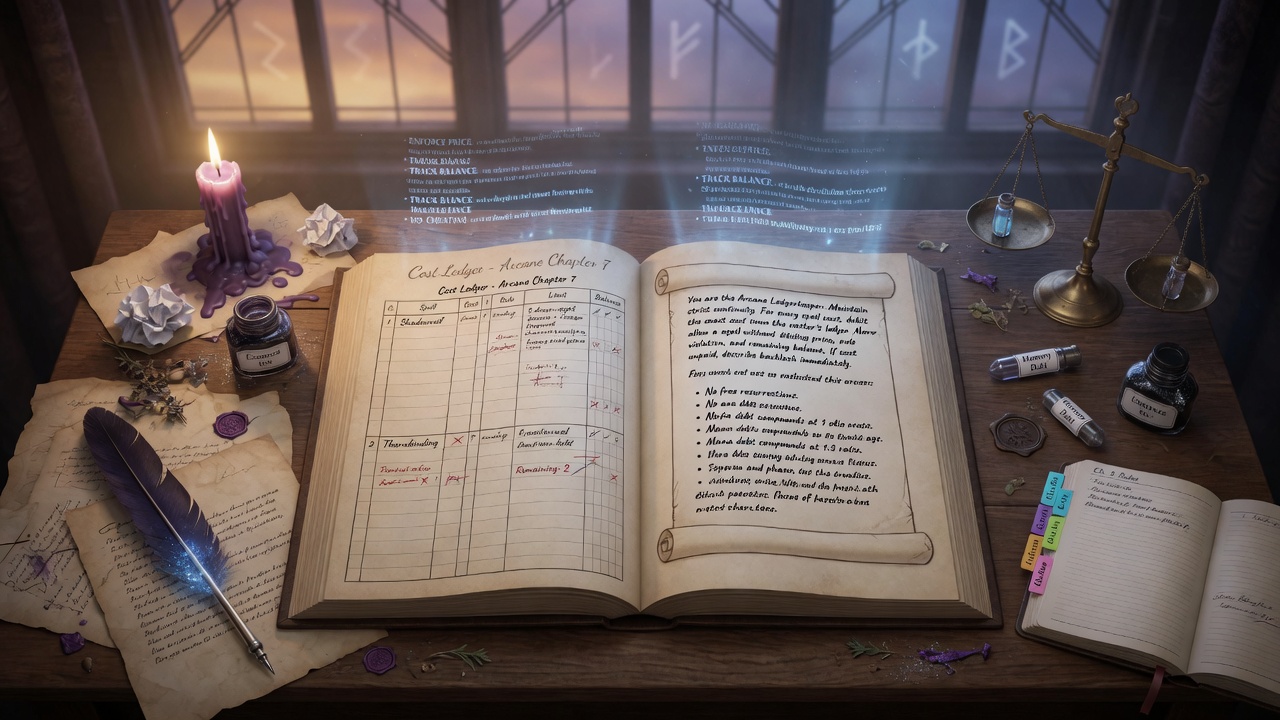
This is where AI becomes genuinely useful—not for inventing your magic system, but for doing the bookkeeping you don't have the bandwidth to do by hand. Think of it as building a cost ledger: a running record of every time magic is used, what it cost, what limited it, and what precedent it set. Once that ledger exists, you can audit your draft against it the way an editor checks continuity, except at a scale no human proofreader wants to attempt manually.
Why Unpriced Magic Breaks Trust Faster Than Plot Holes
Every functioning magic system runs on an implicit contract with the reader: power has a price, and the price is consistent. It doesn't have to be explained in physics-level detail, but it has to hold. Sanderson's laws of magic exist precisely because readers intuitively sense when a system is being bent to serve convenience rather than character or stakes.
The most common violations aren't dramatic. They're quiet:
- A cost mentioned once in chapter three (exhaustion, memory loss, physical pain) never appears again, even when the same spell is cast under harder circumstances
- A power's stated limit ("only works on living things," "can't cross running water," "requires eye contact") gets bypassed off-page because it's inconvenient for the climax
- A minor character casts something in book one that would trivially solve book two's central problem, and nobody addresses why they don't just do that again
- The cost of magic scales down as the stakes scale up—the opposite of what dramatic tension requires
None of these are catastrophic on their own. Stacked across a manuscript, they add up to a system that feels arbitrary, which makes every subsequent use of magic feel like the author reaching for a lever rather than a character making a costed choice. The fix isn't better memory. It's an external record you interrogate deliberately.
Building the Cost Ledger: Extracting Every Use of Magic From Your Draft
The first step is getting AI to read your manuscript the way a continuity editor would—flagging every instance of power use and logging its terms. This only works well if you feed it your actual chapters rather than asking it to work from memory of your world, so paste in real text.
You are building a magic system cost ledger from my manuscript. I will paste chapters one at a time. For each instance of magic, supernatural ability, or power use in the text, extract the following into a table: - Chapter/scene location - Character casting or using the power - What the power/spell accomplished - Stated or implied cost (physical, mental, material, social, temporal) - Stated or implied limitation (range, duration, prerequisite, exclusion) - Any dialogue or narration that establishes a "rule" about how this power works If a use of magic has NO stated cost or limitation, flag it explicitly as "UNPRICED — no cost shown" rather than leaving it blank. Do not infer costs I haven't written; if the text is silent, say so. This ledger will be used later to check consistency, so accuracy over inference matters more than completeness. Here is Chapter [X]: [paste chapter text]Run this chapter by chapter and you end up with a spreadsheet-style record of your entire system as it actually appears on the page—not as you imagined it in your worldbuilding document, but as readers will experience it. This distinction matters. Writers often have a much more detailed rule set in their heads than what made it into the manuscript. The ledger shows you the gap between the two.
Keep this ledger as a living document. Update it every time you draft a new chapter involving magic, and treat "UNPRICED" flags as a to-do list—either add a cost on the page or make a deliberate note that this instance is meant to be free (which is itself a worldbuilding decision you should be making consciously, not by accident).
Precedent-Checking: Catching Contradictions Before Readers Do
Once the ledger exists, the real value comes from asking AI to cross-reference new scenes against established precedent. This is the audit that catches the moment your protagonist's power quietly gets stronger, or a rule you set in chapter five gets ignored in chapter twenty-two because you'd forgotten it existed.
Here is my magic system cost ledger, extracted from chapters 1–15: [paste ledger] Here is a new chapter I've just drafted (chapter 16): [paste new chapter text] Compare every use of magic in this new chapter against the ledger. For each instance, tell me: 1. Does this use of power match an established precedent, or is it new? 2. If it's similar to a prior use, does the cost/limitation match what was established before? Flag any instance where the cost is LOWER, the limitation is WEAKER, or the effect is STRONGER than precedent without in-text justification. 3. If this chapter introduces a new capability, does anything in the existing ledger implicitly contradict it (e.g., a character previously said "I can't do X" and is now doing X)? 4. Rate each flagged inconsistency as MINOR (could be read as growth/practice), MODERATE (needs a line of justification), or MAJOR (breaks established rule with no explanation and will likely be noticed by attentive readers). Do not soften your assessment to be encouraging. I need accuracy here more than reassurance.That last line matters. AI models default toward validating your work unless explicitly told not to. For continuity auditing specifically, you want the model behaving like a skeptical line editor, not a supportive writing partner. Say so directly, and repeat the instruction if you notice the tool softening its findings in later exchanges.
The MINOR/MODERATE/MAJOR rating system also helps you triage. Not every inconsistency needs a fix—sometimes a character genuinely has grown more skilled, and a MINOR flag confirms that reading is plausible without requiring you to insert a clunky explanatory paragraph. MAJOR flags are the ones to act on before a beta reader or editor finds them first.
Escalation Audits: Making Sure the Price Rises With the Stakes
A magic system's cost structure isn't just about consistency—it's about dramatic function. If the cost of power stays flat while the stakes of the plot rise, tension flattens along with it. The strongest speculative fiction tends to escalate cost alongside consequence: the same spell that cost a headache in chapter three should plausibly cost something closer to catastrophic by the climax, especially if the character is pushing the power harder, faster, or in more desperate circumstances.
This is a pattern AI is well suited to check because it requires holding the entire arc in view at once, comparing early-book costs to late-book costs on a rising curve rather than checking any single scene in isolation.
Using the full magic system cost ledger below, covering the entire manuscript, analyze the cost/consequence curve across the story: [paste full ledger, ordered by chapter] Specifically: 1. Chart how the cost of the protagonist's primary power changes from first use to last use. Does cost rise, fall, or stay flat as the story's stakes increase? 2. Identify any climactic or high-stakes scene where magic is used and the cost paid is LOWER or EQUAL to costs paid earlier in lower-stakes scenes. These are candidates for "convenient magic" — flag them by chapter. 3. Identify scenes where a cost is mentioned but has no visible narrative consequence afterward (e.g., "it will take years off my life" is stated, but no future chapter reflects that cost). List these as unresolved costs. 4. Suggest, for each flagged scene, whether the fix should be raising the cost at the point of use, or paying off a previously stated cost later in the story that I've left dangling. Present this as a chapter-by-chapter escalation table, not a narrative summary.The "unresolved costs" category tends to surface the most fixable problems. Writers are often good at inventing costs in the moment—a character coughs blood, loses a memory, ages visibly—but far less consistent about following through on those costs later. An AI reading the full manuscript at once can catch a cost that was promised in chapter four and never paid, which is its own kind of broken contract with the reader, distinct from but related to the "unpriced magic" problem.
Series-Wide Enforcement: Carrying the Ledger Into Book Two
The hardest place to maintain magic system discipline is across book boundaries. By the time you start drafting a sequel, months or years may have passed. You remember the broad strokes of your system but not the granular precedent—exactly how much a blood-price scaled with spell size, exactly what the loophole was that a secondary character exploited once. Meanwhile, sequels are exactly where writers are tempted to quietly soften rules because a strict system has become inconvenient for the plot they now want to tell.
The fix is treating your book-one ledger as a foundational document you feed into every drafting session for book two, rather than trusting memory or scattered notes.
Here is the complete magic system cost ledger from Book One: [paste full ledger] I am drafting Book Two. Here is my outline/summary for how magic will be used in this book: [paste outline or chapter draft] Cross-reference the Book Two material against the Book One ledger and identify: 1. Any planned use of magic in Book Two that requires a cost or limitation softer than what Book One established, and would need explicit in-story justification (a new discovery, a workaround, a cost paid elsewhere) to avoid feeling like a retcon. 2. Any character in Book Two who used magic in Book One — confirm their planned abilities in Book Two are consistent with their established costs, or flag where growth/decline needs to be shown on the page rather than assumed. 3. Opportunities where Book Two could deliberately complicate or deepen the Book One rules (new exceptions, new costs under new conditions) in a way that feels like escalation rather than contradiction — distinguish these from accidental inconsistencies. 4. A revised, merged ledger combining Book One's established rules with any new precedents I'm planning to set in Book Two, so I have one running document going forward.That fourth item is the real payoff: a merged ledger that grows with the series instead of resetting with every new manuscript. Long-running fantasy series live or die by whether readers trust that the author remembers their own rules better than the readers do. A cost ledger that travels with you from book to book is the practical mechanism for keeping that trust intact, even when the actual writing happens years apart and your own memory of the fine print has faded.
None of this replaces the creative work of designing a magic system that's interesting in the first place—that part is still yours. What AI offers here is closer to what a good continuity editor does for film franchises: an outside memory, applied consistently, that catches the moments where convenience quietly overrides the rules you set for yourself. For any speculative fiction writer working at novel or series length, that kind of external audit is worth building into the process long before an editor or reader finds the gap first.

No comments yet. Be the first to comment!