



Ask an AI drafting tool to write a chapter and it will almost certainly produce clean, grammatical, forward-moving prose. Ask it to write ten chapters and a pattern emerges that most writers feel before they can name: the sentences all move the same way. Subject, verb, object. A comma. A dependent clause. A period. Repeat. Nothing is wrong on the sentence level, which is exactly why the problem is so hard to catch — you're not looking for an error, you're looking for an absence of variation, and absence doesn't trigger the same alarm bells that a typo or a plot hole does.
This is syntactic monotony, and it's a different failure mode than the repetition writers usually hunt for. Word-level repetition — "suddenly," "seemed," "a wave of" — is easy to flag with a find-and-replace mentality. Syntactic repetition lives one level up, in the architecture of the sentence itself: how it opens, how long it runs, where the clauses stack, how the rhythm lands on the ear. A chapter can have zero repeated words and still read like it was extruded from a machine, because every sentence is built on the same three-piece frame.
Why AI defaults to uniform sentence architecture
Language models are trained to produce the statistically likely next token, and the statistically likely sentence shape in edited English prose is short-to-medium length, subject-first, with a single comma break before a trailing clause. That shape is common because it's clear. It's also common because it's safe — it rarely breaks, rarely confuses, rarely draws attention to itself. For a paragraph of expository writing, that safety is fine. For a novel, where sentence rhythm is one of the primary tools for controlling a reader's pulse, that safety becomes a flattening force.
The result is prose that passes every individual sentence-level check — grammatical, readable, on-topic — while failing the chapter-level check that actually determines whether a reader stays engaged. Tension scenes don't accelerate. Reflective passages don't slow down and breathe. Every paragraph has roughly the same shape regardless of what's happening inside it. Readers register this as "flat" or "generic" without being able to point to a single bad sentence, because the problem isn't in any one sentence — it's in the aggregate pattern across dozens of them.
The fix isn't to distrust every AI-generated sentence individually. It's to build a habit of auditing structure at the chapter level, the way a copyeditor checks for consistency and a director checks for pacing, before you ever get down to word choice. The four prompts below are built for that: two diagnostic, one corrective, one calibrating specifically for tension.
Diagnostic prompt: cataloging sentence-opener clustering
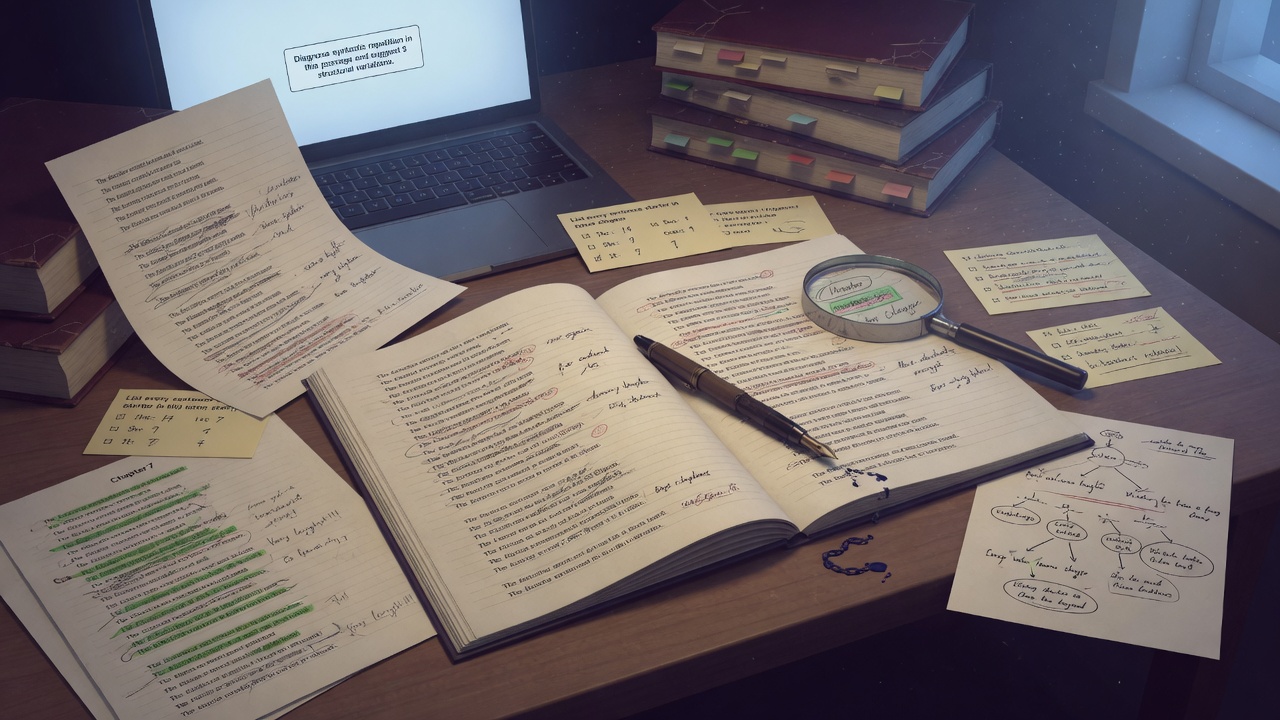
The fastest tell of syntactic monotony is how sentences begin. If a disproportionate share of your sentences open with the subject followed immediately by the verb — "She walked," "The door creaked," "He felt" — your prose has a metronome quality even if the content varies wildly. This prompt forces a literal accounting, which matters because writers consistently underestimate how clustered their openers are when they're reading for content rather than form.
You are analyzing sentence-opener patterns in a chapter of a novel manuscript. I will paste the full chapter text below. Do not summarize the plot or comment on content — focus exclusively on sentence-level syntax. For every sentence in the chapter, identify: 1. The first three words of the sentence 2. The grammatical category of the opener (subject pronoun, subject noun, adverb, prepositional phrase, subordinate clause, dialogue tag, coordinating conjunction, etc.) Then produce: - A frequency table showing what percentage of sentences fall into each opener category - A list of every instance of three or more consecutive sentences that share the same opener category, quoted in full with paragraph location - A list of the five most common exact first words across the chapter (e.g., "She," "He," "The," "I") - A brief note on whether opener clustering correlates with specific scenes (dialogue-heavy passages, action beats, introspection) versus appearing evenly throughout Do not suggest rewrites yet. I only want the diagnostic data so I can decide where to intervene. [PASTE CHAPTER TEXT]
Run this before you touch a single word, because the output tells you where to spend your limited revision time. A chapter where openers cluster only during a single dialogue scene needs a targeted fix. A chapter where subject-first openers sit at sixty or seventy percent across every scene type needs a structural pass, and you should know that before you start line-editing, not after.
Diagnostic prompt: mapping length rhythm against pacing needs
Opener variety solves one problem, but a chapter can vary its openers and still flatline on length — every sentence landing in the twelve-to-eighteen-word range regardless of whether the scene calls for a burst of three-word fragments or a long, winding, comma-laced sentence that mimics a spiraling thought. Sentence length is one of the few purely mechanical levers a writer has to control pacing, and AI-generated prose tends to compress that range toward the statistical middle. This prompt asks the model to map length against the emotional or narrative function of each passage, which is the part a plain word-count tool can't do.
I'm going to paste a chapter from my novel manuscript. I need a sentence-length and rhythm analysis, not a content summary. Step 1: Break the chapter into its constituent scenes or beats (a beat is a section with a consistent emotional register or narrative purpose — for example, an action sequence, a quiet dialogue exchange, an interior reflection, a transitional passage). Step 2: For each beat, calculate: - The average sentence length in words - The range (shortest to longest sentence) - The standard deviation or general variance — is the beat's rhythm tight and uniform, or does it swing? Step 3: For each beat, state what pacing that scene's content seems to call for (e.g., "this is a physical confrontation and would likely benefit from short, clipped sentences and sentence fragments" or "this is a grief scene that might sustain a slower, longer-breathed rhythm"). Step 4: Flag every beat where the actual sentence-length pattern mismatches the pacing the content seems to want — specifically call out any beat where sentence length stays flat (low variance) regardless of rising or falling tension within the scene. Present this as a table: Beat | Avg Length | Range | Variance | Pacing Mismatch (Y/N) | Notes. [PASTE CHAPTER TEXT]
The output from this prompt is more useful than a generic readability score because it ties structure to function. A flatlined variance score means nothing on its own — plenty of good writers hold a tight, controlled rhythm on purpose for an entire scene. What matters is whether the flatline is a choice or a default, and you can only tell the difference by looking at what the scene is trying to do and whether the syntax is doing anything to help it.
Revision prompt: restructuring for variety without touching meaning
Once you know where the monotony lives, the temptation is to just ask an AI tool to "make this sound better," which produces vague, often over-corrected prose that drifts from your voice. A more controlled instruction constrains the model to structural change only — no new information, no altered tone, no added imagery — so what comes back is a legitimate revision candidate rather than a rewrite you have to fight with.
Below is a passage from my novel that has been flagged for repetitive sentence structure — either clustered sentence openers, flatlined sentence length, or both. I want you to restructure the syntax while preserving the content, tone, and voice exactly. This is a structural edit, not a rewrite. Rules: - Do not add new information, imagery, dialogue, or detail that isn't already present in the passage - Do not remove any plot-relevant content or character beats - Do not change the register (if the passage is plain and unadorned, keep it plain and unadorned — do not "elevate" the prose) - Vary sentence openers so no more than two consecutive sentences share the same opener type - Vary sentence length so the passage doesn't sit in a narrow band — mix short, medium, and longer sentences where the rhythm supports it - Preserve every piece of dialogue verbatim; you may only restructure the narration and description around it - Keep character-specific speech patterns and any established narrative voice intact After the revision, provide a short list of the specific structural changes you made (e.g., "combined two short subject-first sentences into one sentence with a subordinate clause" or "moved a prepositional phrase to the front of sentence 4 to break opener repetition") so I can evaluate each change individually rather than accepting the passage wholesale. [PASTE PASSAGE]
The changelog requirement at the end matters more than it looks. Wholesale AI rewrites are hard to evaluate because you're comparing two finished paragraphs against each other and relying on gut feel. A list of discrete structural moves lets you approve or reject each change on its own terms — accepting the opener fix in sentence three while rejecting the clause-merge in sentence seven — which keeps you the editor rather than a rubber stamp.
Calibration prompt: matching syntax to scene intensity
The highest-value use of syntactic control is in scenes where stakes are rising, because sentence rhythm is one of the few tools that can make a reader feel acceleration independent of what's literally happening in the plot. A fight scene written in uniform fourteen-word sentences reads slower than the actual events warrant, no matter how much action is packed into each one. This prompt is designed specifically for high-tension passages, asking the model to audit whether syntax escalates alongside stakes or stays inert while the plot does the work alone.
I'm pasting a high-tension scene from my novel — a scene where stakes, danger, or emotional intensity should be escalating as it progresses. I want you to evaluate whether the sentence structure escalates along with the content, or whether the syntax stays static while only the plot events change. Analyze the passage in three sections: beginning, middle, and climax/peak moment. For each section, report: - Average sentence length - Ratio of simple to complex sentences - Use of fragments, if any - Punctuation density (commas, dashes, semicolons per sentence) Then answer directly: does the syntax intensify toward the climax (shorter sentences, more fragments, tighter punctuation, fewer subordinate clauses) or does it stay structurally flat while the stakes rise in content only? If it stays flat, rewrite only the climax section (the final section) to intensify the syntax — shorter sentences, more fragments where appropriate, sentence structure that mimics urgency or breathlessness — without changing any plot events, actions, or dialogue content. Preserve every fact and beat exactly; only the sentence construction should change. Show the original climax section and the revised version side by side so I can compare the syntactic shift directly. [PASTE SCENE]
What this prompt catches most often is the scene that reads as competent but oddly inert during the pages you most need to grip a reader. The plot escalates — the villain draws a weapon, the building starts to collapse, the character realizes the truth — but the sentences describing all of it stay the same shape and length they were three pages earlier during a calm conversation. Fixing that mismatch is one of the few structural edits that reliably changes how a scene feels without changing a single event in it.
Building this into a revision pass, not a one-time fix
None of these prompts are meant to run once. Syntactic monotony creeps back in every time you draft a new chapter, whether you're writing longhand, dictating, or working with AI assistance, because the underlying causes — habit, fatigue, a comfortable default rhythm — are constant. The value of formalizing the audit as a repeatable prompt is that it turns a vague craft instinct ("this chapter feels flat") into a specific, actionable diagnosis ("seventy percent of sentences in this scene open with the subject, and sentence length barely varies across the climax"). That specificity is what makes revision fast instead of endless. You're no longer rewriting a chapter on a hunch — you're fixing a named, measured problem, one structural pass at a time, while the meaning, the voice, and the story underneath stay exactly where you put them.
No comments yet. Be the first to comment!