
Why Generic Hook Advice Fails Novelists
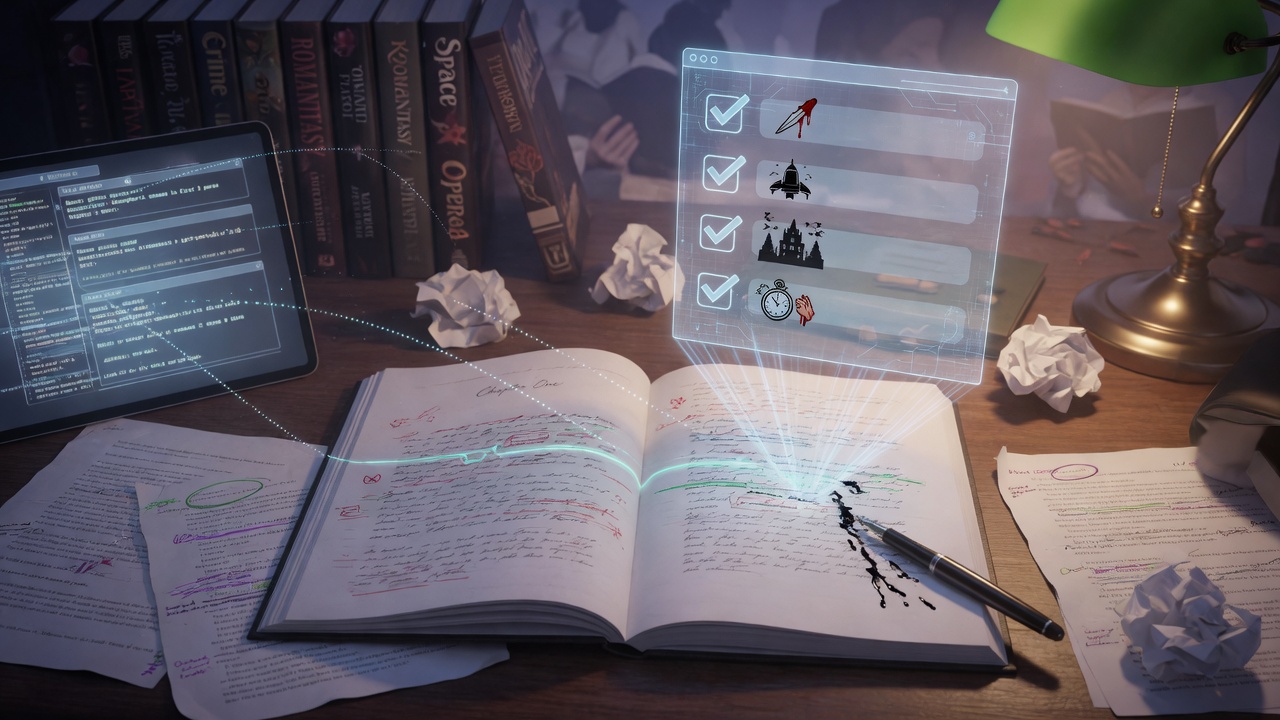
Most writing advice about first chapters collapses all fiction into a single problem: be interesting immediately. That framing is too broad to be useful. The real challenge is more specific — you need to be interesting in the right way for your genre, because readers arrive at page one carrying an invisible checklist built from every other book they've loved in that category.
A thriller reader wants to feel threat within the first few pages, even if they can't name the antagonist yet. A cozy mystery reader wants a sense of contained community — the village, the bakery, the knitting circle — before the body drops. An epic fantasy reader will tolerate a few pages of world establishment, but they'll bail if there's no human-scale problem anchoring all those invented nouns. A literary fiction reader expects psychological interiority, but will disengage if the narrator's voice is obscure without being rewarding.
These aren't arbitrary preferences. They represent genre contracts — implicit agreements between author and reader about what kind of experience is being offered. When your first chapter violates that contract, the reader doesn't think "this book broke the rules." They think "this book isn't for me," and they stop reading.
Generic hook advice — start with action, avoid prologues, cut the weather description — can't address this because it treats all readers as a single audience. Genre-specific diagnostic work is different. It asks not whether your opening is interesting in the abstract, but whether it's firing the correct signals for your specific reader. AI is surprisingly useful here, not because it has aesthetic taste, but because it has processed enormous amounts of genre fiction and can identify signal patterns with reasonable accuracy.
The Four Stress-Test Dimensions Every Opening Chapter Needs to Pass
Before reaching for any prompts, it helps to understand the four dimensions you're actually testing. Think of these as the structural load-bearing elements of any first chapter, each of which can fail independently.
Protagonist Legibility
Within the first chapter, readers need a clear enough sense of who the protagonist is — not their biography, but their stance toward the world — to anchor their emotional investment. Legibility doesn't mean simplicity. It means the reader knows whose experience they're inhabiting and can make basic predictions about how that person might react. Opacity at this stage reads as a craft failure, not depth.
Tonal Contract
Tone is the fastest signal a genre reader processes. The sentence rhythms, the narrative distance, the humor register, the vocabulary density — all of these tell a reader whether this book will feel like the books they already love. Mismatched tone is one of the most common first-chapter failures, and it's often invisible to the author because they're reading their own work with context the reader doesn't have.
Genre Signal Density
Every genre has a vocabulary of signals — not just content elements, but structural and atmospheric markers. A romance signals through the quality of attention paid to emotional states. A thriller signals through compressed time and threat proximity. When signal density is too low for your genre, readers can't confirm they're in the right book, and uncertainty breeds disengagement.
Inciting Promise
This is different from the inciting incident. The inciting promise is the question your opening pages implant in the reader's mind — the thing they need to know that will pull them to page two, then page ten, then page fifty. Every genre has a characteristic shape for this promise. In a mystery, it's usually a puzzle. In a thriller, it's usually a threat with a ticking dimension. In a romance, it's usually the tension of two people who need each other before they know it. If your opening doesn't plant the right question, readers have no reason to keep going.
Prompt Set 1: The Genre Identification Test
The first diagnostic is counterintuitive but revealing. Instead of asking AI to evaluate your chapter against your target genre, you ask it to guess the genre blind — and then explain its reasoning. The gap between what it identifies and what you intended is the diagnostic.
I'm going to paste the first chapter of my novel (approximately [X] words). Do not read any description or context I give you — just read the chapter itself. After reading, please: 1. Identify which genre or subgenre you think this manuscript belongs to, based purely on the signals present in the text. Offer your top two or three genre guesses and explain which textual evidence led you to each. 2. List the five strongest genre signals you detected — specific sentences, phrases, structural choices, or tonal markers that pointed you toward your assessment. 3. Identify any signals that conflicted with each other or that seemed to belong to different genre conventions simultaneously. 4. Note anything that was conspicuously absent — signals you'd expect in the genres you identified that weren't present in this chapter. My actual target genre is [thriller / cozy mystery / epic fantasy / literary fiction / romance — specify yours]. After you've done the blind analysis, give me a one-paragraph assessment of how closely the chapter's signal pattern matches the conventions of my intended genre, and where the biggest divergences are. [Paste your first chapter here]
What you're looking for in the response: if the AI confidently identifies your target genre, your signals are working. If it guesses wrong or hedges between genres, that confusion is telling you exactly what confused readers will feel — before they articulate it as disappointment.
Prompt Set 2: The Genre-Savvy Reader Simulation
This prompt asks AI to roleplay as a reader who has consumed extensively in your genre — not a general reader, but someone with developed expectations. You ask that reader to report their mental state at three specific checkpoints: the end of page one, the end of page three, and the end of page ten. The questions a reader is or isn't asking at each checkpoint tell you whether your inciting promise is landing.
I want you to read my first chapter as a genre-savvy reader who has read extensively in [your target genre]. This reader knows the conventions deeply — not just the plot conventions, but the tonal expectations, the pacing rhythms, the questions they expect to be planted in their mind. After reading the full chapter, simulate that reader's mental experience at three specific stopping points: PAGE ONE (approximately the first 250-300 words): — What questions, if any, is this reader already forming? — What emotional register have they calibrated to? — Are they leaning in or reading on autopilot? — What do they expect to happen next based on genre training? PAGE THREE (approximately the first 750-900 words): — Has the tonal contract been confirmed or has anything disrupted it? — What is the reader's primary question at this point — the thing they need to know? — Does that question match the kind of hook that [target genre] readers expect? Or is it the wrong kind of question for this genre? PAGE TEN (the full chapter or nearest equivalent): — What promise does this reader believe the book has made? — Are they likely to continue to chapter two? Why or why not? — What, specifically, is the unresolved tension driving that continuation? For each checkpoint, be specific about which sentences or passages generated the reader's response. I want to understand not just what the reader feels but what in the text produced those feelings. [Paste your first chapter here]
This prompt is particularly useful for identifying the mismatch between the questions your chapter plants and the questions your genre reader wants to be asking. A thriller writer might discover their reader is asking "what's this character's backstory?" when they should be asking "will she survive the next twenty minutes?"
Prompt Set 3: Surgical Revision Without Wholesale Rewriting
Once you've identified what's misfiring, the temptation is to tear the chapter apart. Resist it. Most first-chapter problems can be addressed with targeted changes — a reordered scene, a shifted paragraph, a single paragraph of added grounding. This prompt asks AI to be deliberately conservative in its revision suggestions.
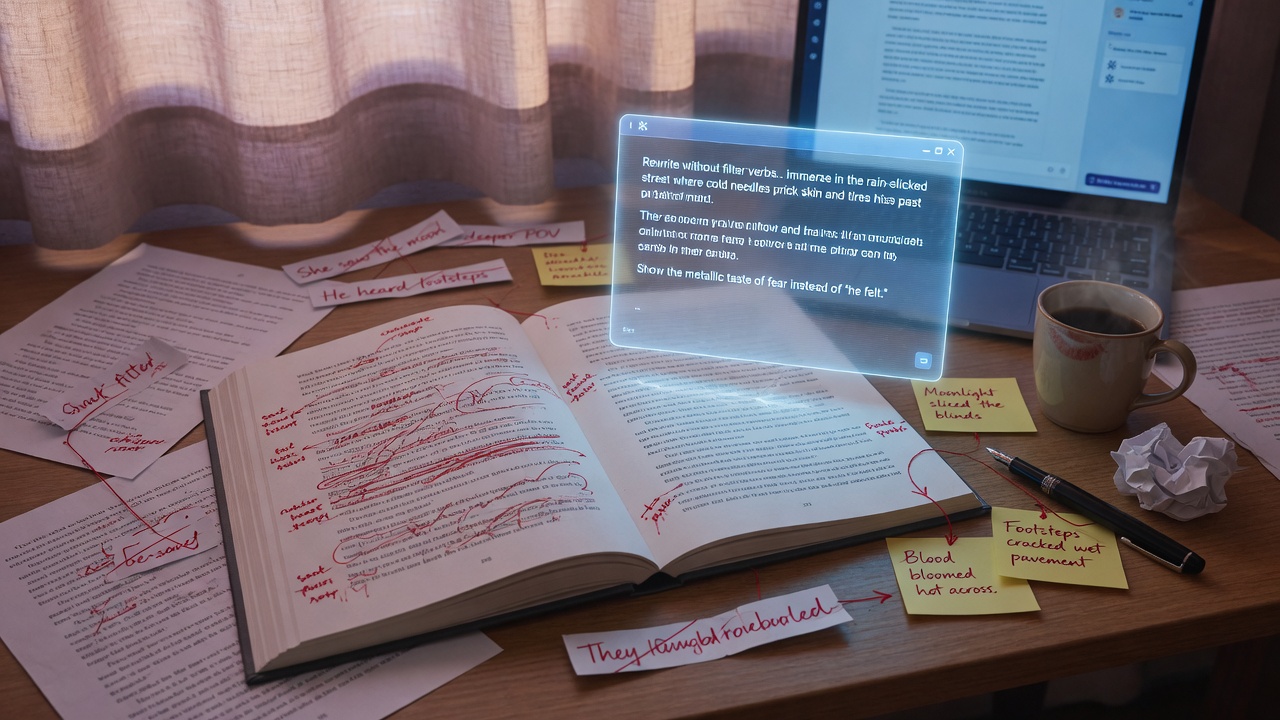
Based on the genre-signal analysis we've discussed (or based on your reading of this chapter for [target genre] conventions), I want surgical revision suggestions — not a rewrite, not an outline of what the chapter should be, but specific, minimum-intervention changes that would strengthen the following: 1. TONAL ANCHORING: What is the single most effective addition, deletion, or repositioning that would more clearly signal the emotional register of [target genre] to a reader in the first 250 words? Show me the specific passage that needs attention and offer one revised version alongside the original. 2. INCITING PROMISE: Where is the earliest point in this chapter where the book's central question could be more clearly implied — not stated, but implied? Suggest how the existing material could be rearranged or lightly augmented to plant that question earlier without adding scenes. 3. PROTAGONIST LEGIBILITY: Is there a moment where the protagonist's emotional stake or worldview could be made sharper with minimal added words? Point to the specific location and suggest an addition of no more than three sentences. 4. GENRE SIGNAL DENSITY: Which two specific genre signals are most conspicuously absent, and what is the least disruptive way to introduce each one — ideally by deepening existing material rather than adding new scenes? For each suggestion, explain why it addresses the specific genre expectation it targets. I want to understand the diagnostic logic, not just receive the edit. [Paste your first chapter here, or reference previous analysis]
Common First-Chapter Failure Modes by Genre
Understanding the patterns that tend to recur in each genre helps you ask sharper questions before you even run the prompts above.
Fantasy: The Lore Frontload
Epic fantasy openings frequently begin with world-building that the author finds fascinating but the reader hasn't yet earned an investment in. Invented calendars, magic taxonomies, and geopolitical histories all feel essential to the writer and irrelevant to the reader before they care about a character. The diagnostic question to ask AI: At what point in this chapter does a human-scale problem with personal stakes appear, and how many invented nouns precede it?
Thriller: The Throat-Clear
Thriller openings often spend too many pages establishing normalcy before disrupting it. The thinking is that readers need to care about the status quo before it's threatened. But thriller readers want the threat close from the start — not necessarily explicit, but present in the atmosphere. The diagnostic: Does any sense of danger, urgency, or disrupted safety appear in the first 300 words? If not, where is the earliest moment it could?
Romance: The Delayed Meet
Romance readers often have one dominant early expectation: the energy of the central relationship, even if the two characters haven't yet fully encountered each other. When romance openings spend too long establishing backstory or setting without gesturing toward the emotional dynamic that will drive the book, readers lose their orientation. The diagnostic: Does the opening chapter establish the specific emotional want or wound that will make the protagonist susceptible to this particular love interest?
Literary Fiction: The Opacity Trap
Literary fiction has more latitude with conventional hooks, but it earns that latitude through voice and specificity — not through deliberate withholding. When literary openings mistake obscurity for interiority, readers who would otherwise embrace unconventional structure disengage because there's nothing specific enough to hold them. The diagnostic: Is every ambiguous element in this chapter producing productive uncertainty — questions readers want answered — or decorative uncertainty that produces only frustration?
Building a Diagnostic Habit, Not a One-Time Audit
These prompts work best not as a one-time checklist before submission, but as part of a revision habit you return to each time you substantially change your opening. Genre signals can erode during revision — you add a scene that works beautifully in isolation but dilutes the tonal contract you'd already established. Running the genre identification test after major revisions takes ten minutes and can prevent months of confused feedback from beta readers.
- Run the genre identification test after any structural change to chapter one
- Use the simulated reader prompt whenever you receive feedback that your opening "doesn't quite work" but the reader can't articulate why
- Return to the surgical revision prompt when you've confirmed the problem but feel the impulse to overhaul — it forces you toward economy
- Keep a note of which genre signals AI consistently identifies as strong in your chapter; these are your foundation to protect during subsequent edits
The first chapter is the only part of your novel that every potential reader will see. The work of getting it right isn't just about craft in the abstract — it's about understanding the specific reader you wrote the book for and speaking their language from the first sentence.

No comments yet. Be the first to comment!