



Most stalled novels aren't stalled because the writer ran out of story. They're stalled because somewhere around chapter twelve, the scenes stopped having jobs. The writer sits down, knows roughly "something happens here," and drafts by feel. Sometimes that works. Often it produces a chapter that's technically fine — clean prose, competent dialogue — but does nothing. It doesn't move the plot, doesn't change the character, doesn't earn its page count. You don't notice until revision, when you're staring at 4,000 words trying to figure out what to cut and why it feels so flat.
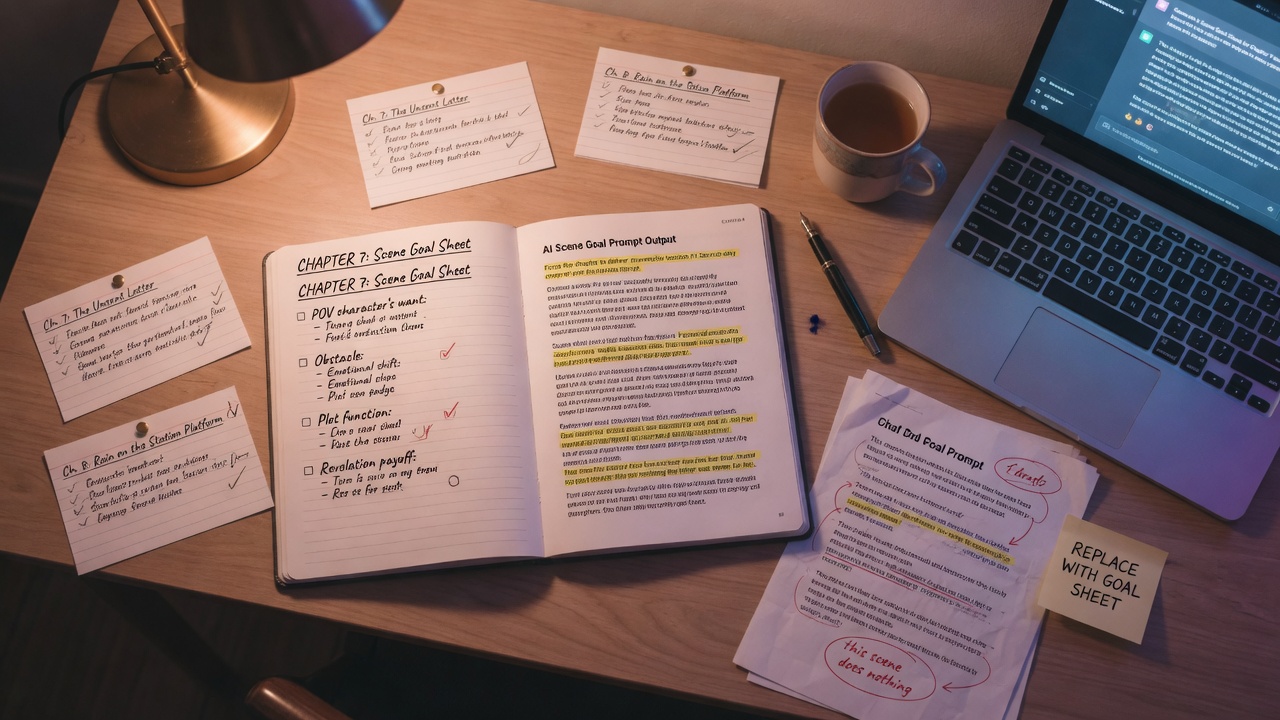
The fix isn't more outlining in the traditional sense. It's a lightweight document — a scene goal sheet — that you generate before you draft, so the chapter knows its job before you write a single sentence of prose. This is one of the places AI is genuinely useful for novelists, not as a prose generator, but as a structural sparring partner that forces clarity before you're emotionally invested in sentences you'll have to cut later.
The hidden cost of drafting blind
Scenes without a defined goal tend to fail in one of three predictable ways. They meander — the POV character wanders through an environment or a conversation without wanting anything specific, so there's no tension to resolve. They pad — the writer knows the scene needs to "cover" a plot point, so they stretch two paragraphs of actual content across ten pages of description and small talk. Or they stall — nothing changes by the end, so the next chapter has to awkwardly restate information or manufacture urgency the previous chapter should have built.
All three failures share a root cause: the writer didn't know, going in, what the character wanted, what stood in the way, or what would be different by the last paragraph. You can't diagnose that problem in revision nearly as cheaply as you can prevent it at the drafting stage. A scene that's structurally hollow needs to be rewritten, not line-edited. That's the expensive kind of fix.
The scene goal sheet solves this by making you answer four questions before you write, not after.
The four-part scene goal sheet
A goal sheet is deliberately short — a few sentences per section, not a treatment. It covers:
- The POV character's want. Not the plot's want. The specific, immediate thing this character is trying to get, avoid, prove, or find out in this scene. If you can't state it in one sentence, the scene doesn't have a spine yet.
- The obstacle. What's standing between the character and that want — another character, a piece of information, a physical barrier, their own fear. Conflict is what makes a scene worth reading; without it you have a status update.
- The turn. What's true at the end of the scene that wasn't true at the beginning. A revelation, a decision, a relationship shift, a reversal. If nothing turns, the scene is filler no matter how well it's written.
- The exit hook. How this scene's ending connects to the next chapter's opening — the question, tension, or obligation that pulls the reader forward and gives the next scene something to react to.
That's the whole framework. It fits on a page. And it's exactly the kind of structural scaffolding AI is well-suited to help you build quickly, because the value isn't in creative flourish — it's in forcing precision through a repeatable interrogation.
Prompt 1: Generate the goal sheet before you draft
The point of this prompt is to take a one-line summary of what "needs to happen" in a chapter and force it into the four-part structure before you write prose. If the AI's output feels vague or generic, that's diagnostic — it usually means your one-line summary was covering for a scene you hadn't actually thought through yet.
I'm about to draft a chapter in my novel and want to build a scene goal sheet first. Here is the context: - Chapter number and rough summary: [e.g., "Chapter 14 — Mara confronts her brother about the missing shipment records"] - POV character: - What happened in the previous chapter (last 2-3 sentences of it): [paste] - What needs to be true by the start of the NEXT chapter: [your notes, even if rough] - Anything already fixed in the outline that this scene must hit: [plot points, reveals, character beats] Using only this information, build a scene goal sheet with these four sections: 1. POV WANT — one sentence stating exactly what the character is trying to achieve, avoid, or find out in THIS scene specifically, not the book's overall plot goal. 2. OBSTACLE — what concretely stands in the way (a person, a lie, a physical constraint, an internal fear). Explain why this obstacle is strong enough to sustain the scene's length. 3. THE TURN — state precisely what is different, known, decided, or broken by the end of the scene compared to the beginning. If you can't identify a clear turn from what I've given you, say so directly and ask me clarifying questions instead of inventing one. 4. EXIT HOOK — the specific unresolved question, threat, or obligation the scene should end on that gives the next chapter something to open against. Do not write any prose for the scene itself. Do not describe setting or dialogue. I only want the four-part structural skeleton, and I want you to flag anywhere my input was too thin to support a strong answer.Notice the instruction to flag thin input rather than paper over it. This is the most useful behavior you can ask for. If you feed the AI a vague chapter summary, a compliant assistant will generate a plausible-sounding but hollow goal sheet, and you'll draft from it feeling falsely secure. Asking it to call out weak spots turns the tool into an early-warning system instead of a rubber stamp.
Prompt 2: Audit the finished draft against its own goal sheet
Once you've drafted the scene, the goal sheet becomes a checking document, not just a planning one. This is where drift shows up — you started with a clear want and obstacle, but three pages in, the character's motivation quietly shifted, or a subplot elbowed its way into what was supposed to be a tight confrontation scene. AI is good at this kind of comparison because it's mechanical: does the text you actually wrote match the structure you committed to before you wrote it?
Here is the scene goal sheet I built before drafting this chapter: [paste the four-part goal sheet from Prompt 1] Here is the actual scene draft: [paste the full chapter or scene text] Compare the draft against the goal sheet section by section and answer directly: 1. POV WANT — Does the draft clearly establish this want early, or does it emerge late or get diluted by unrelated business? Quote the line(s) where the want is (or should be) established. 2. OBSTACLE — Is the obstacle from the goal sheet actually the thing creating tension in the draft, or did a different, unplanned obstacle take over? If the obstacle changed, tell me explicitly and note whether the new version is stronger or weaker than what I planned. 3. THE TURN — Identify the exact paragraph or line where the turn happens. If you cannot locate a clear turn, say so and describe what the scene currently does instead (e.g., "ends on a mood beat with no factual or relational change"). 4. EXIT HOOK — Does the final beat of the draft point toward the next chapter the way the goal sheet intended? If the ending feels resolved/closed rather than propulsive, flag it. Then give me a short list of specific padding: paragraphs or sections that don't serve the want, obstacle, or turn and could be cut or condensed without losing anything structural. Be specific about location, not general.Run this before you move to the next chapter, not weeks later during a full-manuscript revision pass. Catching a missing turn or a hijacked obstacle while the scene is fresh costs you an afternoon of rewriting. Catching it during a developmental edit of a 100,000-word draft costs you a week of untangling downstream consequences, because everything you wrote after that scene was built on its faulty foundation.
Prompt 3: Cross-check consecutive chapters for cause and effect
Individual scenes can each pass their own audit and the book can still sag, because the chapters aren't actually talking to each other — stakes plateau instead of rising, or chapter nine's ending doesn't logically produce chapter ten's opening problem. This prompt compares goal sheets across a run of chapters rather than checking one in isolation.
I'm going to give you the scene goal sheets for three to five consecutive chapters in my manuscript, in order. For each, I've included the POV want, obstacle, turn, and exit hook. [paste goal sheets for chapters, e.g., Ch 11 through Ch 15, in order, labeled clearly] Analyze this run of chapters as a sequence and answer: 1. CAUSE AND EFFECT — For each chapter transition, does the exit hook of the earlier chapter logically and specifically set up the POV want of the next chapter? Identify any transition where the connection is weak, coincidental, or requires the reader to infer too much. 2. RISING STAKES — Track the obstacle across this run. Are the obstacles escalating in difficulty or consequence, staying flat, or (worse) getting easier? Tell me plainly if stakes plateau or dip anywhere in this sequence. 3. REPEATED STRUCTURE — Are any of these chapters structurally redundant with each other — same type of want, same category of obstacle, same flavor of turn — in a way that risks reader fatigue? Name the chapters if so. 4. GAPS — Is there a turn in one chapter that later chapters seem to forget or contradict, based only on the information in these goal sheets? Give me your analysis as a direct list, not a summary paragraph, and tell me which single chapter in this run is the structural weak point of the sequence.This prompt earns its keep on books with ensemble casts or multiple POV threads, where it's easy to lose track of whether Thread B's stakes are actually climbing while you've been focused on Thread A. It also catches the specific failure mode of the "connective tissue" chapter — the one that exists mainly to get a character from point A to point B, with a want so thin it barely counts as one.
Building a running log instead of relying on memory
The real payoff of this framework shows up at scale, not on any single chapter. Keep every goal sheet in one running document, in chapter order, even for scenes you've already drafted and revised. By the midpoint of a manuscript, that log becomes something closer to a structural x-ray of your whole book — you can scan down the "obstacle" column and see instantly where two chapters in a row have the same kind of conflict, or scan the "turn" column and see three consecutive scenes that all end on discovery rather than decision, which flattens pacing even if each individual chapter reads well.
This is also what makes revision faster later. Instead of rereading the entire manuscript to diagnose why the middle third feels slow, you reread four sentences per chapter — want, obstacle, turn, hook — and the pattern of what's missing becomes visible almost immediately. Revision stops being "reread everything and hope you notice the problem" and becomes pattern-spotting against a document you already built.
None of this replaces the actual writing. The prose, the voice, the sentence-level craft — that's still yours, and no prompt substitutes for it. What this framework does is cheap, boring, and effective: it makes sure that by the time you sit down to write the sentences, the chapter already knows what it's for. Most of the flat, aimless, or bloated chapters in a first draft trace back to that one missing piece of clarity, and it's far easier to build in before drafting than to excavate afterward.



No comments yet. Be the first to comment!