
Why Every Character Starts Sounding Like You by Scene 20
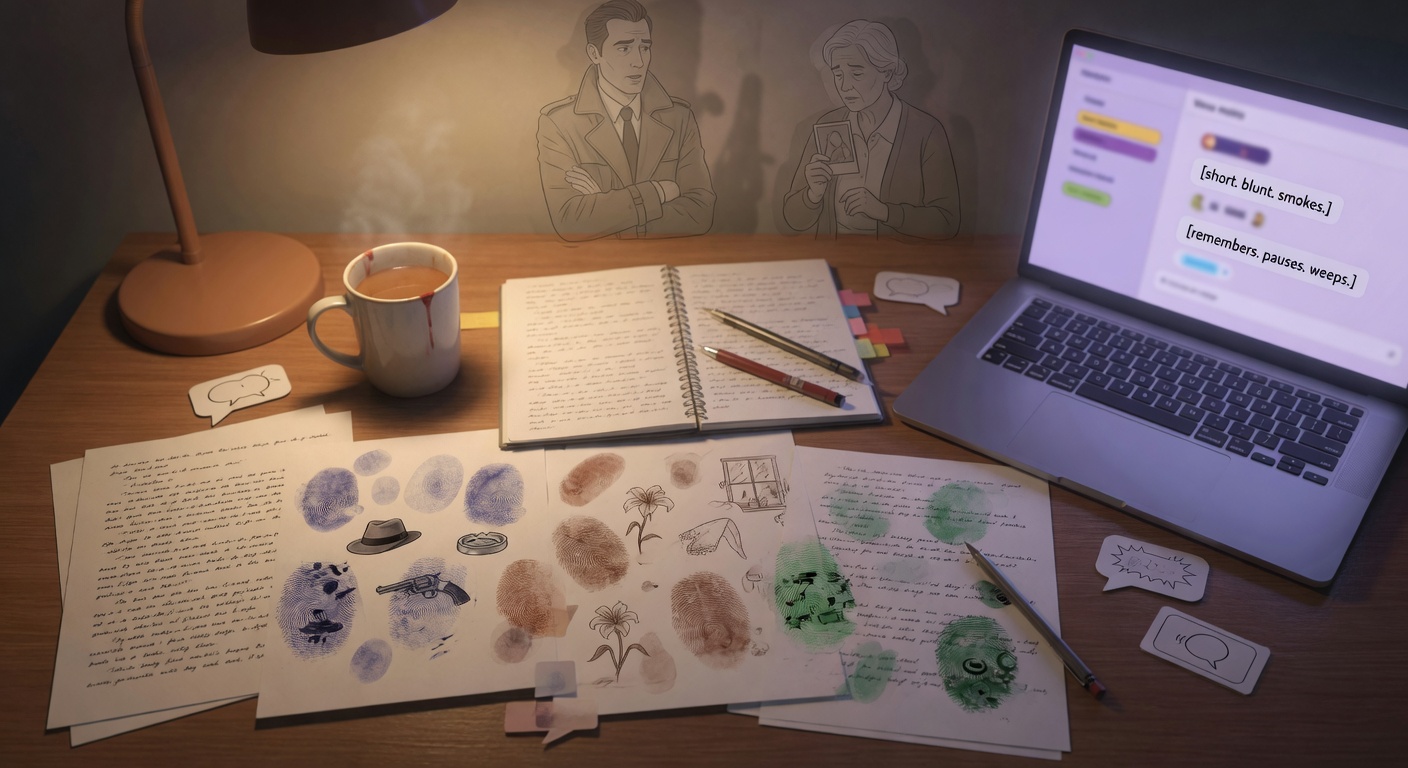
There's a particular exhaustion that sets in around the middle third of a novel draft. You know your characters well enough to move them through plot, but the intimacy you had with each distinct voice in the opening chapters has quietly eroded. Your sardonic detective starts using the same sentence rhythms as your grieving mother. Your teenage runaway begins phrasing things the way your middle-aged professor does. Nobody sounds wrong, exactly. They just sound like variations on the same person — which is to say, they sound like you.
This is one of the most common and least-discussed craft problems in long-form fiction. Most dialogue advice focuses on what characters say. The real problem, especially across thirty or forty or eighty scenes, is the texture of how they say it — and texture degrades under the pressure of production. When you're trying to hit a chapter deadline or push through a difficult plot beat, your brain defaults to its own native voice. Everyone in the room starts talking like the author showed up and took over.
AI tools, used strategically, offer something genuinely useful here: not the ability to write your characters for you, but the ability to build a formal system around voice — one that can audit, flag, and constrain your dialogue against a documented standard. The key is building that standard deliberately before the manuscript gets long enough to blur everything together.
The Six Components of a Voice Fingerprint
Before you can use any tool to enforce a character's voice, you need a precise definition of what that voice actually is. Vague notes like "she's blunt" or "he's intellectual" won't survive contact with a hundred pages of draft. A workable voice fingerprint has at minimum six trackable components:
- Diction level: Does the character reach for Latinate abstractions or Anglo-Saxon concreteness? Do they use technical vocabulary from a specific domain — legal language, medical terms, sports idiom — or actively avoid anything that sounds educated?
- Sentence length patterns: Some characters speak in long, clause-heavy structures that spiral before landing. Others cut. The rhythm is as identifying as a fingerprint, and it's the first thing to drift across a long draft.
- Filler habits and verbal tics: The specific sounds a character makes when stalling — not generic hedges, but this character's specific ones. "I mean" reads differently than "look" or "the thing is" or silence followed by a subject change.
- What the character never says: Negative space is often more revealing than positive content. A character who grew up poor might never use the word "investment" casually. A character afraid of intimacy might never say "I need." These avoidances are harder to track than inclusions, which makes them more important to document explicitly.
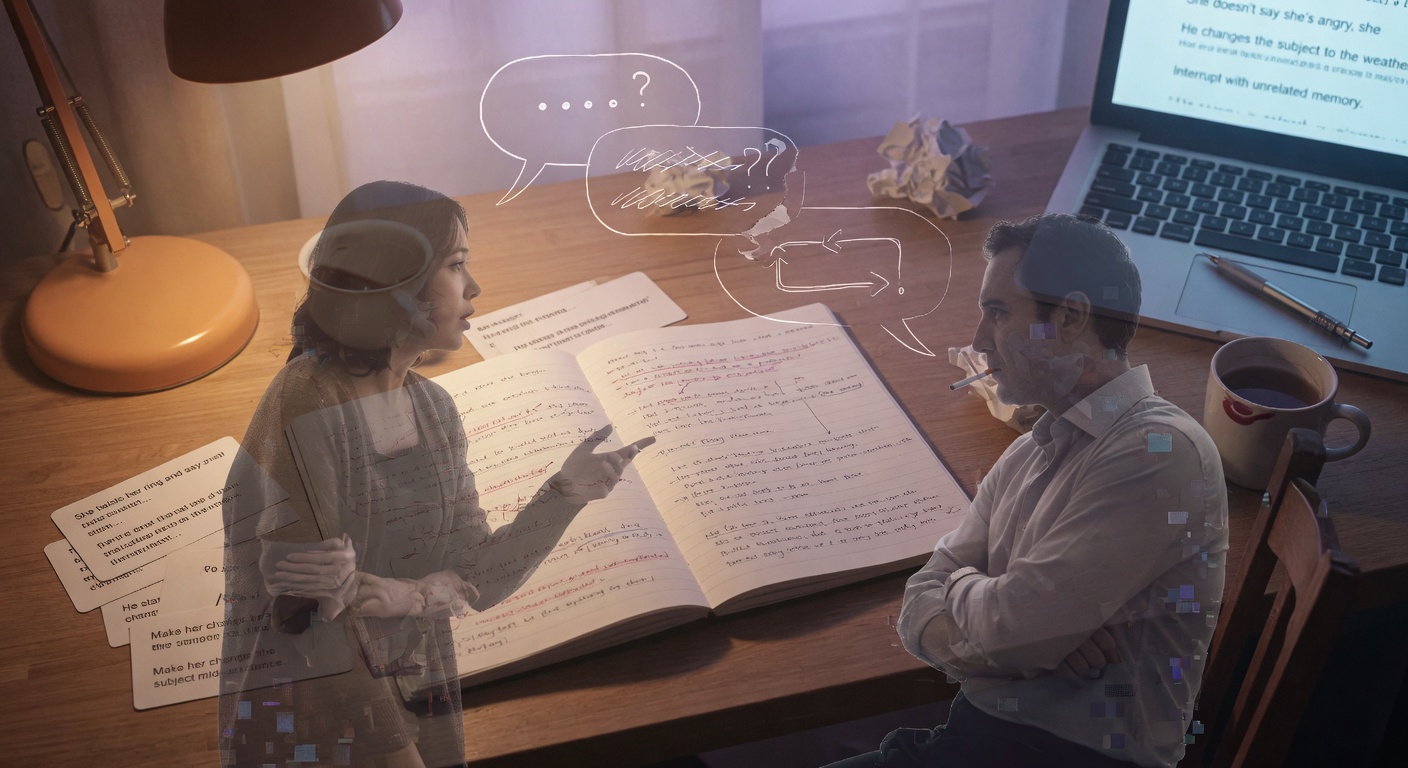
- Emotional deflection style: Everyone deflects. The question is how. Humor, aggression, intellectualization, over-explanation, subject change, physical action — each character should have a signature deflection move that appears when the conversation threatens their wound.
- Subject obsessions: What topics does this character route every conversation toward, consciously or not? A character haunted by a dead sibling might keep finding ways to bring mortality into discussions about traffic. These gravitational pulls are deeply individualizing.
The goal is a document specific enough that you could hand it to someone who'd never read your manuscript and they could write a passing imitation of the character's dialogue on the first try.
Generating a Voice Fingerprint from Backstory
You don't need a complete draft to build a voice fingerprint. You need three things: backstory (where the character came from), wound (what broke them or bent them), and want (what they're actively pursuing, consciously or not). From those three inputs, an AI can help you extrapolate a detailed voice profile you can actually use as a constraint document.
I'm building a detailed voice fingerprint for a character in my novel. Here is their core profile: NAME: [Character name] BACKSTORY: [3-5 sentences about their history, class background, education, and formative relationships] WOUND: [The central psychological injury — what happened, what it cost them, what they believe about themselves because of it] WANT: [What they're pursuing in the story, including the surface want and the deeper emotional need beneath it] Using only these inputs, generate a detailed voice fingerprint with the following six components: 1. DICTION LEVEL: Specific vocabulary tendencies, domains they draw language from, words or register they avoid and why 2. SENTENCE LENGTH PATTERN: Their characteristic rhythm — give 2-3 example sentences that demonstrate the pattern, not generic descriptions of it 3. FILLER HABITS AND VERBAL TICS: 3-4 specific stalling phrases or sounds unique to this character, explained by their psychology 4. WHAT THEY NEVER SAY: 5-6 words, phrases, or types of statements this character would not produce — and the backstory reason for each avoidance 5. EMOTIONAL DEFLECTION STYLE: Their specific move when conversation threatens the wound — be concrete, not categorical 6. SUBJECT OBSESSIONS: 2-3 topics they route conversations toward, with example dialogue showing the gravitational pull After completing the fingerprint, write one paragraph of internal justification explaining how these six elements cohere as an expression of the wound and want working together. Flag any tensions or contradictions in the fingerprint that could become interesting dramatic material.Run this prompt for every major character before you hit scene fifteen. The internal justification paragraph is not decorative — it forces the AI to check its own work for coherence, and it gives you a quick reference for why the voice is what it is, which matters when you're three months into a draft and can't remember your own reasoning.
Auditing an Existing Scene for Voice Bleed
Once you have voice fingerprints documented, the most immediately useful application is auditing scenes you've already written. The diagnostic method is simple in principle and surprisingly uncomfortable in practice: strip all speaker tags from a scene and ask the AI to assign each line of dialogue to a character based only on the fingerprint documents. Where it can't assign confidently, your voices have blurred.
I'm going to give you two character voice fingerprints and a scene of dialogue with all speaker tags removed. Your task is to perform a voice attribution audit. CHARACTER A FINGERPRINT: [Paste full fingerprint for Character A] CHARACTER B FINGERPRINT: [Paste full fingerprint for Character B] STRIPPED SCENE: [Paste dialogue with speaker tags removed — keep all action beats and stage directions, but replace every "she said/he said/ said" with a blank line] INSTRUCTIONS: 1. Go line by line through every piece of dialogue. For each line, assign it to Character A, Character B, or AMBIGUOUS, and give a one-sentence reason citing the specific fingerprint element that guided your attribution. 2. After the line-by-line audit, provide a VOICE HEALTH REPORT with these four sections: - Lines that are strongly attributed (list count and %) - Lines that are ambiguous (list them in full) - Specific fingerprint elements that are being consistently honored - Specific fingerprint elements that are being consistently ignored or violated 3. Identify the single most common voice-blur pattern in this scene — the specific way these two characters are currently sounding alike — and name it precisely (e.g., "both characters use three-beat hedging before direct statements" or "both use rhetorical questions as deflection rather than their distinct styles").The percentage figure from section two is worth tracking across your manuscript. If more than fifteen to twenty percent of your dialogue lines come back AMBIGUOUS in a two-character scene, you have a structural voice problem, not an isolated line problem. The "single most common blur pattern" instruction at the end is important: generic feedback like "the voices are too similar" doesn't give you anything to fix. A named pattern gives you a surgical target.
Rewriting Blurred Dialogue Against the Fingerprint
Diagnosis without repair is just discouragement. Once you've identified where voices are bleeding together, you need a rewrite process that uses the fingerprints as active constraints rather than reference documents you glance at and then ignore. The following prompt is structured to make the fingerprint do real mechanical work on the rewrite, not just serve as background inspiration.
I have a dialogue exchange between two characters that my voice audit flagged as having blurred voices. I need you to rewrite it so that every line could only have come from one specific character. CHARACTER A FINGERPRINT: [Paste fingerprint] CHARACTER B FINGERPRINT: [Paste fingerprint] ORIGINAL BLURRED EXCHANGE: [Paste the specific dialogue section — include surrounding action beats for context] THE BLUR PATTERN TO CORRECT: [Name the specific blur pattern identified in your audit, e.g., "Both characters currently deflect with humor; Character B should deflect through aggression or silence"] REWRITE INSTRUCTIONS: Rewrite this exchange with these hard constraints: HARD CONSTRAINTS FOR CHARACTER A: — Must use [specific diction level from fingerprint] — Must maintain [specific sentence rhythm from fingerprint] — When deflecting in line [X], must use [Character A's specific deflection style] rather than the current approach — Must avoid these words/phrases: [list from fingerprint] HARD CONSTRAINTS FOR CHARACTER B: — [Same structure as above, using Character B's fingerprint] After the rewrite, provide: 1. A brief annotation on 3-4 specific lines explaining which fingerprint element you applied and how 2. One line in the rewrite that you feel best captures Character B's unique voice — and explain why that line could not have come from Character A 3. Any place where the hard constraints created dramatic tension or conflict that wasn't present in the originalThe annotation requirement in the output is not bureaucratic overhead — it trains you to see the mechanics of voice differentiation in real time. After running this process on five or six scenes, most writers find they start applying the constraints instinctively in first drafts, because they've internalized what those constraints actually produce at the sentence level.
Building Voice Fingerprinting Into Your Drafting Workflow
The system described here works best when it's embedded in your process rather than applied retroactively to a finished draft. The sequence that tends to work: generate fingerprints for your three to four most important speaking characters before you start drafting. Run the audit prompt after every fifth scene or so — not to fix everything immediately, but to catch drift early before it compounds. Save the rewrite prompt for scenes where the audit flags persistent patterns, not isolated ambiguous lines.
Keep your fingerprint documents in a single reference file and update them when the character genuinely changes — when a wound gets named out loud, when a want shifts, when a relationship changes what a character is willing to say. Voice fingerprints aren't meant to be cages. They're meant to be precise enough that deviation from them means something, rather than being noise.
The underlying craft principle here predates AI entirely: the best character voices are not invented, they're discovered through systematic attention to the specific psychological logic of a specific person. What AI offers is a collaborator that can hold the formal structure of that logic in working memory for longer than you can — across scenes, across months of drafting, across the inevitable blur of the middle. The voice fingerprint is yours. The audit is the tool that keeps you honest about whether you're honoring it.
What Distinct Voices Actually Do for a Reader
There's a reason this work matters beyond craft satisfaction. When readers can track character voices without speaker tags, they experience the dialogue as something that exists in the world of the story rather than on the page. The exchange stops feeling authored and starts feeling overheard. That perceptual shift is one of the things that creates the specific reading experience people describe when they say a novel felt real to them — not the plot, not even the prose style, but the sensation that these people actually existed and you were simply listening.
Thirty distinct scenes with four or five speaking characters creates a very large surface area for drift. The fingerprint system doesn't eliminate the problem of having one brain write everyone. It gives that brain a precision instrument for catching and correcting what it inevitably loses track of — which is, in the end, what most of the useful craft tools in a novelist's kit actually do.

No comments yet. Be the first to comment!