
Readers forgive awkward description. They rarely forgive characters who explain their feelings in complete sentences. AI dialogue defaults to therapist speak—everyone is articulate about their wounds. Subtext prompts fix that by giving the model a hidden objective per speaker.
Prompt 1: The unsaid objective
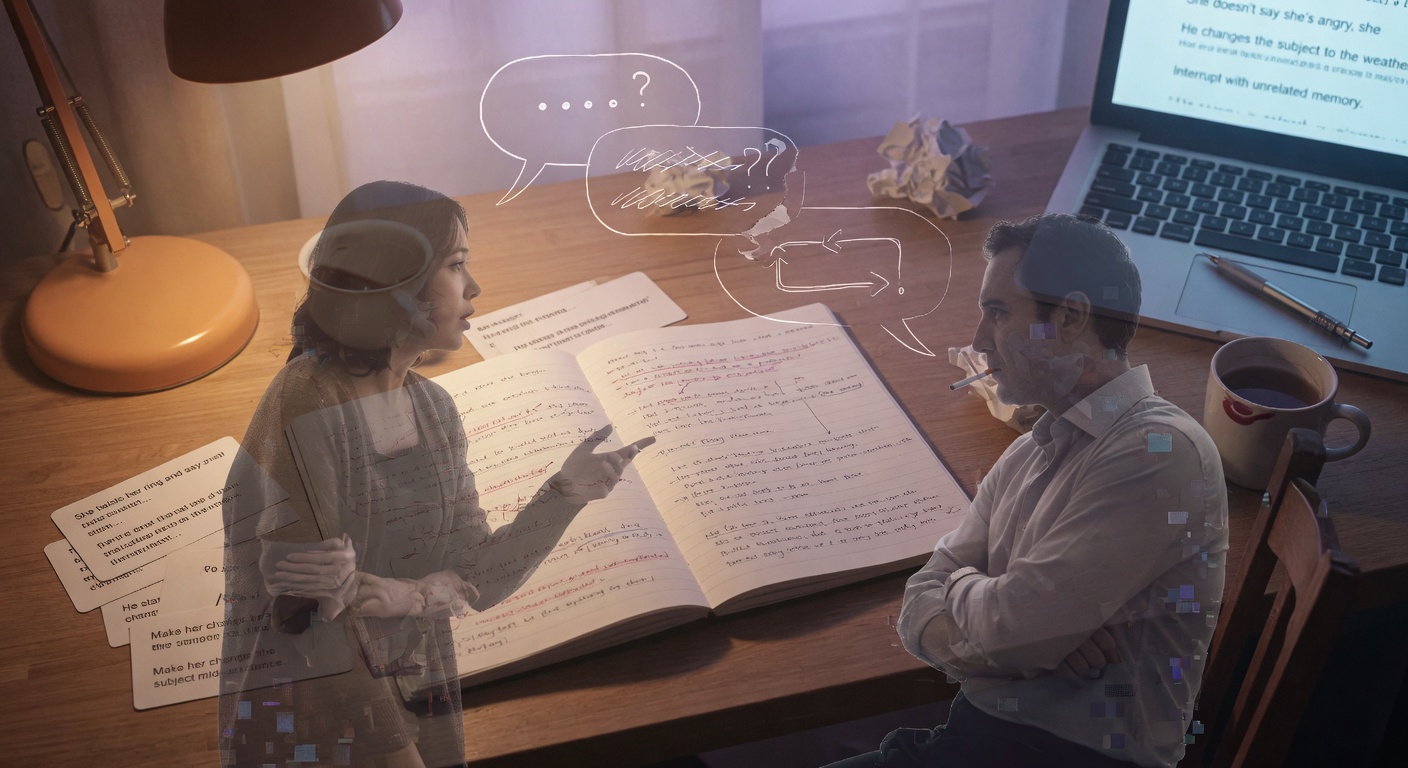
Two characters: A wants [concrete goal], B wants [different goal]. Neither may state their goal or the word "feel." Rewrite the dialogue so each line advances their hidden agenda through misdirection, deflection, or false agreement. Add one interruption and one subject change that feels rude but realistic. DRAFT DIALOGUE: [Paste]
Prompt 2: Register mismatch
Distinct voices come from syntax, not accents spelled phonetically.
Character A: speaks in short declarative sentences, avoids questions, uses job jargon from [profession]. Character B: speaks in conditional clauses ("maybe," "I guess"), apologizes before requests, never uses jargon. Rewrite the exchange. Same plot beats. No dialect spelling. Max 12 lines each. EXCHANGE: [Paste]
Prompt 3: The third thing in the room
Characters talk around the real issue by fixating on a prop.
The real conflict is [e.g. inheritance, affair, failed pitch]. Characters discuss only [object: dishwasher, parking ticket, houseplant] for the first 8 lines. Subtext must be readable but never named. Line 9: one character almost names the conflict, then stops mid-word. SCENE SETUP: [2 sentences of context] DRAFT: [Paste]
Prompt 4: Subtext extraction (reverse prompt)
When you wrote on-the-nose lines and need to recover.
For each line of dialogue, write what the character is actually thinking in 5 words or fewer. Then rewrite the spoken line so it contradicts or barely touches that thought. Remove all emotional labels ("angrily," "sadly"). DIALOGUE: [Paste]
Red flag to edit by hand
If the model gives you symmetrical exchanges—each character gets a perfectly balanced paragraph—break the pattern. Real arguments have winners, overlaps, and people who go quiet. Cut the most eloquent line. Keep the stumble.
No comments yet. Be the first to comment!