
Why Beta Feedback Paralyzes Writers—and Why AI Makes a Useful Triage Partner
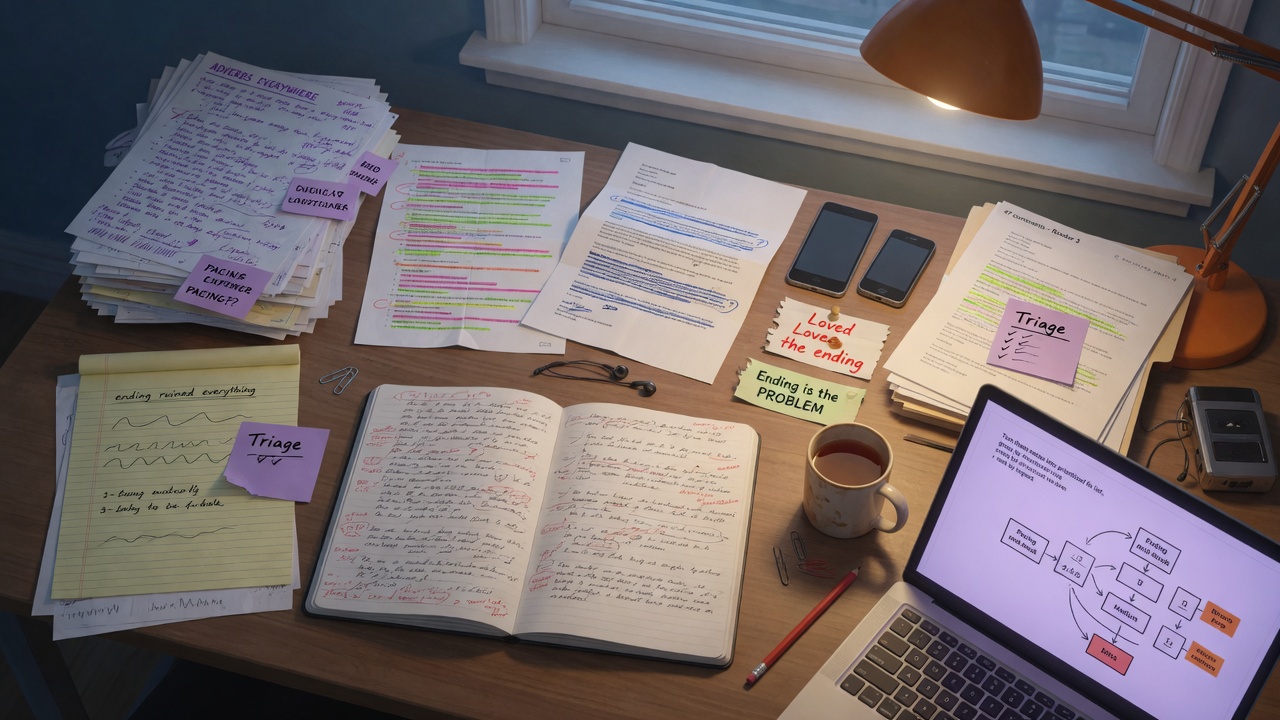
You sent your manuscript to six readers. Three weeks later, the notes arrive in a flood: forty-seven comments from one reader, a three-paragraph email from another, a color-coded PDF from a third, and two voice memos you still haven't transcribed. One reader loved your ending. One thought the ending was the single biggest problem in the book. Someone flagged every adverb. Someone else said the pacing dragged in the middle but couldn't say exactly where.
This is not a failure of your beta readers. It's a structural problem with how most writers process feedback. Raw beta notes arrive organized by the reader's reading experience—chapter by chapter, page by page, in the order things bothered them. That organization is useful for understanding one person's journey through your manuscript. It's nearly useless for knowing what to fix first.
The result is revision paralysis: you open a document, stare at forty contradictory comments, and either start making random edits that create new problems downstream, or you don't open the document at all.
AI doesn't solve this problem by being smarter than your beta readers. It solves it by being emotionally uninvested and organizationally tireless. You can paste every note from every reader into a single prompt, and the AI won't feel hurt that Reader 3's opinion contradicts Reader 1's, won't protect the chapter you secretly love, and won't lose track of comment forty-seven while thinking about comment two. It reads the whole pile at once and can sort it by whatever taxonomy you give it. That sorting step—triage—is what most revision processes skip entirely.
Formatting Raw Beta Notes So AI Can Cluster Them Meaningfully
Before you prompt anything, your notes need minimal formatting work. The goal is not perfect organization—that's the AI's job—but legibility. Each note should include three things: which reader left it, roughly where in the manuscript it applies (chapter number or scene description), and the actual comment verbatim or closely paraphrased.
A simple format works well:
- Reader label: Beta A, Beta B, etc. (you don't need real names)
- Location: Ch. 7, or "opening scene," or "throughout second act"
- Comment: Direct quote or close paraphrase
Once you have that list—even as a messy paste—you're ready to run a clustering prompt. The key instruction is telling the AI to sort by problem type, not by source or location. You want it to build categories like pacing, character motivation, structural logic, worldbuilding consistency, and prose clarity, then pull every relevant note into each category regardless of which reader said it or what chapter they were in.
You are a developmental editor helping me triage beta reader feedback before I begin revisions on my novel. Below is a raw list of notes from [number] beta readers. Each note is labeled with the reader (Beta A, B, etc.) and the manuscript location. Your task: 1. Read all notes without skipping or summarizing prematurely. 2. Cluster every note into one of these problem categories: STRUCTURE, PACING, CHARACTER MOTIVATION, WORLDBUILDING/LOGIC, DIALOGUE, PROSE STYLE, EMOTIONAL RESONANCE. If a note fits multiple categories, list it under the primary one and flag the secondary category in brackets. 3. Within each category, note whether the feedback is CONSISTENT across readers or CONTRADICTORY (readers disagree). 4. Do not yet recommend fixes. Do not prioritize. Just cluster and flag contradictions. Here are the raw beta notes: [PASTE ALL NOTES HERE] Output format: One section per category. Under each category, list the relevant notes verbatim, the reader source, and a one-line description of what the note is actually pointing at beneath the surface language.That final instruction—"what the note is actually pointing at beneath the surface language"—is where this prompt does real work. Beta readers describe their reading experience, not craft problems. "I got bored around chapter nine" is an experience report, not a diagnosis. You need the AI to translate experience reports into craft problems you can actually address.
Separating Structural Problems From Surface Symptoms
The most expensive mistake in revision is fixing a symptom rather than its source. A beta reader flags stilted dialogue in chapter seven. You spend two hours rewriting that dialogue. Three drafts later, the dialogue still feels wrong—because the real problem is that the character speaking it has an unclear motivation established in chapter two, and no amount of sentence-level polish will fix a line that the reader doesn't believe the character would say.
This is what developmental editors call a "bleed": a structural problem that bleeds forward into surface-level symptoms throughout the manuscript. AI prompts can be specifically designed to detect these patterns.
I am going to give you a list of beta reader complaints that appear to be line-level or scene-level problems. Your job is to act as a structural analyst and determine whether each complaint is: A) A genuine surface-level issue (fixable by revising that specific scene or passage) B) A symptom of a deeper structural problem earlier in the manuscript (fixing the scene won't help until the root cause is addressed) C) Ambiguous—could be either, and requires more information For every complaint you categorize as B, identify: - The most likely root cause and where in the manuscript it probably originates (act, chapter range, or scene type) - What kind of structural problem it suggests: unclear character arc, broken cause-and-effect, missing setup, thematic inconsistency, pacing architecture issue, etc. - A brief explanation of why fixing the surface symptom first would be wasted effort Here is the list of complaints: [PASTE SURFACE-LEVEL OR SCENE-LEVEL NOTES HERE] My manuscript is a [genre] novel, approximately [word count], with a [single/dual/ensemble] POV structure. The protagonist's core internal conflict is [one sentence description]. Please use this context when assessing whether complaints suggest structural root causes.The genre and protagonist context matter here. A complaint about a passive protagonist reads differently in a literary novel where interiority is intentional versus a thriller where plot momentum depends on character agency. Give the AI enough context to make meaningful distinctions rather than generic developmental notes.
Building the Staged Revision Roadmap
Once you have your clustered feedback and your surface-versus-structure analysis, you're ready to build the actual revision plan. The principle behind staged revision is simple and widely understood among developmental editors: you always work largest to smallest. Fix structure before you fix scenes. Fix scenes before you fix paragraphs. Fix paragraphs before you fix sentences. Doing it in any other order means polishing work you might cut and leaving unaddressed problems that will contaminate everything you touch.
The AI prompt for this stage takes your triage outputs and converts them into a tiered roadmap with something most revision plans lack: an honest assessment of impact versus effort so you can protect manuscript strengths while targeting genuine weaknesses.
I have completed a triage of my beta reader feedback. I am now ready to build a staged revision roadmap. Below I will paste: - Section 1: Structural problems and their root causes - Section 2: Scene-level problems - Section 3: Surface/prose-level problems - Section 4: A brief description of my manuscript's core strengths (what beta readers responded to positively) Your task is to build a three-pass revision roadmap: PASS 1 — STRUCTURAL (big picture: arcs, plot logic, act structure, POV consistency, thematic coherence) PASS 2 — SCENE-LEVEL (individual scene function, pacing within chapters, dialogue serving character, emotional beats) PASS 3 — PROSE (sentence rhythm, word choice, cutting redundancy, consistency of voice) For each item in the roadmap: 1. State the specific problem to address 2. Assign a REVISION IMPACT SCORE from 1–5 (5 = fixing this improves multiple other problems or reader experience broadly; 1 = isolated fix with limited ripple effect) 3. Flag any items in Pass 2 or Pass 3 that should be DEFERRED until a specific Pass 1 fix is complete (to avoid wasted effort) 4. Flag any areas of the manuscript that beta readers consistently praised—mark these DO NOT DISTURB unless a structural fix requires it Here is my triage data: [PASTE SECTIONS 1–4] Output format: Numbered list within each Pass. Sort each Pass by Impact Score descending (highest impact first). Include a one-paragraph summary at the top of each Pass explaining the overarching revision goal for that stage.The DO NOT DISTURB flag is not sentimentality. It's craft strategy. Beta readers often praise specific scenes, a particular character voice, or a recurring motif. Those wins are data about what the book does well, and careless structural revision can accidentally flatten or remove them. Having the AI note these explicitly means you revise with the manuscript's strengths as a map, not just its weaknesses.
Holding Your Authorial Vision Against Contradictory Opinions
Beta readers are not your collaborators. They are your readers, which is a meaningfully different role. Their job is to report their experience. Your job is to interpret that experience through the lens of the book you are trying to write—not the book they might have preferred to read.
Contradictory feedback is almost always the most instructive kind, because it reveals where your manuscript is genuinely ambiguous versus where different readers simply want different books. A dark ending that divided your betas is not the same problem as a chapter-three reveal that confused everyone. The first might be working exactly as intended. The second almost certainly isn't.
I have a list of contradictory beta reader opinions—places where readers disagreed significantly about whether something worked. I need help determining which contradictions reflect genuine manuscript ambiguity I should resolve, and which reflect reader preference variation I should honor or consciously disregard. To do this analysis, here is my authorial intent context: - Genre and subgenre: [e.g., literary thriller with unreliable narrator] - Target reader: [e.g., adults who read psychological suspense; comfortable with ambiguity and moral complexity] - Core theme: [one or two sentences about what the book is fundamentally about] - Intentional choices I do not want to revise away: [list any deliberate stylistic or structural decisions that might be flagged as problems, e.g., non-linear timeline, distant narrator, unresolved ending] For each contradictory note I provide, give me: 1. A judgment: Is this contradiction likely caused by manuscript ambiguity (unclear execution) or reader preference (different taste/expectation)? 2. If it's manuscript ambiguity: What is probably unclear, and what minimal revision would resolve the confusion without compromising my stated intent? 3. If it's reader preference: Which reader's preference aligns with my target audience and stated theme, and which reader's preference represents a different book than I'm writing? 4. A one-line recommendation: REVISE, HOLD, or CLARIFY (meaning add context rather than change the choice) Contradictory notes: [PASTE CONTRADICTORY FEEDBACK PAIRS OR GROUPS HERE] Do not default to "both readers make valid points." Make a clear recommendation based on my stated authorial intent.That final instruction matters. AI has a tendency toward diplomatic hedging—telling you that both perspectives have merit. In feedback triage, that's not useful. You need a decision, and the decision should be grounded in your stated intentions, not in splitting the difference between two readers who want incompatible things.
What Triage Actually Gives You
After running these prompts, you should have four things you didn't have when you opened that pile of raw notes:
- A feedback map organized by problem type rather than reader opinion or chapter number
- A clear distinction between structural root causes and the surface symptoms they generate
- A staged revision roadmap with impact scores, sequencing logic, and explicitly protected strengths
- A principled framework for handling contradictions based on your genre, audience, and thematic intent
None of this replaces your judgment as a writer. The AI doesn't know your book the way you do, and it can't feel the difference between a sentence that's technically correct and one that carries weight. What it does is handle the organizational cognitive load that prevents most writers from getting to judgment at all.
Triage isn't about distancing yourself from your manuscript. It's about creating enough order in the noise that you can return to the work with clarity instead of dread—knowing exactly what you're fixing, in what sequence, and why. That's not a shortcut around revision. It's the preparation that makes revision actually work.


No comments yet. Be the first to comment!