


Psychic Distance Is a Dial, Not an Accident
Most craft conversations about point of view stop at person and tense: first or third, past or present. But there's a third axis that does more emotional work than either of those choices, and most writers control it by instinct rather than intention. That axis is psychic distance—how close the narration sits to a character's immediate, moment-to-moment consciousness.
John Gardner's old five-point scale still holds up as a working model:
- Level 1: "It was winter of the year 1853. A man was walking down a road near the town of X."
- Level 2: "Henry Fleming was a man who had waited a long time in the cold."
- Level 3: "Henry hated the cold. He'd hated it since childhood."
- Level 4: "Damn this cold. Would it never end?"
- Level 5: "The cold. Would it never—god, just walk. Just keep walking."
Same POV character, same tense, wildly different intimacy. A story can hold third-person limited past tense for three hundred pages while sliding freely up and down this scale sentence by sentence. That sliding is a craft tool. Used deliberately, it's one of the most powerful levers a novelist has for controlling emotional impact. Used accidentally, it flattens everything.
Here's the problem it solves: writers tend to have a default distance they write in without noticing, and they stay there regardless of what the scene needs. A death scene gets the same distance as a scene of someone driving to the store, because that's just how the prose naturally comes out. The reader feels the mismatch even if they can't name it—grief that reads like a police report, or a car chase bogged down in interior rumination that should be pure kinetic motion.
The fix isn't "always write closer." Distance is a dial, and the skill is in moving it to match the scene's emotional job. Action, transitions, and scene-setting usually want more distance—camera pulled back so pacing stays brisk and the reader isn't stuck inside a head during a car chase. Grief, revelation, decision points, and trauma usually want less distance—the reader dropped directly into raw, unfiltered thought.
AI is unusually good at this kind of work because psychic distance is, at bottom, a linguistic pattern: sentence length, verb choice, the presence or absence of filter words ("she noticed," "he felt," "she realized"), whether we get summary or immediate sensation, whether thought is reported or rendered as it occurs. A language model can be taught this scale explicitly and then asked to diagnose, adjust, or map it across a manuscript with a precision that's hard to do by eye, especially in your own prose, where you're too close to see your own default settings.
Step One: Diagnose Before You Adjust
Before touching a word, you need to know where your prose actually sits, scene by scene, not where you think it sits. Writers are notoriously bad at self-diagnosing this because we read our own work through the intention behind it rather than what's on the page. You know you meant for that paragraph to feel intimate. Whether it reads that way is a separate question.
This is where AI does something genuinely useful: cold, unsentimental labeling. Feed it a chapter and ask it to score distance levels sentence by sentence or beat by beat, then flag places where the level doesn't match what the scene is trying to do emotionally.
I'm going to paste a chapter from my novel. I want you to analyze psychic distance throughout, using this five-level scale: Level 1 (Distant/Camera-eye): Objective, external description, no access to interior thought. Reads like a screenplay or historical account. Level 2 (Observational): Third-person summary of a character's general traits, habits, or states, but not their immediate thought. "She was the kind of person who..." Level 3 (Moderate): Reported interior thought using filter words ("she felt," "he knew," "she realized"). We're told about the thought rather than experiencing it directly. Level 4 (Close): Interior thought rendered directly, without filter words, but still grammatically structured — the character's voice starts to bleed into the narration. Level 5 (Deep interior/stream): Fragmented, associative, immediate. Syntax mimics the actual texture of thought as it happens, including interruption and non-sequitur. For each paragraph or beat in this chapter, tell me: 1. What distance level it's operating at (you can note if it shifts mid-paragraph) 2. What's happening emotionally or dramatically in that beat (is this action, transition, revelation, grief, decision, banter, etc.) 3. Whether the distance level matches the stakes of that beat, or whether there's a mismatch — flag anything where a high-stakes emotional moment is being told at Level 1 or 2, or where a routine transitional moment is bogged down at Level 4 or 5 Give me the results as a table, then a short summary of the overall pattern: what's my default distance level across this chapter, and where are the three biggest mismatches? [PASTE CHAPTER]What comes back from this prompt is usually more revealing than writers expect. Most manuscripts have a strong default — often Level 2 or 3 — and drift toward that default even during scenes explicitly written to be devastating. The AI isn't judging your prose quality; it's just naming where the camera is standing. That's information you can act on.
Step Two: Zoom In Without Adding Content
Once you've identified a scene that needs closing distance — a confession, a death, a betrayal discovered — the temptation is to just write more. Add interiority, add reflection, pad the moment with additional sentences of feeling. That's usually the wrong move. Closing psychic distance isn't about adding content; it's about changing how the existing content is delivered. The character doesn't need three new paragraphs of grief. The one paragraph you have needs to stop being reported and start being experienced.
This distinction matters enormously when working with AI, because the default failure mode of an unconstrained "make this more emotional" prompt is bloat — extra sentences of unearned sentiment stacked onto a scene that was already complete in its events. You want the opposite: same events, same information, different distance.
Below is a scene from my novel where [character] discovers/experiences [brief description of the emotional beat]. I want you to rewrite this passage to close the psychic distance to Level 4 or 5 on Gardner's scale — direct, unfiltered interior experience rather than reported or summarized emotion. Constraints: - Do not add new plot content, new information, or new events. Everything that happens in my version should still happen in yours. - Do not add explanatory interiority that tells the reader what to feel (no "she felt a wave of grief wash over her"). Instead, render the actual texture of the thought as it occurs — fragmented if appropriate, non-linear if that's how panic/grief/shock actually moves, sensory rather than analytical. - Remove filter words entirely where possible ("she noticed," "she realized," "she felt," "she thought"). Let the thought appear on the page directly, in her voice, without narrative mediation. - Preserve my character's existing voice and vocabulary — don't make her sound more literary or poetic than she is elsewhere in the manuscript. Look at the sample of her established voice below for calibration. - Keep the passage roughly the same length as the original, or shorter. Closing distance should not mean adding words. Established voice sample (for calibration): [PASTE 1-2 PARAGRAPHS OF CHARACTER'S ESTABLISHED VOICE ELSEWHERE IN MANUSCRIPT] Scene to revise: [PASTE PASSAGE] After the rewrite, briefly explain the specific techniques you used to close the distance, so I can apply the same moves myself in other scenes without you.The instruction to explain technique at the end matters more than it looks like it should. You're not trying to outsource every emotional scene in your manuscript to an AI rewrite loop forever. You're trying to learn the moves — filter word removal, fragment syntax, sensory substitution for analysis — so you can execute them yourself in the next draft, and the one after that, without a prompt.
Step Three: Zoom Out on Purpose
The inverse problem gets less attention but causes just as much damage: scenes that should move quickly get stuck in interior monologue. Action sequences, travel montages, scene transitions, and group dialogue often suffer from writers defaulting to Level 3 or 4 out of habit, larding a car chase or a fight scene with reflective interiority that kills momentum. Readers start skimming, not because the writing is bad sentence by sentence, but because the distance is wrong for the job the scene is doing.
Pulling back deliberately is a different skill than closing distance, and it requires its own constraint set — mainly around resisting the urge to explain or interpret.
The following passage is meant to be a fast-paced action/transition scene, but it's currently written at a close psychic distance (heavy interiority, reflection, filtered thought) that's slowing the pacing down. I want you to pull the distance back to Level 1-2 on Gardner's scale — external, observational, camera-eye — while preserving all plot-critical information and character actions. Constraints: - Cut or drastically minimize interior reflection. The character can still have brief flashes of thought, but they should be short, almost telegraphic — not full sentences of analysis. - Prioritize external action verbs and concrete physical detail over emotional or analytical content. What does the body do? What does the camera see? - Shorten sentence length overall. Distant, fast-paced prose tends to run shorter and more clipped than close interior prose. - Do not cut any plot-necessary information — if a fact or decision needs to reach the reader, keep it, but deliver it through action or dialogue rather than internal reasoning. - Flag anywhere you had to make a judgment call about what interior content was "plot-necessary" versus purely reflective, so I can double check your read against my intentions. Passage to revise: [PASTE PASSAGE]Writers are often surprised how much interior content turns out not to be plot-necessary at all once it's isolated this way — it was doing emotional work that belonged in a different scene, or explaining a decision the action itself already made clear. Pulling distance back frequently reveals redundancy that closer distance had been quietly hiding.
Step Four: Map the Whole Chapter (or Act) On Purpose
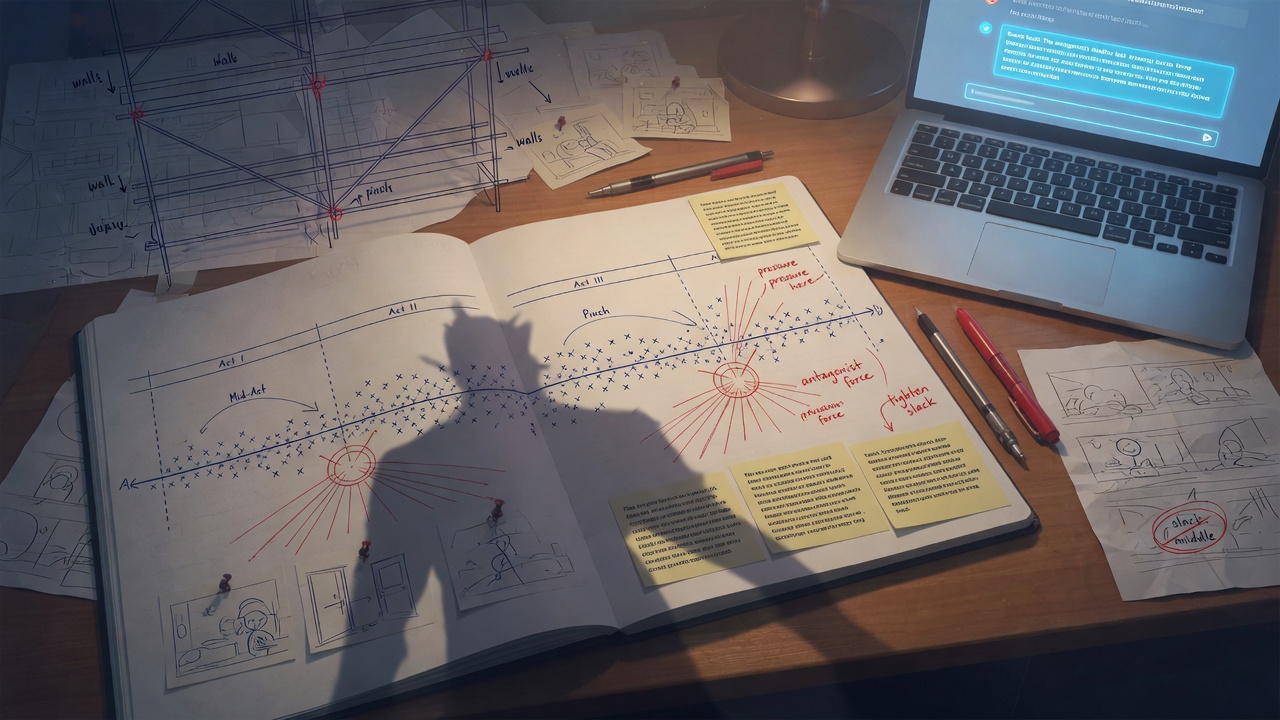
Diagnosing and adjusting individual scenes is necessary but not sufficient. The real goal is intentional variation across a whole chapter or act — a deliberate rhythm of close and distant, rather than either a flat, unvarying default or a random drift that happens to land wherever the prose naturally settles that day. Readers register this rhythm even when they can't name it; it's part of what makes a chapter feel controlled versus meandering.
Building an explicit map turns this from an invisible instinct into a visible structural decision you can revise against.
I want to build a psychic distance map for this chapter (or act) of my novel. Break the text into beats (scene units, roughly paragraph-to- scene-break length) and for each beat, tell me: 1. A one-line summary of what's happening 2. The current psychic distance level (1-5, Gardner's scale) 3. What I'd guess the "ideal" distance level is for that beat, based on its emotional/dramatic function — action and transition beats trending toward 1-2, decision points and emotional peaks trending toward 4-5, everything else somewhere in between 4. Whether the current and ideal levels match Then give me: - A simple sequence showing the distance level across the whole chapter beat by beat (like: 2, 2, 4, 4, 1, 3, 5, 2), so I can see the shape of the rhythm at a glance - Flag any stretch of three or more consecutive beats sitting at the same distance level, since that often signals monotony even if each individual beat is technically fine - Identify the single highest-stakes emotional beat in this chapter and confirm whether it's actually the closest-distance beat in the sequence — if a lower-stakes beat is closer than your climax, flag that as a priority fix [PASTE CHAPTER OR ACT]Use the resulting map as a revision checklist, not a rulebook. The goal isn't a mechanically perfect alternation of near and far — some of the best chapters hold close distance for long stretches on purpose, building unbearable intimacy before a hard cut to distance for contrast. The map's value is in making that choice visible and intentional, so that when a chapter is flat or a climax doesn't land, you have a concrete diagnostic — not "something's wrong with the pacing" but "your climax is sitting at Level 2 while the scene before it hit Level 5." That's a fixable problem, and now you know exactly where to point the fix.

No comments yet. Be the first to comment!