



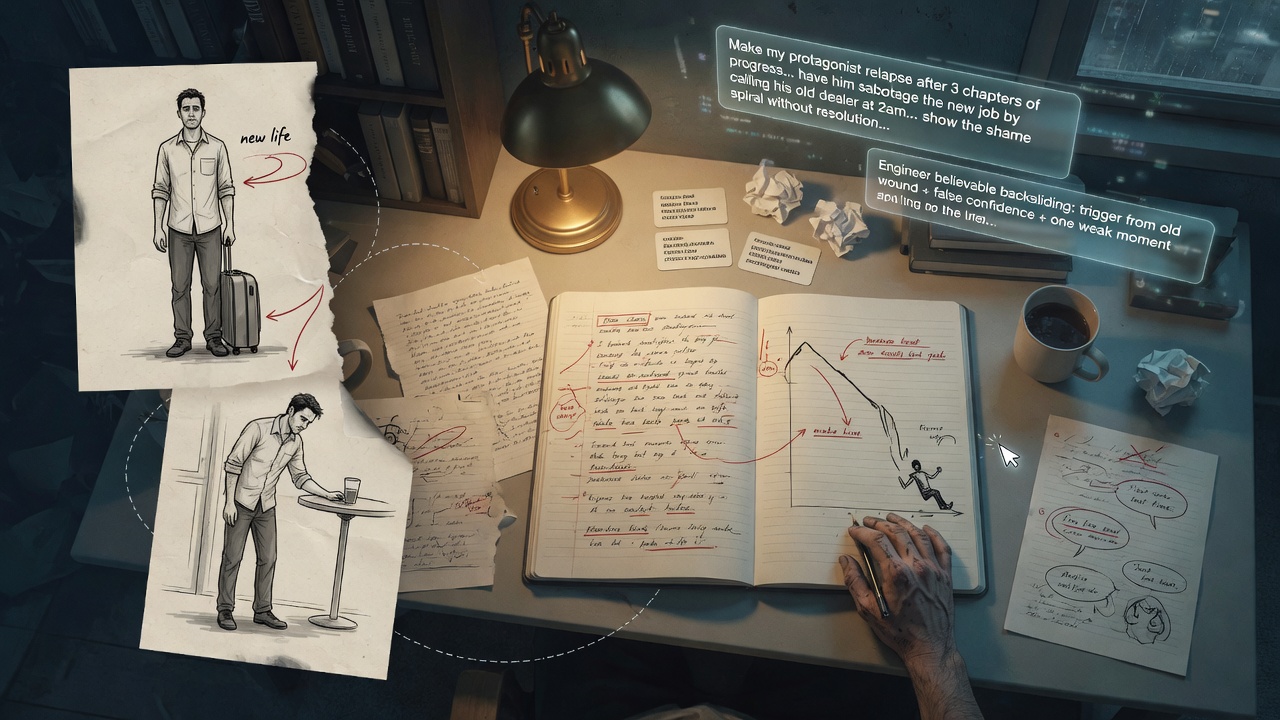
Every experienced editor has read the manuscript where the protagonist's arc goes wrong in the same way. Chapter 1: wounded, defended, stuck. Chapter 12: healed, open, changed. The math works. The psychology doesn't. Readers don't consciously flag it, but they feel the thinness—the sense that a character "decided" to change rather than earning it through failure. This is the relapse problem, and it's one of the most fixable structural issues in a novel draft, especially when you bring AI into the diagnostic process.
Why Clean Change Reads as Unearned
Behavior change research—the stuff clinicians actually use, not the pop-psychology version—consistently shows that lasting change is rarely linear. Prochaska and DiClemente's stages-of-change model, the one underlying most addiction and habit-change treatment, explicitly includes relapse as a normal stage, not a failure state. People cycle through contemplation, action, and maintenance, and they slide backward before the change consolidates. It's not a bug in human transformation. It's the mechanism.
Readers have absorbed this pattern from their own lives even if they've never read the clinical literature. They know that quitting smoking usually involves at least one relapse. They know that leaving a bad relationship often means going back once before leaving for good. So when your protagonist's arc skips this step—when the character who was avoidant in chapter 3 is suddenly securely attached by chapter 20 with no backslide—the prose might be technically competent, but something reads as false. The change feels imposed by the author rather than survived by the character.
The craft term for the fix is the relapse beat: a moment, usually late in the second act, where the character reverts to their old defense mechanism under pressure, often right when they seem closest to having changed. It's not a repeat of the opening wound state. It's a regression that's more painful specifically because the character had already tasted something better. The relapse beat is what makes the eventual change feel like a hard-won recovery instead of a straight line.
AI is particularly good at helping with this because relapse placement, severity, and triggering logic are all pattern-matching problems—exactly the kind of structural analysis a language model can do quickly across a full outline or manuscript, even when you as the writer are too close to your own draft to see the gap.
Finding Where the Relapse Belongs
The most common mistake is placing the relapse too early, where it just reads as more of the same stuck behavior, or too late, where it undercuts the climax instead of setting it up. The sweet spot is almost always adjacent to a false victory—either right before the character believes they've changed for good, or right after a real but partial win that hasn't been tested under real pressure yet.
Feed your outline or chapter summaries to an AI model and ask it to locate the candidate spots. Be specific about what you're looking for so you don't get generic pacing notes.
I'm attaching my chapter-by-chapter outline for a novel. My protagonist's core wound is [describe wound, e.g., "was blamed as a child for a sibling's accident, developed a compulsive need to control outcomes and prevent harm"]. Their arc moves from [starting behavior pattern] toward [ending behavior pattern]. I need to place one significant relapse beat—a moment where the character reverts hard to their old defense mechanism—somewhere in the back half of act two or the opening of act three. Analyze the outline and identify: 1. The chapter or scene that currently reads as a "false victory"—where the character or reader might believe the change has already stuck, but it hasn't been tested yet. 2. Any partial win in the preceding chapters that hasn't yet been stress-tested by a real setback. 3. Two or three candidate locations for a relapse beat, ranked by how much dramatic damage they'd do if the character backslid there instead of continuing to progress smoothly. 4. For each candidate, tell me what specific pressure or trigger event in the surrounding chapters could plausibly provoke the regression, using only material already present in my outline—don't invent new subplots. Present this as a ranked list with a one-paragraph justification for the top choice.
What this prompt does that a generic "where should my character struggle" question doesn't is force the model to work from your existing structure rather than suggesting a new crisis to bolt on. The best relapse beats almost always emerge from material you've already written—an early promise, a secondary character's warning, a previous failure the protagonist thought they'd moved past. The AI's job here is pattern recognition across your own outline, not invention.
Calibrating How Bad the Backslide Should Be
Once you know where the relapse goes, the harder question is how severe it should be. Too mild, and it reads as a minor wobble that doesn't cost the character or the reader anything. Too severe, and you burn the goodwill the character has spent a whole draft earning—readers stop believing in the possibility of change at all, or worse, they stop liking the character.
The right calibration is proportional to how much visible progress the character has shown by that point in the manuscript. A character who's had one small win should have a small, forgivable relapse. A character who's had three or four consecutive wins and seems fully transformed can sustain a much harder, uglier backslide, because the fall has further to travel and the reader has more invested in the outcome.
Here are the scenes in my manuscript where my protagonist shows visible progress on their arc (I'll paste them below, in order, with brief context). My protagonist's wound is [X], and their old defense mechanism is [Y, e.g., "shutting down emotionally and withdrawing from anyone who gets close"]. I'm planning a relapse beat at [chapter/scene]. Based on the cumulative progress shown in the pasted scenes: 1. Estimate how much "reader goodwill" or belief in the character's change has likely accumulated by this point, on a rough scale of mild/moderate/strong. 2. Recommend a severity level for the relapse that matches this accumulated goodwill—specify what the character should do (and not do) so the regression feels earned rather than either too soft or too damaging. 3. Give me two boundary lines: the least severe version of this relapse that would still register as a real setback, and the most severe version that wouldn't permanently alienate the reader from the character. 4. Flag any specific action within that range that would cross into "unforgivable" territory for this character, given what we've established about them so far—actions that would make the reader stop rooting for them rather than worrying for them. [Paste progress scenes here]
The "unforgivable territory" flag in step four is worth taking seriously. AI models are reasonably good at reasoning about reader sympathy thresholds when you give them the character's established behavior, but you as the author still make the final call. The output here is a calibration range, not a mandate—use it to check your instincts, not replace them.
Making Sure the Relapse Trigger Is Earned
The fastest way to make a relapse beat feel cheap is to trigger it with a plot convenience instead of a psychological consistency. If your character's wound is about abandonment, the relapse needs to be provoked by something that reads as abandonment to them specifically—not just any stressful event that happens to occur at the right structural moment. Readers can tell the difference between "this happened because the plot needed a setback here" and "this happened because this exact pressure hits this exact wound."
This is a good use case for an audit prompt rather than a generative one—you're asking AI to check your work against your own established rules, not to invent new material.
I've established my protagonist's core wound and need as follows: Wound: [e.g., "Was repeatedly promised stability by a parent who then relapsed into addiction multiple times during childhood"] Surface want: [what the character consciously pursues] Deeper need: [what would actually heal them] Old defense mechanism: [specific behavior pattern, e.g., "preemptively sabotages relationships before others can leave first"] Here is the scene where I've drafted their relapse beat: [Paste scene] Audit this scene against the wound and defense mechanism I've described above: 1. Does the triggering event in this scene connect specifically to the wound, or could it be swapped for a generic stressful event without changing the psychological logic? If it's generic, tell me exactly why. 2. Does the character's regression manifest as the SAME defense mechanism established earlier, or a different behavior that just resembles "backsliding" without being consistent? 3. Is there a more specific, wound-consistent trigger already present elsewhere in my manuscript that I should use instead of what I currently have? 4. Rewrite the first paragraph of the relapse trigger only, using the most wound-specific version of the inciting pressure, in my existing prose voice (I'll paste a sample of my voice below for reference). [Paste voice sample]
The request for a rewritten opening paragraph, not a full scene, keeps you in control of the actual prose. You're using the model to sharpen the psychological logic and then writing the scene yourself in your own hand, informed by what the audit surfaced.
Writing the Recovery So It Lands Harder
The relapse beat only pays off if the recovery that follows feels different from the character's earlier progress—not a repeat of the same growth moment, but a harder-won version of it that specifically incorporates what the relapse revealed. If the recovery scene just returns the character to where they were before the backslide, the whole detour reads as filler. The recovery has to show the character doing something they couldn't have done without having relapsed first.
My protagonist just relapsed into their old defense mechanism [describe the relapse briefly]. I need to write the recovery scene that follows, where the change starts to truly stick. Wound: [X] What the earlier, pre-relapse "progress" scenes showed the character doing: [brief description] What the relapse specifically exposed or forced the character to confront: [what they learned or can no longer deny about themselves] Help me think through the recovery scene, not by writing it, but by answering: 1. What does the character now know about themselves that they didn't know before the relapse—something the earlier "progress" period let them avoid facing? 2. What should the recovery scene show the character DOING differently than in the earlier progress scenes, so it doesn't read as a repeat of growth we've already seen? 3. Is there a specific line of dialogue or internal thought from the relapse scene that the recovery scene should directly answer or contradict, to make the two scenes feel structurally paired? 4. What's the smallest, most concrete action (not a speech, not an epiphany—an action) that would demonstrate the change has actually taken hold this time? Give me answers as discussion points, not prose, so I can write the scene myself.
That last instruction matters more than it might seem. The temptation with AI-assisted plotting is to let the model write the emotional climax for you, but recovery scenes are exactly where a character's voice needs to be entirely yours. Use the model to clarify the psychological beats—what's different, what's being answered, what small action proves the change—and then write the scene in your own hand, informed by the clarity rather than replaced by generated prose.
The relapse beat is a small structural addition with an outsized effect on how earned your ending feels. It costs you a scene or two of apparent regression, but it buys you a transformation that readers believe because they watched it survive a real test. Used well, AI doesn't write this moment for you—it helps you find where your own story already contains the seeds of the setback, and helps you make sure the fall is specific enough that the eventual rise means something.



No comments yet. Be the first to comment!