

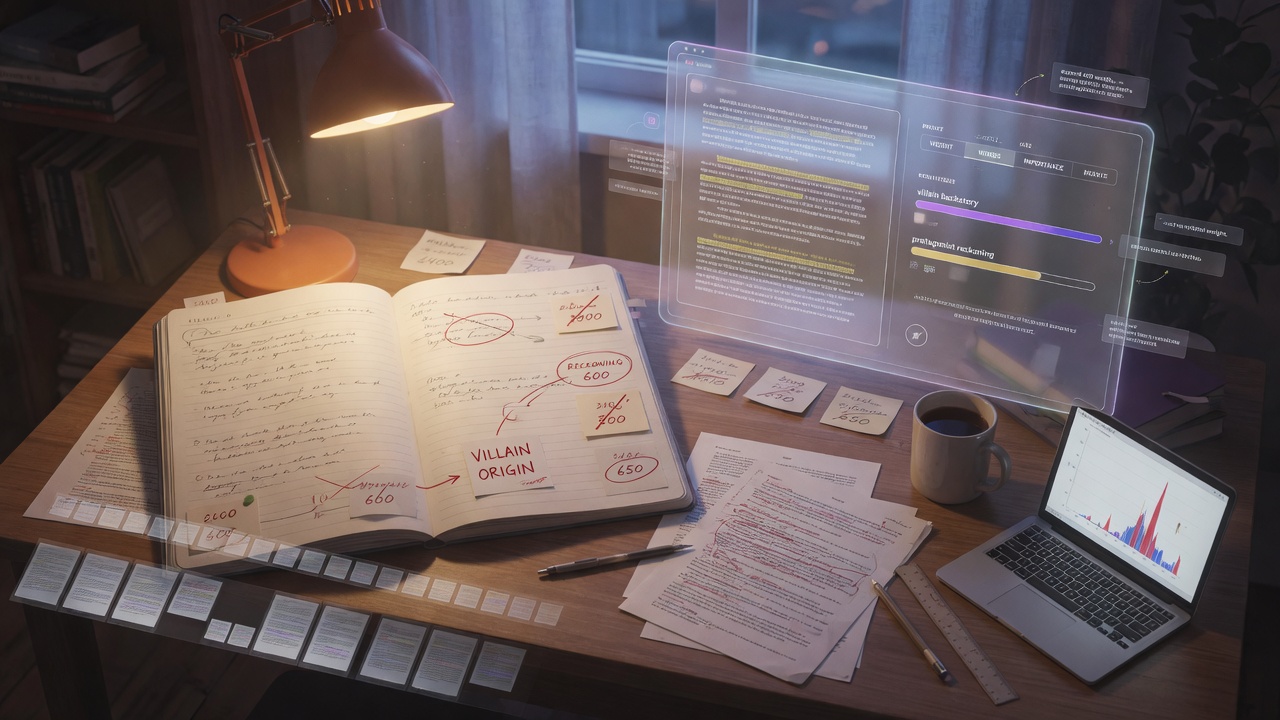
Every novelist has felt it: the villain's origin story spools out for four thousand words while the protagonist's moment of reckoning gets six hundred. Nobody planned it that way. It happens because scenes tend to get however many words they get—based on how much dialogue felt fun to write, how long a description took to nail, or simply how tired you were when you drafted it. Word count follows habit instead of following the story.
This is where AI becomes useful in a way that has nothing to do with generating prose. Used as an analytical partner rather than a ghostwriter, an AI model can help you separate two questions that usually get conflated: how much a scene matters to your story, and how much space it currently takes up on the page. Once those two numbers are visible side by side, pacing problems stop being a vague feeling and become a spreadsheet problem—one you can actually fix before you draft, not just during a fourth-pass revision.
Why Word Count Should Follow Weight, Not Convention
Most pacing advice tells you to "trust your instincts" or "cut what's boring." That's fine advice for a finished draft, but it's useless as a planning tool, because instinct is exactly what got you into the lopsided draft in the first place. The chapter-length convention—aim for 2,500 to 4,000 words, keep it consistent—solves for uniformity, not for importance. But uniformity is the wrong goal. A scene where your protagonist finally confronts the secret that's been driving the whole plot should not be the same length as the scene where she buys coffee and thinks about it.
Narrative weight is a function of three things converging or diverging:
- Plot advancement — does this scene change what the reader knows about where the story is going?
- Emotional stakes — does this scene put something the reader cares about at risk?
- Character change — does someone enter the scene different from how they leave it?
A scene can score high on one axis and low on the others—a big plot reveal that happens to a character who isn't present for it emotionally, for instance—and that combination itself tells you something about how the scene should be built. The goal of scene weight budgeting is to make those three axes visible before you write the scene, so the word count you're aiming for is a decision, not an accident.
This is not about mechanically forcing every "10" scene to be long and every "3" scene to be short. It's about noticing when the gap between weight and length has gotten wide enough to distort your book's rhythm—and then closing that gap on purpose.
Prompt 1: Scoring Scene Weight and Suggesting a Range
The first move is diagnostic. Before you touch word counts, you need weight scores for every scene in a chapter or arc. This works whether you're scoring an outline (planning stage) or an existing draft (revision stage), and the prompt below is built to handle either.
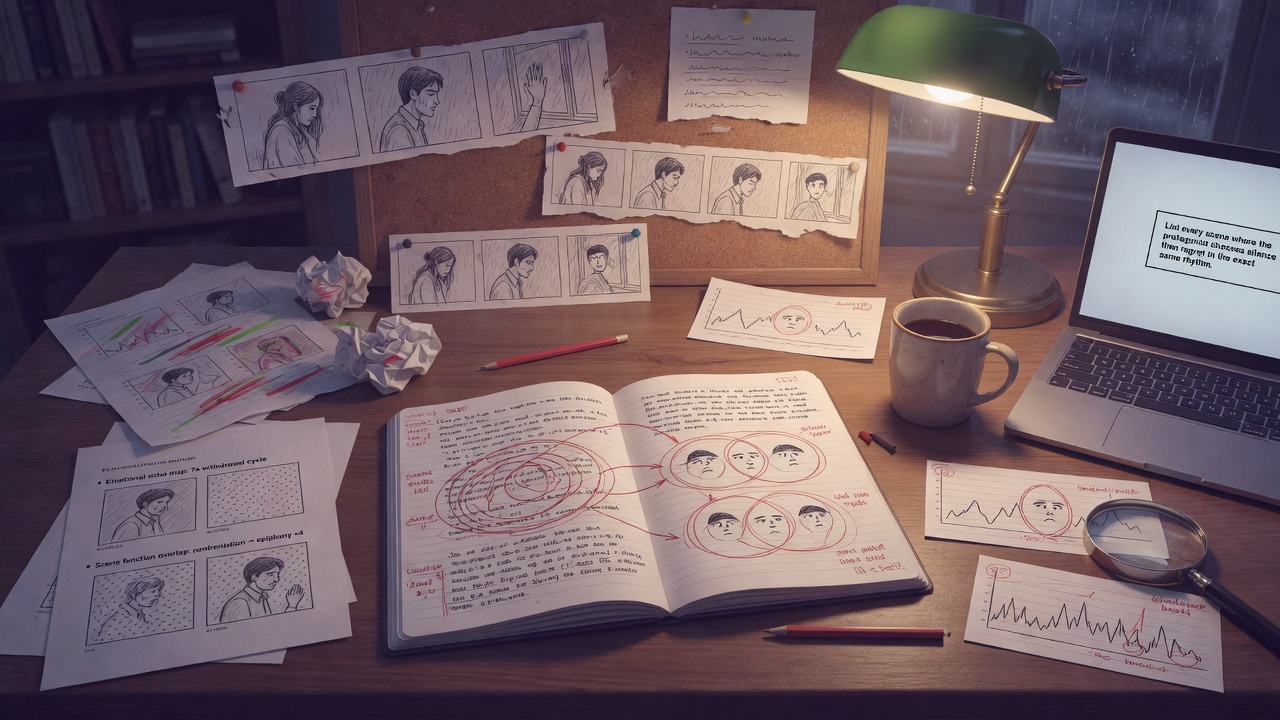
I'm going to give you a list of scenes from my novel, either as outline beats or as drafted text. For EACH scene, do the following: 1. Assign three separate scores from 1-10: - PLOT WEIGHT: how much does this scene change the reader's understanding of where the story is headed, or unlock/close off future plot options? - EMOTIONAL WEIGHT: how much is at stake for the reader's investment in the characters—dread, hope, grief, tension, longing? - CHARACTER WEIGHT: does someone change, decide, or reveal something that alters who they are or how they'll act going forward? 2. Calculate a COMBINED WEIGHT score (average of the three, weighted toward whichever axis is highest if there's a big gap between them— explain your weighting logic). 3. Based on the combined weight, suggest a WORD COUNT RANGE for this scene. Use this rough scale as a starting point, but adjust based on genre and my book's established scene lengths (I'll tell you those below): - Weight 1-3: 200-500 words (functional/transitional) - Weight 4-6: 600-1,200 words (developed but not central) - Weight 7-8: 1,200-2,200 words (major beat) - Weight 9-10: 2,200-3,500+ words (pivotal, earns extended space) 4. Give a one-sentence justification for the combined score. My book's typical scene length is [X] words, and my genre is [genre]. Adjust your suggested ranges to fit that context rather than applying the scale rigidly. Here are the scenes: [paste scene list, outline beats, or drafted text]The output from this prompt gives you a table, essentially: scene, three sub-scores, combined weight, suggested range. That table is the foundation for everything else in this process. Don't skip the "explain your weighting logic" instruction—it forces the model to show its work, which matters because sometimes a scene will score low on plot and character but very high on emotion (a quiet grief scene, say), and you want to see that reasoning rather than just a flattened average that obscures it.
What to Do With Disagreement
You will disagree with some of these scores, and that's the point of the exercise—not to outsource judgment, but to have something concrete to argue with. If the model says your inciting incident is a 6 and you feel strongly it's a 9, that disagreement is information. Either the scene needs to be rewritten to earn the weight you intend for it, or your instinct about its importance is out of step with how it reads on the page. Both are useful things to know before you spend three thousand words on it.
Prompt 2: Flagging Weight-to-Length Mismatches
Once you have weight scores, the second prompt compares them against your actual draft's word counts. This is the prompt that catches the overwritten minor scene and the rushed pivot—the two most common symptoms of accidental pacing.
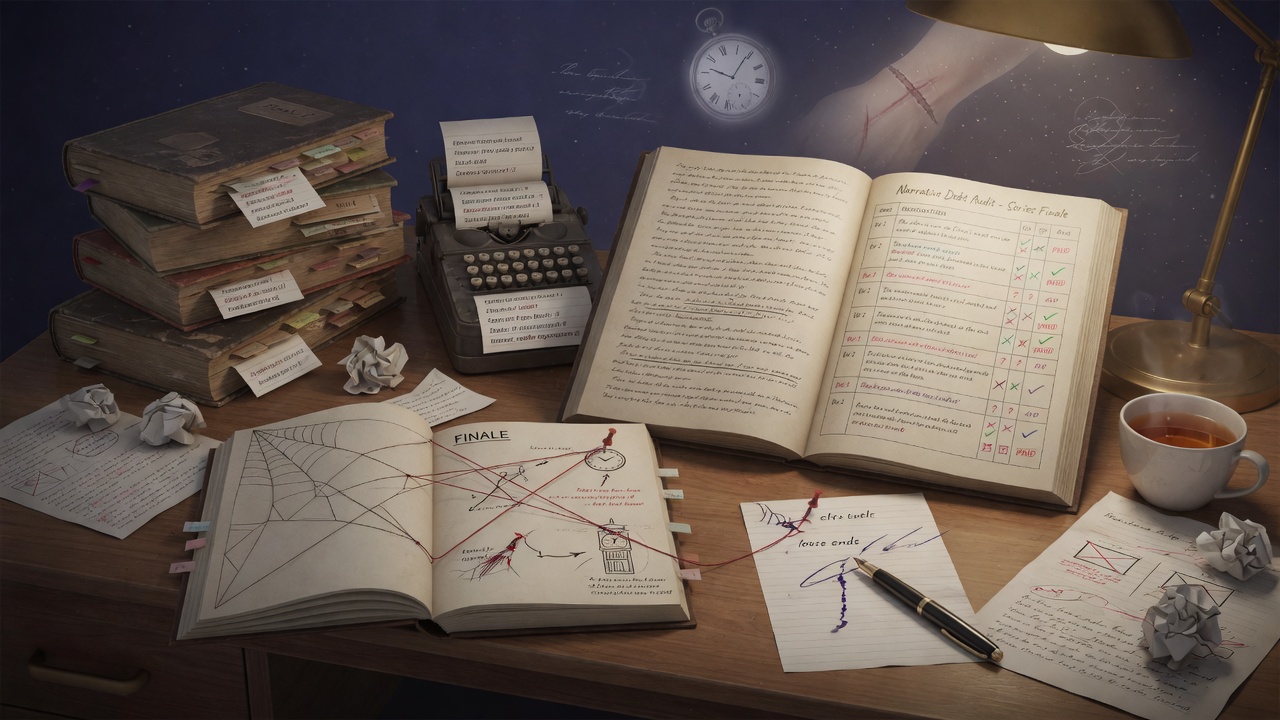
I'm going to give you a table of scenes with their combined weight scores (1-10) and their ACTUAL current word counts from my draft. Compare weight to actual length for each scene and flag mismatches using these categories: - OVERWRITTEN: word count is disproportionately high for the weight score (a weight-3 scene running 1,800 words, for example) - UNDERWRITTEN: word count is disproportionately low for the weight score (a weight-9 scene running 400 words) - ALIGNED: word count roughly matches the expected range for that weight score For every OVERWRITTEN or UNDERWRITTEN flag, give me: 1. The size of the mismatch (e.g., "roughly 900 words over what this scene's weight justifies") 2. A hypothesis for WHY the mismatch might exist—common causes include: over-explained backstory, redundant description, a scene doing double duty as two scenes, dialogue that circles without advancing, or (for underwritten scenes) a pivotal moment being summarized instead of dramatized, or emotional beats being skipped past 3. One concrete suggestion for closing the gap—what to cut, or what to expand and how (add interiority, add a complication, slow down the action, add a beat of resistance before the character changes, etc.) Do NOT flag scenes as mismatched if they're within roughly 20% of the suggested range—I don't want to over-correct minor variance. Here is the scene data: [paste table: scene name / weight score / actual word count]This prompt is where the abstraction of "weight scoring" turns into an actionable revision list. It's worth running this at the chapter level first, then again at the full-manuscript level once you've built weight ledgers for several chapters (more on that below), because mismatches that look minor within a single chapter sometimes reveal a pattern—every scene involving your antagonist's backstory, say, consistently running long regardless of its actual weight, which tells you something about your own drafting habits rather than about any single scene.
The most useful output here tends to be the hypothesis for why the mismatch exists, not just the flag itself. Knowing a scene is 900 words overwritten doesn't tell you what to cut. Knowing it's overwritten because two characters are relitigating a decision they already agreed on in the previous chapter tells you exactly what to cut.
Prompt 3: Rebalancing a Chapter Against a Fixed Total
Sometimes the problem isn't that any single scene is wrong in isolation—it's that a chapter has a fixed target length (because you're matching a publisher's expectations, a serialized format, or your own established chapter rhythm) and the internal distribution needs to shift without changing the chapter's overall size. This prompt treats word count as a budget to be allocated according to weight, the way you'd allocate a fixed budget across departments according to priority.
This chapter needs to total approximately [X] words. I'm giving you the scenes in this chapter along with their combined weight scores (1-10) and their current word counts. Redistribute the word count across these scenes so that: 1. The total stays at or near [X] words (within 5%) 2. Higher-weight scenes get proportionally more space and lower-weight scenes get proportionally less—use the weight scores as the basis for the new allocation, not equal division 3. No scene drops below [minimum, e.g., 150] words regardless of weight, since even a low-weight scene needs enough space to function as a transition 4. Show your allocation as a table: scene name / old word count / new target word count / net change (+/- words) After the table, tell me: - Which scenes need to be CUT DOWN and what specifically to remove (a subplot thread, a description, a redundant exchange) - Which scenes need to be EXPANDED and what specifically to add (a complication, an internal reaction, a delay before the character gets what they want, sensory grounding) - Whether any scene's weight score suggests it should be SPLIT into two scenes or MERGED with an adjacent scene, rather than just resized Here is the chapter data: [paste: scene name / weight score / current word count]This prompt does something the first two don't: it forces trade-offs. You can't expand the pivotal confrontation scene without taking words from somewhere else in the same chapter, and seeing that trade-off explicitly—"the reconciliation scene gains 600 words, which come from cutting the market scene from 900 to 400"—makes the decision concrete instead of aspirational. It's easy to say "I should slow down for the big moments." It's harder, and more useful, to see exactly which other scene has to shrink to make room.
Building a Running Weight Ledger Across Chapters
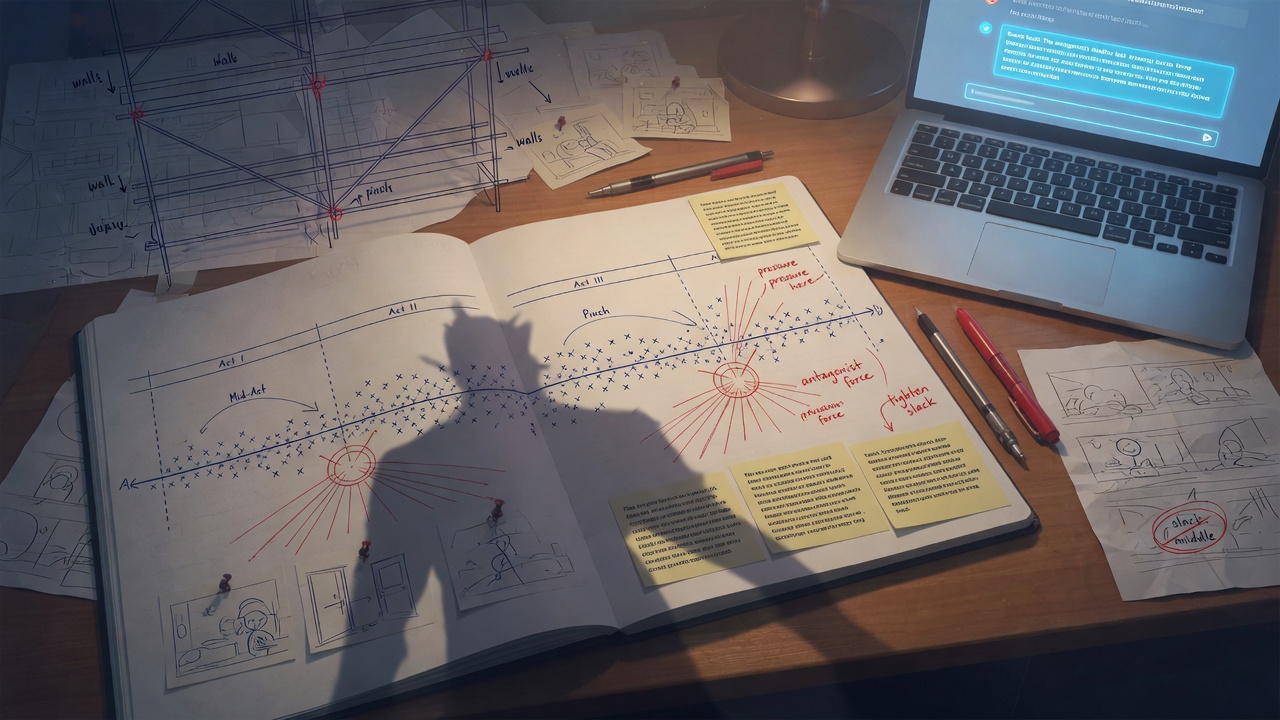
None of this holds together if you treat each chapter as an isolated exercise. The real value shows up when you keep a running ledger—a single document tracking every scene's weight score and word count across the whole manuscript, updated as you draft. This matters most through the second act, where pacing tends to drift because you're far enough from the outline to have lost your bearings but not close enough to the ending to feel the pull toward the climax.
A ledger lets you ask questions no single-chapter prompt can answer: are your weight-8 and weight-9 scenes clustering in the first third of the book, leaving the middle stretch full of 4s and 5s? Is your average word-per-weight-point ratio drifting upward over time, meaning you're gradually inflating every scene regardless of its actual importance? Is a subplot's combined weight across ten chapters actually low enough that it shouldn't be getting a tenth of your total word count?
To build this, keep the output tables from Prompts 1 and 2 in a single running document—spreadsheet or plain text, doesn't matter—organized by chapter, and periodically feed the whole thing back into a prompt like this:
Here is my running weight ledger for chapters 1 through [X]: a list of every scene with its combined weight score (1-10) and its word count. Analyze this across the full range, not chapter by chapter, and tell me: 1. Is there a drift in word-count-per-weight-point over time (i.e., am I gradually writing longer for the same weight score, or shorter)? 2. Are high-weight scenes (8-10) clustering in certain sections and sparse in others? Where are the gaps? 3. Based on weight scores alone, does the SHAPE of tension across these chapters look like a believable rising action, or are there long stretches of flat, low-weight scenes with no scene above a 6? 4. Flag any three-chapter stretch where the average combined weight is notably lower than the surrounding chapters, since that often signals a saggy middle even if individual scenes seem fine in isolation. Ledger: [paste full ledger]This is the prompt that catches what no single chapter review can: the slow, chapter-over-chapter drift where everything is individually reasonable but collectively flat. A saggy middle rarely announces itself scene by scene. It shows up as a pattern across ten or fifteen chapters where nothing scores above a 6, and you only see that pattern when the data is laid end to end.
None of this replaces judgment—the AI is scoring based on what you tell it and what's on the page, and it will happily rate a scene a 9 if you've written it to seem urgent even when it isn't actually load-bearing to the plot. But that's exactly why the exercise is useful. It doesn't just tell you where your pacing is off. It tells you where your own sense of what matters and what you've actually put on the page have quietly stopped agreeing with each other, which is usually the real problem hiding underneath the pacing symptom.

No comments yet. Be the first to comment!