
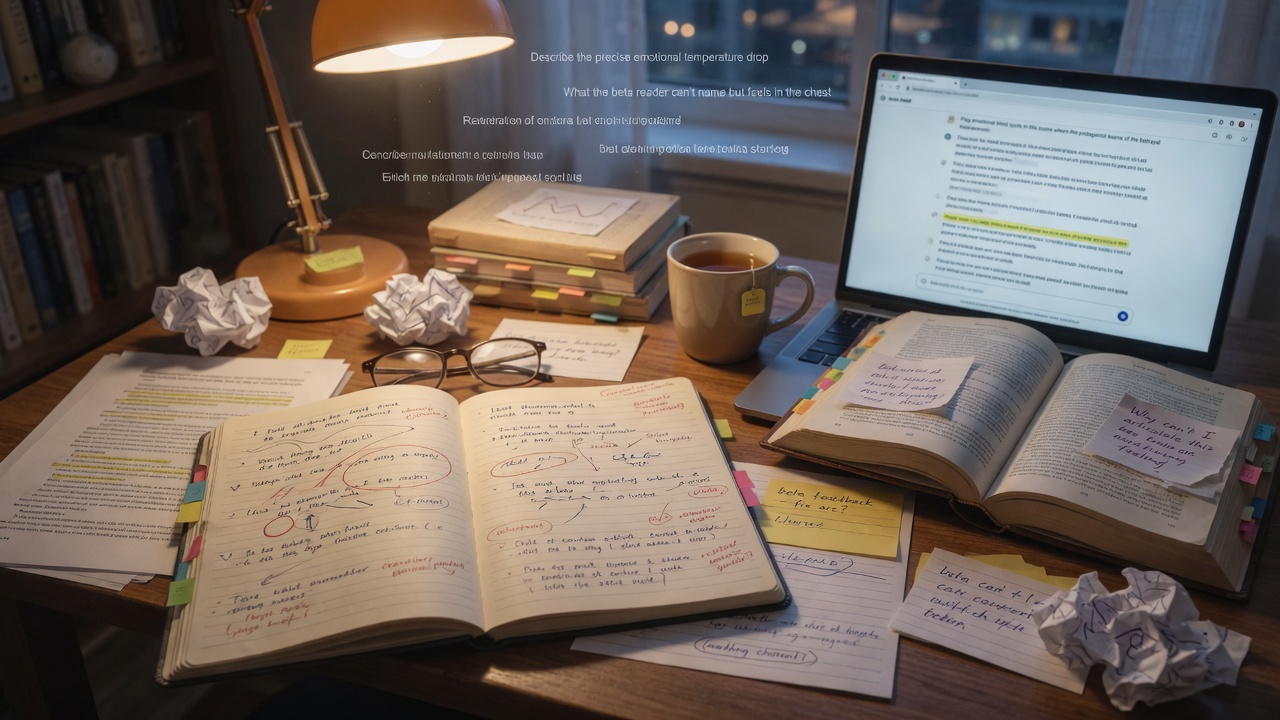
Why "I Felt Disconnected Here" Is the Most Useful Note You're Probably Ignoring
Beta readers apologize for this kind of feedback constantly. They write it in the margins with small, uncertain handwriting, or bury it at the bottom of an email after three paragraphs of praise: I'm not sure why, but I stopped caring around chapter fourteen. Most writers read that note, feel vaguely defensive, and move on to the comments they can actually use—the ones about plot holes and timeline inconsistencies and the character whose eye color changes between scenes.
That's a mistake. The vague emotional note is often the most diagnostically rich piece of feedback you'll receive, precisely because it's registering something real that the reader can't name. Beta readers aren't craft instructors. They don't have the vocabulary to tell you that your protagonist's grief arc skipped the bargaining stage, or that the reconciliation scene in act three delivered emotional resolution before the relationship had accumulated enough visible damage to earn it. What they have is a felt response—a genuine moment of disengagement—and they're handing it to you as honestly as they can.
The problem is translation. Between "I stopped caring around chapter fourteen" and "the emotional payoff in the hospital scene arrived three scenes too early, which drained all the tension from the climax," there's a significant gap. Filling that gap used to require either a developmental editor with deep craft knowledge or a second, third, and fourth beta read hoping someone would triangulate their way to the actual problem. Now there's a faster path.
The Three Emotional Blind Spots That Show Up Most in Novel Manuscripts
Premature Catharsis
This is the most common one, and it's subtle enough that many writers never catch it on their own. Premature catharsis happens when a scene delivers emotional release—tears, relief, anger, forgiveness—before the narrative has built sufficient pressure to justify it. The character cries, and it's written beautifully, but the reader doesn't cry with them. They watch. The mechanics are right but the timing is off, and the result is a scene that should devastate and instead lands somewhere between pleasant and mildly affecting.
Writers fall into this pattern because they're tracking story logic, not emotional accumulation. The plot says it's time for the breakdown. The outline says the reconciliation happens here. But readers don't experience story through plot logic—they experience it through accumulated feeling, and if that accumulation hasn't happened yet, the emotional moment plays in an empty room.
Skipped Vulnerability Beats
Readers need to watch a character be genuinely exposed before they'll trust a moment of emotional openness. Skipped vulnerability beats happen when a character moves from composed to broken, or from guarded to intimate, without the manuscript showing the intermediate steps—the moment they almost said something, the scene where they deflected instead of confronting, the physical tell that signals something cracking beneath the surface.
Beta readers experience this as characters feeling "inconsistent" or "hard to connect with" even when the writing is technically accomplished. The character is doing emotionally coherent things; the reader just hasn't been invited to witness the interior process that makes those things coherent.
Mismatched Reader/Character Emotional Registers
This is the one that generates the most confusing beta feedback. It happens when the manuscript is asking the reader to feel one thing while the narrative structure is generating something else entirely. A scene written for grief is accidentally structured for tension. A scene meant to be hopeful carries the pacing and imagery of dread. The character is experiencing joy; the reader is vaguely unsettled and doesn't know why.
Register mismatches often happen at the sentence and paragraph level—through rhythm, through the emotional valence of the verbs, through the distance or intimacy of the point of view. A writer can fix every craft problem a developmental editor flags and still have this problem, because it lives in cumulative effect rather than individual choices.
Prompting AI to Simulate a Felt Response, Not a Craft Critique
The key distinction here is the difference between asking an AI to evaluate a scene and asking it to experience one. When you ask for a craft critique, you get observations about structure, pacing, dialogue mechanics, and character consistency. These are useful. They are not the same as what your beta reader was reporting when they said they stopped caring in chapter fourteen.
To simulate the felt response of a reader moving through your scene in real time, you need to frame your prompt as an experiential exercise rather than an analytical one. You're not asking the AI to judge your scene. You're asking it to inhabit it, track its own moment-to-moment emotional responses, and report back in the kind of language a thoughtful but non-technical reader would actually use.
This requires a specific prompt architecture. You need to suppress the AI's default toward craft vocabulary. You need to give it permission to report confusion, disengagement, and underwhelmed responses without softening them. And you need to ask it to flag not just where it felt something, but where it expected to feel something and didn't—because that gap is exactly where your blind spot lives.
A few structural elements that make these prompts work:
- Explicitly ask for a reader-position response, not a writer-position analysis
- Ask the AI to report emotional temperature at multiple points through the scene, not just an overall assessment
- Ask it to name what it anticipated feeling before each significant beat, and what it actually felt
- Ask it to flag any moment where it found itself observing the scene rather than inhabiting it
- Request that it translate any vague impressions into specific scene-level observations—not fixes, just locations
From Emotional Report to Revision Plan: Prioritizing by Reader Impact
Once you have an AI-generated emotional experience report for a scene, the instinct is to treat it like a punch list and work through it sequentially. Resist that. The more useful approach is to sort the flagged moments by their impact on the reader's relationship to the story—not by their position in the manuscript, and not by how easy they are to fix.
A skipped vulnerability beat in chapter three might be generating disconnection that doesn't fully register until chapter seventeen. A premature catharsis in the midpoint might be the reason your climax is receiving flat responses even though the climax itself is technically well-executed. Reader impact doesn't obey chapter order, and a revision plan that works from the front of the manuscript to the back will keep missing the upstream causes of downstream problems.
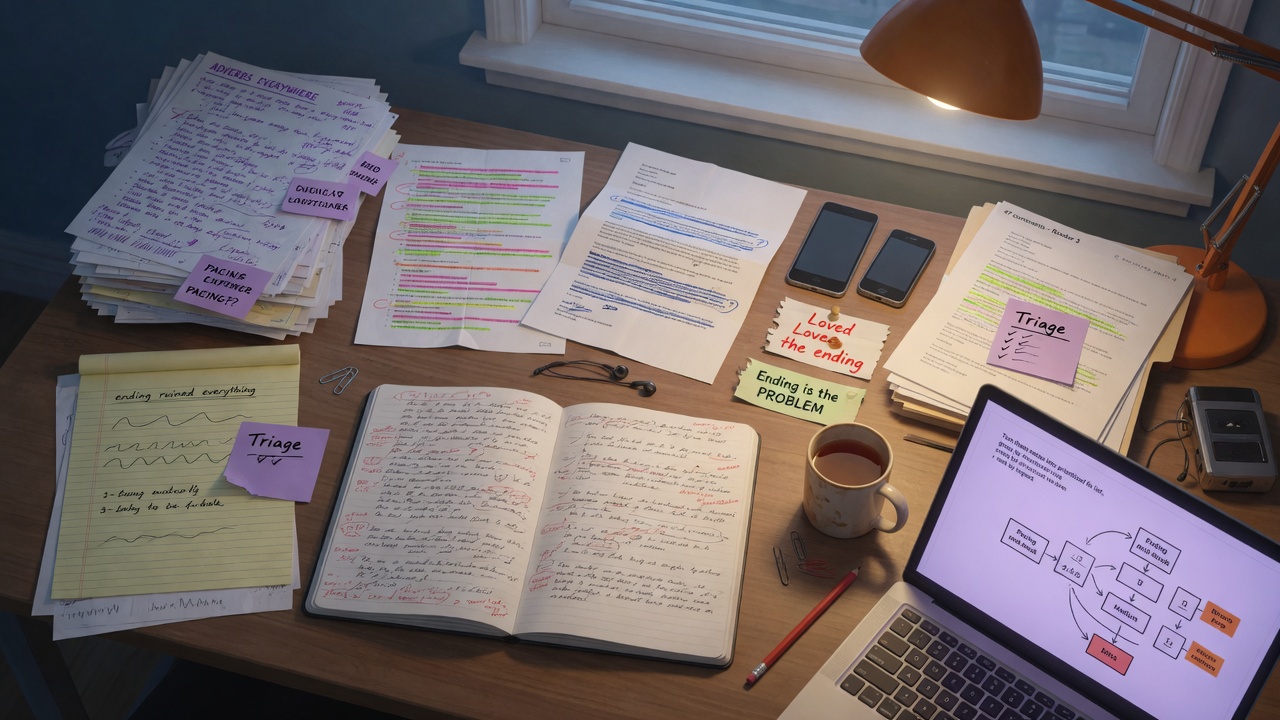
When you're reading through your emotional blind spot report, mark every flagged moment with one of three categories: root cause (this is generating problems elsewhere), symptom (this is a downstream effect of something earlier), or isolated (this problem is self-contained and can be addressed directly). Revise in that order. Root causes first. This is slower than it sounds but significantly faster than revising symptoms repeatedly and wondering why they keep coming back.
Prompt Examples: Generating Blind Spot Flags for Specific Scene Types
The following prompts are built for scenes where the emotional machinery is most likely to misfire. Paste your scene text directly into the prompt, or follow the bracketed instructions to adapt them to your specific manuscript.
For a Key Emotional Scene That Feels Correct but Isn't Landing
I'm going to share a scene from my novel with you. Before I do, I want to establish how I'd like you to respond. I don't want a craft critique. I don't want feedback on prose style, dialogue mechanics, or structural analysis. I want you to read this scene as a reader moving through it for the first time—someone who has been following this story and these characters, and who arrives at this scene with accumulated expectations and emotional investment. As you read, I want you to track your emotional temperature in real time. After you finish, give me a report that includes: 1. A moment-by-moment account of what you felt (or didn't feel) at each significant beat in the scene—not what the scene intended, but what you actually experienced as a reader. 2. Any moments where you found yourself watching the scene from the outside rather than experiencing it from inside. What triggered that shift? 3. Any moments where you anticipated feeling something—sadness, relief, tension, hope—and the feeling didn't arrive. Where exactly did that gap happen, and what was the last line or beat before you noticed it? 4. If there's a central emotional moment in this scene, tell me when you became aware it was coming, and whether that awareness helped or flattened your response. Translate any vague impressions ("something felt off") into specific locations in the scene—a paragraph, an exchange, a description—without telling me how to fix them. I want the diagnosis before the prescription. [Paste your scene here]For a Climax That Beta Readers Say Falls Flat
The scene I'm sharing is the climax of my novel. Multiple readers have told me it doesn't land the way they expected, but they can't articulate why. I need you to simulate that underwhelmed reader response. Read this scene and then give me an emotional blind spot report that focuses specifically on: 1. The moment when you first felt certain about how this scene would resolve— whether that certainty arrived too early, too late, or felt correctly withheld. Be specific about which line or beat triggered it. 2. Whether the emotional stakes felt real to you as a reader at the moment of peak tension, or whether you were aware of them intellectually without feeling them. If the latter, trace back to where the felt stakes dropped out—not the climax itself, but where the preparation for the climax stopped building. 3. Which character's emotional experience you were most inside during the climax, and whether that's the character you should have been inside. If there was a split or a distance, describe when it happened. 4. The emotional state you were in as a reader when you reached the final line of this scene—not your assessment of the scene, but the actual felt residue. Describe it the way you'd describe the feeling after a movie ends, before you've had time to form an opinion about it. Use plain language throughout. I'm looking for reader experience, not editorial vocabulary. [Paste your climax scene here]For an Antagonist Confrontation That Should Devastate
This is a confrontation scene between my protagonist and antagonist. The scene is meant to be emotionally devastating for the protagonist—and ideally for the reader. I've been told it doesn't hit hard enough. Read through it and give me a reader-experience report focused on: 1. When the antagonist felt genuinely threatening to you as a reader—not threatening in the plot sense, but threatening in the way that made you feel something on behalf of the protagonist. If that feeling never arrived, or arrived and then receded, mark exactly where. 2. The protagonist's emotional arc through the scene. Track what you felt for them at the opening, at the midpoint, and at the end. Note any moments where your emotional engagement shifted unexpectedly—either intensified or dropped. 3. Whether you ever felt the protagonist's pain as your own, even briefly. If yes, identify which specific beat created that identification. If no, describe the quality of your distance from them—were you sympathetic but separate? Neutral? Resistant? 4. Any moment where the scene asked you to feel devastated but instead you felt something adjacent—tension, frustration, disappointment in the character rather than for them, detached concern. These adjacent feelings are clues about where the register is misaligned. Do not recommend solutions. Report only what you experienced and where you experienced it. [Paste your confrontation scene here]For a Reconciliation Scene That Feels Unearned
I'm sharing a reconciliation scene from my novel—a moment where two characters resolve a significant conflict between them. Readers have described it as feeling "too easy" or "unearned," but haven't been able to tell me more than that. Read this scene and give me a felt-experience report that examines: 1. At what point you felt ready, as a reader, for these two characters to reconcile. Had you reached that readiness before the scene began? During it? Not at all? Describe the emotional condition you were in when the resolution arrived. 2. Whether the reconciliation felt mutual—meaning, whether you believed both characters had moved through something genuine to arrive here, or whether one character's change felt imposed by the narrative rather than generated by the story. If the latter, which character, and what was missing from their journey? 3. The moment in the scene where forgiveness or repair became inevitable— where you knew the reconciliation would happen regardless of what came next. Did that moment arrive at the right time, or did it short-circuit your emotional investment in how the scene would resolve? 4. What you felt in the final exchange between these characters. Not what the scene intended you to feel—what you actually felt. Warmth, relief, skepticism, a complicated mixture, numbness, faint disappointment. Describe the texture of it. Avoid craft language. I want to understand what this scene felt like from inside a reader's experience, not what it looks like from outside it. [Paste your reconciliation scene here]What to Do With the Reports You Get Back
The emotional blind spot report will not always feel comfortable to read. That's the point. You're receiving simulated versions of the vague, uncertain, apologetic feedback your beta readers were already giving you—but rendered specific enough to act on. Treat each flagged moment not as a verdict on your writing but as a coordinate. Something happened here. Something failed to happen here. Now you can investigate.
The real value of this process isn't any single report. It's the pattern that emerges across multiple scenes. If the AI is consistently reporting that it lost its felt connection to your protagonist in scenes involving [a specific relationship, a particular emotional register, a recurring type of conflict], you've found something structural—something that no amount of sentence-level revision will fix. That's the finding that changes a manuscript.
Beta readers knew something was wrong. They were right. They just didn't have the words for it. Now you have a method for finding the words yourself.

No comments yet. Be the first to comment!