




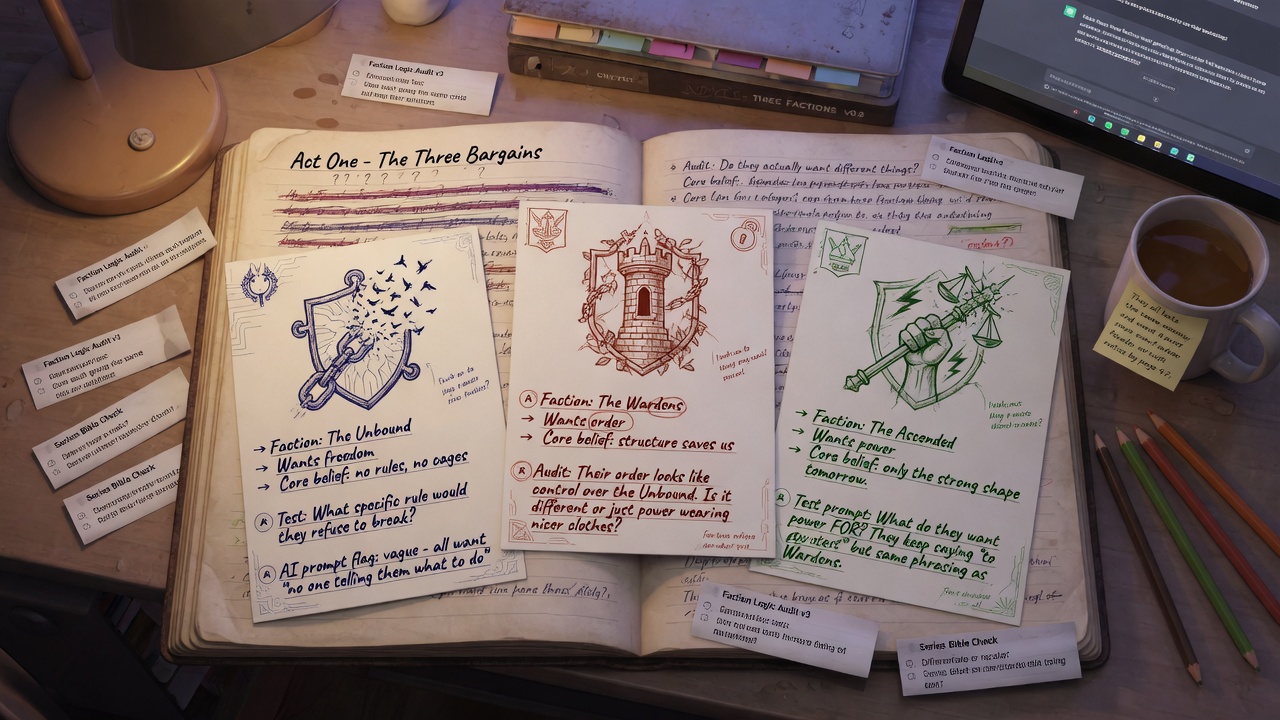
Why Faction Blur Kills Worldbuilding
Three factions walk into a novel. One wants freedom. Another wants order. A third wants power. The reader finishes act one and realizes, with a slow sinking feeling, that she cannot articulate what separates these groups beyond their color schemes and the vague sense that some of them are meaner than the others.
This is faction blur, and it is one of the most common structural failures in multi-faction fiction. It shows up in fantasy trilogies where rebel factions are functionally identical to the empires they oppose. It surfaces in dystopian novels where three competing governments all enforce control through slightly different bureaucratic flavors. It wrecks political thrillers where every organization, when you strip the jargon, wants the same thing: dominance, dressed in different uniforms.
The reason faction blur happens is not that writers are lazy. It is that most writers build factions from the outside in. They design insignias, name leaders, assign territories, and decide which faction the protagonist joins. What they skip—because it is harder and less immediately visual—is the interior logic. The founding wound. The theory of human nature embedded in the faction's methods. The thing they would refuse to do even under existential pressure.
When readers stop caring which side wins, it is almost always because they cannot feel those differences. Faction conflicts that live only at the surface level—territory, resources, old grudges—produce plot events but not meaning. The reader watches the chess pieces move without understanding why any particular configuration of the board matters.
AI can help you fix this before you write yourself into a structural corner. Not by generating your factions for you, but by stress-testing the ones you already have—probing their logic until the gaps become visible and workable.
The Four Pillars of a Coherent Faction
Before any faction earns sustained page time in your manuscript, it needs four things. Think of these as load-bearing walls. Remove any one of them and the structure becomes unstable in ways that won't be obvious at first but will eventually collapse under the weight of plot.
- A founding grievance. Not just "they were oppressed" but a specific wrong, a specific moment, a specific group of people who decided that existing structures could not be reformed from within. The grievance shapes everything: what the faction notices, what it cannot forgive, what it considers a victory worth celebrating.
- A core belief about how the world works. Every functioning faction has an embedded theory of human nature and social causation. Marxist movements believe material conditions determine consciousness. Religious fundamentalisms believe moral corruption causes civilizational decay. Technocratic factions believe human error is the root problem and that better systems solve it. Your faction's theory of causation determines its chosen methods and its blind spots.
- An internal contradiction. The belief that holds the faction together also produces its primary internal tension. A faction built on radical egalitarianism still needs a chain of command. A faction built on preserving tradition must decide what to do when traditions conflict. The internal contradiction is not a weakness in your worldbuilding—it is the source of your most interesting secondary characters and your most believable betrayals.
- A reason someone would defect. If you cannot articulate under what circumstances a loyal faction member would walk away, your faction is a monolith, not an organization. Defection logic requires knowing what the faction demands of its members and where that demand becomes intolerable. This is also, frequently, your protagonist's arc.
Prompt Block 1 — The Motivation Divergence Test
The following prompts are designed to force explicit articulation of each faction's unique motivational core. Run them for every major faction in your novel, separately, before comparing results. The goal is to see whether the outputs are genuinely distinct or whether you are essentially describing the same group with different aesthetics.
When you paste your faction description into these prompts, be as specific as you can about the faction's history, methods, and membership—but do not pre-answer the questions the prompt is asking. Let the AI surface the logic, then interrogate whether that logic actually appears in your manuscript.
I am writing a [genre] novel with a multi-faction world. I want to stress-test the internal logic of one of my factions before I continue drafting. Here is a description of the faction: [Paste your faction description here — include founding history, current goals, membership demographics, methods, and any leadership details you have] Please do the following: 1. Articulate, in one precise sentence, what this faction believes is the fundamental cause of suffering or injustice in the world. This is not their stated goal — it is their underlying theory of what is wrong. 2. Based on that theory, identify three specific actions this faction would consider justified that a rival faction operating on different assumptions would find morally unacceptable. Be concrete — not "they use violence" but the specific type of violence and the logic that makes it acceptable to them. 3. Identify one thing this faction would refuse to do even if doing it would guarantee their victory. Explain what core belief that refusal protects. 4. Identify where this faction's worldview contains a logical gap — a place where their theory of the world cannot account for something they will eventually be forced to confront. This should be specific to their beliefs, not a generic "all movements have corruption." 5. Write one paragraph of internal faction rhetoric — the kind of speech a mid-level true believer would give to new recruits. The language should reflect their specific theory of causation, not generic revolutionary or conservative talking points. After completing all five, flag any points where my description of the faction contradicts the logic you've identified. I want to know where I've told you one thing but implied another.Prompt Block 2 — The Conflict Specificity Audit
Once you have run the motivation divergence test on each faction, the next problem is usually this: the factions are now distinct in isolation, but their conflicts with each other are still shallow. Two groups can have completely different theories of the world and still end up fighting over the same bridge for reasons that have nothing to do with ideology.
Genuine faction conflict requires incompatible values—situations where both factions cannot get what they most want at the same time, not because of scarcity but because of what each group believes a good outcome looks like. A faction that values collective survival and a faction that values individual sovereignty will eventually reach a moment where no compromise is possible, because the moment the collective overrides an individual, one faction's core value has been violated by definition.
This prompt is designed to test whether your faction conflicts have that structural incompatibility, and to generate the specific historical incident that made reconciliation impossible:
I am writing a [genre] novel and I want to audit the conflict between two specific factions to make sure it is driven by genuine value incompatibility rather than circumstantial opposition. Faction A: [Paste Faction A description and their core motivational theory from your previous audit] Faction B: [Paste Faction B description and their core motivational theory from your previous audit] Please do the following: 1. Identify the deepest value incompatibility between these two factions — not a territorial or resource dispute, but a situation where both factions getting what they fundamentally want is logically impossible. Describe the specific scenario that makes this incompatibility unavoidable. 2. Describe a historical incident — something that could have happened 10-50 years before my novel's present — that transformed this value incompatibility from a theoretical tension into an active, irreconcilable enmity. The incident should feel like a genuine point of no return, not a misunderstanding that could be cleared up with better communication. 3. Identify what each faction tells itself about that incident — the version of events each group has canonized in its own history. The two accounts should not simply be "opposite perspectives on the same facts" but should emphasize entirely different causal chains because each group's theory of the world leads them to see different things as significant. 4. Identify one moment in my novel's present timeline where these factions might be forced to cooperate despite their incompatibility. Describe what each faction would have to suppress or rationalize to participate in that cooperation, and what internal fractures that suppression would create. 5. Flag any aspect of my faction descriptions where the two groups seem more similar than different — places where their actual methods, rhetoric, or structures overlap in ways that would make them hard for a reader to distinguish.Prompt Block 3 — Internal Hierarchy and Defection Logic
Most faction worldbuilding focuses on the faction as a unified actor. The faction wants this, the faction does that. But organizations are not unified actors. They are collections of people with different relationships to the faction's stated ideology, different amounts of power, and different thresholds for the point at which loyalty becomes too costly.
Mapping the internal hierarchy of your faction—and specifically the people inside it who are most likely to defect, splinter, or quietly subvert—is where secondary characters come from. It is also where you find the mechanism for your protagonist's most painful plot turns:
I am writing a [genre] novel and I need to map the internal power structure of one of my factions and identify its most likely points of fracture. Faction description: [Paste your faction description, including any named characters who are members] Please do the following: 1. Describe three distinct tiers of membership in this faction, based on the logic of their ideology and founding grievance — not just "leaders, soldiers, civilians" but the specific internal categories this faction's belief system would naturally produce. For each tier, describe what they believe about the faction's purpose and what they are willing to do that the other tiers might not be. 2. Identify who holds formal power in this faction and who holds informal power, and describe the specific tension between those two power sources. What does the formal leadership need from the informal power-holders to function? What do the informal power-holders resent about formal leadership? 3. Identify three specific types of faction member who would be likely to defect — not personality types, but structural positions within the faction where the demands of membership and the rewards of membership are most misaligned. For each, describe the specific triggering condition that would push them toward defection. 4. If a protagonist belongs to this faction and eventually either leaves or is forced out, describe what they would lose that cannot be recovered — not just safety or status, but the specific identity, community, or sense of purpose that faction membership provided. This should be something a reader can feel as a genuine cost, not just a plot consequence. 5. Describe one faction ritual, formal or informal, that reveals the faction's ideology through action rather than statement — something a member does regularly that embeds the faction's core belief into behavior. This should be specific enough to write as a scene.Turning Audit Results Into Draft Material
The audit process will produce gaps. Expect this. The gaps are the work.
The most common result of running these prompts is discovering that two factions you thought were distinct actually share the same founding grievance with different proposed solutions—which means they should be competing for the same membership pool rather than fighting as external enemies. That is a structural insight that changes your act two. You now have infiltration plots, defection plots, and ideological conversion arcs available to you that were invisible before the audit.
The second most common result is discovering that your protagonist's faction allegiance has no real cost because you have not built anything inside the faction worth losing. The defection logic prompt usually surfaces this quickly. If you cannot name what your protagonist gains from faction membership that they cannot get elsewhere, readers will not understand why leaving is hard.
Convert audit findings into manuscript fixes at the scene level, not the outline level. If the audit reveals your faction has an unexplored internal contradiction, the fix is not to add a paragraph of exposition explaining that the contradiction exists. The fix is a conversation between two faction members who are on opposite sides of it—a conversation that reveals the fracture through disagreement, not through summary.
If the conflict specificity audit reveals that your two rival factions tell completely different stories about the same historical incident, plant that divergence in a scene where a character from each faction describes the event to a neutral third party, not knowing the other account exists. The reader holds both versions. The dramatic irony does the work.
If the defection logic prompt identifies a faction ritual that embeds ideology into behavior, write that ritual as a scene early in the novel—before the protagonist has any reason to question it. When the defection eventually comes, readers will remember the ritual. They will feel the distance your protagonist has traveled from the person who participated in it without hesitation.
Faction logic is not background material. It is the substrate your plot grows from. The more precisely you understand what each group wants, what it would refuse, and who inside it is already quietly choosing the door—the more every scene involving faction conflict carries structural weight, because the reader feels that the outcome actually matters. Different futures are genuinely possible depending on which faction's theory of the world turns out to be right. That is the condition for stakes that persist past the last page.




No comments yet. Be the first to comment!