
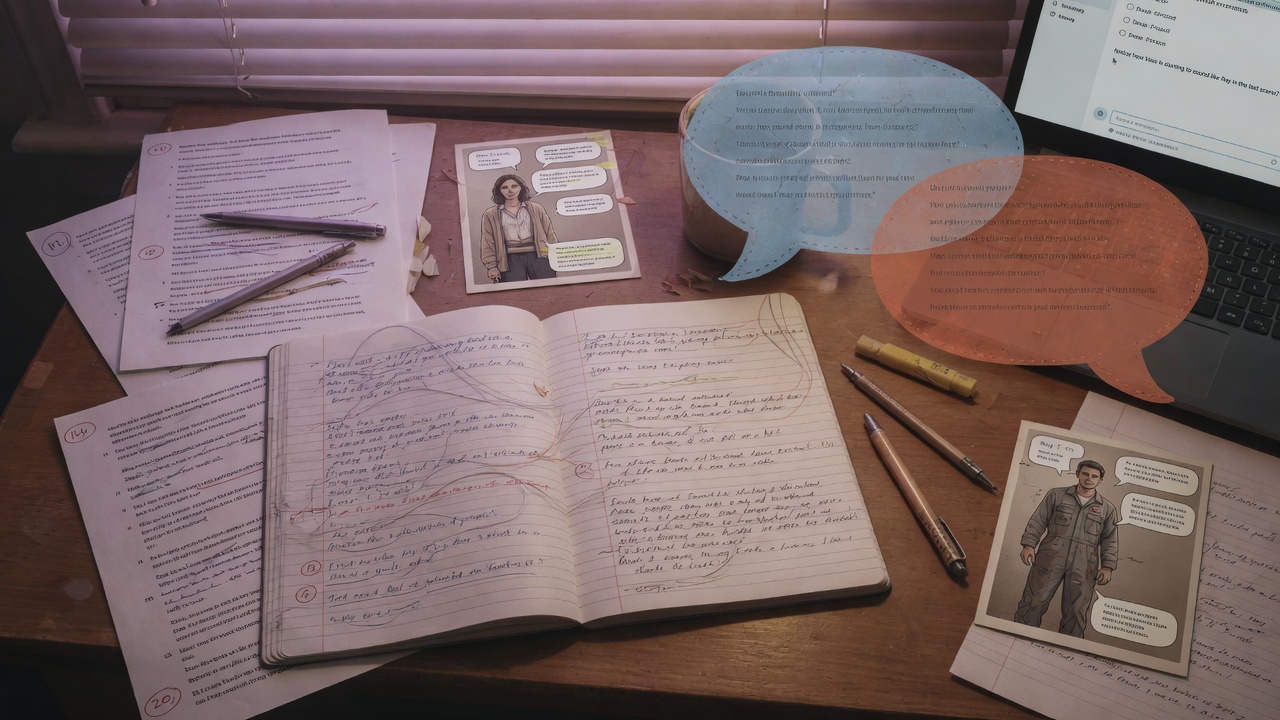
Why Speech Pattern Drift Happens — And Why You Won't Catch It Alone
Somewhere around chapter twelve, your anxious academic stops hedging her sentences. By chapter twenty, your working-class mechanic has started using subordinate clauses he'd never touch in real life. Nobody decided this would happen. It happens because you — the author — have been living inside these characters for months, and your own voice is quietly colonizing theirs.
Speech pattern drift is one of the most damaging and least discussed problems in long-form fiction. It erodes the thing readers experience as character identity. When every person in your novel starts sounding like a variation of the same educated, articulate narrator, individual scenes lose tension and readers stop trusting that the characters are distinct people with distinct minds.
The mechanics are straightforward. You write a high-pressure scene and reach for clarity. Your nervous character, who normally fragments her sentences and qualifies everything, suddenly delivers a clean, direct speech because you need the reader to understand exactly what she means. You fix it later, you tell yourself. You don't, because by chapter fourteen she's done it thirty more times and you've stopped hearing it.
The other problem is familiarity blindness. You know what each character is supposed to sound like, so your brain autocorrects as you read. You see what should be there rather than what is. This is why self-editing for voice drift is so unreliable — your own knowledge of your intentions works against you.
AI tools don't have your intentions. They have only what's on the page. That makes them genuinely useful for this particular kind of audit.
Building a Speech Fingerprint Document Before You Audit
Before you run any audit prompt, you need a reference document for each major character. This isn't a character sheet in the traditional sense — it's a linguistic profile, a set of measurable speech rules that describe how this specific person uses language.
For each character, document the following:
- Sentence length and rhythm. Does she speak in short declaratives? Long, qualifying chains? Does he trail off, or does every sentence land with finality?
- Vocabulary register. Formal or colloquial? Profession-specific jargon? Regional diction? Does she use abstract nouns or concrete ones?
- Filler habits and hesitation markers. "I mean," "the thing is," "look" — these tiny words are among the most distinctive and the first to drift.
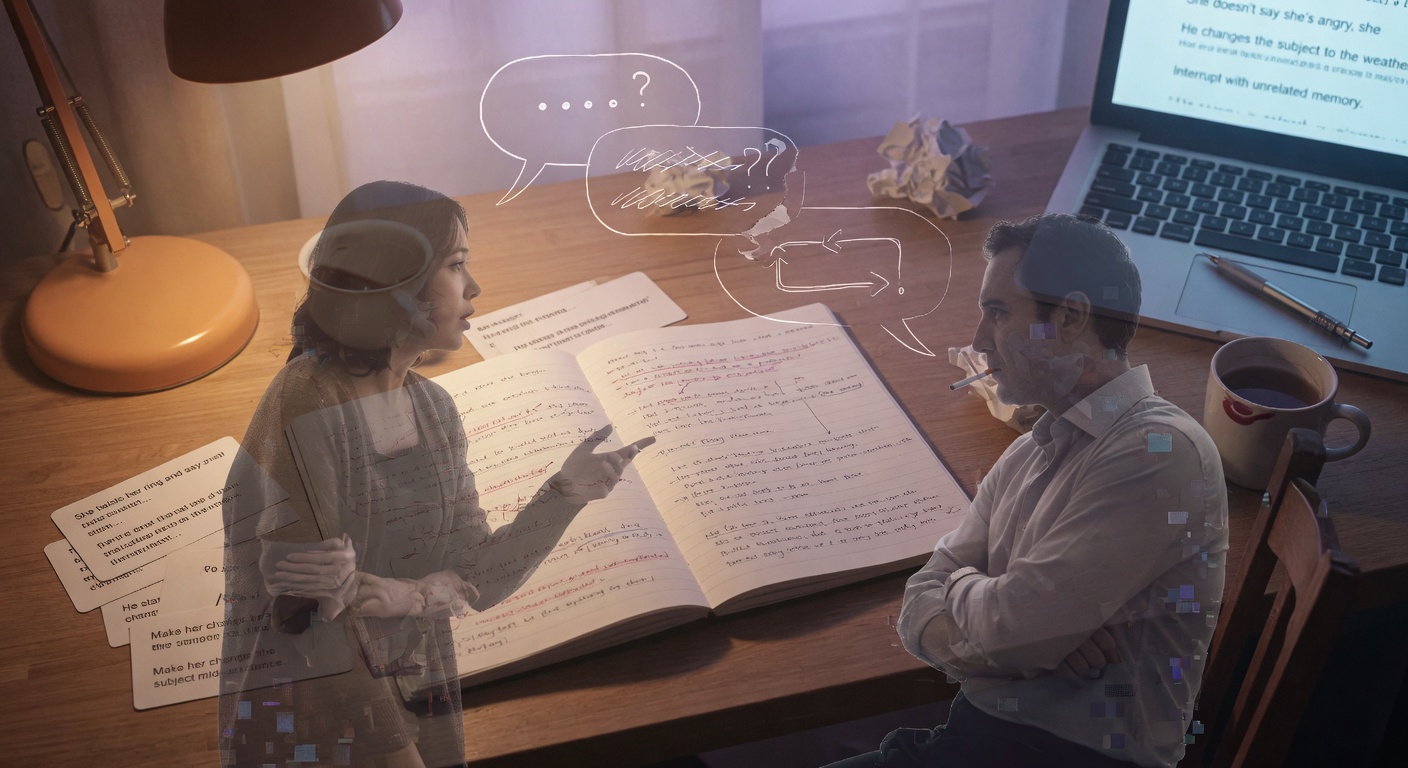
- Deflection and evasion style. When cornered, does he go quiet? Change the subject? Attack? Answer a different question? This is as much a speech pattern as word choice.
- What this character refuses to say. This is the most overlooked element. A man who grew up poor and ashamed of it will not say "I simply don't have the bandwidth for that." A woman who prides herself on directness will not say "I suppose it's possible that maybe..." Prohibitions are fingerprints.
Keep this document open while you work with AI. The prompts below ask you to supply it directly — the more precise and specific your fingerprint document, the more precise and useful your results.
Prompt Framework 1: The Cross-Scene Voice Comparison
This prompt asks the AI to compare two dialogue excerpts from the same character across different parts of your manuscript. The goal is to identify specific moments where the character's speech rules broke down — not to critique the writing generally, but to flag violations of the documented fingerprint.
Paste Scene A (an early appearance of the character where the voice is working well) alongside Scene B (a later scene you suspect may have drifted). Include the fingerprint document. Ask for line-level identification of the discrepancies.
I'm auditing dialogue consistency in my novel manuscript. Below is a speech fingerprint document for my character [CHARACTER NAME], followed by two dialogue excerpts — one from early in the book (Scene A) and one from a later chapter (Scene B). SPEECH FINGERPRINT — [CHARACTER NAME]: [Paste your full fingerprint document here: sentence length patterns, vocabulary register, filler habits, deflection style, and words/ constructions this character would never use] SCENE A — [Chapter/location reference]: [Paste dialogue excerpt, including enough context for each line to be understood — ideally 300–600 words] SCENE B — [Chapter/location reference]: [Paste dialogue excerpt — same length range] Please do the following: 1. Using Scene A as the baseline, identify every line in Scene B where [CHARACTER NAME]'s speech violates one or more rules in the fingerprint document. Quote the specific line and name the rule it breaks. 2. Note any patterns in the violations — are they clustered in particular moments (confrontation, explanation, vulnerability)? 3. Do not rewrite anything at this stage. I want analysis only.The instruction to do analysis only matters. If you allow the AI to move immediately to fixes, you lose the diagnostic data you need to understand why the drift is happening and where it's concentrated across your full draft.
Prompt Framework 2: The Cast Lineup Test
This is the most revealing of the three frameworks. Strip all dialogue tags, action beats, and context from a scene involving multiple characters. Feed the AI only the speech lines themselves, labeled generically as Speaker 1, Speaker 2, Speaker 3. Then ask it to tell you which lines could believably belong to more than one speaker — and which speaker identities it cannot determine from voice alone.
I'm testing dialogue differentiation in a scene from my novel. Below is a stripped dialogue transcript with all character names, action beats, and context removed. The speakers are labeled only as Speaker 1, Speaker 2, and Speaker 3. After the transcript, I've included a brief speech fingerprint for each of the three characters who actually speak this scene (labeled Character A, B, and C — not matched to the speaker numbers). DIALOGUE TRANSCRIPT: [Paste the stripped dialogue here. Each line formatted as: Speaker 1: "..." Speaker 2: "..." etc.] FINGERPRINT SUMMARIES: Character A: [3–5 sentence summary of key speech markers] Character B: [3–5 sentence summary of key speech markers] Character C: [3–5 sentence summary of key speech markers] Please do the following: 1. Based solely on the speech patterns in the transcript, attempt to match Speaker 1, 2, and 3 to Characters A, B, and C. 2. For any lines where you could not determine the speaker from voice alone — or where the line could plausibly belong to more than one character — quote the line and explain why it's ambiguous. 3. Note any lines that seem inconsistent with whichever speaker you've assigned them to. 4. Do not guess based on subject matter or topic. Focus only on how the dialogue is constructed — word choice, rhythm, syntax, register.When the AI can't match speakers to fingerprints, that's your data. Those are the specific lines where the voices have collapsed into each other. Pay particular attention to emotionally heightened moments — arguments, confessions, revelations — where drift is most likely because you were focused on the scene's stakes rather than its linguistics.
Prompt Framework 3: The Drift Repair Pass
Once you have flagged lines from either of the first two frameworks, this prompt handles the repair work. The critical constraint is that the AI must preserve the information, subtext, and emotional function of each line while rebuilding it inside the character's documented register. You're not rewriting the scene — you're translating it back into the right voice.
I'm repairing dialogue drift in my novel. Below is the speech fingerprint for [CHARACTER NAME], followed by a list of flagged lines that need to be restored to her/his/their documented voice. Each flagged line includes a brief note on why it was flagged. SPEECH FINGERPRINT — [CHARACTER NAME]: [Full fingerprint document] SCENE CONTEXT: [2–3 sentences describing what's happening in this scene, who's present, and what this character needs from the exchange — emotionally and practically] FLAGGED LINES FOR REPAIR: Line 1: "[paste the original line]" Why flagged: [e.g., "Uses subordinate clause structure inconsistent with her fragmented speech pattern; sounds too assured for this moment"] Line 2: "[paste the original line]" Why flagged: [e.g., "Vocabulary register too formal; this character would not say 'it's worth considering' — too measured, too neutral"] Line 3: "[paste the original line]" Why flagged: [e.g., "Missing her deflection pattern — when pressed, she redirects with a question, not a direct answer"] For each line, please provide: 1. A repaired version that restores the character's documented voice 2. A one-sentence explanation of what you changed and why 3. If the original line's meaning or subtext cannot be preserved within the character's speech rules, flag this as a structural issue — the scene may need to be restructured rather than just line-edited Do not change the information being communicated. The character must still convey the same facts, intentions, or evasions — just in her/his/ their actual voice.What to Do With the Results
Run the cross-scene comparison on at least three different chapters per major character — one early, one from the middle of the draft, one near the climax. If the drift analysis shows violations clustering in high-tension scenes, that tells you something specific about your own writing process: you abandon voice when you're most focused on stakes. That's useful craft knowledge, not just a correction task.
When the cast lineup test produces ambiguous lines, resist the urge to fix them one by one. Look at them as a group first. If ambiguity is concentrated in a particular character's dialogue, the problem may not be individual lines — the fingerprint itself may be underbuilt, or two characters may be too similar in their documented speech rules to coexist in the same scenes without collision.
The repair pass produces suggestions, not final copy. Read every AI-generated repair aloud. Some will be immediately right. Some will be technically compliant with the fingerprint but will feel mechanical — that's your signal to use them as a direction rather than a destination, and write the actual line yourself.
Using These Prompts Across a Full Manuscript
For a novel of 80,000 words or more, a complete voice audit using these frameworks will take several sessions. A practical sequence: extract fingerprints for your top three to five characters using early dialogue that you trust. Run the cross-scene comparison in the middle act first — chapters eight through eighteen are where drift typically accelerates. Use the lineup test on any scene with more than two speaking characters. Save the repair pass for the penultimate draft, after structural revisions are complete.
The fingerprint document itself will evolve. As you audit, you'll discover speech rules you'd intuited but never articulated. Write those down. By the time you've completed the audit cycle, the fingerprint document becomes something more valuable than a correction tool — it becomes a precise record of who these people are at the level of language, which is the level that readers actually experience character.
Speech pattern drift isn't a sign of weak writing. It's a sign of long writing. The authorial voice is strong, and it exerts pressure over time. The solution isn't to write faster or be more disciplined in the moment — it's to build an audit process that catches what familiarity blinds you to, and to use tools that read only what's on the page.

No comments yet. Be the first to comment!