




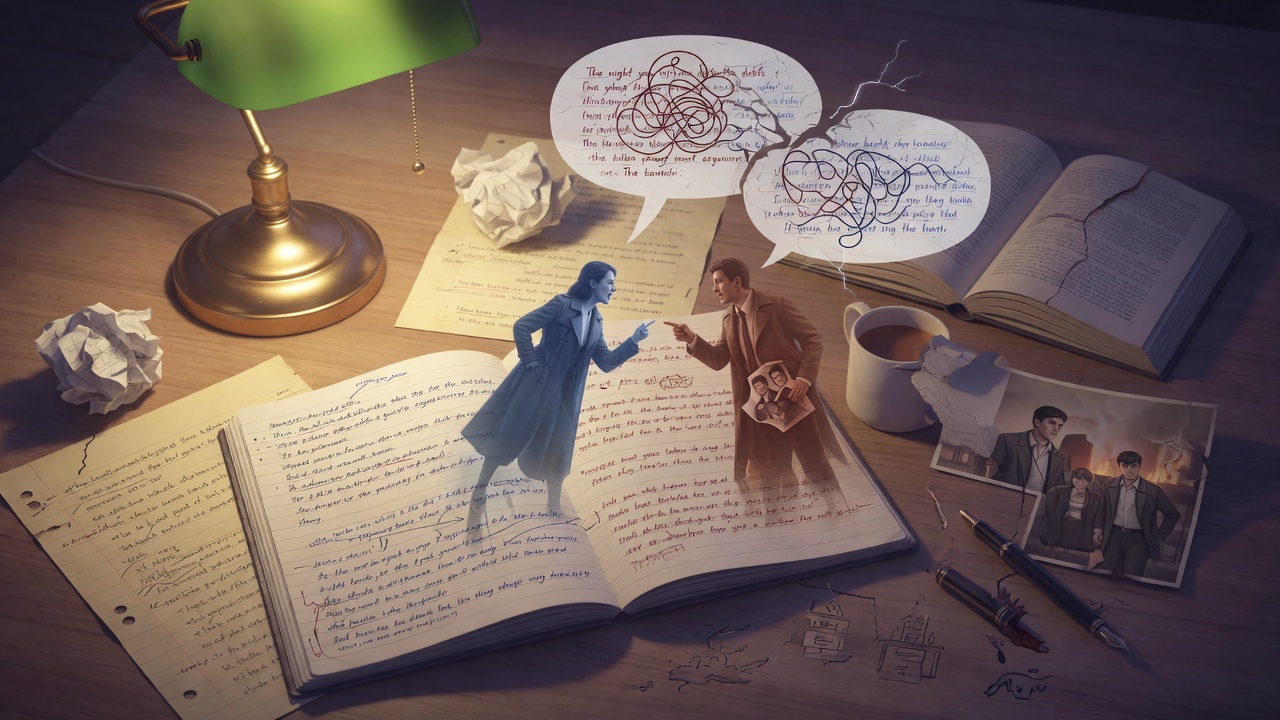
The Exposition Smuggler: AI Prompts That Hide Backstory Inside Conflict-Driven Dialogue
The "Two People Explaining Things at Each Other" Problem
Every novelist knows the moment. You've just written a scene where two characters sit down and one of them says something like, "As you know, Marcus, your father founded this company thirty years ago after the accident that cost him his partnership with Delacroix." The other character nods, or pushes back mildly, and the chapter grinds to a halt while the reader watches information change hands between people who already possess it.
This is the classic "as-you-know-Bob" failure, and it's more insidious than it looks because it doesn't just bore readers — it signals a structural collapse. The moment two characters start explaining shared history to each other in measured, informative sentences, readers instinctively understand that the author has paused the story to stock the shelves. Tension doesn't survive that kind of interruption. The conflict that was building before the expository exchange has to be rebuilt from scratch afterward, and by then you may have lost the reader's investment entirely.
The problem isn't that backstory doesn't belong in dialogue. It absolutely does. The problem is that backstory delivered without dramatic pressure reads as authorial intrusion wearing a costume. Two characters who both know the information, who have no stake in revealing or concealing it, and who are simply recapping it for the reader's benefit have effectively stopped being characters and started being a Wikipedia sidebar.
The Pressure Principle
The fix isn't to remove backstory from dialogue. It's to ensure that backstory is never released unless at least one character has something to lose by releasing it. This is the pressure principle: information earns its place in a scene when someone in that scene is actively working to hide it, distort it, deploy it as a weapon, or reveal only the version that serves their immediate interest.
Think about how backstory surfaces in life. You don't learn someone's family history because they sit you down and narrate it. You learn it because you catch a fragment during an argument, because a lie slips out and then has to be papered over, because a detail gets weaponized and then the person who used it regrets saying it. The information arrives under pressure, and the pressure is what makes it stick.
When you apply this principle to prose, two things happen simultaneously: the backstory lands harder because it was fought for, and the conflict advances because the act of revealing or concealing information changes the power dynamics between characters. You're not pausing the scene to deliver exposition. The exposition is the scene.
AI writing tools are particularly well-suited to this kind of structural revision because they can hold the complete informational content of a flat expository exchange and then rewrite the container while preserving the payload. The prompts below are designed to do exactly that across four distinct dramatic mechanisms.
Prompt Framework #1 — The Reluctant Witness
The reluctant witness technique corners one character so that they can only reveal what they cannot plausibly deny. Instead of a character choosing to explain something, they're forced to confirm fragments under interrogation, each admission costing them something. The backstory still reaches the reader, but it arrives in pieces, each one extracted rather than offered.
This works particularly well for scenes involving secrets, betrayals, or histories one character wants to bury. The key craft move is ensuring that the character who holds the information is reacting to pressure rather than initiating disclosure.
I'm going to give you a flat expository dialogue scene from my novel. The scene currently has Character A explaining [BACKSTORY ELEMENT] to Character B in a way that pauses the narrative conflict. I need you to rewrite this exchange using the Reluctant Witness technique. Rules for your rewrite: - Character A must hold the backstory information and actively resist releasing it - Character B must be applying pressure that makes concealment increasingly untenable - Reveal the backstory only in fragments, each extracted by a specific line of pressure from Character B - Each admission should cost Character A something visible — a defensive shift, a retreat into evasion, a moment of calculation before answering - Do not allow any single speech from Character A to deliver more than one piece of the backstory in a coherent package - The scene should end with the reader holding all the necessary backstory but with Character A's relationship to that history now more complex and suspicious than before Here is the original flat scene: [PASTE YOUR SCENE] After the rewrite, annotate which sentence or exchange delivers each specific piece of backstory, so I can audit completeness.
After running this prompt, read the rewrite against your original and verify that nothing essential was dropped. The annotation request is not optional — without it, it's easy to assume the AI preserved all your backstory when it actually compressed or omitted a detail that becomes important three chapters later.
Prompt Framework #2 — The Loaded Half-Truth
The half-truth technique is more advanced because it requires the reader to receive accurate information while simultaneously registering that the character delivering it is lying about something adjacent. This creates a secondary layer of dramatic irony: the reader gets the fact, but they also get a reason to distrust the character who provided it.
This is particularly effective when you need to plant information that will later be weaponized or recontextualized. The character embeds the true backstory inside a misdirection, which means the reader learns the fact without trusting the frame around it — exactly the kind of productive unease that keeps readers turning pages.
I need you to rewrite the following expository dialogue scene using what I'm calling the Loaded Half-Truth technique. Here is how it works: The character delivering the backstory [NAME THIS CHARACTER] must embed the accurate information inside a statement that is technically true but strategically incomplete, misleading in its emphasis, or framed to redirect the other character's suspicion away from the real issue. Specific requirements: - The factual backstory content must be preserved with complete accuracy - The character delivering it must have a clear, scene-visible motivation for the misdirection (they want something, they're protecting someone, they're buying time — establish which one) - Insert at least one behavioral tell that a close reader will catch: a change in subject, an overly specific denial, a sudden generosity with information that was previously guarded - The receiving character should not catch the misdirection in this scene — that recognition should remain available to the reader alone - Maintain the scene's existing conflict trajectory; the backstory revelation should escalate rather than pause it Original scene for revision: [PASTE YOUR SCENE] Stated backstory that must survive the rewrite: [LIST THE 3-5 FACTS THE READER MUST WALK AWAY KNOWING] After the rewrite, write a one-paragraph note explaining what the character is specifically hiding and why their version of events is strategically constructed rather than honest.
Prompt Framework #3 — The Interrupted Confession
Some backstory genuinely needs to come out in a longer revelation — a confession, an explanation, a reckoning. The problem is that extended monologues, even dramatically motivated ones, flatten tension by removing the other character's agency. The interrupted confession technique breaks a necessary expository monologue into fragments scattered across the physical and emotional beats of a scene, so no single speech delivers the full picture and the interruptions themselves become story.
The interruptions can be external (a door, a noise, another character entering) or internal (the speaker losing nerve, changing their mind about how much to reveal, being derailed by the listener's reaction). What matters is that the flow of information is never smooth, and that each interruption changes what gets revealed next.
The following scene contains an expository monologue or extended explanation that I need to restructure using the Interrupted Confession technique. The goal is to break the continuous information delivery into fragments separated by action, reaction, or interruption, so that the backstory accumulates across the scene rather than arriving in a single block. Instructions for the rewrite: - Identify the scene's existing action beats (physical movement, emotional reactions, environmental details) and use them as interruption points - No single fragment of the confession should deliver more than one complete piece of information before being interrupted or deflected - At least two of the interruptions must change what the confessor chooses to reveal next — meaning the interruption has consequences for the content, not just the pacing - The confessor should visibly recalibrate after each interruption: deciding whether to continue, retreat, or redirect - The final fragment of the confession should feel earned by everything that preceded it, and should land with more weight because the reader has waited for it - Preserve all factual backstory content from the original Original scene: [PASTE YOUR SCENE] Please also provide a brief structural map showing which action beat triggers each interruption and what informational fragment follows it, so I can see the architecture of the rewrite.
Prompt Framework #4 — The Wrong Moment Tell
The most emotionally volatile backstory reveals happen when a character is not prepared to reveal them — when information gets blurted during an argument, when grief breaks through a composed facade, when anger makes someone say the thing they'd spent years not saying. The wrong moment tell takes backstory that you've been delivering in controlled, considered dialogue and relocates it to a moment of maximum emotional pressure where the character has lost their editorial control.
This technique is particularly valuable for backstory that the reader needs to receive with some skepticism about its accuracy. Information blurted in rage or anguish carries emotional weight but unreliable framing, which creates exactly the kind of productive ambiguity that sustains reader engagement across multiple chapters.
I have a scene where backstory is currently delivered in a relatively controlled, explanatory way. I need you to relocate this backstory delivery to what I'm calling the Wrong Moment — a point of maximum emotional pressure where the character revealing the information has lost or is losing their composure. For this rewrite: - Identify what emotional state would cause this character to abandon their guard and blurt this information: grief, rage, desperation, humiliation, or something else — choose the one that fits their established characterization and specify your choice - The backstory should emerge not as an explanation but as an accusation, a confession of guilt, a cry for recognition, or a weapon — depending on the emotional state you've chosen - The accuracy of the information should now feel questionable in small, specific ways — not because the facts are wrong, but because the emotional framing colors everything and the reader knows it - The character who receives this information should be visibly affected by the manner of delivery as much as the content - The scene should not resolve cleanly — the blurted backstory should create a new problem rather than solving the existing one Character delivering backstory: [NAME AND BRIEF DESCRIPTION] Emotional context of the scene: [DESCRIBE THE PRECEDING CONFLICT] Backstory content that must be preserved: [LIST YOUR FACTS] Original dialogue to be rewritten: [PASTE YOUR SCENE]
Auditing the Revised Scene
Running these prompts produces stronger scenes, but it also introduces a real risk: in the process of making exposition dramatic, essential information gets buried so effectively that first-time readers can't retrieve it. Before you move on from a revised scene, run it through a completeness audit using the following checklist.
- The stranger test. Read the revised scene as someone who has read nothing before it. Could a first-time reader extract each factual element you need them to have? If a piece of backstory is now so embedded in subtext that it's invisible on first read, it's not smuggled — it's missing.
- The repetition check. Dramatically delivered backstory often needs a light repetition elsewhere — not as exposition, but as a character's reference to what was just revealed. A single line later in the chapter that acknowledges the information confirms it without re-explaining it.
- The lie audit. If you used the Loaded Half-Truth framework, map every distortion the lying character introduced. Ensure that the accurate information still surfaces clearly enough despite the misdirection frame around it.
- The fragmentation check. If you used the Interrupted Confession, read only the fragments — strip out all the interruptions and read the confession pieces in sequence. The factual content should still be complete and coherent when reassembled.
- The emotional distortion check. If you used the Wrong Moment Tell, list the exact facts the reader needs to retain and confirm that each one appears, even if under emotional pressure. Tone is now unreliable. Facts should not be.
- The conflict continuity check. Trace the scene's tension from the moment before the backstory arrives to the moment after it. Tension should have increased, not paused and restarted. If there's a flatline in the middle, find where the revision slipped back into explanation mode.
- The character cost check. In every revised scene, at least one character should have paid something for the information exchange — revealed a vulnerability, lost a tactical position, or been pushed into a corner they weren't in before the scene started.
What These Techniques Have in Common
Each of the four frameworks above operates on the same underlying principle: backstory is not content to be transferred but pressure to be created. The moment you stop thinking about exposition as information the reader needs and start thinking about it as something a character is fighting to keep, distort, or weaponize, the mechanics of how to write it become almost obvious.
AI tools are genuinely useful here because they're good at holding an information payload stable while rebuilding the dramatic container around it. They don't forget that your character's mother died in 1987 while they're busy making sure the dialogue crackles. What they need from you is clarity about the specific dramatic mechanism you're after — which is exactly what these prompts provide.
The goal is never to make backstory harder to find. It's to make it impossible to receive passively. When readers have to work a little — following the fragments, registering the lie, catching what slipped out under pressure — they remember what they learned because they earned it alongside the character who was trying not to give it away.




No comments yet. Be the first to comment!