


Midpoint Reversal Design: AI Prompts That Engineer the Story-Flipping Twist at Your Novel's Exact Center
Most manuscripts have a midpoint scene. Very few manuscripts have a midpoint reversal. This is the single most common structural gap I see in drafts, and it's almost invisible to the writer who made it, because something does happen at the center of their book. A character dies. A secret comes out. A bomb goes off. The pages turn. The problem is that "something happening" and "the story reversing" are not the same event, and mistaking one for the other is why so many second acts feel like they're treading water even when they're technically full of incident.
What a Reversal Actually Reverses
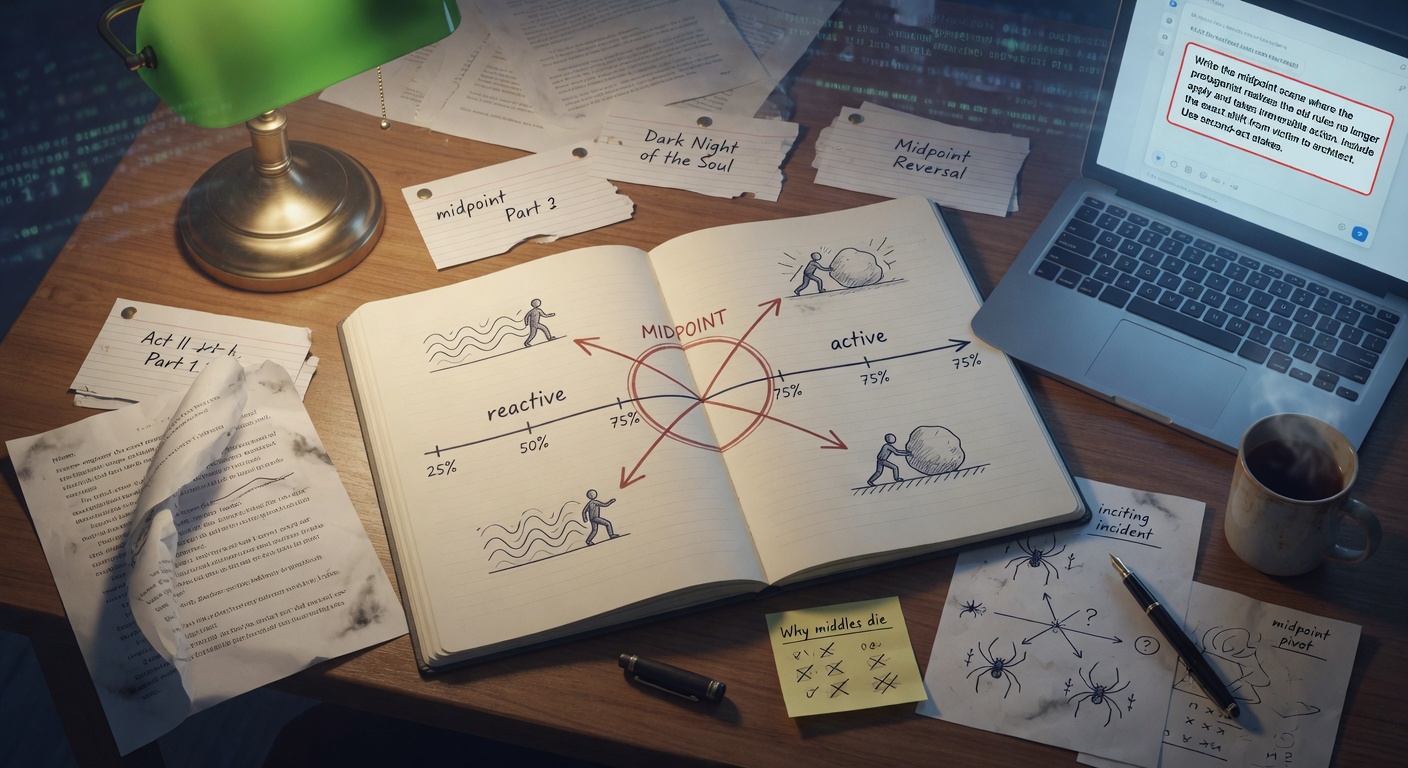
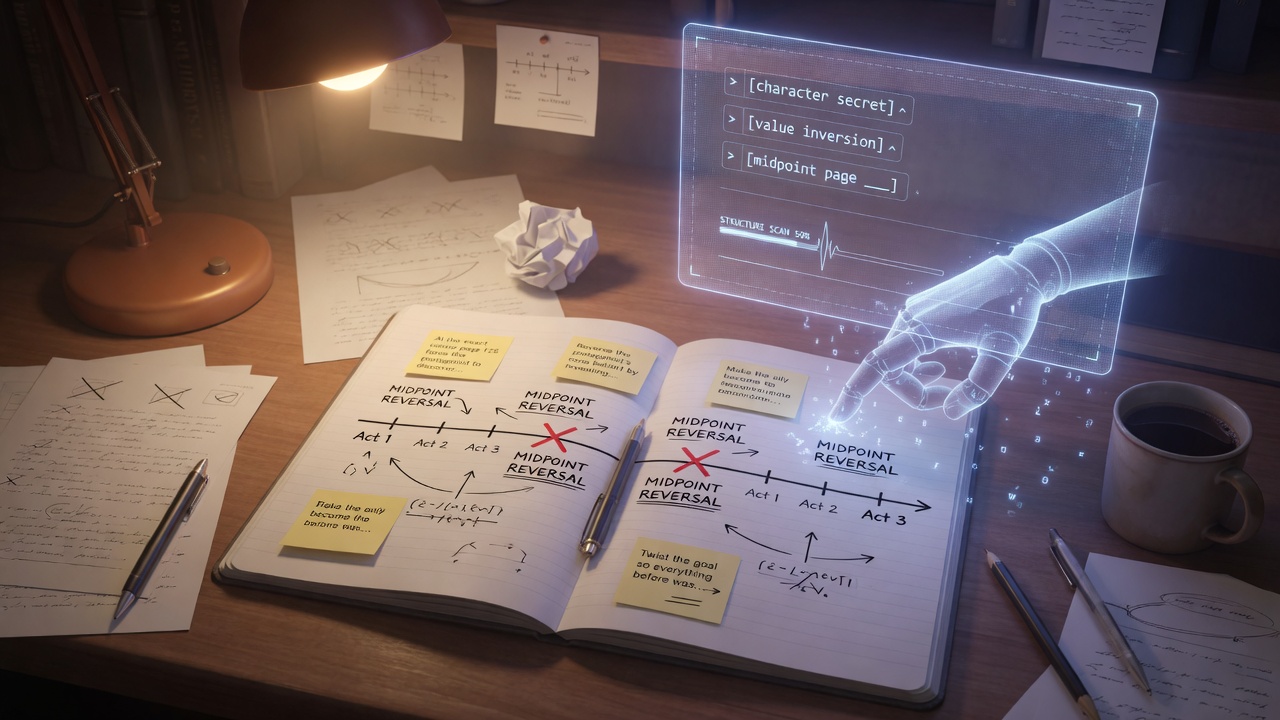
A true midpoint reversal flips one of three things: what your protagonist wants, what they know, or what they believe is possible. It's not an escalation of the existing plot line—it's a hinge that turns the story to face a new direction. The classic version of this is the shift from reactive to proactive: your protagonist spends Act 2A responding to things that happen to them, and at the midpoint they get information, power, or clarity that lets them start acting on the plot instead of being acted upon. The inverse version—proactive to reactive, or false victory collapsing into false defeat—works the same way in reverse. Either way, the character who exits the midpoint is oriented differently than the character who entered it.
Here's the diagnostic test: if you deleted your midpoint scene, would your protagonist's Act 2B goal, knowledge, or belief system be unchanged? If yes, you don't have a reversal. You have an event. Events are easy to write and they feel productive because something dramatic occurred on the page. Reversals are harder because they require the writer to know, at a structural level, what the character's internal orientation was before the scene and what it becomes after.
The other common failure mode is the midpoint that reverses the plot's external circumstances without reversing anything about the protagonist. The villain's plan is revealed, say, but the protagonist's goal, knowledge, and belief about what's possible stay exactly the same—they just now have a new obstacle. That's a complication, not a reversal. Complications pile up. Reversals pivot.
Auditing Your Current Midpoint
Before generating anything new, find out what you already have. This prompt is designed to force a precise, structural read of your existing midpoint scene rather than a plot summary of it.
I'm going to describe my novel's midpoint scene, and I need you to audit it against the strict definition of a midpoint reversal, not just summarize what happens in it. NOVEL CONTEXT: - Genre and one-line premise: [fill in] - Protagonist's Act 1 goal (what they want going into Act 2A): [fill in] - Protagonist's Act 1 belief about what's possible or what the story is about: [fill in] - What the protagonist does NOT know yet at the start of Act 2A that they will need to know eventually: [fill in] MIDPOINT SCENE (describe in 200-400 words, including what happens, who's present, what's revealed or decided, and how the scene ends): [paste description] Do the following: 1. State plainly whether this scene changes what the protagonist WANTS, what they KNOW, or what they believe is POSSIBLE. Identify which of these three (if any) actually shifts. If none shift, say so directly — don't soften it. 2. Classify the current shape of my Act 2A. Is my protagonist reactive (responding to problems, chasing information, on the defensive) or proactive (driving the plot, pursuing their goal directly) up to this point? Then tell me what the midpoint scene, as written, does to that posture — does it flip it, intensify it, or leave it unchanged? 3. Give me the "delete test" result: if this scene were removed entirely, would the protagonist's Act 2B goal, knowledge, or belief be any different than it currently is? Answer yes or no and explain your reasoning in 3-4 sentences. 4. If you conclude this is an event rather than a reversal, tell me specifically what's missing — is it that the protagonist doesn't change their goal, that the new information doesn't actually alter their strategy, or that the stakes are the same before and after? Be specific rather than generic. 5. Rate the current midpoint's reversal strength on a scale of 1-5, where 1 is "pure incident, no reversal" and 5 is "textbook reversal that recontextualizes everything before it." Justify the number.
Run this before you touch a single word of revision. Writers frequently discover their midpoint is a strong scene in isolation—tense, well-written, full of good dialogue—that simply isn't doing structural work. That's a fixable problem, but only once you can see it clearly.
Generating Reversal Options That Recontextualize Act 2A
The best midpoint reversals don't just change what happens next—they change how the reader understands what already happened. A line of dialogue in chapter six that seemed like throwaway characterization turns out to be the protagonist unknowingly revealing information to the person who will betray them. A minor setback in chapter eight is retroactively understood as the villain testing the protagonist rather than an accident. This retroactive recontextualization is what separates a twist that feels engineered from one that feels inevitable once you see it. Use this prompt once you know your reversal is weak and you need real alternatives, not just a patch on the existing scene.
I need 4 distinct options for a midpoint reversal in my novel. Each option must be a genuine reversal by this definition: it changes what my protagonist WANTS, KNOWS, or believes is POSSIBLE, and it recontextualizes at least two scenes from Act 2A that the reader has already read. NOVEL CONTEXT: - Genre and premise: [fill in] - Protagonist and their Act 1 goal: [fill in] - Antagonist or opposing force and their actual objective (may be hidden from protagonist): [fill in] - Summary of Act 2A scene-by-scene (list 5-8 key scenes in the order they occur, one line each): [fill in] - Planned or existing climax, so reversal options stay compatible with where the story needs to end up: [fill in] For each of the 4 options, provide: 1. THE REVERSAL: One sentence stating exactly what flips — goal, knowledge, or belief — and the before/after state. 2. THE MECHANISM: What specific event, revelation, or decision causes the flip. This needs to be a concrete scene, not an abstract shift. 3. RECONTEXTUALIZED SCENES: Name 2-3 specific scenes from my Act 2A list above and explain precisely how this reversal changes their meaning in retrospect. I want to feel a small jolt of "oh — that's what that was actually about" for each one. 4. NEW ACT 2B ORIENTATION: State whether the protagonist becomes more proactive or more reactive after this reversal, and what their new immediate goal becomes. 5. COST OF THIS OPTION: What would I have to change or set up earlier in the manuscript for this option to be earned rather than arbitrary? Be honest if an option requires heavy retrofitting. After all 4 options, rank them by which requires the least retrofitting of existing chapters while still landing as a genuine, surprising-but-inevitable reversal. Explain the ranking.
Pay close attention to the "cost" section for each option. It's tempting to pick the reversal that sounds the most dramatic on paper, but the one that requires you to rewrite your first ten chapters from scratch isn't necessarily the right call for the draft you're currently revising. Sometimes the least flashy option is the one that was already half-built into your manuscript and just needed to be pulled forward and sharpened.
Stress-Testing for Stakes, Not Just Surprise
A reversal can satisfy the technical definition—it changes goal, knowledge, or belief—and still fail dramatically if it doesn't raise the cost of failure. This is the twist-for-its-own-sake trap: the protagonist learns something shocking, but the thing they now stand to lose isn't bigger than what they stood to lose before. Reversals need to escalate stakes, not just redirect the plot.
I want you to stress-test a midpoint reversal for whether it genuinely escalates stakes or just introduces a twist without raising the cost of failure. REVERSAL DESCRIPTION: - Before state (goal/knowledge/belief pre-midpoint): [fill in] - After state (goal/knowledge/belief post-midpoint): [fill in] - What happens in the scene that causes the flip: [fill in] CURRENT STAKES: - What the protagonist stood to lose if they failed BEFORE the midpoint: [fill in] - What the protagonist stands to lose if they fail AFTER the midpoint: [fill in] - What "success" looked like before the midpoint vs. what it looks like after: [fill in] Evaluate the following, in order: 1. Compare the before/after stakes I've listed. Is the after-stakes scenario categorically worse, more personal, or more costly than the before-stakes scenario — or is it just different? A reversal that trades one problem for an equally-sized different problem is a twist, not an escalation. Tell me which one I have. 2. Identify whether the new stakes are personal to the protagonist specifically, or whether they're generic/external stakes that could apply to any protagonist in this situation. Personal stakes escalate harder than generic ones. 3. Check whether failure after the midpoint costs the protagonist something they didn't even know they could lose before the midpoint (this is often the strongest form of escalation). If this isn't present, suggest one way to add it without changing the core mechanism of the reversal. 4. Tell me if the reversal makes the antagonist or opposing force more formidable, more sympathetic, or more entangled with the protagonist than before. If the antagonist's position is unchanged by this reversal, that's a signal the stakes aren't really escalating — flag this. 5. Give me a one-paragraph verdict: does this reversal earn its place at the center of the book, or does it need to be pushed further? If it needs pushing, suggest one specific way to increase the cost of failure without abandoning the reversal's core mechanism.
Mapping the Ripple Effect Forward
A reversal that's structurally sound but narratively isolated will still sink your Act 2B if its effects don't propagate. The test isn't just "does the reversal matter in the scene where it happens"—it's "does every subsequent chapter have to reckon with it." If your characters can go back to business as usual three chapters later, the reversal wasn't strong enough, or you failed to carry its consequences forward.
I've finalized my midpoint reversal. Now I need to map how it ripples forward through the rest of Act 2B to make sure every subsequent chapter is forced to reckon with it rather than reverting to pre-reversal patterns. MIDPOINT REVERSAL: [describe the finalized reversal in 3-5 sentences] REMAINING ACT 2B CHAPTERS (list them in order with a one-line description of current content): [fill in] For each remaining chapter listed: 1. Tell me specifically how the midpoint reversal should change the protagonist's decision-making, dialogue, or priorities in that chapter compared to how it's currently written or planned. 2. Flag whether the chapter, as currently described, seems to ignore the reversal or treat it as old news too quickly. If a chapter could be dropped into the manuscript unchanged before or after the midpoint, that's a problem — identify it. 3. Suggest one concrete scene beat or line of dialogue that would make the reversal's presence unmistakable in that chapter without requiring the character to explicitly re-explain it to the reader. Finally, identify which single chapter after the midpoint should carry the heaviest visible weight of the reversal — the one where its consequences are most concentrated — and explain why that placement works better than spreading the weight evenly.
The output of that last prompt often reveals a second problem hiding behind the first: an Act 2B that was plotted before the reversal was locked in, and now needs its chapter order or content adjusted to actually carry the consequences forward. That's not a sign you did something wrong. It's a sign the reversal is strong enough to require the rest of the book to answer to it, which is exactly what a midpoint is supposed to do.

No comments yet. Be the first to comment!