
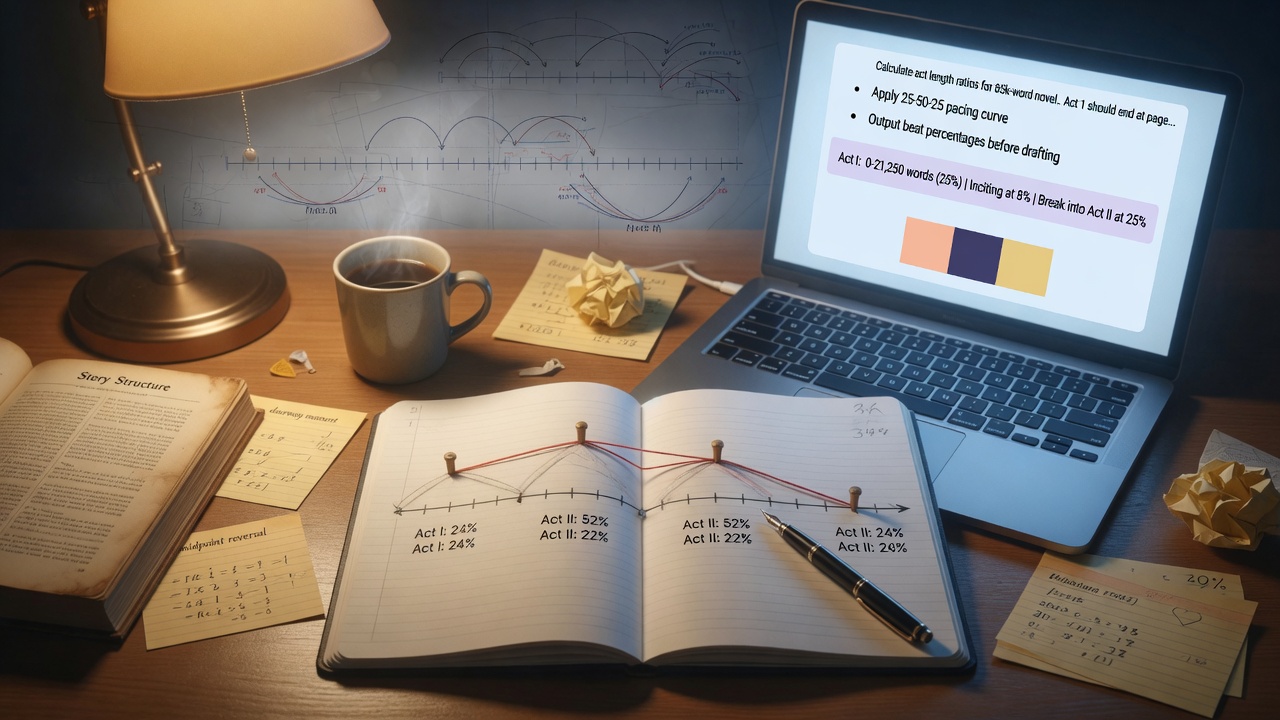
Act Ratio Mapping: AI Prompts That Calculate the Right Length for Each Act Before You Draft
Every craft book tells you what has to happen in each act. Fewer of them tell you how long each act should actually be. That's the gap that quietly sinks a lot of manuscripts. Writers hit every beat on the checklist—inciting incident, midpoint reversal, dark night of the soul—and the book still drags, because the beats are landing at the wrong percentage of the manuscript. A midpoint at 30% isn't a midpoint. An Act 1 that eats 40% of a 90,000-word thriller isn't slow-burn, it's structurally broken.
This is a math problem before it's a craft problem, and AI is well-suited to it. You give it your genre and target length, it gives you ratio-based word count ranges, and you check your outline against them before you write a single chapter. Here's how to do that mapping in four passes.
Why proportion, not just presence, controls pacing
A beat sheet tells you that the midpoint happens. A ratio tells you when, and when is what readers actually feel. Genre expectations around act length are real and fairly consistent, even though nobody hands you a rulebook when you start writing.
- Commercial thriller/mystery: Act 1 tends to run lean, around 20-22% of the book, because the inciting incident needs to land early and the plot machinery has to start turning fast. Act 2 stretches long, often 55-58%, split by a hard midpoint. Act 3 compresses to 20-25% for a fast resolution.
- Romance: Act 1 (the meet and the initial spark) can run slightly longer, 22-25%, because the reader needs real time with the central relationship before the plot pressure escalates. The midpoint is often the "first kiss" or point-of-no-return moment, sitting close to true center. Act 3 needs room for the black moment and reconciliation, so it rarely compresses below 20%.
- Literary fiction: Ratios loosen considerably. Act 1 can extend to 25-30% because voice and interiority are doing narrative work that genre fiction offloads to plot. Act 2 is still the bulk of the book, but the midpoint may be thematic rather than a plot swing, so it's less locked to the 50% mark.
- Epic fantasy: Act 1 often runs 20-25% but in absolute word count that's still 30,000+ words in a 150,000-word book, enough for a full world-building arc. Act 2 frequently needs the 2A/2B split treated as its own structural unit because of subplot density.
None of these are laws. They're defaults, and defaults are exactly what AI is good at generating quickly so you have a baseline to push against on purpose rather than by accident.
Prompt 1: Generate target ranges for your genre and length
Start here, before you touch your outline. This prompt produces the ratio scaffold you'll measure everything else against.
I'm planning a novel with the following parameters: - Genre: [e.g., domestic thriller] - Comp titles: [2-3 books similar in tone/pace] - Target total word count: [e.g., 95,000] - POV structure: [single POV / dual POV / multiple POV] Generate a structural word-count map for this book using standard three-act proportions adjusted for this genre. For each of the following, give me a word-count RANGE (not a single number) and the percentage of the total manuscript it represents: 1. Act 1 (setup through inciting incident and first plot point) 2. First pinch point / midpoint approach 3. Midpoint (the reversal or point of no return) 4. Second pinch point / low point 5. Act 2 total (from first plot point to third plot point) 6. Act 3 (climax through resolution) Also flag: - Where in the manuscript the inciting incident should land (word count and percentage) - Where the "point of no return" that ends Act 1 should land - Whether this genre typically supports a 2A/2B midpoint split, and if so, what the approximate word counts for 2A and 2B would be Present this as a table, then add 3-4 sentences explaining WHY this genre pulls proportions the way it does compared to a generic three-act template.The table is the deliverable, but don't skip the explanation at the end. That's where you find out if your instincts about your own genre are actually wrong. Writers coming from literary backgrounds often build thriller outlines with literary-length Act 1s without realizing it, and this is where that mismatch surfaces before it costs you a revision.
Prompt 2: Audit your existing beat sheet against the ratios
Now bring in what you've already built—a beat sheet, a chapter-by-chapter outline, or even a rough synopsis with chapter breaks. This prompt cross-references it against the targets from Prompt 1 and tells you where the proportions are off before you've written a word of prose.
Here is the word-count target map you generated for my novel: [paste the table from the previous prompt] Here is my current beat sheet / chapter outline, with estimated word counts per chapter or section: [paste your outline, e.g.: Ch 1 (2,200 words) - Protagonist's ordinary world, introduce job stress Ch 2 (2,400 words) - Inciting incident: the letter arrives Ch 3 (2,100 words) - Protagonist tells best friend, denial ...continue through full outline] Audit this outline against the target ranges. Specifically: 1. Calculate the running total and percentage of manuscript at the end of each act boundary in my outline, based on my chapter word estimates. 2. Compare those percentages to the target ranges. Flag any act, pinch point, or midpoint that falls outside the target range by more than 5 percentage points. 3. For each flagged section, tell me whether it's running LONG or SHORT relative to target, and by roughly how many words. 4. Identify the single biggest structural risk in this outline based on the proportions (e.g., "Act 1 is 34% of the book against a 20-24% target — the inciting incident is arriving too late"). 5. Do NOT suggest content fixes yet. Just give me the diagnostic.The instruction to withhold content fixes matters. It's tempting to let the model start rewriting your outline immediately, but you want the diagnosis clean first. A model that's simultaneously diagnosing and fixing will sometimes paper over a structural problem with a plausible-sounding scene addition rather than naming the actual imbalance. Get the flags first, then move to repair.
Prompt 3: Redistribute an overloaded Act 2
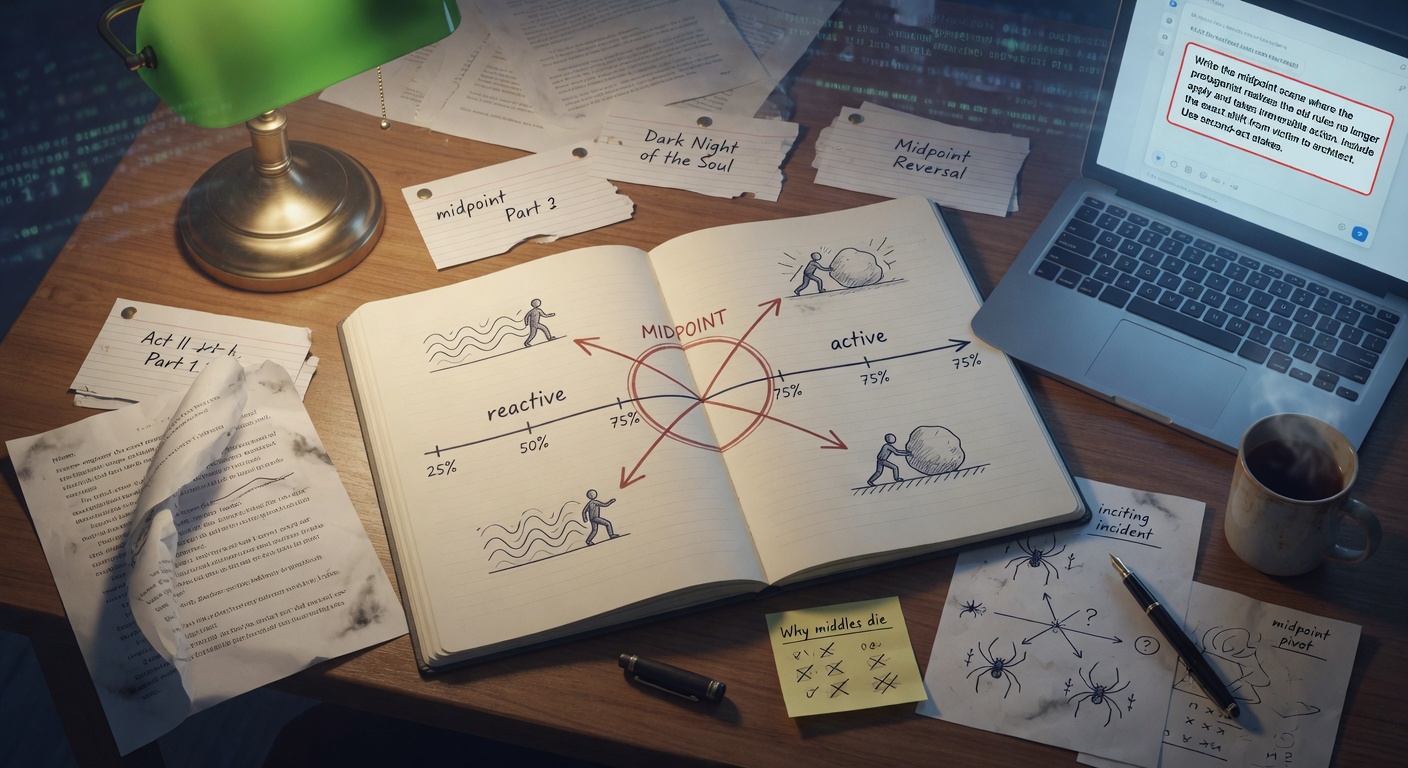
Act 2 is where almost every proportion problem concentrates, because it's the largest act and the easiest one to lose control of—subplot creep, a sagging middle, a midpoint that arrives without enough preceding pressure to make it land. If your audit flagged Act 2 as overloaded, this prompt breaks it into a proper 2A/2B structure with a real midpoint gate instead of a vague middle stretch.
My Act 2 is currently running long: [X words / X% of manuscript] against a target of [Y words / Y% target range]. Here is my current Act 2 beat sheet, chapter by chapter with word estimates: [paste Act 2 chapters/beats] Help me split this into 2A and 2B with a clear midpoint gate between them. 1. Identify the strongest candidate scene in my current outline to serve as the midpoint — it should be the moment where the protagonist's approach to the central problem fundamentally changes (reactive to proactive, or the stakes/rules of the conflict shift). Tell me which existing beat this is, or if none qualifies, tell me what's missing. 2. Reassign every beat currently in Act 2 to either 2A (before the midpoint) or 2B (after it), based on target word counts of [2A target] and [2B target]. 3. Flag any beats that don't clearly belong in either half — these are candidates for cutting or merging. 4. Flag any gaps: places where 2A or 2B is under target and needs an additional beat to reach proportion, and suggest what TYPE of scene would fill that gap (not full content, just function — e.g., "2B needs a subplot complication around the 65% mark to avoid a flat stretch before the low point"). 5. Give me the revised 2A/2B breakdown as a table with beat, word estimate, and running percentage of total manuscript.What this prompt is really doing is forcing a decision most outlines avoid: naming the exact scene where the midpoint happens. Vague midpoints are the single most common cause of a sagging Act 2, because without a hard gate between 2A and 2B, every scene in the middle third feels interchangeable. Once you've named the gate, the redistribution becomes mechanical rather than mysterious.
Turning the audit into a chapter-by-chapter budget
The last step converts all of this from a planning exercise into something you actually use while drafting. A ratio map that lives in a separate document you never look at again isn't worth much. The move is to fold the targets directly into your chapter outline as a running checkpoint.
Using the finalized act targets and my revised beat sheet (including the 2A/2B split), generate a chapter-by-chapter word budget for the full manuscript. For each chapter, give me: - Chapter number and one-line beat description - Target word count for that chapter - Cumulative word count through that chapter - Cumulative percentage of total manuscript - Which structural zone it falls in (Act 1 / 2A / 2B / Act 3) Flag the three chapters that carry the most structural weight (the inciting incident, the midpoint, and the Act 3 turn) so I can identify them at a glance while drafting. Format as a table I can keep open as a reference document.Keep that table next to your draft. As you finish each chapter, log the actual word count against the target and let the cumulative percentage update. When a chapter runs 800 words over budget, that's not automatically a problem, but three chapters running long in a row inside Act 1 is an early warning that your setup is sprawling before you've written far enough in to feel it as pacing drag. Catching that at chapter four is a lot cheaper than catching it at chapter fourteen during a revision pass.
The ratio work doesn't replace beat-level craft judgment, and no genre default should override a structural choice you're making deliberately. But most proportion problems aren't deliberate. They're the result of nobody checking the math until the manuscript is finished and something feels wrong without an obvious cause. Running these prompts before you draft turns that vague feeling into a number you can actually act on.

No comments yet. Be the first to comment!