


Why the Midpoint Breaks More Novels Than the Ending Does
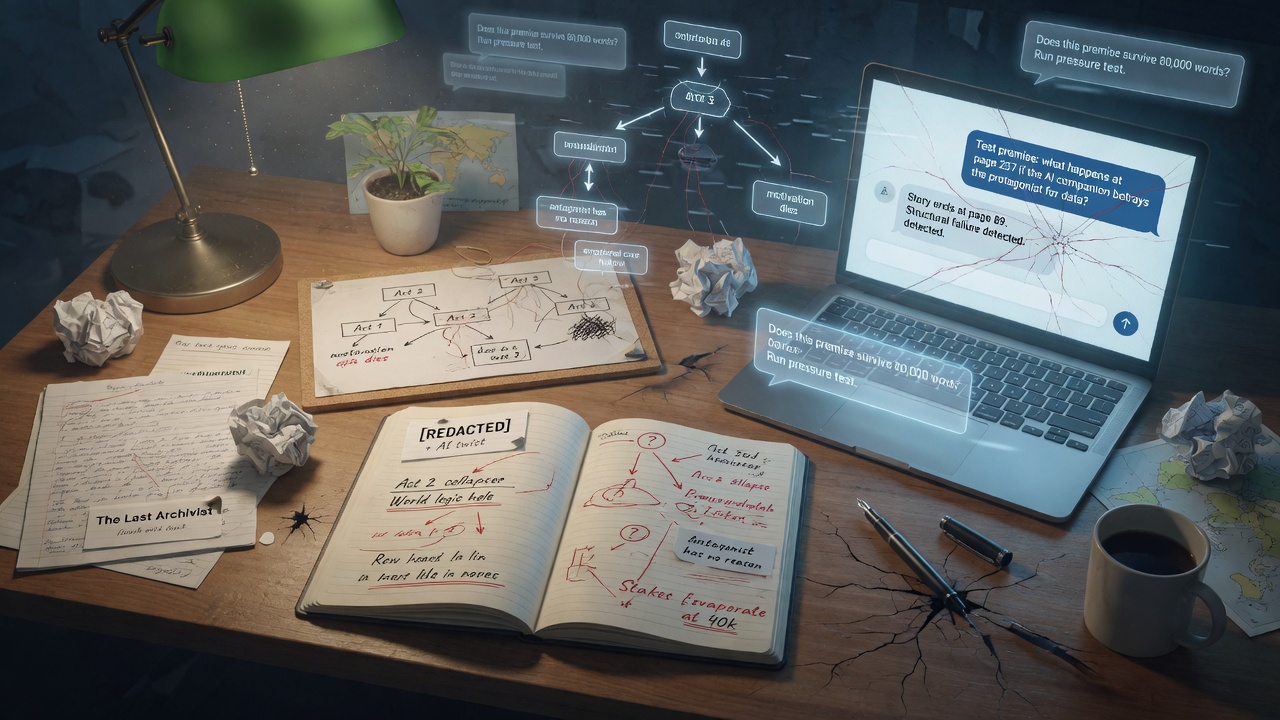
Most writing advice fixates on endings. Get the climax right, the thinking goes, and everything else will hold together. But experienced developmental editors will tell you something different: the manuscript pages between roughly 40% and 60% are where novels quietly collapse. The prose stays competent. The dialogue still crackles. And yet something has gone slack, like a tent whose center pole has been replaced with a suggestion.
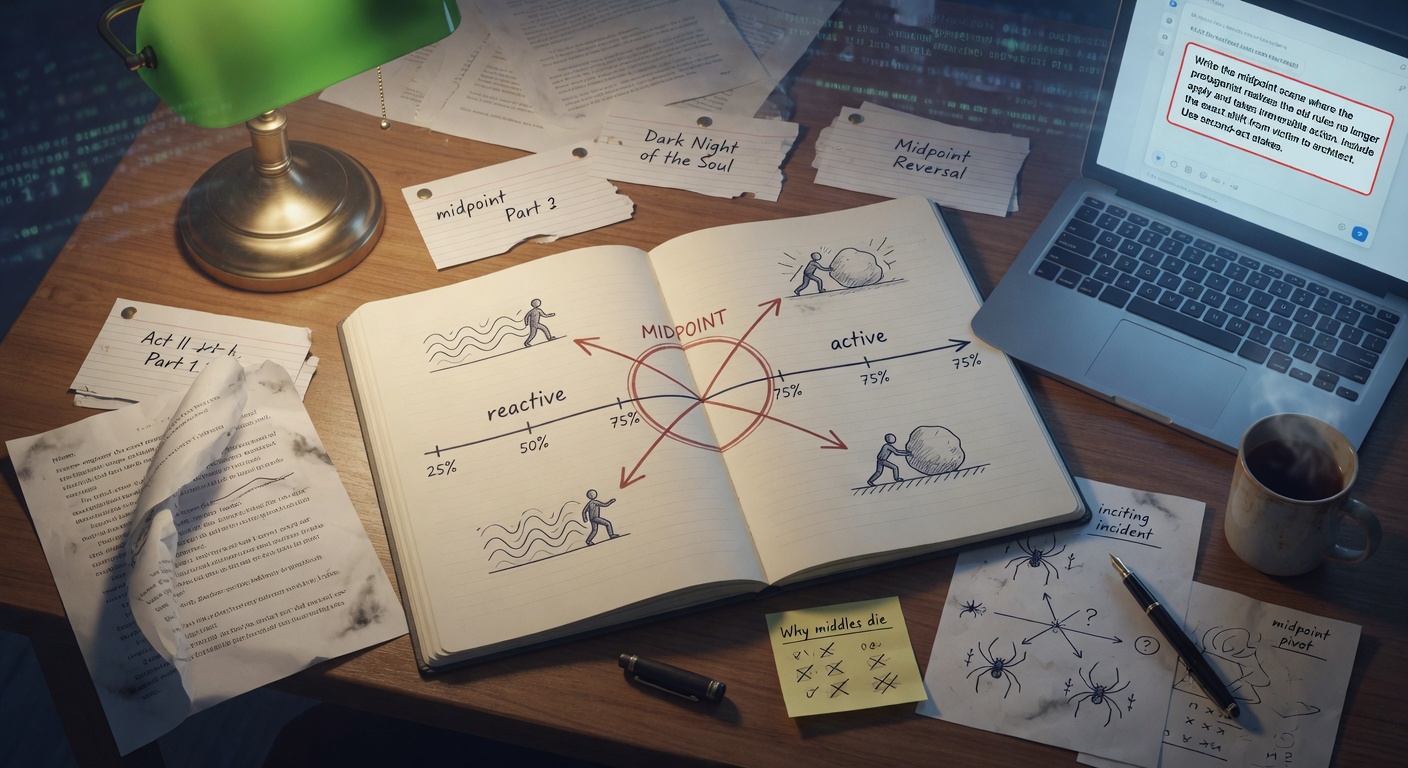
The midpoint is structural in a way that writers often underestimate. It is not a chapter where things happen to get more interesting. It is the precise moment where your protagonist's relationship to the story's central problem undergoes an irreversible transformation. Before the midpoint, the protagonist is reacting—testing the world, forming alliances, gathering information, making mistakes that are still recoverable. After the midpoint, the story's logic changes. The protagonist is no longer the same person operating in a familiar problem space. Something has shifted that cannot be unshifted.
When that shift is vague or merely cosmetic—when the protagonist just encounters a bigger obstacle rather than genuinely changing their orientation to the story's core conflict—the second act begins to drag. Readers sense the incoherence before they can name it. They describe it as feeling like nothing is happening, even when the plot is technically active. What they're detecting is the absence of genuine structural pivot. The midpoint is a load-bearing wall, and you can paper over a missing load-bearing wall for a surprisingly long time before the ceiling comes down.
Working with AI to diagnose, design, and sharpen your midpoint is one of the more immediately practical applications of these tools for novel-length work—because the midpoint problem is fundamentally a structural and logical one, and AI is genuinely useful at stress-testing logic.
The Two Midpoint Archetypes and How to Identify Which Your Story Demands
Story theorists generally describe two dominant midpoint configurations, and understanding which one your premise is actually calling for is the first diagnostic step.
The False Victory midpoint occurs when the protagonist appears to have won—achieved the goal, defeated the antagonist, resolved the central tension—only for the second half to reveal that this victory was illusory, incomplete, or purchased at a cost that will define the remainder of the story. Think of the moment in a thriller when the protagonist catches the killer, only to realize there's a second killer, or that the first one was working for someone larger. Think of the romantic comedy where the couple finally gets together at the midpoint, and the second half is about whether they can actually sustain something real.
The False Defeat midpoint is its mirror: the protagonist appears to have lost everything—their plan has collapsed, their mentor is dead, their allies have scattered—but this devastation catalyzes a deeper commitment or a fundamental reorientation that makes the final push possible. The protagonist hits bottom and discovers what they're actually made of.
The crucial diagnostic question is not which archetype you prefer but which one your premise structurally demands. A story about a character who has been overconfident needs a False Victory to expose that overconfidence. A story about a character who has been holding back needs a False Defeat to force the final commitment. Getting this wrong produces a midpoint that technically exists but doesn't do the right work.
Here's a prompt designed to help you identify which archetype your story is calling for before you've committed to either:
I am writing a novel and need help identifying the correct midpoint archetype for my story. Here is the core information: PROTAGONIST: [Name, core flaw or wound, what they want externally, what they need internally] INCITING INCIDENT: [The event that kicked off the main plot] PREMISE CONFLICT: [The central problem or question the story is exploring] INTENDED ENDING: [How the story concludes—what the protagonist achieves, loses, or understands] Based on this information, evaluate both midpoint archetypes against my story's logic: 1. FALSE VICTORY VERSION: Describe what a midpoint False Victory would look like for this specific protagonist and premise. What would the illusory win be? What would it reveal about the protagonist's flaw? How would it set up the second half? 2. FALSE DEFEAT VERSION: Describe what a midpoint False Defeat would look like for this specific protagonist and premise. What would the loss be? How would it catalyze the protagonist's internal shift? How would it set up the second half? 3. STRUCTURAL RECOMMENDATION: Based on the protagonist's flaw and the story's intended ending, which archetype does this premise demand and why? Be specific about the logical connection between the midpoint type and the ending I've described.
Reverse-Engineering the Midpoint: Working Both Directions at Once
The most reliable method for identifying your true midpoint is triangulation. You work backward from your climax and forward from your inciting incident simultaneously, looking for the single scene that must logically exist at the intersection.
Working backward from the climax: ask what state your protagonist must be in—emotionally, informationally, relationally—when they enter the final confrontation. Then ask what experience could have produced that state. Keep asking that question, moving backward through the manuscript, until you reach a scene that couldn't have been produced by anything earlier in the story. That scene is your midpoint.
Working forward from the inciting incident: ask what the protagonist now understands, fears, or desires that they didn't before. Then ask what the next logical revelation or escalation would have to be. Keep moving forward until you reach the point where the protagonist's original approach to the problem is definitively exhausted—where they cannot continue doing what they've been doing. That exhaustion point is your midpoint.
When both directions of analysis point to the same scene or scene-type, you've found your structural center.
I need help reverse-engineering the midpoint of my novel by working backward from my ending and forward from my inciting incident simultaneously. Please treat this as a structural logic problem. INCITING INCIDENT: [Describe the event that launches the main plot, including what changes for the protagonist and what goal or problem it creates] PROTAGONIST'S INITIAL APPROACH: [How does the protagonist initially try to solve the central problem? What assumptions are they operating under in Act One?] CLIMAX SCENE: [Describe what happens in the final confrontation or resolution of the central conflict] PROTAGONIST AT CLIMAX: [What must the protagonist understand, believe, or be willing to do in the climax that they couldn't have understood, believed, or been willing to do at the story's beginning?] WORKING BACKWARD FROM CLIMAX: Starting from the climax state you've described for the protagonist, trace backward through three logical steps. For each step, describe what experience or revelation would have produced the preceding state. Stop when you reach a transformation that is too large to have been caused by anything earlier in the story—that stopping point is likely the midpoint. WORKING FORWARD FROM INCITING INCIDENT: Starting from the protagonist's initial approach and assumptions, trace forward through three logical escalations. For each step, describe what would push the protagonist's original approach to its limit. Stop when you reach the point where the original approach is definitively exhausted and cannot continue. INTERSECTION ANALYSIS: Where do these two lines of reasoning meet? Describe the single scene or scene-type that satisfies both the backward and forward logic. What must happen in this scene? What must irrevocably change?
Stress-Testing Your Midpoint Scene
Once you've identified your midpoint scene—whether you've drafted it already or have a clear conception of it—the next phase is adversarial. You need to pressure-test it against three specific structural criteria.
Irreversibility. The protagonist's internal shift must be genuinely impossible to undo. If they could simply forget the midpoint event and continue as before, the scene is not doing structural work. Ask whether the protagonist's understanding of themselves, their world, or their central relationship has been permanently altered. Escalation of stakes. The second half of the novel must cost more than the first half. The midpoint scene needs to raise the stakes in a way that the protagonist cannot ignore. This doesn't mean raising the external threat level—though it can mean that. It means that the protagonist now has more to lose, or understands more clearly what losing would mean. Structural necessity. Could the second half of your novel proceed coherently without this exact midpoint scene? If the answer is yes, the scene is decorative rather than structural. The second half should be not merely different but impossible without the specific transformation the midpoint produces.I have drafted or outlined my midpoint scene and need to stress-test it against three structural criteria. Please be rigorous and adversarial in this analysis—identify weaknesses honestly. MY MIDPOINT SCENE: [Describe the scene in detail: what happens externally, what the protagonist understands or experiences internally, what changes in their relationships or circumstances] MY PROTAGONIST'S STATE BEFORE THIS SCENE: [How are they thinking, what are they trying to do, what are they avoiding or not yet understanding?] MY PROTAGONIST'S STATE AFTER THIS SCENE: [How have they changed?] MY SECOND HALF OUTLINE: [Brief summary of what happens in the second half of the novel] STRESS TEST 1 - IRREVERSIBILITY: Is the protagonist's internal shift in this scene genuinely irreversible? Could they realistically return to their pre-midpoint state and continue operating as before? If there is any way this transformation could be walked back, identify it and suggest what would make the shift truly permanent. STRESS TEST 2 - STAKES ESCALATION: Do the stakes meaningfully increase as a result of this scene? Identify specifically what the protagonist now has more to lose, or understands more clearly. If the stakes escalation is vague or primarily external rather than also internal, explain what is missing. STRESS TEST 3 - STRUCTURAL NECESSITY: Could the second half of this novel proceed coherently without this exact midpoint scene? If yes, explain what elements of the second half would actually work without the midpoint transformation I've described—and suggest what would need to change either in the midpoint scene or the second half to create genuine structural dependency. OVERALL DIAGNOSIS: What is the single most significant structural weakness in this midpoint scene, and what is the most targeted revision that would address it?


No comments yet. Be the first to comment!