




Why Magic Systems Collapse Before the Series Does
Every magic system feels airtight when you're building it. You know the rules. You know why fire-calling costs three days of exhaustion, why memory-weaving requires a blood anchor, why the protagonist can't simply dissolve the antagonist on page forty. The logic lives in your head in full three-dimensional clarity, and from inside that clarity, inconsistencies are nearly invisible.
Then a reader gets to chapter nineteen and asks why the protagonist didn't just use the memory-weave to expose the villain's plan at the senate hearing. You have an answer—you always had an answer—but you never put it on the page. The rule existed, but the enforcement didn't, and to a reader encountering the system cold, the omission reads as a cheat. The magic did whatever the plot needed it to do.
This is the central failure mode of complex magic systems: not that the author didn't think hard enough, but that the rules were never tested against a reader who hadn't spent six months building the world. The author's brain fills gaps automatically. A reader's brain flags them as broken promises.
AI gives you something valuable here—a tool that will engage with your rules exactly as stated, without the background knowledge you've been accumulating for months. When you feed it your magic system bible and ask it to probe for weaknesses, it functions as a first-pass adversarial reader: informed enough to follow logic chains, but without the author's reflex to paper over contradictions.
The Stress-Test Method
The core technique is simple. You treat your magic system documentation—whether that's a few paragraphs of notes or a full ten-page bible—as source material, and you ask the AI to work against you. Not to help you build the system, but to dismantle it.
This requires a specific kind of prompting. You're not asking the AI to be creative on your behalf or to invent new lore. You're asking it to apply pressure to what already exists, the way a structural engineer stress-tests a bridge by imagining the worst conditions it might face.
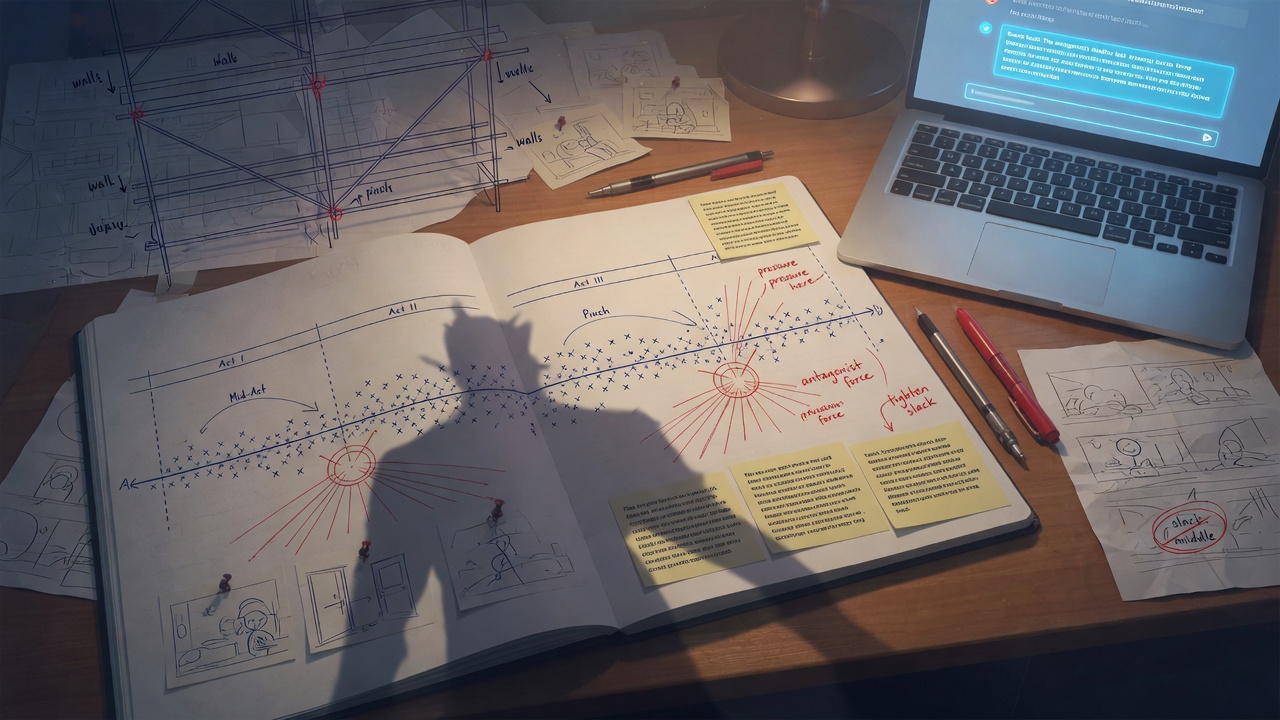
There are three distinct angles worth running separately, because they catch different categories of problem. Loophole audits find places where your rules logically permit characters to solve problems you intended to be unsolvable. Cost-consequence tracking finds places where your manuscript's actual scenes violate the costs you established. Escalation mapping finds the point at which your protagonist's power growth outpaces your antagonist's threat—a timeline problem that tends to surface around the midpoint of longer works.
Before running any of these, consolidate your magic system documentation into a single clean block. Include every stated rule, every established limitation, and every cost-consequence pair you've defined. The more complete this source material, the more precise the analysis you'll get back.
Prompt Set 1: The Loophole Audit
Loophole problems are the most immediately damaging to reader trust, because they create the impression that the protagonist is being artificially prevented from solving problems in obvious ways. If your magic system permits something, readers will expect characters to use it—and when they don't, the story feels rigged.
The goal of a loophole audit is to identify those permitted uses before your readers do. You want a list of every way a clever, motivated character could exploit your stated rules to bypass the central conflicts of your plot. Then you can decide, consciously and in advance, whether to close the loophole through rule refinement, address it in the text through character reasoning, or accept it and work around it.
You are an adversarial story editor specializing in fantasy magic systems. Your job is to find weaknesses, not to be supportive. Below is the complete magic system documentation for my novel-in-progress. Read it carefully, then do the following: 1. List every loophole you can identify — places where a clever, motivated character could exploit the stated rules to bypass conflict, avoid danger, or solve problems the plot depends on remaining unsolved. 2. For each loophole, explain the exact logical chain: which stated rule permits it, what action a character would need to take, and which specific plot problems it would dissolve. 3. Prioritize ruthlessly. Mark each loophole as HIGH (breaks central conflict), MEDIUM (undermines a subplot or specific scene), or LOW (creates minor implausibility). 4. Do not suggest fixes. Only identify problems. I'll handle solutions separately. [PASTE YOUR MAGIC SYSTEM DOCUMENTATION HERE] After your analysis, list any rules that seem deliberately vague or underspecified — places where I may have left myself an intentional escape hatch but haven't committed to how it actually works.
Run this prompt twice if your system is complex: once with just the magic system bible, and once with the magic system bible plus a summary of your central plot conflicts. The second pass often catches loopholes that only become visible when the AI can see what problems your story needs to remain hard.
Prompt Set 2: The Cost-Consequence Tracker
Magic systems that charge costs but forget to collect them are among the most common manuscript problems, and they're nearly impossible to catch through self-editing. You wrote the cost into the system. You believe it's there. What you don't notice is the scene where the protagonist uses the costly magic and then immediately has a full conversation, walks briskly to the next location, and performs a second magical act—none of which reflects the exhaustion, pain, or resource depletion you defined.
This happens for a completely understandable reason: in the moment of writing a scene, you're focused on narrative momentum, character voice, and what needs to happen next. Tracking accumulated magical debt simultaneously is genuinely difficult. The AI can do this mechanical accounting work in a way that's tedious for humans but straightforward for pattern-matching across a document.
You are a continuity editor reviewing a fantasy manuscript for magic system compliance. You are meticulous, skeptical, and focused on inconsistency rather than storytelling quality. I'm going to give you two things: - My magic system's established costs and consequences (Section A) - A sequence of scenes from my manuscript (Section B) Your task: 1. Build a running ledger of every magical act performed in Section B. For each act, note: the character performing it, the type of magic used, the cost that should apply according to Section A, and whether that cost appears to be paid within the scene or the scenes immediately following. 2. Flag every instance where the cost is absent, delayed beyond plausibility, or appears to have been forgotten. Quote the specific manuscript text that demonstrates the problem. 3. Flag any scene where a character performs magic that the rules in Section A would classify as impossible or prohibited, given their established abilities or resource state. 4. Note any pattern you observe — if costs tend to disappear during action sequences but reappear in quieter scenes, for example, name that pattern explicitly. [SECTION A — MAGIC SYSTEM COSTS AND CONSEQUENCES] [SECTION B — MANUSCRIPT SCENES]
For longer manuscripts, run this prompt in chapter clusters rather than all at once. A cluster of three to five chapters is usually enough to catch recurring patterns without overwhelming the context window or producing output too diffuse to act on. Keep a separate document tracking which clusters you've run so you can cross-reference the ledger across the full manuscript later.
What to Do With the Ledger
The output from a cost-consequence audit tends to fall into three categories: genuine omissions you need to fix, intentional rule exceptions you never made explicit, and false flags where the cost is present but the AI missed it because the language was oblique. Sort each flagged item into one of these categories before revising. The false flags are worth examining anyway—if the cost language was oblique enough that an attentive reader missed it, you may want to make it more explicit on the page.
Prompt Set 3: The Escalation Ceiling
Power escalation is the most structurally dangerous problem in a magic system, because it develops slowly across a manuscript and only becomes catastrophic in retrospect. The protagonist gets stronger. This is necessary—growth is the spine of most genre fiction. But if the growth curve isn't mapped against the antagonist's threat level and the central conflict's requirements, you can arrive at act two with a character who has logically outgrown the story's danger.
When this happens, authors typically respond by either inflating the antagonist's power retroactively (which readers notice as cheating) or by introducing artificial limitations that weren't in the original rules (which readers notice as cheating differently). The cleaner solution is to catch the escalation ceiling before you've written yourself into it.
You are a structural analyst specializing in long-form fantasy fiction. Your focus is power progression and narrative threat balance. I'm going to give you: - My magic system's documented power progression (how characters grow, what the ceiling is, and how quickly advancement typically occurs) — Section A - A summary of my protagonist's magical development across my current outline or completed chapters — Section B - A description of my primary antagonist's threat level and the nature of the central conflict — Section C Your task: 1. Map the protagonist's power progression as a rough timeline, using the benchmarks in Section B against the progression rules in Section A. At what point in the narrative does the protagonist's established abilities logically match or exceed the antagonist's documented threat level? 2. Identify the specific moment — the chapter or act — where the central conflict's tension mathematically breaks down if the progression continues unchecked. 3. List any mechanisms in Section A that could naturally cap or complicate progression without requiring retroactive rule changes. If none exist, say so directly. 4. Identify any antagonist capabilities described in Section C that are currently unaddressed by the protagonist's growth trajectory — places where the antagonist retains a genuine structural advantage that isn't just a matter of raw power. 5. Give me a clear, direct assessment: does this magic system as currently designed support the full arc I've described, or will it require structural intervention to maintain viable threat? [SECTION A — POWER PROGRESSION RULES] [SECTION B — PROTAGONIST DEVELOPMENT SUMMARY] [SECTION C — ANTAGONIST AND CENTRAL CONFLICT DESCRIPTION]
Reading the Escalation Report
The most useful output from an escalation audit is often not the breaking point itself but the list of unaddressed antagonist capabilities. These are your leverage points. If the antagonist has abilities or advantages that fall entirely outside your protagonist's growth trajectory, those are the elements worth developing—because they're the ones that will keep the threat viable even as the protagonist grows stronger. An antagonist who is simply more powerful than the protagonist on a single axis becomes obsolete. An antagonist who operates in a domain the protagonist cannot access remains dangerous regardless of how strong the protagonist gets.
Building the Stress-Test Into Your Revision Process
These prompts work best at two specific points in a project: after you've finished your magic system documentation but before you've drafted significant manuscript pages, and again after you've completed a full first draft. The first pass catches systemic design problems when they're still cheap to fix. The second pass catches implementation problems—where the rules you designed didn't survive contact with actual storytelling.
A few practical notes on running these effectively:
- Paste your documentation directly rather than summarizing it. Summaries introduce your own interpretive bias, which defeats the purpose of adversarial testing.
- Ask for problems without asking for solutions in the same prompt. When the AI is solving and critiquing simultaneously, the solutions tend to smooth over problems that deserve harder examination.
- Keep a running log of every flagged issue and your decision for each one—fix, address in text, or accept as-is. This log becomes essential continuity documentation for later books in a series.
- Don't expect the AI to catch everything. Run the loophole audit, then read the output and ask a follow-up: "Given these loopholes, are there second-order problems I haven't considered?" Adversarial prompting benefits from iteration.
The goal of all of this is not a magic system with no loopholes or no escalation problems—such a system is probably too constrained to generate good story. The goal is a magic system whose loopholes and limits you understand completely, whose costs you enforce consistently, and whose escalation curve you've designed rather than stumbled into. Readers don't need perfection. They need the confidence that you know what your rules are and that you're applying them honestly. These prompts are one of the more reliable ways to build that confidence before you need it.




No comments yet. Be the first to comment!