



The Repetition Blindspot: AI Prompts That Catch When Your Novel Keeps Making the Same Emotional Move
Word-level repetition checkers are everywhere. Paste your manuscript into any number of tools and you'll get a frequency list showing that you wrote "glanced" forty-seven times and used "somehow" as a crutch in every other paragraph. That's useful, but it's also the shallow end of the problem. The deeper repetition—the one that makes readers put a novel down around chapter fourteen with a vague sense of boredom they can't name—operates at the level of emotional structure.
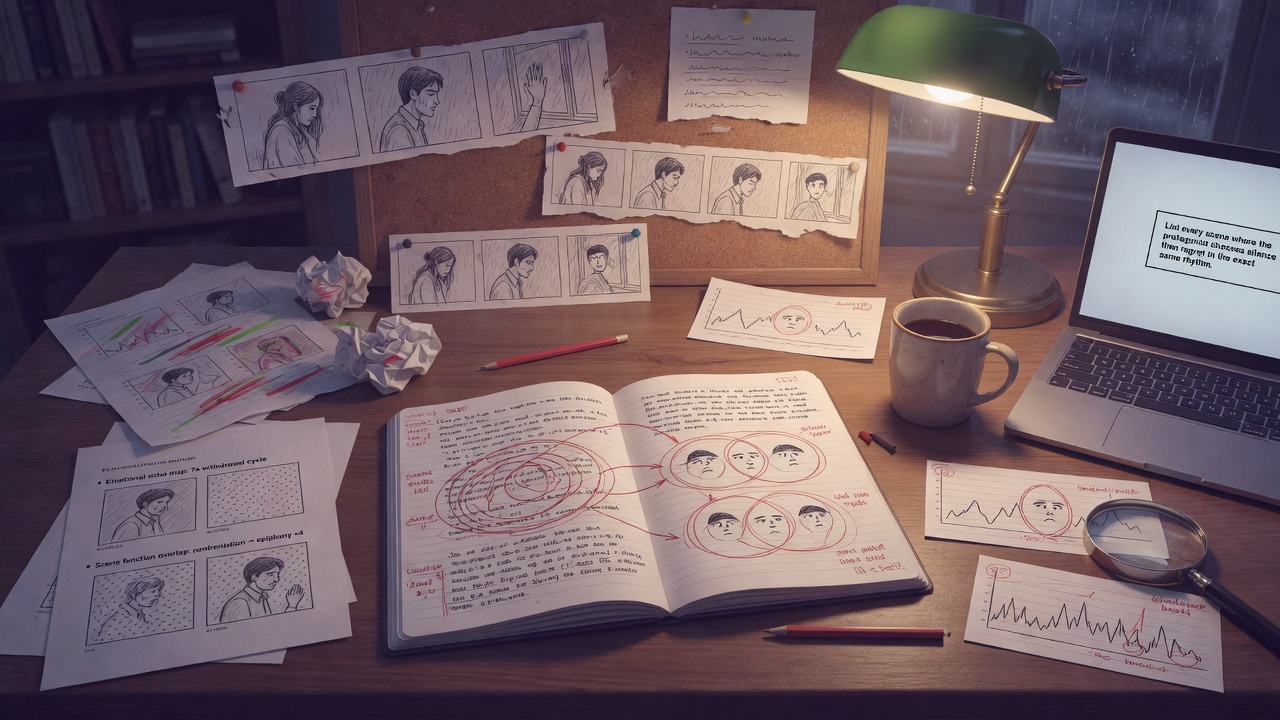
Your protagonist withdraws when confronted. Then withdraws again. Then withdraws a third time in a slightly different setting with slightly different dialogue, but the same interior collapse, the same pulling inward, the same scene resolution where the other character eventually gives up and leaves. Forty thousand words in, readers don't consciously register this pattern. They just stop trusting that anything will change. They stop believing the next scene will deliver something new. That's when the machinery becomes audible.
AI tools are well-suited to catching this class of problem—not because they understand your novel emotionally, but because they're exceptionally good at pattern recognition across large volumes of text when you give them the right framework to work with. The key is knowing what to ask for and how to build the data that makes the audit meaningful.
Why Emotional Repetition Is More Damaging Than Word Repetition
Repeated words are a surface irritant. A reader notices "glanced" too many times and feels mild friction. Repeated emotional beats are a structural problem. They train readers to anticipate resolution before it happens, which kills dramatic tension entirely. Once a reader's unconscious has learned that this character always deflects at the moment of peak vulnerability, the scene loses its capacity to surprise. The reader is waiting for the deflection rather than experiencing the confrontation.
This is particularly dangerous because the repetition usually wears different clothes each time. The settings change. The triggering conflict changes. The specific words exchanged change. What doesn't change is the shape of the scene—the angle of pressure, the moment of avoidance, the way the emotional temperature drops rather than resolves. A human editor reading chapter by chapter often misses it. The pattern only becomes visible at scale, when you're looking at the architecture rather than the sentences.
The other reason emotional repetition is harder to catch is that it often feels like characterization. A character who consistently withdraws under pressure isn't necessarily a victim of lazy writing—withdrawal might be exactly right for who they are. The problem isn't the behavior itself but the failure to vary how the scene handles it: sometimes the withdrawal costs something, sometimes it's challenged by another character, sometimes it backfires, sometimes it works and that creates its own complication. Repetition of behavior is human. Repetition of consequence and resolution is mechanical.
Building an Emotional Beat Inventory
Before you can audit emotional repetition, you need a vocabulary and a dataset. The vocabulary is a set of resolution types—the categories of how a scene ends emotionally rather than narratively. Common categories include:
- Avoidance: The tension is dissolved by a character leaving, changing the subject, or going internal rather than engaging
- Confrontation and rupture: The conflict is spoken and something breaks between characters
- Deflection through humor or irony: Emotional weight is lightened before it can land
- Sacrifice: One character absorbs the emotional cost to protect the other
- Revelation and reframe: New information changes the emotional stakes mid-scene
- Suppression and deferral: The character resolves to deal with it later, and the reader is left in suspension
- External interruption: The scene's emotional work is cut off by plot event rather than completed
You don't need more categories than you can remember. What matters is that you apply them consistently. Write a one-to-three sentence summary of each scene in your manuscript, then feed those summaries to an AI model with the following prompt:
I'm going to give you scene summaries from a novel manuscript. For each summary, identify: (1) the primary emotional conflict at stake in the scene, (2) which character holds the most power at the scene's emotional peak, (3) how the scene resolves emotionally—choose from this list [avoidance / confrontation and rupture / deflection through humor or irony / sacrifice / revelation and reframe / suppression and deferral / external interruption] or suggest a more accurate label if none fits, and (4) whether the resolution feels earned by the scene's internal logic or imposed. After processing all summaries, give me a frequency breakdown of resolution types, flag any resolution type that appears more than three times consecutively, and identify which character name appears most often as the emotional resolution agent (the one who makes the move that ends the scene's tension). Here are the scene summaries: [paste summaries]The output won't be perfect—you'll disagree with some of the labels—but that disagreement is itself useful. When you push back on the AI's categorization of a scene, you're forced to articulate what the scene is actually doing, which sharpens your own diagnostic eye.
Mapping Relationship Patterns Across the Manuscript
Some of the most persistent emotional repetition isn't distributed across all scenes—it's concentrated in specific character pairings. The protagonist and her mother always end in suppression and deferral. The protagonist and her colleague always end in deflection through irony. Once you've mapped this, you can see which relationships are stuck in a groove and which are actually evolving.
The audit here requires a slightly different approach. Instead of feeding all scene summaries at once, filter by character pairing and run the analysis on scenes featuring only those two characters together. The pattern, if there is one, becomes dramatically clearer when you're not looking at everything simultaneously.
I'm going to give you summaries of every scene in my manuscript where [Character A] and [Character B] appear together. I want you to track the following across all of these scenes in order: 1. What does each character want from the other at the start of the scene? 2. Who initiates the emotional escalation? 3. What move does [Character A] make when tension peaks—be specific about the type of move (withdrawal, attack, appeal, humor, silence, revelation, etc.)? 4. How does [Character B] respond to that move? 5. What is the emotional state of each character at scene's end compared to the start? After analyzing all scenes, tell me: Does this relationship follow a recognizable dramatic template? If so, describe the template in one paragraph. Identify which scene, if any, breaks the template—and if none breaks it, flag that explicitly. Then suggest two specific ways the dynamic could be varied in future scenes while remaining consistent with what we know about both characters. Here are the scenes: [paste filtered summaries or excerpts]Pay particular attention to the escalation initiator. If one character always starts the emotional climb and the other always holds or retreats, that imbalance might be intentional—but it might also be a pattern you fell into rather than chose. The AI's job here isn't to tell you what's wrong but to make visible what's habitual.
Auditing the Protagonist's Internal Monologue Structure
Internal monologue is where emotional repetition hides most effectively, because the content changes even when the structure doesn't. Your protagonist faces a new crisis in chapter twelve. The surface content of her internal response is completely new—she's thinking about her father's disapproval rather than her childhood abandonment—but the structure is identical: she catalogs her failures, reaches for a memory, decides the feeling is too large to act on, and returns to the present slightly numb. If that's the shape of every crisis response, readers learn to fast-forward through it.
The following prompt requires you to extract only the internal monologue passages from crisis or high-stakes scenes—moments when your protagonist is alone with her thoughts under pressure. Paste these in sequence without the surrounding scene text.
I'm going to give you a series of internal monologue passages from a novel's protagonist. These passages all occur during moments of high emotional stakes or crisis. I want you to analyze them for structural repetition—not repeated words or images, but repeated thinking patterns. Specifically, identify: 1. Does the protagonist's internal voice tend to move in a consistent direction under pressure (e.g., always toward self-blame, always toward intellectualization, always toward a remembered past moment)? 2. Is there a consistent sequence of cognitive moves—for instance, does she always go from feeling to memory to a resolution to withhold action? Describe the sequence if one exists. 3. Does the length or density of internal monologue correlate with the stakes of the scene, or does it remain roughly constant regardless of how serious the crisis is? 4. Find two passages that are structurally most similar to each other, quote the structural skeleton of each (not the content, just the shape), and explain why a reader might experience them as repetitive even though the content differs. At the end, suggest a contrasting internal monologue structure the protagonist could use in a future crisis scene that would feel like genuine development rather than a new surface on the same pattern. Here are the passages: [paste internal monologue excerpts]Breaking the Pattern Without Breaking the Character
The most common anxiety when writers discover an emotional repetition is that varying it will feel false to the character. If your protagonist always withdraws, how do you write a scene where she doesn't, without making her seem like a different person? The answer is that variation doesn't require abandoning the behavior—it requires changing what the behavior costs, what triggers it, whether it succeeds, and how other characters respond to it.
A character who always withdraws can still withdraw in chapter eighteen. But maybe this time the withdrawal is interrupted and she has to stay in the room. Maybe it works, but what she avoids saying causes damage she doesn't discover until chapter twenty. Maybe another character explicitly calls it what it is and she has to hear herself described. The behavior is consistent; the consequences and complications aren't.
Once you've identified a repeated emotional move, use this prompt to draft a variation:
I have identified a repeated emotional pattern in my novel. In multiple scenes, [describe the pattern specifically—e.g., "my protagonist deflects emotional confrontation by shifting into practical problem-solving mode, which ends the scene with tension unresolved and the other character feeling dismissed"]. I want to write a new version of this scene type that breaks the pattern while remaining consistent with the character as established. Here is what I know about the character that would make simple reversal feel false: [describe relevant character history, psychology, relationships]. Here is the specific scene I want to vary: [paste the scene or a detailed summary]. Please generate three alternative versions of the emotional move at the scene's critical moment. Each version should: - Keep the character's core psychology intact (she is still someone who finds direct emotional engagement difficult) - Introduce a different consequence, complication, or interruption that makes this instance feel distinct from previous iterations - Suggest what this variation would reveal about the character that the repeated pattern has been concealing For each version, briefly explain the dramatic logic—why this variation is available to this character at this point in the story, given what has happened to her before this scene.The three-version approach is important. The first alternative the AI generates is usually the most obvious variation—still fairly close to the original pattern. The second stretches further. The third often surprises you with a possibility that reframes the scene entirely. You're not obligated to use any of them; what you're doing is expanding your sense of what's possible within the character's emotional range.
Making This Part of Your Revision Process
None of this replaces close reading or the judgment of a skilled editor. What AI auditing does is scale pattern recognition in a way that human readers working chapter-by-chapter genuinely can't match. The emotional beat inventory, the relationship map, the internal monologue structural analysis—these are tools for seeing your novel from altitude before you go back in with a scalpel.
The most effective time to run these audits is after a complete first draft, before you begin substantive revision. You want the full manuscript's patterns in front of you so you can see what you actually wrote rather than what you intended to write. The emotional repetitions that damage novels most severely are almost never conscious choices. They're grooves cut by habit, by the character as you first conceived them, by scenes written in isolation from each other over months. The audit makes the groove visible. The variation prompts give you the tools to climb out of it.
Readers rarely articulate why a novel started to feel predictable. They won't tell you "the protagonist's internal monologue always moves from feeling to memory to suppression." They'll just say the middle dragged, or they lost investment, or the ending didn't land. The emotional repetition blindspot is upstream of those judgments—which is exactly why catching it before publication matters more than any word-frequency report ever will.



No comments yet. Be the first to comment!