
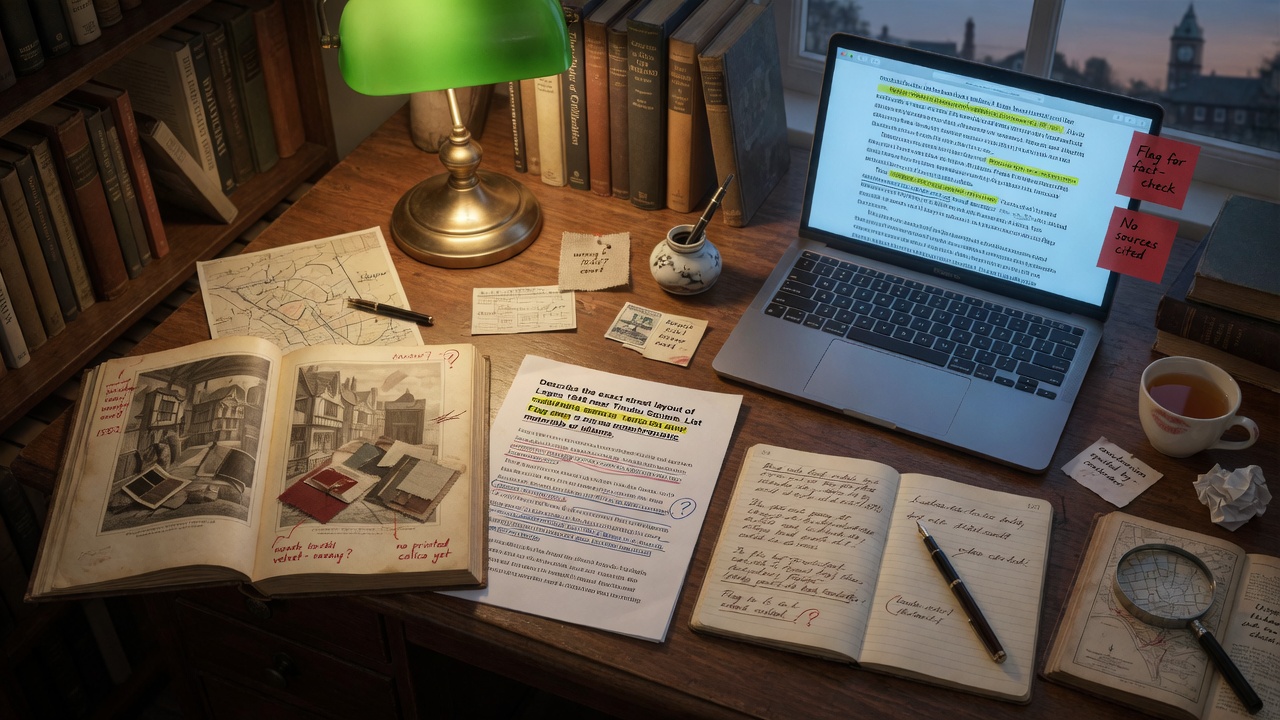
Why AI Is Useful but Dangerous for Setting Research
Historical fiction lives or dies on its texture. The wrong fabric at a Tudor court, an anachronistic idiom in a 1940s Lagos kitchen, a street name that didn't exist until twenty years after your scene is set—these are the details that pull a reader out of the dream and send them to Google. For writers who aren't academic historians or regional insiders, AI looks like an attractive shortcut to that texture. And in some ways, it is. In other ways, it is quietly catastrophic.
The core problem isn't that AI makes things up. Every novelist knows that. The problem is the register in which AI makes things up. A large language model describing the smell of a 1920s Cairo bazaar or the protocol of a Victorian mourning household does so with the same confident, fluent specificity it uses when it's drawing on ten thousand corroborating sources. There is no audible difference between a well-documented claim and a plausible-sounding hallucination dressed in period-appropriate vocabulary.
This is particularly dangerous for three categories of fiction:
- Historical fiction, where specialist readers—including historians, reenactors, and enthusiasts—will recognize fabricated specifics that general readers won't catch
- Regional and place-based fiction, where local readers experience invented geography or misrepresented cultural practice as a form of erasure rather than just inaccuracy
- Diaspora and living-culture stories, where errors about food, language, spiritual practice, or social structure can cause genuine harm to communities whose lives are being represented
The solution is not to abandon AI as a research scaffold. It's to change your relationship with what AI produces—treating it as a first-pass texture generator that you then systematically audit, rather than a reference source you quote into your manuscript.
The Two-Pass Method: Drafting With Detail, Then Auditing for Risk
The two-pass method separates what AI does well (generating plausible period texture quickly) from what it cannot do reliably (confirm that any specific claim is accurate). It's a discipline, not a workflow hack, and it requires treating your first-pass draft as a research artifact rather than a finished scene.
In the first pass, you ask AI to generate a richly detailed scene that gives you the atmospheric scaffolding you need—sensory detail, social dynamics, material culture, language texture. You are not fact-checking at this stage. You are getting a usable draft that's dense enough to work from.
In the second pass, you return to that same AI (or a separate conversation) and ask it to audit the scene it just wrote—or that you've now drafted using its material—flagging every claim that carries factual risk. You are explicitly asking AI to be honest about its own uncertainty, which it can do more reliably when you build that into the prompt architecture than when you assume it will volunteer that information unprompted.
The output of the second pass is not a corrected scene. It's a verification checklist: a prioritized list of the claims in your scene that need to be cross-referenced against reliable sources before the manuscript goes to an editor. This turns an opaque AI-generated draft into a transparent research document with clearly marked gaps.
Prompt Architecture for Setting Detail With Built-In Guardrails
Most writers prompt AI for setting detail the way they'd ask a knowledgeable friend: "Tell me what a market in 1890s Marrakech would have looked like." The problem is that AI responds to that prompt the same way a friend who wants to seem helpful would—confidently, fluently, and without volunteering what they're guessing at.
You need to restructure the prompt so that uncertainty disclosure is baked in as a required output, not an optional afterthought. The following prompt architecture does this for the generative pass:
I'm writing a scene set in [location], [time period], for a literary novel. The scene involves [brief description of what's happening—characters, action, emotional stakes]. Please generate a richly detailed version of this scene's physical and cultural setting—sensory texture, material culture, social atmosphere, ambient language or sound—that I can use as a first-draft scaffold. As you write, apply these constraints explicitly: 1. After any specific factual claim (a named street, a particular food, a dated practice, a piece of material culture, a social custom), add a bracketed confidence tag using one of three labels: [DOCUMENTED] — you are drawing on widely corroborated historical or ethnographic record [PLAUSIBLE] — this fits the period and place but you cannot confirm it is specifically documented [INFERRED] — this is a reasonable extrapolation that an expert might dispute 2. Where you are uncertain about a period-specific detail, offer the detail you think is most likely, but flag it clearly and note what the uncertainty is. 3. Do not smooth over uncertainty by using vague language that hides the gap. If you don't know whether a specific detail is accurate, say so in the tag rather than softening the claim. 4. At the end of the scene, add a section titled FLAGGED FOR VERIFICATION listing every [PLAUSIBLE] and [INFERRED] claim in the order they appeared, with a one-sentence note on what a researcher would need to confirm. The goal is a usable draft scene with a built-in transparency layer, not a polished scene that buries its uncertainty.This prompt does several things at once. It makes uncertainty disclosure a structural feature of the output rather than something you have to excavate. It separates three meaningfully different epistemic states. And it produces the raw material for your verification checklist in the same pass as the scene draft, which means you don't have to reconstruct what was flagged after the fact.
Scene-Level Verification Checklists: Prompts That Produce a Research Hit List
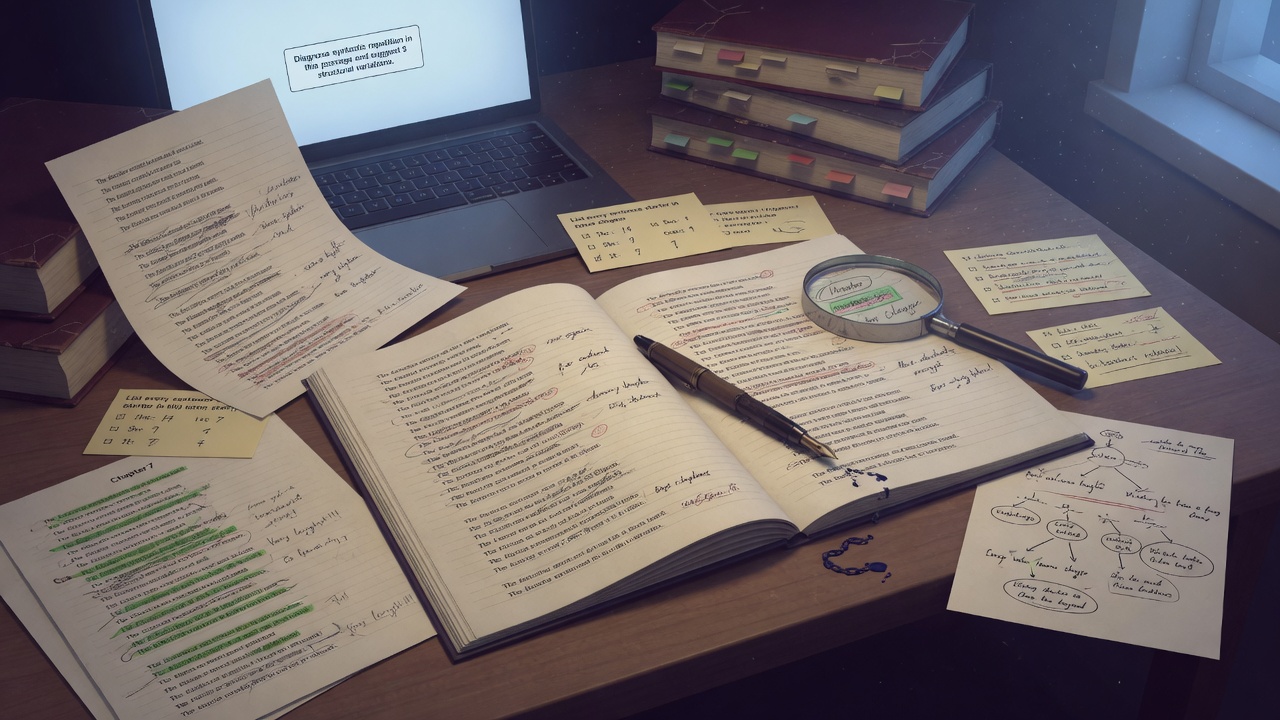
Once you have a drafted scene—whether you wrote it from scratch using AI texture as scaffolding, or you're working with a more direct AI draft—the second pass produces a structured verification checklist. This is a different kind of prompt with a different goal: you're asking AI to read your scene the way a hostile expert reader would.
Below is a scene from my novel set in [location] in [year/decade]. Read this scene as a historical and cultural accuracy auditor, not as a creative collaborator. Your job is to produce a verification checklist, not feedback on the prose. For every factual claim in the scene—material objects, place names, social customs, food, clothing, language, technology, infrastructure, political context—do the following: 1. Identify the claim precisely (quote the relevant phrase or sentence) 2. Assign a risk level: HIGH RISK — if this is wrong, a knowledgeable reader, sensitivity reader, or expert reviewer will notice and it will damage the book's credibility MEDIUM RISK — if this is wrong, it may cause a quiet loss of trust with regional or specialist readers but may not surface as a public error LOW RISK — atmospheric or impressionistic detail that would not constitute a verifiable claim 3. Flag whether you are confident this claim is accurate, uncertain, or unable to verify 4. For every HIGH RISK and MEDIUM RISK claim you are uncertain about, suggest what type of source (primary document, academic monograph, regional archive, living-culture expert) would be the appropriate verification route Format the output as a numbered checklist, HIGH RISK items first, sorted by the order they appear in the scene. Do not summarize. Do not reassure me that the scene is generally plausible. Surface every potential problem. [PASTE SCENE HERE]The instruction to avoid reassurance is not incidental. AI defaults to being encouraging. If you don't explicitly override that tendency, the audit pass will soften its findings—telling you the scene "feels authentic" while quietly burying the three claims that a Nigerian cultural historian would immediately recognize as wrong. Requiring a numbered, risk-sorted list without summary commentary removes the social lubricant from the output.
Calibrating for What Your Readers Will Know
Different books have different audiences, and the risk calculus shifts accordingly. A novel that will primarily be read by general trade readers has a different risk profile than one being published by a press with a strong regional or academic readership, or one that will be reviewed by diaspora publications. You can build this into the audit prompt:
Before generating the verification checklist, factor in this reader profile: [Describe your expected readership—e.g., "primarily general literary fiction readers in the US and UK, but the book deals with Yoruba cultural practices and will likely be reviewed in publications with Nigerian and Nigerian-diaspora readership" or "readers of WWII-era historical fiction who are likely to include enthusiasts with deep knowledge of military logistics and period material culture"] Weight your HIGH RISK flags toward claims that this specific readership is most likely to recognize as errors. A claim that would go unnoticed by general readers but would be immediately visible to specialist or community readers should still be flagged HIGH RISK.Where to Actually Verify: Routing Flagged Claims to Reliable Sources
A verification checklist is only useful if you know where to take it. The AI audit pass will often suggest source types—"consult a regional archive," "check an academic monograph"—but that's abstract guidance. Here's a practical routing framework for the most common categories of flagged claims.
Material Culture and Period Objects
For specific objects—what a lamp looked like, what fabric was available, what a tool was called—the most reliable sources are museum collection databases (the V&A, the Smithsonian, the British Museum all have searchable online collections), period trade catalogs where digitized, and academic dress history or decorative arts journals. Google Books search limited to pre-[date] publications can also surface primary-source confirmation for what contemporaries actually called things.
Place Names, Infrastructure, and Geography
Historic maps are essential and frequently ignored. The David Rumsey Map Collection is free and extensive. National archives for many countries have digitized Ordnance Survey equivalents. For urban settings, local history collections at public libraries often hold street directories that can tell you exactly what existed on a given block in a given decade. This is the category where AI is most confidently wrong, because it will generate plausible street names or neighborhood descriptions that simply did not exist.
Social Custom, Ritual, and Domestic Practice
Academic ethnography published before the period in question is your most reliable source for living-culture details that were documented by contemporaries. JSTOR and university press databases are the appropriate route here—not general web searches, which will surface tourist-facing descriptions that may themselves be inaccurate or decontextualized. For practices that are living traditions rather than historical ones, sensitivity readers with insider knowledge are not supplementary; they are primary.
Language, Idiom, and Dialect
The Oxford English Dictionary's historical record is the standard for English-language anachronism checking—its dating entries for when words and phrases entered documented use are based on primary source citations. For non-English languages, historical dictionaries and academic linguists are the appropriate resource. AI is particularly unreliable on idiom dating, because it will generate period-appropriate-sounding phrases that weren't actually in use.
Living Cultures and Community Knowledge
For fiction involving communities where the author is an outsider—whether that's defined by ethnicity, religion, region, or specific historical experience—sensitivity readers with direct community ties are not a final polish step. They belong in the verification loop alongside academic sources. The distinction matters: academic sources can tell you what was documented; community readers can tell you whether the documented version matches the lived reality, and whether your scene's emotional register rings true.
Building the Verification Habit Into Your Process
The most practical way to use the checklist output is to route each flagged claim into a research log—a simple spreadsheet works—with columns for the claim, the risk level, the source type needed, the source consulted, and the resolution (confirmed, revised, or cut). This transforms the AI audit pass from a one-time document into a living research record that you can hand to a fact-checker, a sensitivity reader, or your editor as evidence that the manuscript's accuracy claims have been actively managed rather than assumed.
The deeper discipline here is resisting the temptation to use fluent AI output as confirmation. A scene that reads as historically plausible is not a scene that has been verified. The two-pass method works precisely because it keeps those two things—plausibility and accuracy—in separate columns, and never lets the first substitute for the second.
Your editor will eventually catch some of what slips through. Expert reviewers will catch more. But readers who live in the world your novel is representing will catch what everyone else misses—and their trust, once broken by a careless specific, is the hardest thing to rebuild.
No comments yet. Be the first to comment!