




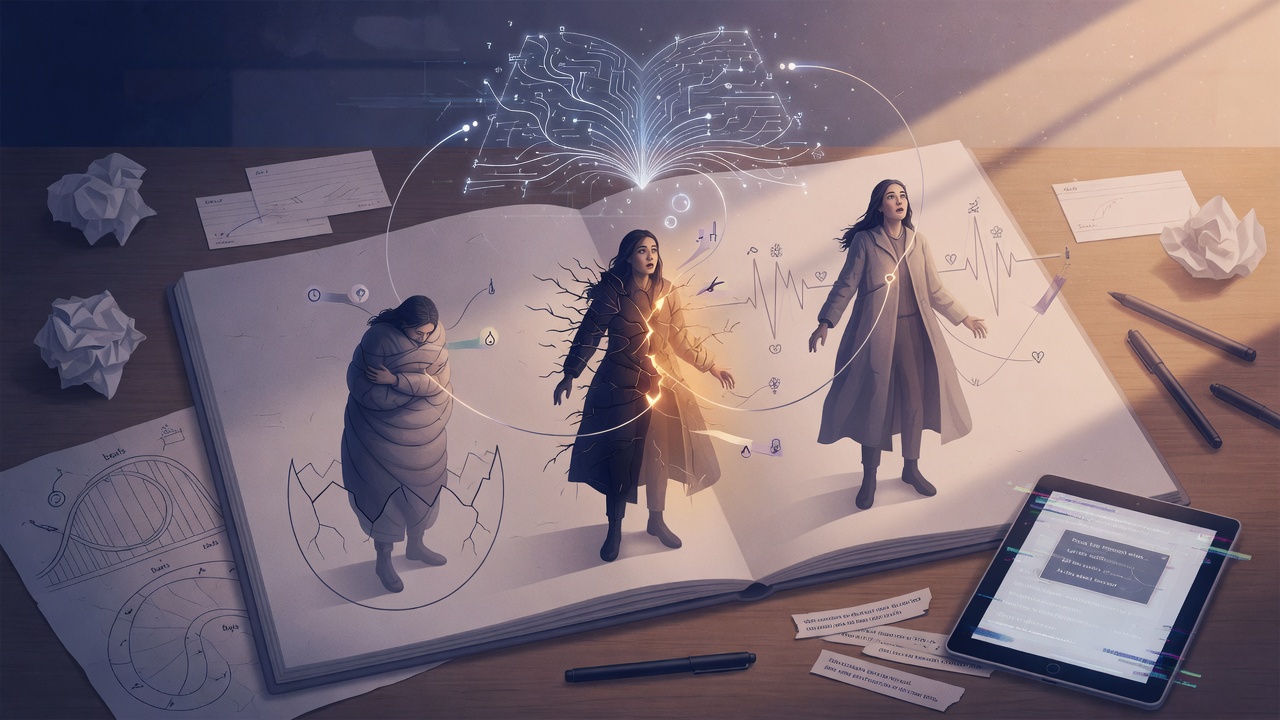
The Transformation Beat Problem Every Novelist Faces
You know your protagonist changes. You've always known it. She starts the book closed off and ends it open to love. He begins convinced the world is transactional and finishes with something resembling faith. The arc is there, baked into your premise. But somewhere between chapter one and your climax, the change becomes more of a declaration than an experience—a summary rather than a series of lived moments. Readers reach the ending and feel the transformation is logical but not earned. They can see the math. They can't feel the accumulation.
This is the transformation beat problem, and it's endemic to novel writing at every level. The good news is that AI tools are specifically well-suited to diagnosing and solving it, because the issue is fundamentally structural and analytical—it requires someone (or something) to hold your entire manuscript in mind at once and ask where the internal changes are actually happening, scene by scene.
Why Transformation Beats Fail: The Montage Problem
In film, a montage communicates change through compression—a sequence of shots, a musical swell, and suddenly the scrawny kid is strong. Readers tolerate this in movies because they're watching time pass. In novels, the equivalent is prose that tells us a character has changed between scenes without showing us the specific micro-moment where the shift occurred. The protagonist goes through a terrible event in chapter eight and then, somehow, by chapter twenty-two, they've quietly become a different person. No single scene did the work. The change happened in the whitespace.
Writers cluster transformation beats for a few reasons. First, the big structural moments—the dark night of the soul, the climax, the resolution—feel like the natural home for internal change, so that's where writers put it. Second, the middle of a novel is already difficult to write, and adding the weight of incremental psychological shift on top of plot mechanics and pacing concerns often gets deferred. Third, most writers are building outlines and drafts around plot events, not around the specific internal shifts those events are supposed to catalyze.
AI tools are well-suited to catching this pattern because they can be asked to look at your manuscript or chapter-by-chapter summary without the familiarity blindness you've developed after months of drafting. They don't already know your character changed. They can audit the evidence.
Defining the Transformation Beat
Before using any prompt, you need a working definition that's specific enough to be useful.
A plot event is something that happens in the external world of the story. A character loses their job, finds a clue, wins an argument.
An emotional reaction is the character's internal response to that event. They feel scared, hopeful, betrayed. Emotional reactions are necessary and valid, but they are not transformation beats.
A transformation beat is a micro-moment where the character's self-concept, core belief, or behavioral pattern shifts incrementally—even slightly. Not "she felt sad," but "for the first time, she considered that her anger might be a habit rather than a response." Not "he was frightened," but "he noticed he was asking for help before the problem was unsolvable, which he had never done before."
Transformation beats operate at the level of how the character understands themselves or the world. They accumulate into an arc. A single beat is almost invisible. Twelve beats across 80,000 words, spaced at structurally sound intervals, create the experience of inevitability readers describe when they say they "believed" a character's change.
A functional arc typically includes these beat types: the inciting wound (the belief or damage that begins the book), the first resistance (the protagonist defending that wound), a crack in the armor (an experience that almost gets through), a false conversion (the character appears to change but hasn't fundamentally), a collapse (the defense fails), the true change (the moment of genuine internal shift), and proof of change (a scene where new behavior demonstrates the arc is complete).
Prompt Set 1: Beat Inventory
The first task is extraction. You need to find every existing transformation beat in your manuscript and map them against your arc structure. These prompts work with either a full manuscript text or a detailed chapter-by-chapter summary.
I'm working on a novel manuscript and need to audit my protagonist's transformation arc. I'll give you either the full text or a detailed chapter-by-chapter summary. Your task is to identify every moment that qualifies as a transformation beat—defined specifically as a moment where the protagonist's self-concept, core belief, or behavioral pattern shifts, even incrementally. Do not flag emotional reactions or plot events unless they contain a genuine internal shift. For each beat you identify, note: (1) the chapter or scene where it occurs, (2) the specific belief or behavior being shifted, (3) the direction of that shift (toward or away from the endpoint of the arc), and (4) which structural beat type it most closely resembles from this list: inciting wound, first resistance, crack in the armor, false conversion, collapse, true change, proof of change. At the end, give me a visual map—even a simple numbered list with chapter numbers and beat types—so I can see the distribution across the manuscript at a glance. Here is my chapter summary / manuscript excerpt: [PASTE TEXT]
Based on the beat inventory you just created, I want you to analyze the distribution. Answer these specific questions: 1. Which acts or quarters of the manuscript are carrying the heaviest concentration of transformation beats? 2. Which beat types from the arc structure (inciting wound, first resistance, crack in the armor, false conversion, collapse, true change, proof of change) are missing or underrepresented? 3. Are there stretches of 15,000 words or more with no transformation beat present? If so, identify them by chapter range. 4. Does the protagonist have any scene in the first quarter of the book that establishes the core wound clearly enough to make the arc legible to a reader from the start? Give me your findings as a diagnostic report, not a list of vague suggestions. I need specific chapter references and concrete gaps.
Prompt Set 2: Gap Diagnosis
Once you have the inventory, the next step is identifying exactly where the emotional flatness is occurring and why. Most manuscripts have two problems: too many beats packed into the final act, and a hollow middle that relies on plot momentum to carry emotional weight it hasn't earned.
I have a transformation beat map for my novel. I'll share it with you now. Based on this map, I need you to diagnose the gap problem in detail. Specifically: - Identify which quarter of the novel (chapters 1-25%, 26-50%, 51-75%, 76-100% of the manuscript) has the fewest transformation beats relative to its word count. - For any 10,000-word-or-longer section that is emotionally flat (no transformation beats present), describe what is likely happening in that section based on context—is it plot mechanics, action sequences, dialogue without internal shift, or something else? - Tell me what beat types are missing from the second quarter of the book specifically, since that's the most common location for the "montage problem." - Suggest which of the missing beat types (from the standard arc list) would be most structurally valuable to add in each identified gap, and explain why those beat types belong at that point in a character arc. Here is my beat map: [PASTE MAP] Here is additional context about my story: [PASTE SYNOPSIS OR NOTES]
Prompt Set 3: Beat Placement Surgery
Gap diagnosis tells you where the problems are. Placement surgery tells you exactly what to do about them—without necessarily adding scenes or word count. Many writers assume fixing the arc means adding chapters. Often, it means retrofitting existing scenes with subtext and internal beat moments that are currently absent.
I need to redistribute transformation beats across my novel without significantly expanding the word count. I'll give you my current beat map, my chapter-by-chapter summary, and the list of gaps identified in my diagnostic. For each identified gap, do the following: 1. Identify one to two existing scenes in that section that could be retrofitted with a transformation beat. Describe specifically what internal shift could be embedded in that scene's existing action or dialogue—not a new event, but a new layer of internal meaning in a moment that already exists. 2. If no existing scene can carry the beat effectively, suggest one new short scene (under 1,000 words) that could be added. Give me the scene's context, the specific beat type it needs to deliver, and two or three concrete details that would make the beat feel organic to the character's situation at that point in the story. 3. For each suggested intervention, tell me what the before-and-after state of the character's belief or self-concept looks like—what does she think/believe/assume before this beat, and what has microscopically shifted after it? Beat map: [PASTE] Chapter summary: [PASTE] Identified gaps: [PASTE] Character arc endpoint (who she is at the end of the book): [DESCRIBE]
Prompt Set 4: Consistency Check Across Voice
The final failure mode is one writers rarely catch in revision: the transformation beats are now correctly placed, but the character's voice and behavior don't actually reflect them. She has an internal shift in chapter twelve, but in chapter fifteen she speaks exactly the way she did in chapter two. The beat happened on the page; it just didn't propagate forward into how she moves through the world.
This is a continuity problem that's almost impossible to catch while inside the manuscript. It requires the kind of cross-referencing attention that makes AI tools genuinely useful for book-length work.
I need to verify that my protagonist's transformation beats are visible in her voice, dialogue, and behavior in the scenes that follow each beat. I'll provide you with my beat map (which notes the chapter of each beat and what internal shift occurred) and excerpts from scenes that come after key beats. For each post-beat scene excerpt I give you, analyze the following: 1. Does the protagonist's dialogue reflect even a slight shift consistent with the beat that came before? Give specific line-level examples of dialogue that is or isn't consistent with her changed state. 2. Does her internal narration (if present) reflect the new belief or self-concept, or is she still operating from her pre-beat assumptions? 3. Are there specific words, phrases, or behavioral patterns she uses in this post-beat scene that would have been impossible or inconsistent with who she was after the beat occurred? 4. Suggest specific line revisions—no more than three per scene excerpt—that would make the post-beat shift visible in her voice without adding exposition or telling the reader she's changed. Beat map: [PASTE] Post-beat scene excerpts (label each with its chapter number): [PASTE]
Making the Work Practical Across a Full Draft
Running these four prompt sets in sequence gives you a complete arc audit. But a few practical notes on implementation:
- Do the beat inventory and gap diagnosis before you start any new drafting. Understanding where your beats are already placed will stop you from doubling down on act three during revision.
- When doing placement surgery, prioritize the space between the 30% and 60% marks of your manuscript. This is where character change most commonly stalls, and it's where readers begin to disengage if they sense the story is running in place emotionally.
- The consistency check is most useful on a completed draft, not a work-in-progress. Run it after you've placed your beats, not while you're still placing them.
- Keep your beat map as a living document throughout your revision process. Update it each time you add, remove, or retrofit a beat, and re-run the gap diagnosis prompt after major revision passes.
What Transformation Mapping Actually Does for Your Story
The goal of this entire process isn't to mechanize your novel or reduce your protagonist's psychology to a checklist. It's to ensure that the change you've always known was coming feels, to your reader, like it was happening all along—quietly, inevitably, in the accumulation of small moments that only reveal their full shape when the arc is complete.
Readers don't consciously track transformation beats. They just know when they feel earned and when they feel announced. Mapping those beats explicitly during revision is how you engineer the experience of the former, even if your first draft gave you the latter.
The montage problem is solvable. It requires seeing your manuscript the way a structural editor sees it—as a sequence of opportunities for internal change, not just a sequence of events. These prompts help you develop that view, systematically and specifically, across the full length of your book.




No comments yet. Be the first to comment!