
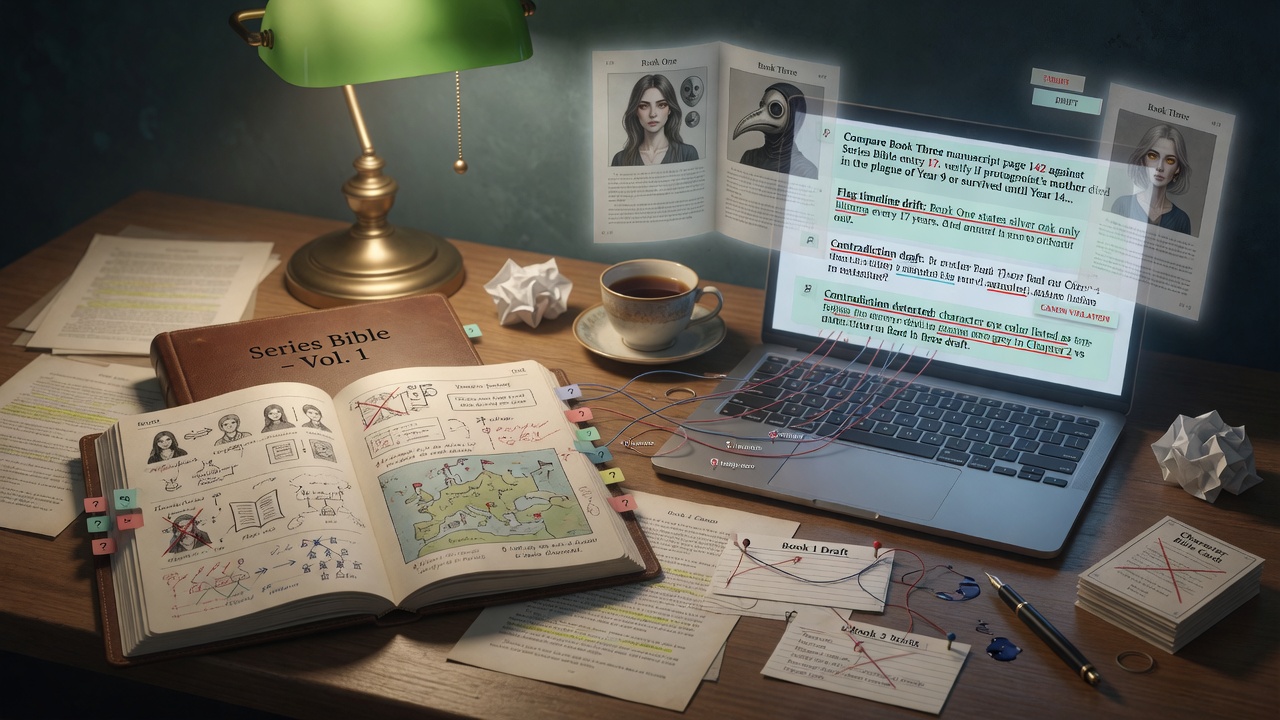
Series Bible Drift Detection: AI Prompts That Catch When Book Three Contradicts Book One
Every long-running series writer knows the feeling. A reader emails you, gently, to point out that in Book One your protagonist's mother died when she was seven, and in Book Three she casually mentions "the year my mom left us" as though it were a different kind of loss entirely. You go back and check. The reader is right. You didn't decide to change the story. You just forgot, three manuscripts later, exactly what you'd written the first time.
This isn't sloppiness. It's what happens to every series bible that isn't actively maintained. Your understanding of your own world deepens as you write more of it, and that deepening quietly rewrites the past. The fix isn't more willpower or a better memory. It's building a repeatable audit process, and AI is unusually well suited to the grunt work involved—pulling facts, comparing documents, flagging inconsistencies at a scale no human editor wants to do by hand for a 400-page manuscript against two prior novels.
Why series bibles decay even when you're careful
The decay isn't random. It follows predictable patterns, and knowing the patterns helps you know where to look.
- Rules get more sophisticated as you understand them better. Your magic system in Book One might be described in broad strokes because you hadn't fully worked it out yet. By Book Three, you understand it so well that you write specific limitations that never existed in the original draft—and that contradict throwaway lines from three years earlier.
- Relationships evolve in your head faster than on the page. You know Character A and Character B have history because you've been living with them, but the reader only knows what's on the page. Sometimes this means you write scenes assuming knowledge that was never actually established, or worse, that contradicts what was established.
- Minor details get "upgraded" without you noticing. A character's job, a town's population, the color of a house—these get restated in later books with more confidence and more specificity than the original vague mention, and confidence plus specificity is exactly how contradictions get created.
- You remember your intentions, not your text. Writers often misremember their own books because they remember what they meant to convey rather than the actual sentence they wrote. This is precisely the gap a language model doesn't have—it can only work from what's actually on the page, which makes it a more reliable canon-checker than your memory.
None of this is a failure of craft. It's an inevitable byproduct of writing long fiction over long timescales. The solution is treating your own back catalog as source material to be audited, not trusted from memory.
Step one: extract a structured bible from what you've already published
Before you can catch drift, you need a clean, structured record of what your existing books actually say—not what you think they say. This means feeding your manuscripts to an AI tool and having it extract facts systematically, book by book, category by category.
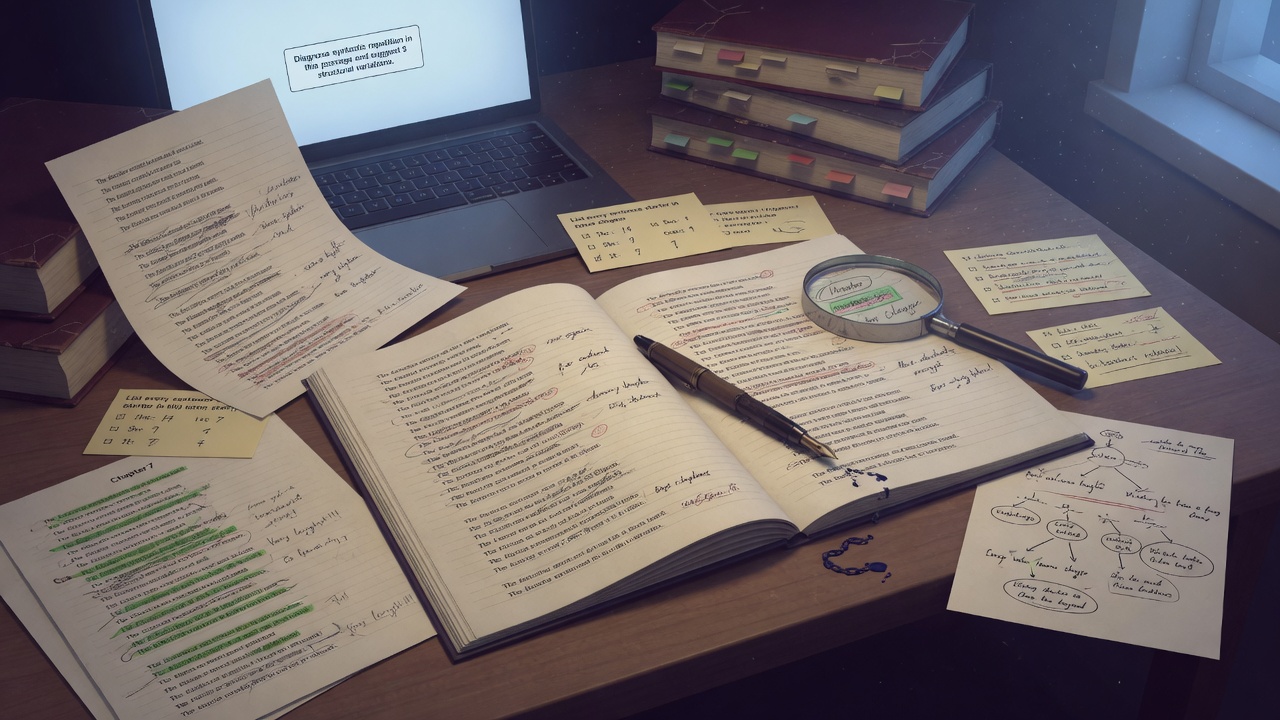
I'm going to paste the full text of Book One of my series [or work through it in sections if it's too long for one pass]. Read it as a continuity auditor, not a literary critic. Your job is to extract every concrete, checkable fact stated or clearly implied in the text, organized into these categories: 1. CHARACTER FACTS: ages, birthdates, physical descriptions, family relationships, histories, stated skills or limitations, anything about their past mentioned in dialogue or narration. 2. WORLD RULES: how magic/technology/politics/social systems are described to function, including any stated limitations or costs. 3. TIMELINE MARKERS: any specific reference to how much time has passed, seasons, ages at specific events, "it had been X years since Y." 4. RELATIONSHIPS: who knows what about whom, who has met whom, the stated history between any two named characters. 5. SETTING DETAILS: specific, statable facts about locations—population, geography, distances, layout—that could be contradicted later. For each entry, include the exact quote or a close paraphrase and note which chapter it appears in. Do not interpret or infer beyond what's stated—if something is ambiguous, flag it as ambiguous rather than resolving it for me. I want this to be a literal record of the text, not your interpretation of the story's "true" facts.Run this same prompt against Book Two once it's complete, and you now have two structured documents instead of one messy memory. The value here isn't just organization—it's that the extraction process itself often surfaces internal contradictions between Book One and Book Two that you never noticed, because you're seeing the facts stripped of narrative context, sitting next to each other in a list.
Once you have both extracts, ask for a merge pass:
I'm providing two structured fact extracts, one from Book One and one from Book Two of my series. Merge them into a single reference document organized by the same five categories. Where a fact from Book Two adds detail to a Book One fact, combine them and note the addition. Where a fact from Book Two seems to contradict a fact from Book One—even a small, easily-missed contradiction like a stated age, a description, or a rule about how something works—flag it explicitly in a separate "POTENTIAL CONTRADICTIONS" section at the end, quoting both instances side by side. Don't resolve the contradictions or guess which one is correct. Just surface them clearly so I can decide.This merged document becomes your working series bible going forward—not a bible you wrote from memory at the start of the project, but one built from what you actually published, which is the only version that matters to your readers.
Cross-referencing your new manuscript against the bible
With a clean bible extract in hand, the real work begins once you have draft pages of Book Three. Rather than trying to hold two prior novels in your head while drafting, you offload the comparison to a structured pass after each chapter or every few chapters.
Here is my series bible extract [paste the merged document from Books One and Two]. Here is a new chapter from Book Three [paste chapter text]. Compare the chapter against the bible fact by fact. Flag anything in the new chapter that: - States a fact that directly contradicts something in the bible (e.g., a different age, a different account of an event, a rule stated differently) - States a fact that is inconsistent with the bible without being a direct contradiction (e.g., implies more time has passed than the bible timeline allows, or implies a character has skills not previously established and not explained as newly acquired) - Introduces a new "fact" about something the bible left ambiguous, in a way that forecloses other interpretations the reader might have reasonably held For each flagged item, quote the bible entry and the manuscript passage side by side, and rate your confidence that this is a genuine contradiction versus a plausible extension of established canon. Do not flag stylistic differences or new information that simply adds to what's known without contradicting it.Running this after every few chapters, rather than waiting for a full draft, keeps the check cheap and catches problems while they're still easy to fix—before you've built forty more pages on top of a wrong assumption about a character's age or a magic system rule.
Deciding what's an accidental error versus an intentional retcon
Not every flagged contradiction needs to be fixed by conforming to the earlier book. Sometimes the later book is right and the earlier one was a mistake you're happy to quietly correct. Sometimes the contradiction is dramatically useful—an unreliable narrator, a character's faulty memory, a deliberate revision the plot can lean into. The AI can't make this creative judgment for you, but it can help you think through the options clearly instead of defaulting to panic-fixing everything.
I've identified a contradiction between my series bible and my current manuscript: [describe the specific contradiction, quoting both versions]. Walk me through the possible ways to handle this, without recommending one as "correct." I want you to lay out: 1. What it would take to fix the new manuscript to conform to the original established fact—how disruptive is this to the current scene and any scenes that build on it? 2. What it would take to retroactively address this in a future edition or reprint of the earlier book, and how noticeable that change would be to readers who've already read it. 3. Whether this contradiction could plausibly be explained in-story—for example, could the original statement be attributed to a character's incomplete knowledge, a lie, faulty memory, or a translation/framing device already present in the series? Be specific about whether this explanation would need to be added explicitly or could be left implicit. 4. What a reader who has closely followed the series would most likely assume happened, and whether leaving the contradiction unaddressed risks feeling like an error versus a deliberate narrative choice. Don't pick an option. Just lay out the tradeoffs clearly so I can decide based on what serves the story I'm trying to tell in Book Three.This kind of prompt is useful precisely because it resists giving you a single answer. The decision about which contradictions are worth turning into story material—versus which are simply errors to quietly correct—is a craft judgment that belongs to you. What the AI can do is make sure you're seeing the full menu of options instead of just reflexively rewriting the newer text to match the older one, which is the default but not always the best move.
Building a drift log that protects Book Four
The final piece of this workflow is making sure the work you do on Book Three doesn't evaporate before Book Four. Every decision you make about a contradiction—fix it, leave it, explain it in-story—needs to be recorded somewhere, or you'll be relitigating the same continuity questions in eighteen months with no memory of how you resolved them the first time.
Create a drift log entry for the following continuity decision I just made in Book Three: [describe the contradiction, the resolution you chose, and your reasoning]. Format the entry as: - ORIGINAL FACT (Book/Chapter): - CONTRADICTING FACT (Book/Chapter): - RESOLUTION CHOSEN: - REASONING: - IMPLICATIONS FOR FUTURE BOOKS: anything a future installment needs to respect about this decision, including whether the "true" version is now the original, the new version, or an in-story explanation that must be maintained consistently going forward. Keep this entry concise enough that I can scan a growing list of these without rereading full context each time, but complete enough that six months from now I won't have to reconstruct my reasoning from scratch.Over a series of four, five, six books, this log becomes as valuable as the bible itself—arguably more valuable, because it's the record of every judgment call you've made about where canon bends and where it holds firm. Feed this log back into your Book Four bible-comparison pass, and you're no longer just checking against the original two books; you're checking against every accumulated decision, which is exactly the kind of layered, high-volume cross-referencing that makes this work tedious for a human editor and straightforward for an AI system built to hold and compare structured text.
None of this replaces your judgment about what your story needs. It replaces the unreliable, quietly decaying memory you'd otherwise be relying on to make those judgments in the first place. A series bible that's actively audited against each new manuscript is the difference between readers trusting your world enough to stop noticing the mechanics, and readers emailing you, politely, to point out that your protagonist's mother apparently died twice.
No comments yet. Be the first to comment!