

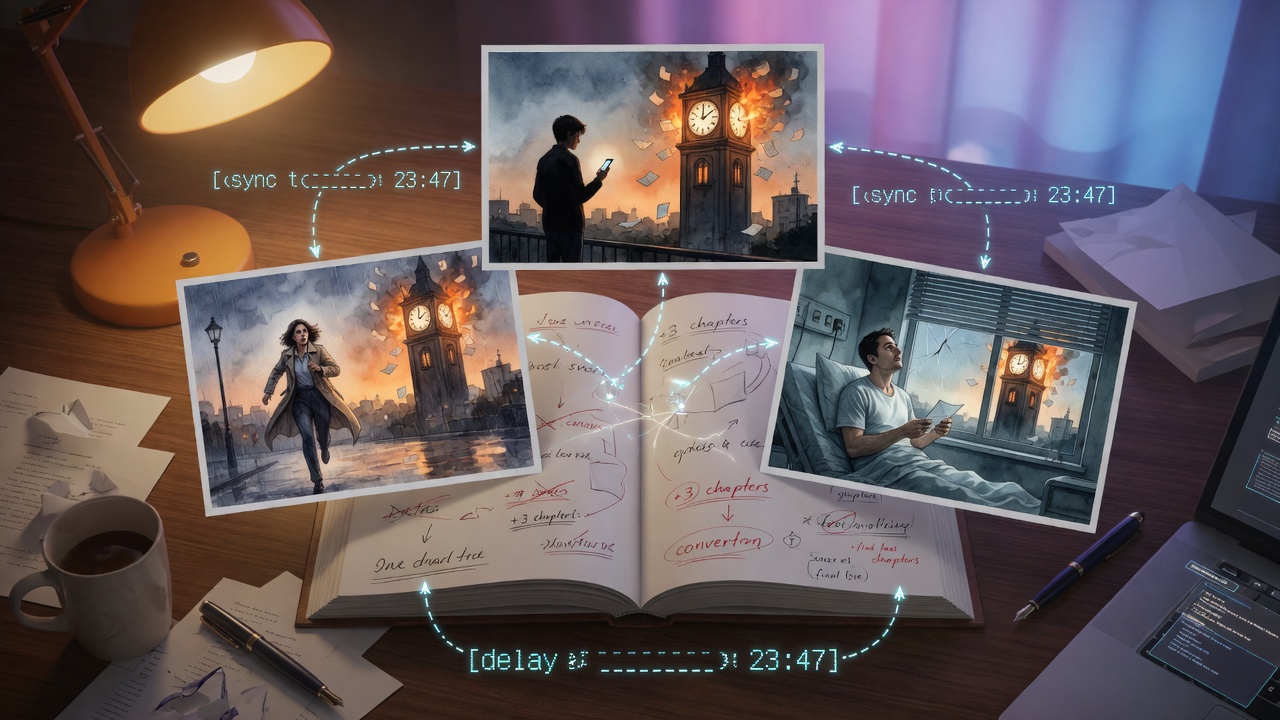
Nonlinear timelines fail in outline meetings, not in prose revisions. By the time a beta reader says "I got lost around chapter twelve," the damage was baked in months earlier, when you decided a flashback belonged there because it felt right rather than because the reader needed it there. Prose-level fixes—smoother transitions, clearer date stamps—can't repair a structural problem. If scene fourteen assumes the reader knows something they won't learn until scene twenty-two, no amount of transitional polish saves that sequence. The fix has to happen at the level of order, not sentence.
This is where AI earns its keep for writers working in dual timelines, fractured chronology, or flashback-heavy structures. Not by generating your plot, but by doing the tedious cross-referencing work your brain resists: tracking two timelines simultaneously, checking dependency order, and flagging the moments where a jump exists because you wanted a change of scene rather than because the story demanded it.
The Two-Column Grid: Chronological Order vs. Narrative Order
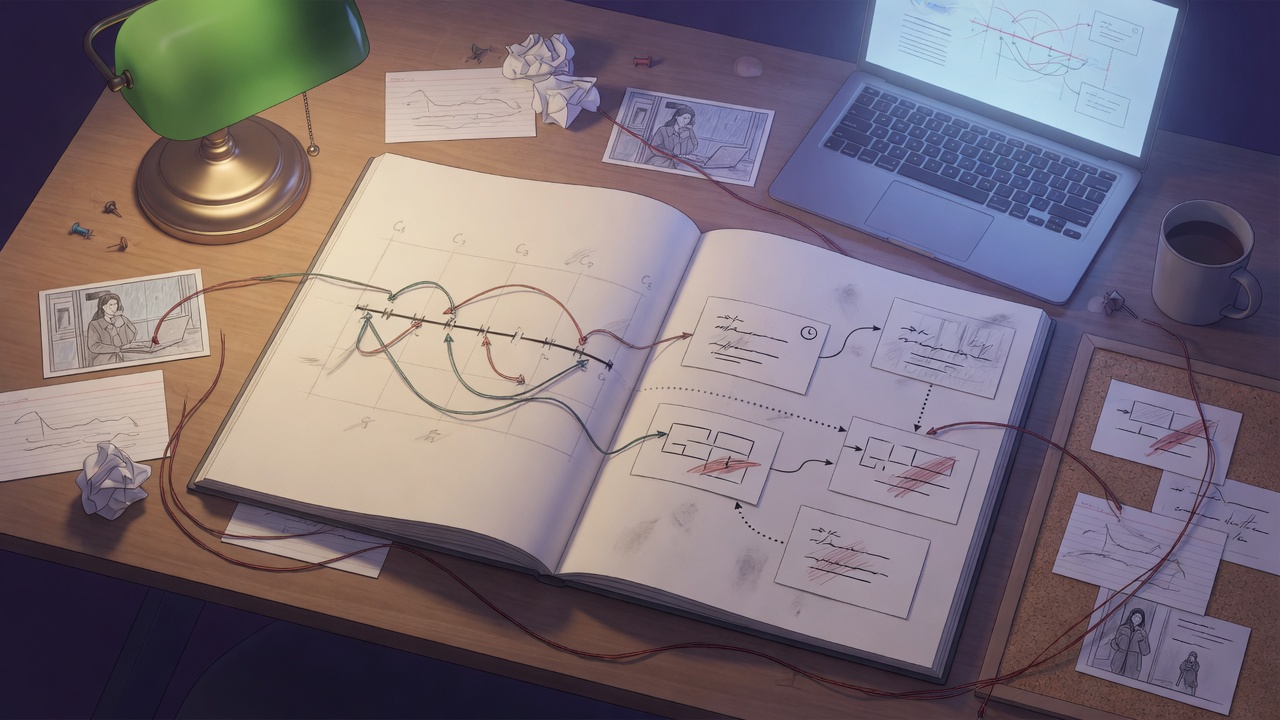
Every nonlinear novel has two timelines running at once. There's chronological order—the sequence in which events actually happened to your characters—and narrative order, the sequence in which you're presenting those events to the reader. Readers experience narrative order. You, as the architect, need to hold both in your head simultaneously, which is exactly the kind of dual-tracking that gets fuzzy after scene thirty.
Build a grid. One column lists every scene in chronological (in-world) order. The second column lists the same scenes in the order they'll appear on the page. AI is useful here not because it knows your story better than you do, but because it can hold both columns without losing track, and it can be blunt about mismatches you've talked yourself out of seeing.
Start by feeding your full scene list with timeline tags—Past A, Past B, Present, or whatever labels fit your structure—and let the model build both columns from that raw list. This becomes the reference document you'll interrogate in every subsequent pass.
Prompt 1: Dependency Check Across Threads
The most common nonlinear failure is a present-day scene that leans on information the past thread hasn't delivered yet. The writer knows the backstory, so the dependency feels invisible. The reader doesn't know it, and the scene reads as confusing or unearned. This prompt catches that gap before beta readers do.
I'm outlining a novel with multiple timelines. Below is my full scene list in NARRATIVE order (the order readers will encounter them), with each scene tagged by timeline: [Past A / Past B / Present]. For each scene, I've included a one-line summary of what happens and what the reader would need to already know for the scene to land as intended. [PASTE SCENE LIST WITH TIMELINE TAGS AND ONE-LINE SUMMARIES] Go through this list in narrative order, scene by scene, and identify any scene that depends on information, context, or emotional stakes that haven't yet been delivered to the reader at that point in the NARRATIVE order—even if that information exists earlier in the CHRONOLOGICAL order of another thread. For each flagged scene, tell me: 1. What the scene assumes the reader already knows 2. Where that information currently appears (which scene, which thread) 3. Whether the fix is to move the informing scene earlier, move this scene later, or add a brief contextual cue in this scene itself Do not flag scenes where withheld information is clearly intentional mystery (i.e., a question the reader is meant to be holding, not a confusion they're meant to be spared). Distinguish between "the reader doesn't know this yet, and that's suspense" and "the reader doesn't know this yet, and that's a hole."
The last instruction matters. Not every unresolved gap is a bug—withheld information is often the entire engine of nonlinear storytelling. You're asking the model to separate load-bearing mystery from accidental confusion, which requires it to reason about reader psychology, not just sequence logic.
Prompt 2: Does Each Flashback Answer an Active Question?
The single best test for whether a flashback earns its place: does it answer a question the present-day reader is actively holding? Not a question they might have, or one you think they should have—an active, currently-open question generated by what just happened in the present-day thread. Flashbacks that arrive without an active question attached read as detours. Flashbacks that answer one read as momentum.
Here is my manuscript's flashback structure. For each flashback scene, I've listed: the present-day scene immediately preceding it, a summary of the flashback content, and the present-day scene immediately following it. [PASTE LIST: PRECEDING PRESENT SCENE / FLASHBACK SUMMARY / FOLLOWING PRESENT SCENE] For each flashback, identify: 1. What specific question, doubt, or curiosity the preceding present-day scene has planted in the reader's mind (be precise—not "the reader wonders about her past" but the exact question implied) 2. Whether the flashback content directly answers that specific question, partially answers it, or answers a different question entirely 3. If the flashback answers a different question than the one just planted, tell me what question it WOULD pair well with, based on the rest of the manuscript, and whether relocating it there is feasible Flag any flashback where the honest answer is "this delivers backstory the reader wasn't asking for at this moment." Those are the scenes most likely to read as pacing drags, regardless of how well-written the prose is.
This prompt tends to surface an uncomfortable pattern: flashbacks placed because the writer needed the reader to know something structurally, not because the reader was hungry to know it narratively. Those two motivations produce very different reading experiences, and only one of them keeps pages turning.
Prompt 3: Tracking Reveal Debt
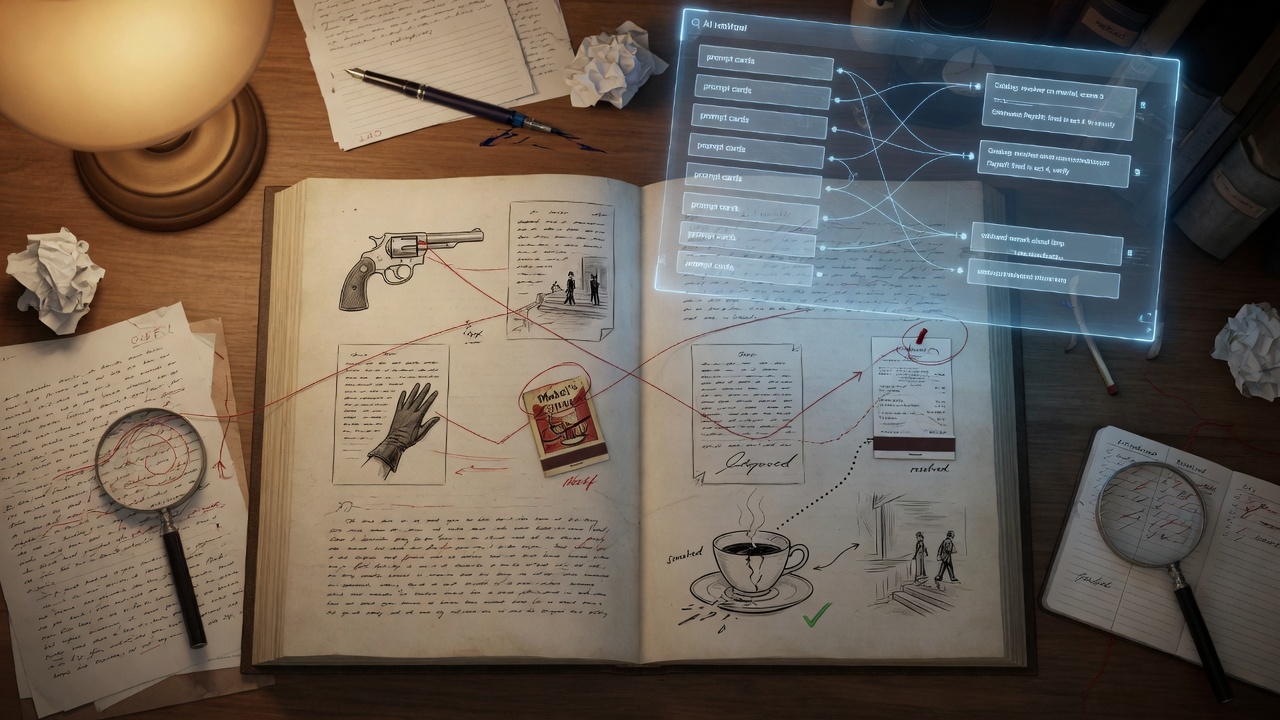
Every mystery you plant in the present timeline that only the past timeline can resolve is a form of debt. You've made a promise to the reader—something is being withheld—and that promise has to be paid off within a window the reader will tolerate. Wait too long, and the reader stops actively wondering and starts passively waiting, which reads as sluggishness even if the eventual reveal is strong.
I want you to map "reveal debt" across my manuscript—instances where the present-day timeline poses a question or mystery that can only be resolved by information from a past timeline. Here is my scene list with timeline tags and brief summaries in narrative order: [PASTE FULL SCENE LIST] For each mystery or open question you identify in the present-day thread, tell me: 1. The chapter/scene where the question is first raised 2. The chapter/scene where it's resolved (via a past-timeline reveal) 3. The gap between them, in chapter count 4. Whether that gap feels sustainable given the size and weight of the question (a minor curiosity can wait 20 chapters; a question tied to the protagonist's core wound usually can't wait past 8-10 without reader fatigue—use your judgment on proportionality, not a fixed rule) Flag any reveal debt that's outstanding for an unreasonably long stretch, and suggest either: moving the resolving flashback earlier, adding a partial/incremental reveal partway through the gap to keep the question active rather than dormant, or reconsidering whether the mystery needs to exist at all if it can't be resolved in a timely way.
The partial-reveal suggestion is often the most useful output here. Long gaps aren't always fatal if you drip incremental information along the way—a detail, a reaction, a half-answer that keeps the question warm instead of letting it go cold. AI is decent at spotting where those mid-gap touchpoints could be inserted without requiring you to move the entire flashback.
Prompt 4: Simulating First-Time Reader Confusion at Transitions
You already know when each scene takes place. That knowledge makes it nearly impossible to judge, from inside your own head, whether a transition is clear enough for someone encountering it cold. This prompt asks the model to role-play the first-time reader specifically at the moment of each timeline jump—the two or three sentences immediately surrounding the cut.
Act as a first-time reader encountering this manuscript with no prior knowledge of the story. I'm going to give you the final few sentences of one scene and the opening few sentences of the next scene, where a timeline jump occurs (from one time period to another). For each transition, tell me: 1. Within the opening 2-3 sentences of the new scene, what cues (if any) signal that a timeline jump has occurred—date references, age references, tense shifts, changed relationship dynamics, physical descriptions that imply a different time period, etc. 2. On a scale of 1-5, how quickly would a first-time reader register "we've jumped timelines" (1 = instant and clear, 5 = they'd read a full paragraph or more before realizing something's off) 3. If the score is 3 or worse, suggest the minimal addition needed to clarify the jump WITHOUT resorting to an explicit date header or "Ten years earlier" tag—use texture, not signage [PASTE TRANSITION PAIRS: END OF SCENE A / START OF SCENE B, REPEATED FOR EACH TIMELINE JUMP IN THE MANUSCRIPT]
The instruction to avoid explicit date headers is deliberate. Overt signage ("Fifteen Years Earlier") works, but it's a blunt instrument, and manuscripts that lean on it exclusively often have transitions that couldn't stand on their own. Testing whether the prose itself carries enough cues—a different job title, a character who's since died, a shift in how two people address each other—reveals whether your scene-level craft is doing its job or whether you've been relying on formatting to do work the writing should be doing.
The Failure Patterns These Prompts Surface
Run these four prompts across a full manuscript and a few recurring problems tend to surface regardless of genre. The first is backstory dump disguised as flashback—past-timeline scenes that exist to inform the reader rather than to create dramatic irony. The distinction matters: a flashback that lets the reader know something the present-day character doesn't yet know (or has forgotten, or is lying to themselves about) creates irony and tension. A flashback that simply explains "here's why she is the way she is" is exposition wearing a scene's clothing.
The second pattern is present-day stall—chapters where the current timeline stops advancing its own plot because all the narrative energy has been shifted to the past thread. Readers invested in the present-day stakes feel the story go quiet even while events are technically happening on the page, just in the wrong timeline.
The third is clustering: timeline jumps bunched together in one stretch of the book and absent for long stretches elsewhere, rather than paced with intention. Uneven jump frequency reads as structural indecision even when each individual jump is well-executed.
From Audit to Revision Plan
Once these prompts have flagged the dependency gaps, the flashbacks answering the wrong question, the overdue reveal debt, and the muddy transitions, the actual revision work is mechanical: reorder scenes on the grid, cut flashbacks that don't answer an active question, insert partial reveals into gaps that ran too long, and add texture-level cues at transitions that scored poorly on the confusion test. None of that requires rewriting your story—it requires rearranging and trimming what you've already built, informed by a reader-simulation you couldn't run on your own because you already know how the story ends.
No comments yet. Be the first to comment!