

Every multi-POV novel has the same math problem hiding in its final act. You've got four or five characters each on their own trajectory, each with their own information, their own obstacles, their own reasons for moving. And somehow, on page 380, they all need to be in the same room—or at least the same moment—when it matters most. Writers solve this constantly, but they solve it badly more often than they'd like to admit. The seams show. Someone's storyline had to sit idle for sixty pages so the timing would work. Someone else covered three days of travel in what reads like an afternoon. The convergence happens, technically, but readers feel the gears grinding.
This is a structural problem, not a prose problem, which makes it exactly the kind of thing AI tools are good at helping you audit. Not write—audit. You still need to know your characters, your geography, your stakes. But an AI can hold five timelines in its head simultaneously and flag the math errors your brain glosses over because you've been staring at this manuscript for eight months. Here's a working system for using AI prompts to engineer a convergence that reads as inevitable rather than lucky.
Start With Trigger Points, Not Endpoints
The mistake most outlines make is working backward from the climax scene without first identifying what individually sets each character in motion toward it. You know where everyone needs to end up. What you often haven't mapped is the specific moment—the trigger—that puts each POV thread on a collision course. If you can't name that moment for each character, your convergence is going to feel authorial rather than causal.
Before you touch timeline math, get an AI to help you isolate these triggers thread by thread. The goal here isn't generation, it's diagnosis—you want the tool reading your existing draft or outline and telling you where the ignition point actually is for each character, because writers are often wrong about where their own trigger points sit. You think the character decided to act in Chapter 12; the AI reads it and points out the actual decision doesn't happen until Chapter 15, which throws off everything downstream.
Why This Step Gets Skipped
Writers tend to think in terms of the climax scene itself—who's standing where, who says what—and treat the path there as a matter of pacing rather than causality. But pacing problems in a convergence are almost always causality problems wearing a disguise. If a character's trigger point is mushy or arrives too late relative to the others, no amount of timeline adjustment will make the ending feel earned. Fix the ignition first.
The Timeline Math Problem
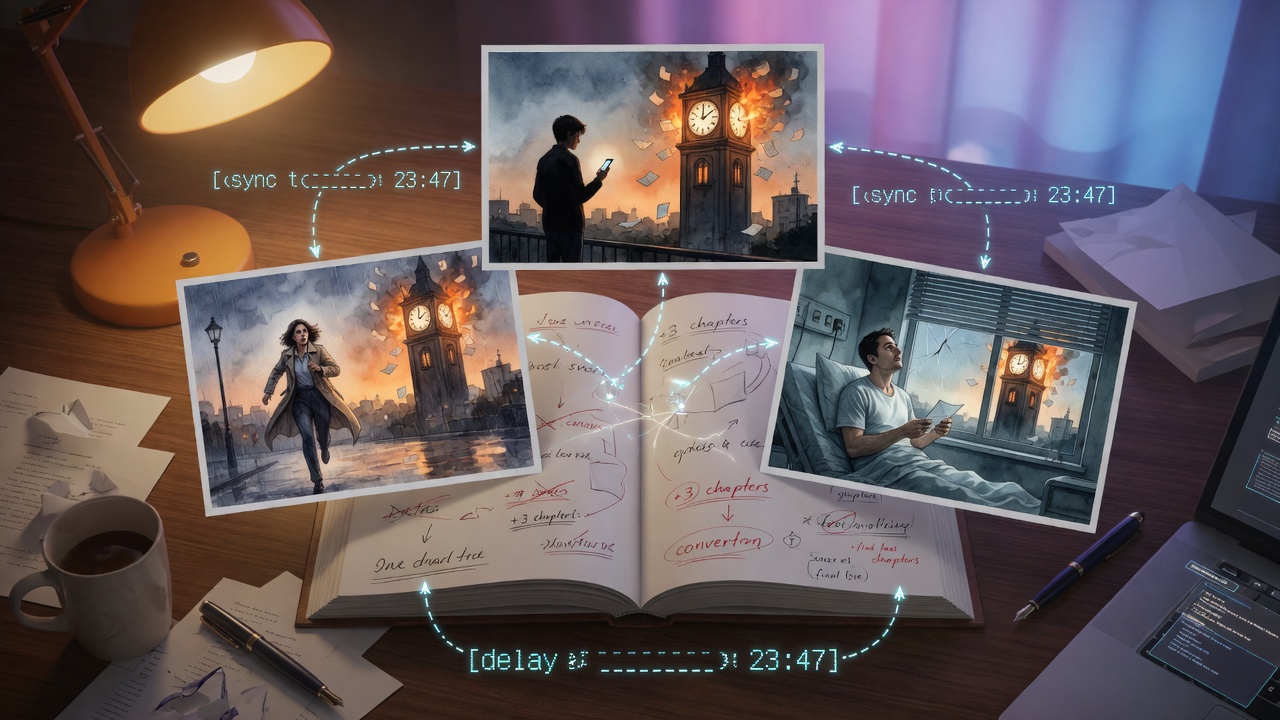
Once you know what sets each thread moving, you need to check whether the actual mechanics of arrival hold up. This is where most multi-POV climaxes quietly fail. A character in one storyline receives news by letter that, realistically, would take four days to arrive—but the plot needs her at the convergence point in two. Another character has to travel across a mountain range in the time it takes his counterpart to walk across town. Readers may not consciously clock the exact math, but they feel when something's been fudged, and that feeling reads as "convenient" even when they can't articulate why.
This is the single most valuable place to bring in an AI collaborator, because checking travel time, information lag, and decision points across four or five simultaneous threads is tedious, detail-heavy work that benefits from a second set of eyes that isn't emotionally attached to the outcome you want.
I'm going to give you a breakdown of [NUMBER] POV threads in my novel, each with its starting point, the trigger event that sets it in motion, and the mode of travel or communication involved. For each thread, list: 1. Total realistic time required to reach the convergence point, accounting for travel method, distance, obstacles, and any required rest, waiting, or decision-making periods. 2. Any information that must pass between characters before they can act (letters, messengers, overheard conversations, etc.) and how long that transmission would plausibly take given the technology and world established in my story. 3. Points where the thread could be delayed or accelerated by an external event, and whether such an event currently exists in my draft or needs to be added. Then cross-reference all threads against each other and flag any pair where the timing doesn't logically permit simultaneous arrival at the climax. Be specific about the discrepancy in hours, days, or scenes— don't just say "this seems off," tell me the actual gap. THREAD DATA: [Paste your thread-by-thread breakdown: character name, starting location, trigger event and chapter, mode of travel/communication, any known obstacles, target arrival chapter]
What you get back from a prompt like this isn't prose, it's a punch list. Thread B is fine. Thread C has a two-day gap you haven't accounted for. Thread D's information relay depends on a courier who was killed off in Chapter 9. These are the kinds of errors that hide in plain sight during drafting because you're focused on scene quality, not spreadsheet logic. Let the AI do the spreadsheet logic so you can go back to focusing on scene quality once the math is sound.
Deciding Who Arrives First
Once the math checks out—or once you've adjusted it so it does—you face a dramaturgical question that's separate from logistics: who should get there first, who should arrive last, and who should interrupt whom. This is not a neutral choice. The order of arrival is one of the primary tools you have for controlling tension in a convergence scene, and it's frequently decided by accident, based on whichever thread the writer happened to be drafting in sequence rather than by what creates the most dramatic pressure.
Think about what each possible order actually does. If your protagonist arrives first and has to hold the line alone before help comes, you get a scene built on endurance and isolation. If the antagonist arrives first and the protagonist walks into a trap already sprung, you get a scene built on disadvantage and reversal. If a secondary character arrives in between—too late to prevent the worst thing, early enough to change what happens next—you get a scene built on partial rescue and complicated relief. These are different scenes with different emotional textures, and you can build any of them from the same set of raw threads depending on sequencing alone.
This is a place where an AI is useful less for calculation and more for generating options you wouldn't naturally reach for, because writers tend to default to the arrival order that matches their outline notes rather than testing alternatives.
Here are my POV characters converging on the climax of my novel, along with what each one wants, what each one knows or doesn't know at the moment of arrival, and what's physically or emotionally at stake for them in this scene: [List each character: name, goal at convergence, key piece of information they have/lack, personal stake in outcome] Generate four different possible arrival sequences for these characters (who arrives first, second, third, etc., and whether any arrivals overlap or interrupt one another mid-action). For each sequence, explain: - What dramatic tension this order creates that the others don't - What each character would be forced to do or decide because of their position in the sequence - Which existing plot threads or character arcs this order would serve best, and which it would undercut - What the emotional experience would be for a reader encountering events in this order versus the others Do not recommend a single "best" answer—lay out the tradeoffs of all four so I can choose based on what my story needs.
The value of this prompt is that it forces you to see your convergence as a set of design choices rather than a fixed sequence you're merely executing. Writers who skip this step often default to arrival orders that are logistically convenient rather than dramatically potent—the character who happens to be closest gets there first, rather than the character whose late arrival would generate the most tension. Running four alternatives side by side, with explicit tradeoffs, tends to surface an option you hadn't consciously considered but immediately recognize as stronger once it's on the page in front of you.
The Coincidence Test
Even after the math works and the sequencing serves the drama, you have one more diagnostic to run, and it's the one most manuscripts fail on first pass: does the convergence feel earned, or does it feel lucky? Readers have a finely tuned sense for the difference between events that were set up chapters earlier and events that just happen to work out. A convergence that depends on a character "just happening" to take a particular road, or a message "just happening" to arrive at the right moment without prior establishment, reads as authorial convenience even if the timeline math is technically sound.
This is a subtler problem than the timing issue, because it's not about hours and distances, it's about causality and foreshadowing. The fix isn't necessarily to change the convergence—it's often to go back into earlier chapters and plant the setup that makes the convergence feel inevitable rather than fortunate. But you can't plant what you can't see, and writers are notoriously bad at spotting their own coincidences because from the inside, the story just feels like it's happening the way it happens.
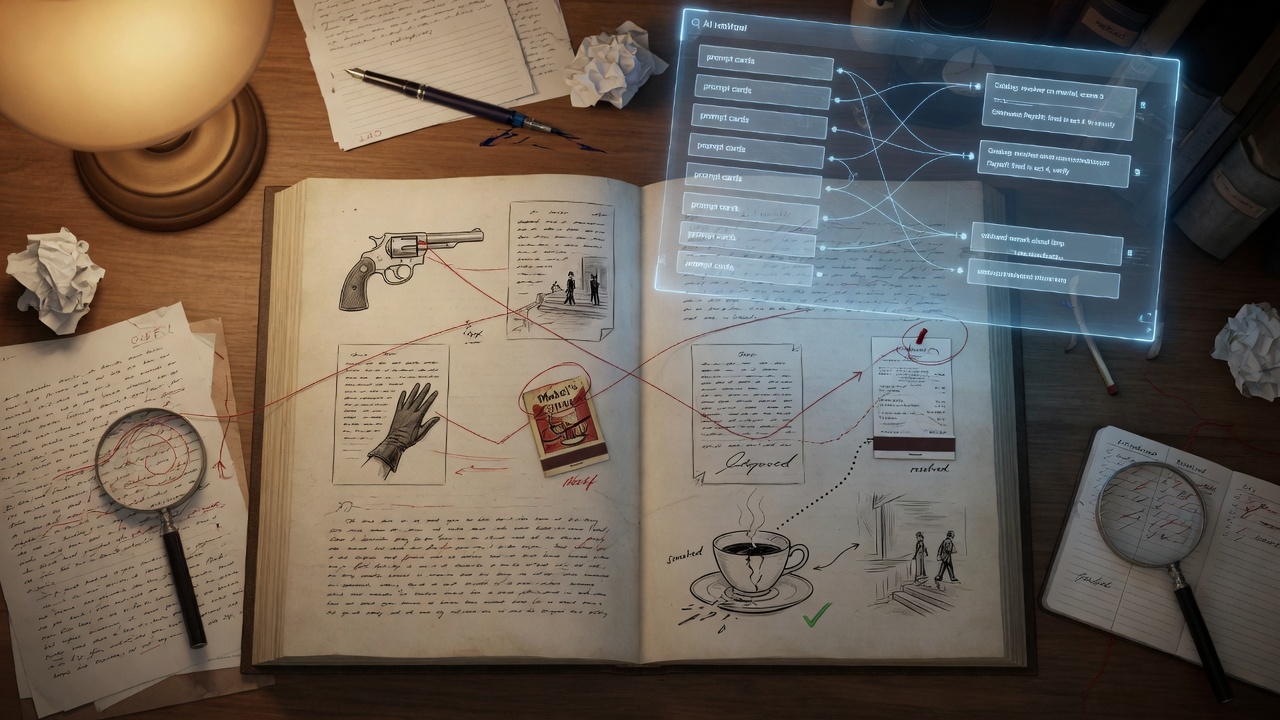
Below is a description of how my POV threads converge at the climax of my novel, followed by a chapter-by-chapter summary of my manuscript up to that point. Read the convergence scene first, then work backward through the summary and identify every element of the convergence that currently depends on chance, timing luck, or unexplained character knowledge rather than something explicitly established or foreshadowed earlier in the story. For each element you flag, tell me: 1. What specifically makes it read as coincidental rather than earned 2. The earliest point in my existing chapter summary where I could plant a setup, clue, or causal chain that would make this element feel inevitable instead of convenient 3. A specific suggestion for what that setup could look like (a line of dialogue, a small scene, an object, a piece of information a character learns) without requiring me to add new POV threads or major new scenes CONVERGENCE SCENE DESCRIPTION: [Describe how and why each character arrives, what they know, what choices lead them there] CHAPTER-BY-CHAPTER SUMMARY: [Paste your outline or summary, chapter by chapter, up to the climax]
What this prompt catches most often is the "unexplained knowledge" problem—a character acting on information they were never shown receiving. It's an easy error to make when you're juggling five POVs, because you know the information as the author and forget that a specific character's access to it needs to be established on the page. Running this test before your final draft saves you from readers flagging it in reviews, which is a much less forgiving place to discover a plot hole than your own revision process.
The Payoff Audit Nobody Runs
There's a final check that separates a convergence scene from a merely busy scene, and it's the one most writers forget because they're exhausted by the time they get here: does every character's personal arc actually resolve within the shared scene, or does it resolve nearby, in a chapter before or after, leaving the convergence itself as pure plot mechanics with no emotional payoff for half your cast?
This happens constantly in multi-POV structures because writers give each character their emotional beat in their own chapter, and then treat the convergence scene as a separate, plot-focused event where everyone just needs to physically be present. The result is a climax that moves the story forward but doesn't actually deliver catharsis for every thread that's been built up over the whole book.
- List each POV character's central emotional question or arc
- Check whether the convergence scene itself—not an adjacent scene—delivers a moment that answers or complicates that question
- Flag any character whose arc technically resolves but does so off-page or in a separate scene stitched around the convergence rather than inside it
- Identify whether any character's presence at the convergence is purely functional (they're there to do a plot task) with no personal stake actively in play during the scene itself
Run this audit last, after the timing and sequencing and coincidence checks, because it's the one that tells you whether your carefully engineered convergence actually earns its emotional weight or just executes its logistics competently. A climax can be perfectly timed, well-sequenced, and free of coincidence, and still feel hollow if half your characters are standing in the room without anything personal at stake in that exact moment. The engineering gets you to the scene. The payoff audit tells you whether the scene was worth engineering toward in the first place.
No comments yet. Be the first to comment!