
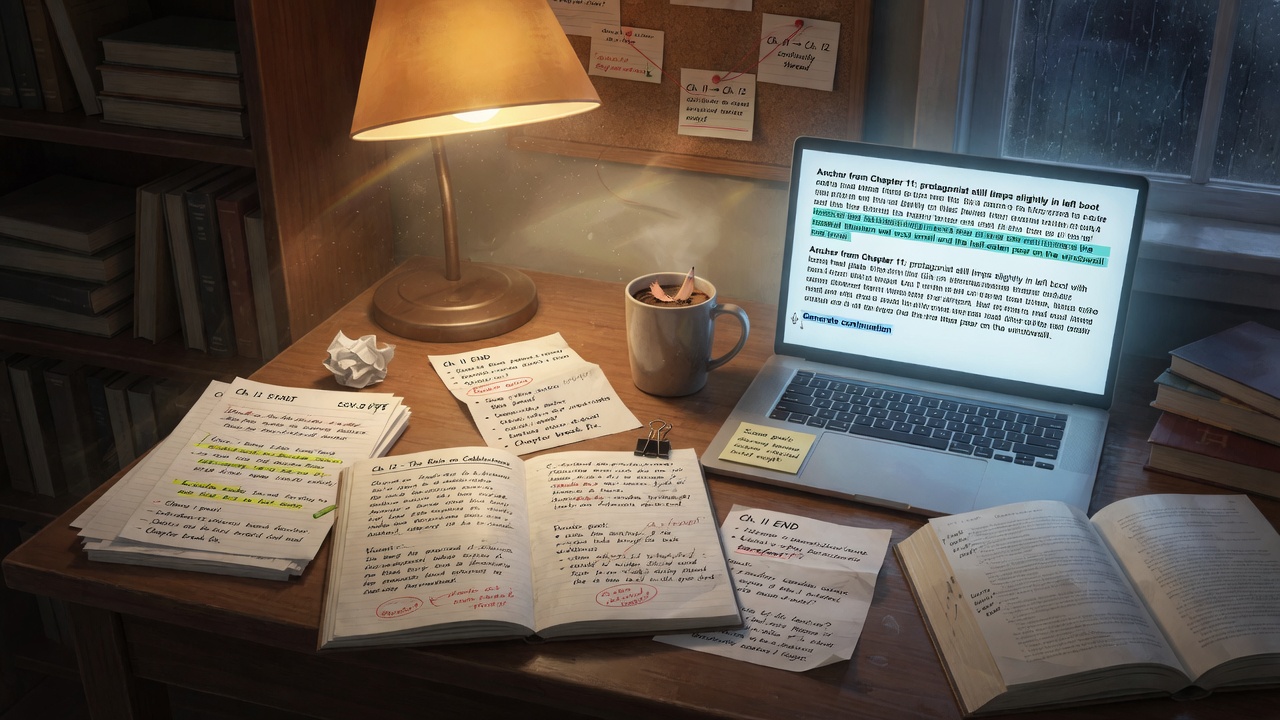
Why Chapter Breaks Are Where Continuity Goes to Die
There is a particular kind of reader experience that never announces itself clearly. The reader doesn't stop and think, "the character was wearing boots in the last chapter but now she's barefoot." They just feel vaguely wrong about the scene. Something is slightly off, like a painting hung two degrees crooked. They keep reading, but some small trust has been broken, and by the end of the book they can't quite say why the whole thing felt a little loose.
Novelists call this the continuity problem, but that name makes it sound administrative. It isn't. It's a craft failure that operates below the level of conscious detection—for the reader, and especially for the author. The writer who just finished Chapter 7 at midnight, emotionally spent from getting the dialogue right, is the absolute worst person to catch what they dropped between that scene and Chapter 8. Their brain filled in the blanks automatically. It always does.
This is the fresh draft blindspot: your working memory holds all the continuity details so well that you cannot perceive their absence on the page. You remember that Elena was holding a half-empty glass when she left the kitchen. You don't notice that she's nowhere near a glass when she appears in the next chapter's opening line, standing in the doorway, hands apparently empty and unaccountable.
AI tools, used deliberately, can break this blindspot open. Not because they understand your novel better than you do—they don't—but because they have no working memory of your story. They only know what you've shown them, which makes them unexpectedly useful readers for the seams between chapters.
The Four Categories That Fall Through the Cracks
Before you can prompt an AI to catch continuity failures, it helps to know what categories of detail are most likely to disappear at a chapter boundary. Through working with novelists and studying the kinds of revision notes that structural editors leave, four categories emerge as the most common offenders.
Physical State
Characters exist in bodies. Those bodies are injured, tired, dirty, wet, dressed in specific clothing, carrying specific objects, positioned in specific places in a room. Physical state continuity breaks are the most common and also the most jarring when caught. A character whose left arm was in a sling in Chapter 4 cannot absently run both hands through her hair in Chapter 5 without an explanation.
Object Continuity
Closely related but distinct: where are the objects? The gun placed on the mantle in Chapter 1 must still be on the mantle in Chapter 2 unless something moved it, and that movement should be noted. Phones get put down. Letters get folded and pocketed. Keys get thrown onto tables. These objects have narrative weight when they appear, and they need to continue existing in the physical space of the story.
Emotional Residue
This one is subtler and more commonly missed. A character who just received devastating news at the end of Chapter 9 cannot open Chapter 10 in a neutral emotional state without that transition being earned. Grief, anger, elation, shame—these states have momentum. They don't simply stop when a chapter ends. The opening of a new chapter needs to either carry that emotional state forward or explicitly account for the time and processing that would have shifted it.
Elapsed Time and Time-of-Day Logic
What time is it? What day is it? How long did that conversation actually take? Scenes that end at dusk cannot open thirty minutes later with a bright morning sun unless a chapter break has clearly indicated a time jump. More insidiously, conversations that feel like they took ten minutes in the prose might have actually covered enough ground to require two hours, and the next scene's timeline needs to account for that.
Extracting a Continuity Handoff Sheet Before You Write the Next Chapter
The most practical intervention point is between drafting chapters, not after the whole manuscript is done. The habit to build is simple: before you open a new document for Chapter N+1, you paste Chapter N into your AI tool and ask it to generate what you might call a continuity handoff sheet—a structured summary of everything the next chapter needs to honor.
This isn't the same as asking for a plot summary. You're asking for the forensic details: the physical states, the object locations, the emotional temperature, the time stamp. You want the AI to read the chapter not as a story but as a technical document that establishes conditions.
You are a continuity editor working on a novel manuscript. I'm going to paste the full text of a chapter below. Your job is not to summarize the plot or evaluate the writing. Your job is to extract a continuity handoff sheet that I will use as a reference document before writing the next chapter. Format your response as four clearly labeled sections: PHYSICAL STATE LOG List every named character who appears in this chapter. For each character, note their physical state at the END of the chapter: clothing described, any injuries or fatigue, their physical location in the scene, and any objects they are holding or have recently handled. OBJECT CONTINUITY LOG List every physical object that received specific attention in this chapter— where it was placed, who last touched it, and where it is at the chapter's end. Prioritize objects that were moved, exchanged, or referenced more than once. EMOTIONAL TEMPERATURE LOG For each named character, note their dominant emotional state at the chapter's close. If there's an unresolved tension between characters—a disagreement left open, a secret revealed, a question hanging unanswered—flag it here. TIME AND CONTINUITY MARKERS Note the time of day at the start and end of the chapter. Estimate how much time has elapsed within the chapter based on the events described. Flag any explicit date, day, or timeline references made in the chapter. Chapter text follows: [PASTE CHAPTER TEXT HERE]
The output from this prompt becomes your working document. Pin it to a sidebar in your writing app or print it out. Refer to it before you write the first word of the next chapter. This single habit catches the majority of the physical-state and object-continuity failures before they ever reach the page.
Stress-Testing the Seam Between Chapters
The handoff sheet handles the prospective problem—what you need to carry forward. But there's a second intervention that handles the retrospective problem: checking whether you actually did it correctly once you've drafted the opening of the next chapter.
This is a simpler, faster prompt. You give the AI the closing paragraph of the previous chapter and the opening paragraph of the new chapter, and you ask it to audit the seam between them for coherence problems.
I'm going to give you two short passages from a novel in progress. The first is the closing paragraph of Chapter [X]. The second is the opening paragraph of Chapter [X+1]. Your task is to audit the transition between these two passages for continuity and logical coherence. Specifically, check for: 1. SENSORY COHERENCE: Do the sensory details (light, temperature, sound, physical environment) at the end of one chapter align logically with those at the start of the next? If there's a shift, is it accounted for? 2. PHYSICAL CONTINUITY: Are the characters in physically consistent positions or locations? Do they appear to be in the same body they were in at the end of the previous chapter, with the same injuries, clothing, or physical conditions? 3. EMOTIONAL CONTINUITY: Does the emotional state implied by the opening of Chapter [X+1] logically follow from where the character was emotionally at the end of Chapter [X]? If there's a shift, does the text acknowledge it or account for elapsed time? 4. TIME LOGIC: Is the implied time of day consistent? If time has passed, is that clearly indicated? Do not rewrite the passages. List only the specific inconsistencies or questions you find, one per line, in plain language. If no inconsistencies are found, say so. CLOSING PARAGRAPH OF CHAPTER [X]: [PASTE HERE] OPENING PARAGRAPH OF CHAPTER [X+1]: [PASTE HERE]
The value of this prompt is in its constraint. You're not asking for editorial feedback or stylistic suggestions. You're asking a narrow, forensic question. The AI doesn't need to understand your themes to catch that your character was explicitly said to be sitting in the dark at 11pm and is now, without any transition, standing in morning light.
Handling the Subtler Problems: Time Gaps and Emotional Bleed-Through
The physical and object checks are relatively mechanical. The harder problems are the temporal and emotional ones, because they require reasoning about implication rather than just cataloging what's on the page.
Time-Gap Logic
Novels often jump forward in time between chapters without fully accounting for what that gap means for the story's logic. A character who ended the last chapter exhausted and unable to sleep shouldn't open the next chapter—set "the next morning"—seeming rested and clear-headed without some acknowledgment of what happened in the intervening hours. The time gap prompt asks the AI to reason through whether the implied time jump makes sense given the story conditions.
I'm working on a novel and I need to check the logic of a time gap between two chapters. I'll give you the final scene of Chapter [X] and the opening scene of Chapter [X+1], along with a note about how much time is supposed to have passed between them. Please evaluate the following: 1. PLAUSIBILITY OF THE GAP: Given what the characters were doing, feeling, and dealing with at the end of Chapter [X], is the indicated time gap (stated below) plausible? What would have needed to happen during that gap that isn't accounted for? 2. UNRESOLVED LOGISTICS: Are there any practical matters left open at the end of Chapter [X]—a character who needed to get somewhere, a time-sensitive situation, an object that needed to be dealt with—that the time gap would require to have been resolved, but which the opening of Chapter [X+1] doesn't address? 3. PHYSICAL RESET: Do the characters' physical conditions at the start of Chapter [X+1] make sense given the time gap? Someone severely injured shouldn't be fully mobile in two hours. Someone who hadn't slept shouldn't seem fresh after six hours if they had no reason to sleep. Intended time gap between chapters: [e.g., "approximately eight hours, overnight"] FINAL SCENE OF CHAPTER [X]: [PASTE HERE] OPENING SCENE OF CHAPTER [X+1]: [PASTE HERE]
Emotional Bleed-Through
The emotional residue problem is perhaps the most artistically significant of the four categories, and it's the one where AI assistance requires the most careful framing. You're not asking the AI to evaluate whether your character's emotions are well-written. You're asking it to check whether the emotional logic is sequential—whether the feelings at the start of a new chapter follow coherently from where the character was when the last chapter ended.
I need to audit the emotional continuity between two chapters in my novel. I'll give you a brief description of what happened emotionally in Chapter [X]— the key events that affected the main character's inner state—and then the opening two to three paragraphs of Chapter [X+1]. Your task: identify any places where the character's implied emotional state in the Chapter [X+1] opening seems inconsistent with what they've just been through, without being earned by the text. I'm not asking you to evaluate the quality of the writing or the emotional depth. I'm asking you to flag logical gaps. Specifically note: - Any moment where the character seems to have processed or moved past something faster than the elapsed time would typically allow - Any place where an emotion from Chapter [X] (grief, guilt, rage, relief) seems to have simply disappeared rather than evolved - Any sensory or behavioral detail in the Chapter [X+1] opening that implies a mood inconsistent with where this character left off What happened emotionally in Chapter [X] (your summary): [WRITE A 3-5 SENTENCE SUMMARY OF KEY EMOTIONAL EVENTS] Opening of Chapter [X+1]: [PASTE HERE]
Building the Practice Into Your Process
These four prompts work best when they become procedural rather than occasional. The writers who benefit most from this approach tend to use the handoff extraction prompt every time they finish a chapter, without exception, and keep the output in a running continuity file alongside their manuscript. The stress-test prompt gets used when they have a nagging feeling about a transition, or as a routine check before sending chapters to a reader or editor.
What changes over time is your eye for what to look for. The first few times you run a chapter through the handoff extraction prompt, you'll be surprised at what you forgot to track. After a dozen chapters, you'll start writing with more continuity consciousness, because the process has trained you to notice the details that need to survive the break. The AI becomes a scaffold that gradually teaches you to build more sturdily on your own.
The goal isn't a manuscript where nothing ever changes between chapters. Characters are allowed to change clothes, heal slightly, calm down, and lose track of where they put things. Real life is full of those small continuity variations. The goal is a manuscript where every change is intentional—where the barefoot character and the missing glass and the surprisingly rested traveler all happened on purpose, and readers feel, without knowing why, that the story is held by a steady hand.
No comments yet. Be the first to comment!