




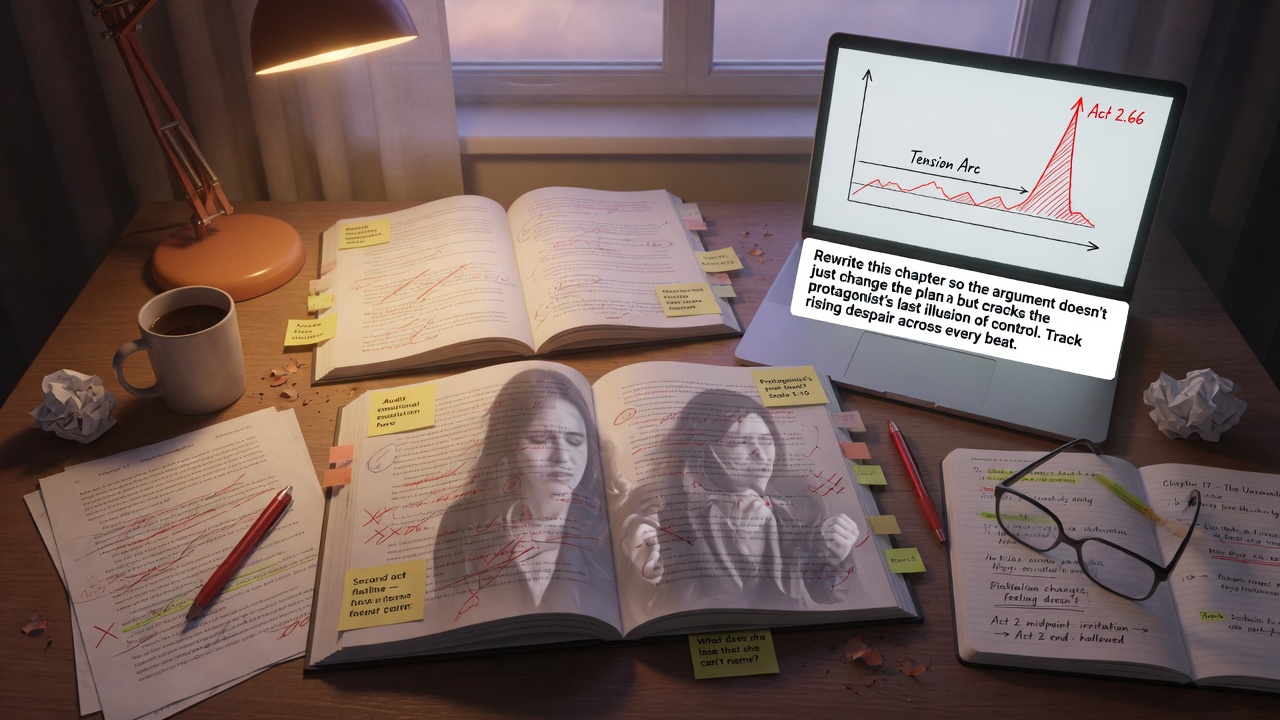
Why Second Acts Flatline Emotionally Even When the Plot Is Busy
There's a particular kind of second act that looks functional from the outside. Events happen. Characters argue, plans unravel, new obstacles materialize. The word count climbs. And yet somewhere around the two-thirds mark, readers put the book down and don't pick it back up—not because they disliked it, but because they stopped caring. The protagonist's situation kept changing without the protagonist's pain deepening.
This is the difference between incident accumulation and genuine escalation. Incident accumulation gives your protagonist things to do. Genuine escalation makes the cost of each thing they do compound on the wound that was opened in act one. A character who loses their job, then their apartment, then their car has experienced three incidents. A character whose each loss strips away one more layer of the identity they built to survive their original trauma has experienced escalation. The external circumstances might be identical. The emotional architecture is completely different.
The second act flatlines not when novelists run out of plot ideas, but when each new setback functions as a replacement for the previous one rather than an addition to it. The character loses something, the reader registers concern, the character responds and partially stabilizes, and then the next incident arrives to replace the old one on the emotional ledger. The pressure never accumulates. It just rotates. Readers sense this even when they can't name it—they feel the story resetting instead of tightening, and their investment quietly drains away between chapters.
AI tools are genuinely useful here, not because they understand narrative emotion intuitively, but because they can be prompted to perform systematic analysis across long stretches of manuscript that are difficult to hold in your head at once. A second act that spans eighty pages is hard to audit with fresh eyes when you've been inside it for months. An AI prompted to track emotional stakes scene by scene, relative to a fixed reference point you define, can surface patterns you've stopped seeing.
Building an Emotional Pressure Map of Your Second Act
Before you can diagnose what's wrong with your escalation curve, you need to make the curve visible. The tool that helps most here is what I call an emotional pressure map—a scene-by-scene account of where your protagonist's internal stakes sit at the end of each scene relative to where they sat at the end of the previous one.
A healthy escalation curve doesn't move in a straight line upward. That would be exhausting and, paradoxically, just as numbing as a flatline. What it does is trend upward with meaningful variation—genuine moments of partial relief or false victory that are then overtaken by deeper pressure. Think of it as a wave pattern with a rising tide underneath. Each wave crests and falls, but the water level is higher than it was three waves ago.
A reset loop looks different. The pressure rises, crests, then returns to roughly the same baseline before the next incident begins. The tide isn't rising. The character is treading water with more dramatic strokes. When you map this visually—even just by scoring each scene's emotional pressure on a scale from one to ten and plotting it—the pattern becomes obvious in a way that reading linearly through the manuscript obscures.
To build this map with AI assistance, you'll feed scene summaries with specific framing instructions. The key is to anchor every analysis to your protagonist's core wound—the foundational fear, shame, or unmet need that the novel is ultimately about. Without that anchor, AI analysis tends toward generic story structure observations. With it, the analysis becomes specific to what your novel is actually doing to your particular character.
Prompt Set 1: Diagnosing Flatline Patterns
The first set of prompts is diagnostic. You're not trying to fix anything yet—you're trying to see clearly. Feed the AI a compact summary of each second act scene (three to five sentences is usually sufficient) along with a precise statement of your protagonist's core wound. Then ask it to evaluate whether the scene moves the needle on that wound or merely moves the plot.
Structure your scene summaries consistently. Include what the protagonist wants in the scene, what happens, what the outcome is, and what the protagonist's emotional state is at scene's end. Consistency in your inputs produces consistency in the analysis, which makes patterns easier to spot across thirty-plus scenes.
I'm auditing the emotional escalation in my novel's second act. Below is my protagonist's core wound, followed by scene-by-scene summaries of my second act in the format: [Scene #, Setting, What protagonist wants, What happens, Outcome, Protagonist's emotional state at end]. Core wound: [Define in 2-3 sentences—the foundational fear, the original damage, what the character has organized their life around avoiding or compensating for] For each scene, score the emotional pressure on the protagonist's core wound from 1-10, where 1 = wound is completely dormant and 10 = wound is being directly and maximally activated. Then flag: - Whether the score represents an increase, decrease, or hold from the previous scene - Whether any decrease represents earned relief (the character made a meaningful choice that cost them something) or a reset (the pressure simply dissipated without consequence) - Any sequence of three or more consecutive scenes where the score neither rises above its entry point nor produces a meaningful earned decrease At the end, plot the scores as a simple list I can graph, and write a two-paragraph summary of the overall pressure curve: is it escalating, resetting, or plateauing, and where are the most significant flatline sequences? [Paste scene summaries here]
What you're looking for in the output is sequences of scenes where the emotional score holds in a narrow band—say, five through six—across many consecutive scenes without meaningful movement in either direction. That's your flatline. You're also watching for patterns where the score rises, then resets to the same baseline repeatedly, which is your reset loop.
Prompt Set 2: The Cumulative Cost Check
Once you've identified where your curve flatlines or resets, the next question is why. In most cases, the answer is that your setbacks aren't compounding—they're replacing. The character loses the job, and that becomes the active problem. Then they lose the relationship, and that becomes the active problem. The job loss recedes from the narrative's emotional foreground. Each wound gets closed before the next one opens, which means the character's total burden never actually grows.
True cumulative escalation means the job loss is still present and unresolved—emotionally if not practically—when the relationship ends. The second wound lands on top of the first, and both are active simultaneously. The character is now carrying more than they were, and the reader feels the weight accumulating.
The cumulative cost check prompts ask the AI to test whether each major setback in your second act references and compounds the losses that preceded it, or whether it effectively replaces them.
I'm going to describe the major setbacks my protagonist experiences in my second act, in chronological order. For each setback after the first, I want you to analyze whether it functions as a cumulative wound or a replacement wound. A cumulative wound means: this setback makes previous losses worse, more significant, or harder to survive. The earlier damage is still active and the new damage multiplies the existing burden. A replacement wound means: this setback effectively takes the place of the previous one on the emotional ledger. The earlier loss recedes, and the character's primary problem simply changes. For each setback from #2 onward, give me: 1. Your classification: cumulative or replacement 2. The specific evidence for your classification—what in my summary suggests the earlier wounds are still active or have been neutralized 3. If it's a replacement: one concrete suggestion for how this setback could be reframed or the scene adjusted so that it lands on unhealed ground from the previous loss rather than displacing it 4. A running tally of how many wounds the protagonist is actively carrying at each point in the second act—this should trend upward toward the act two break Protagonist's core wound: [2-3 sentences] Protagonist's primary want: [what they're consciously pursuing] Protagonist's primary need: [what they actually need, usually in tension with the want] Setbacks in order: [List each major setback with a 3-4 sentence description of what happens and how the protagonist responds]
The running tally this prompt generates is particularly useful. If your protagonist is actively carrying six wounds at the act two break, that's the kind of pressure that earns a genuine crisis. If they're carrying two—because four earlier wounds got quietly resolved—the act two break will feel manufactured rather than inevitable.
Prompt Set 3: The Relief Valve Audit
Not all tension release is a problem. Novels need breathing room. Humor, partial victories, and moments of genuine human connection serve necessary functions—they make the protagonist sympathetic, give readers a moment to catch their breath, and create contrast that makes the subsequent pressure hit harder. The issue is premature or unjustified discharge: tension that bleeds out not because the narrative earned a release, but because a scene resolved more completely than it needed to, a time skip glossed over emotional aftermath, or a tonal shift toward comedy neutralized pressure that should have persisted.
The relief valve audit is about distinguishing between functional breathing room and tension leaks. Breathing room is deliberate and contained—it gives the reader a moment without releasing the underlying pressure. A tension leak is when the pressure itself dissipates, and the next scene has to rebuild from a lower baseline rather than continuing from where the previous scene left off.
I want to audit my second act for scenes that prematurely or unjustifiably discharge emotional tension—what I'm calling tension leaks. I'll provide scene summaries for my second act. For each scene, evaluate whether it ends with tension intact, tension legitimately released (earned breathing room), or tension leaked (dissipated without narrative justification). Definitions for your analysis: - Tension intact: the scene ends with the protagonist's emotional pressure at least as high as when the scene began - Earned breathing room: tension is partially reduced because the protagonist made a meaningful choice, experienced genuine human connection that will cost them something later, or achieved a partial victory that the narrative immediately complicates or contextualizes - Tension leak: tension is reduced through humor that deflates rather than redirects, a resolution that closes the scene's conflict too completely, a time skip that glosses over emotional aftermath, or an emotional beat that is introduced and then abandoned without consequence For each tension leak you identify, tell me: 1. What specific element in the scene caused the leak 2. Whether the leak appears to be intentional craft choice or an accidental dissipation 3. One targeted revision suggestion—not a rewrite, but a specific addition or adjustment that would preserve any necessary breathing room while keeping the underlying pressure from fully dissipating Also flag: any sequence of two or more consecutive tension leaks, since that indicates a structural section where the reader's investment is being systematically drained. Note: Do not flag scenes as leaks simply because they contain humor, warmth, or partial resolution. Flag them only when those elements function to close off tension rather than coexist with it. [Paste scene summaries]
The final instruction in that prompt matters. AI analysis without that qualifier tends to flag all emotional softening as structurally problematic, which would strip necessary human texture from your manuscript. The goal is precision: identifying scenes where the emotional pressure genuinely resets versus scenes where warmth and pressure coexist, which is usually where the best writing lives anyway.
Using the Analysis Without Being Ruled by It
These prompts produce diagnostic information, not editorial verdicts. The AI doesn't know your novel's tonal intentions, its genre conventions, or the specific emotional experience you're engineering for your reader. What it can do is surface patterns that are genuinely difficult to see from inside a long manuscript—flatline sequences you've stopped noticing, replacement wounds masquerading as cumulative ones, tension leaks you didn't intend.
Take the output and look for convergence. If the flatline diagnosis, the cumulative cost check, and the relief valve audit all flag the same thirty-page section of your second act, that section deserves close attention. If one prompt flags a scene that the other two consider structurally sound, trust your own judgment—the single flag may be a calibration issue with how you described the scene, or it may be one legitimate concern among several non-issues.
- Run the diagnostic prompts on scene summaries, not on the prose itself—summaries force you to articulate what's actually happening rather than what you intended to happen
- Define your protagonist's core wound as precisely as possible before running any of these analyses; vague wound definitions produce vague, generalized output
- Use the emotional pressure scores to create a visual graph, even a rough one—patterns that are invisible in a list become obvious in a curve
- Treat identified flatline sequences as questions, not diagnoses: ask yourself whether the plateau serves a specific purpose, and if you can't articulate one, that's meaningful information
- Run the relief valve audit last, after you've identified your flatlines and replacement wounds—it's most useful when you already know where your pressure is leaking and need to understand why
The second act that actually sustains reader investment isn't the one with the most events. It's the one where every event lands on ground that earlier events already damaged, where the protagonist's total burden keeps growing in ways that feel earned rather than arbitrary, and where whatever relief appears doesn't fully close the wounds that are supposed to carry the reader into the final act. Mapping that architecture systematically—even with imperfect tools—is almost always more useful than revising prose in a section that has a structural problem.


No comments yet. Be the first to comment!