
Why Parallel Subplots Feel Like Filler
There's a particular kind of reading experience that's hard to name but easy to recognize: you're moving through a novel, genuinely invested in what's happening, and then a chapter begins and you feel yourself slightly deflate. Not because the writing is bad. Not because the characters are uninteresting. But because you sense, somewhere in your gut, that this section isn't connected to anything that actually matters yet. You're reading about a relationship that's developing or a secret that's being kept, and the story is fine—it's just running beside the main plot like a car in the adjacent lane. Same direction, no interaction.
That's the parallel subplot problem, and it's more structural than most writers initially want to admit. The instinct is to diagnose it as a pacing issue, or a character depth issue, or maybe a prose issue. Tighten the scenes, add some tension, make the dialogue crackle. But a subplot that runs parallel to the A plot doesn't need tightening. It needs to be redirected so that it actively collides with what your protagonist is trying to do.
The distinction between a subplot that "also happens" and one that destabilizes the main plot comes down to pressure. A subplot earns its structural position when it creates a situation your protagonist must navigate at the same time as the main plot crisis—when the demands of the B story make the A story harder, or when what the protagonist learns in the B story forces a reinterpretation of the A story stakes. The moment a subplot can exist in a completely different chapter without affecting anything around it, it's decorative. It may be beautifully written decoration, but the structure is treating it as optional.
This is where AI becomes genuinely useful for novelists, not as a generator of plot ideas, but as an audit tool. It has no emotional investment in your subplot. It can read what you give it and tell you, clearly, whether the B plot is creating pressure on the protagonist or just filling pages between main plot scenes.
The Three Structural Jobs a Subplot Must Do
Before you can audit a subplot, you need a clear definition of what it's supposed to accomplish. Structurally, a subplot has three responsibilities. It should complicate the protagonist's ability to pursue their main goal. It should mirror or contrast the novel's central theme in a way that deepens the reader's understanding of that theme. And it should converge with the A plot at a meaningful beat—not in a wrap-up scene at the end, but at a moment when the collision changes something.
Most failing subplots succeed at one of these and neglect the other two. A romance subplot might beautifully mirror the theme but never actually complicate what the protagonist is trying to do in the main plot. A professional rivalry subplot might create genuine complications but converge with the A plot only in a brief resolution scene that feels tacked on. When you prompt AI to test each of these three functions separately, you get a much more precise diagnosis than you would from a general "does this subplot work?" question.
Prompting for Complication
When testing whether your subplot is complicating the protagonist's main goal, you want the AI to think specifically about scenes where the demands of the B plot pull the protagonist away from the A plot, create resource conflicts (time, attention, emotional bandwidth), or force decisions that have A plot consequences. Give it your main plot goal, your subplot premise, and your current scene list, and ask it to identify every moment where those two things create friction—then note the moments where they don't but should.
Prompting for Thematic Mirroring
For thematic resonance, the prompt should ask the AI to articulate your novel's central argument—the thing it's really saying about human experience—and then evaluate whether the subplot puts that argument under pressure from a different angle. A theme about self-deception, for example, should show up in the subplot not as a restatement but as a variation: a different character, a different type of self-deception, a different consequence. The AI can tell you whether you've written a variation or a repetition.
Act-by-Act Collision Mapping
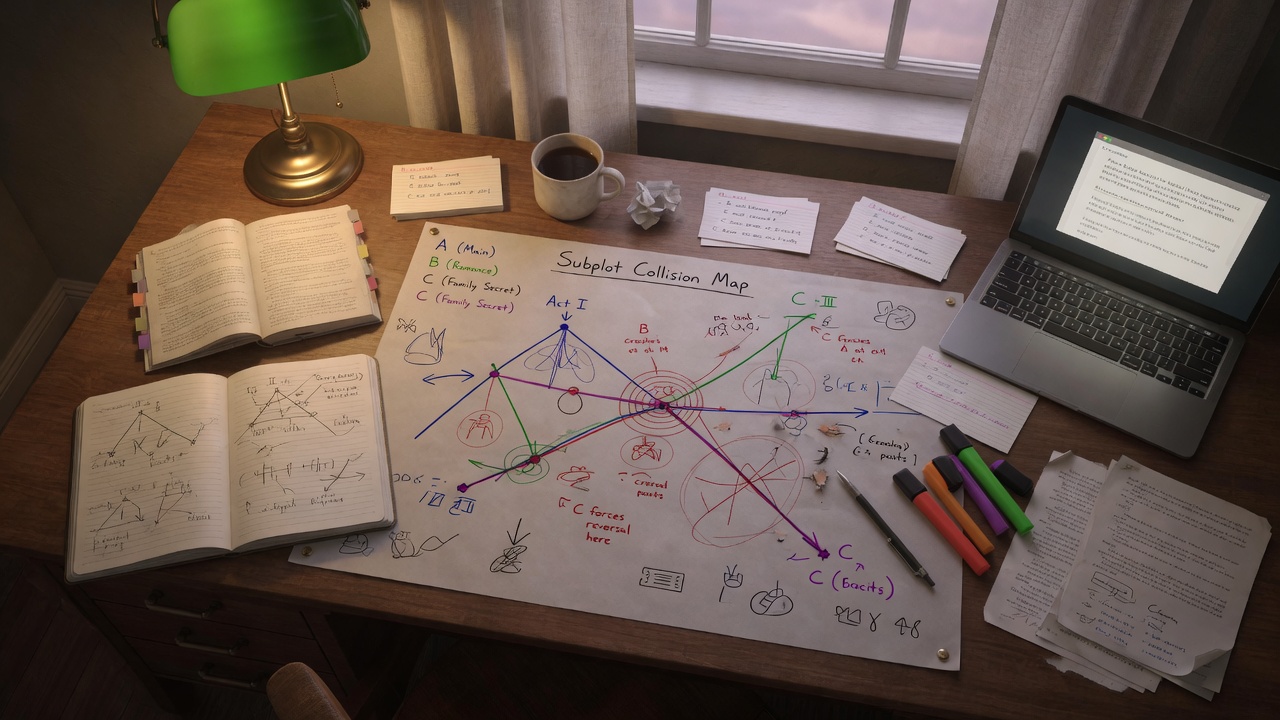
The most useful exercise you can do with AI for subplot integration is building a beat alignment chart: a document that maps your A, B, and C plots across all three acts and shows you, visually, where they intersect and where they run parallel. This isn't something you do by instinct when you're inside the manuscript. You need distance, and AI can provide it.
The goal is to see, at a glance, whether your subplots are colliding with the main plot at structurally important moments. The end of Act One. The midpoint. The dark night of the soul. The climax. These are load-bearing moments in the structure, and if your subplots aren't intersecting with the A plot at any of them, you have a problem that no amount of scene-level revision will fix.
I'm working on a novel and need to audit the structural integration of my subplots. Here is a summary of my main plot (A plot): [paste your A plot summary, including protagonist goal, central conflict, and approximate act breaks]. Here is my B plot: [paste B plot summary]. Here is my C plot: [paste C plot summary]. Please create a beat alignment chart organized by act (Act One, Act Two First Half, Act Two Second Half, Act Three). For each act, identify: 1. The primary A plot beat or crisis that defines that section 2. Where the B plot is active and what it's doing 3. Where the C plot is active and what it's doing 4. Any points where the B or C plot directly intersects the A plot (collision points) 5. Any sections where the B or C plot is running parallel to the A plot without creating friction, pressure, or new information that affects the protagonist's main goal After the chart, give me a one-paragraph assessment of each subplot's structural integration, including where the most important missing collision points are.
This prompt forces the AI to think act-by-act rather than globally, which is where the real diagnostic information lives. You'll often discover that a subplot is reasonably well integrated in Act One and then quietly disconnects from the main plot through most of Act Two—exactly the section where readers are most vulnerable to losing faith in the story's coherence.
Once you have the chart, the next step is to identify the two or three moments in your novel where the main plot reaches a point of maximum stress—where the protagonist is most at risk of failing—and ask the AI to help you engineer subplot collisions that increase that stress rather than relieve it.
Diagnosing Subplot Waste
The most clarifying question you can ask about a subplot is the brutal one: if I deleted this entirely, would the main plot notice? Not "would the reader miss it" or "would it feel less rich"—but would the main plot's logic, emotional progression, and thematic argument actually be damaged by its absence?
If the honest answer is no, you don't necessarily need to cut the subplot. But you do need to understand why the answer is no and change that.
I'm going to describe a subplot from my novel and I need you to help me determine whether it's structurally necessary or structurally decorative. My novel's main plot in one sentence: [write it]. My novel's central theme or argument: [write it]. My protagonist's core want and core need (these may differ): [write them]. Here is my B plot: [describe the subplot, including who it follows, what the central conflict is, how it begins and ends, and which scenes it occupies]. Please answer the following questions as directly as possible: 1. If this subplot were removed entirely, which specific A plot scenes or decisions would be affected? List them. If none would be affected, say so plainly. 2. Does this subplot put the novel's central theme under pressure from a distinct angle, or does it restate what the A plot is already communicating? 3. Does this subplot reveal something about the protagonist's core want or need that the A plot could not reveal on its own? 4. At which act breaks does this subplot intersect the main plot in a way that changes the protagonist's situation or understanding? Based on your answers, give me a verdict: is this subplot structurally integrated, structurally adjacent (present but not connected), or structurally orphaned (running independently with no meaningful collision)? Then give me three specific structural changes that would move it from its current category toward full integration.
What you're looking for in the AI's response is specificity. If it can name actual scenes that would be affected by removing the subplot, the subplot is doing work. If it speaks in generalities about thematic richness and emotional texture without citing specific story beats, that's usually a sign that the subplot is atmospheric rather than structural.
When the diagnosis comes back as structurally orphaned, you have two real options: integrate or excise. Integration means identifying the three or four moments in the main plot where the subplot could productively collide—where it could create a resource conflict, force a protagonist decision, or deliver information that recontextualizes the A plot stakes—and then doing the actual structural work to make those collisions happen. Excision means accepting that the subplot's best material might be redistributable: its scenes rewritten as A plot scenes, its characters absorbed into existing roles, its thematic content carried by the main plot directly.
Rescuing a Structurally Orphaned Subplot
The most common rescue operation involves taking a subplot that has good material but wrong placement and engineering backward from the collision points you need. You start with the load-bearing moments in your main plot—the points where the protagonist most needs to be under pressure—and ask what the subplot would need to be doing at that exact moment to add to that pressure.
I have a subplot that I want to rescue and fully integrate into my novel's structure. Here is the situation: My main plot's load-bearing moments (the scenes where the protagonist faces maximum pressure and the stakes are highest): - End of Act One: [describe what happens] - Midpoint: [describe what happens] - Dark night / Act Two climax: [describe what happens] - Final climax: [describe what happens] My orphaned subplot: [describe it—premise, characters, current arc, how it currently ends]. For each load-bearing main plot moment listed above, propose a specific subplot beat that could collide with it. The collision should meet at least two of these criteria: - It creates a direct resource conflict for the protagonist (time, relationship, information, emotional capacity) - It forces a protagonist decision that has consequences in both the A and B plot - It delivers information that changes how the protagonist understands the A plot stakes - It puts the novel's theme under pressure from the subplot's distinct angle For each proposed collision point, describe: what is happening in the subplot at that moment, how it intersects the main plot scene, and what the protagonist must navigate as a result. Then suggest how the subplot's internal arc might need to be restructured so that these collision points feel earned rather than engineered.
Making Collision Points Feel Inevitable
One risk of this kind of structural engineering is that the collisions can start to feel mechanical—like you've scheduled them rather than discovered them. The antidote is to work backward from the collision points into the subplot's internal logic. If the B plot needs to collide with the A plot at the midpoint, the subplot should have been building toward something that would naturally overflow into the protagonist's main story at that moment.
This is a distinction worth holding onto: the goal isn't to interrupt the subplot with the main plot, or vice versa. The goal is a novel where the subplots have their own gravity and their collisions with the A plot feel like the natural consequence of two things growing under pressure until they touch.
What the AI Can't Do
None of these prompts will write your novel, and none of them will generate the specific emotional insight that makes a subplot collision feel true rather than clever. What they will do is show you the structural skeleton clearly enough that you can see where the bones aren't connected. The intuitive, felt work of making those connections resonate—of deciding what the protagonist should understand in the moment of collision, what it should cost—that's still entirely yours. The audit just makes sure you're doing that work in the right places.
- A subplot that runs parallel to the A plot creates the sensation of filler regardless of its scene-level quality
- The three tests—complication, thematic mirroring, and convergence at meaningful beats—should be applied separately before diagnosing a subplot
- Beat alignment charts reveal disconnection problems that close reading of the manuscript obscures
- The deletion test ("would the main plot notice?") is the fastest way to determine whether rescue or redistribution is the right move
- Engineering backward from load-bearing main plot moments gives orphaned subplots the best chance of genuine structural integration
No comments yet. Be the first to comment!