

Why Recurring Motifs Fail Across a Series—and How AI Can Fix That
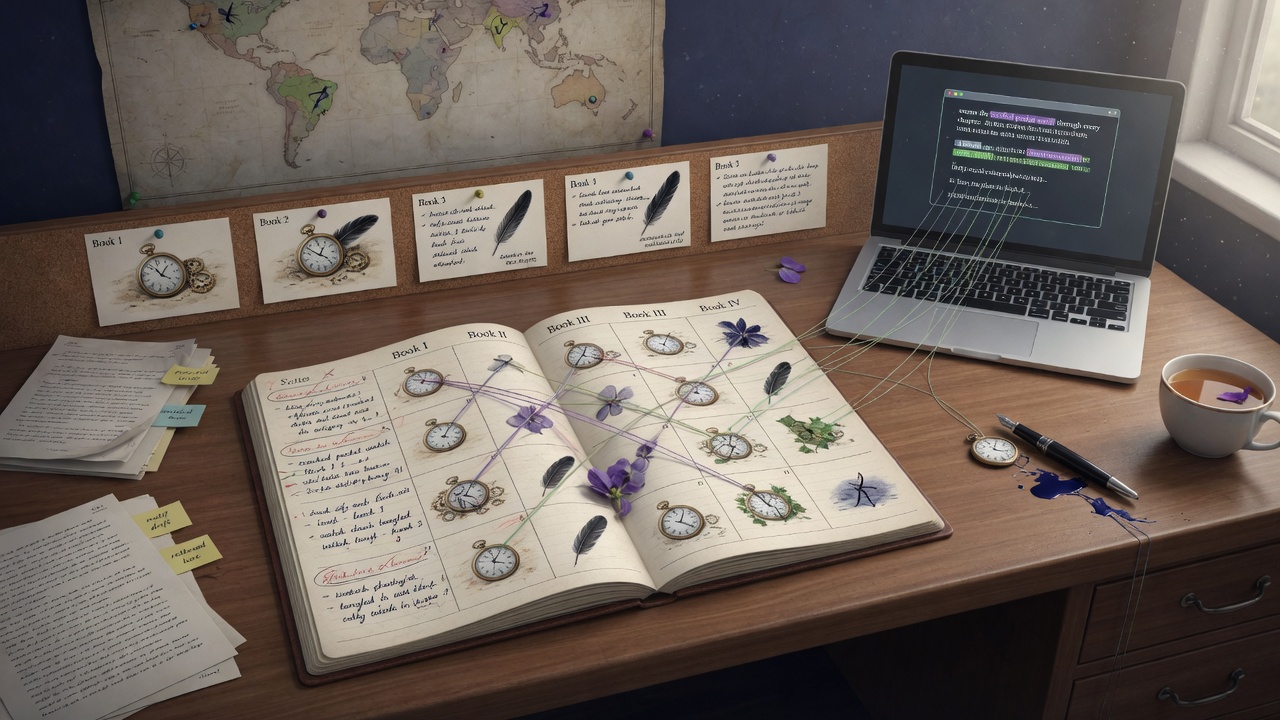
Most authors discover the problem somewhere around the third book. They've been returning to the same image—a cracked pocket watch, the smell of woodsmoke, a phrase whispered between characters—and readers aren't responding to it the way they did in Book 1. The symbol has become wallpaper. It's there, it's recognizable, but it no longer carries weight. The author kept planting it, but forgot to let it grow.
The distinction between a motif that accumulates meaning and one that simply repeats is one of the harder craft problems in long-form fiction. A repeated symbol is a callback. A threaded motif is a living thing that changes shape as your protagonist changes, that means something different at the series midpoint than it did on page one, and that earns an emotional payoff in the final volume precisely because the reader has watched it mutate. Engineering that arc across three, four, or five books requires a kind of sustained architectural attention that's genuinely difficult to maintain without external support. This is where AI becomes a useful collaborator—not to generate your symbols for you, but to help you track, interrogate, and deliberately evolve the ones you've already seeded.
Why Motifs Collapse: The Repetition Trap
The failure mode is almost always the same. An author introduces a powerful image in Book 1—say, a character who always folds paper cranes when she's frightened. It works beautifully. It's specific, it's character-rooted, it earns an emotional scene. In Book 2, the author brings it back because it worked. Then again in Book 3. By Book 4, the paper cranes have become a tic, a branded signifier that readers recognize but no longer feel. The symbol stopped evolving at the end of Book 1.
What went wrong isn't overuse—it's static meaning. The cranes still mean fear. The protagonist's relationship to fear may have transformed across three books, but the symbol didn't follow her. It's still operating under Book 1 logic in a Book 4 world.
A threaded motif needs to do at least three things across a series: introduce itself with emotional resonance in Book 1, shift its meaning in response to what the protagonist learns or loses in the middle volumes, and arrive at a final-volume moment where the reader understands retroactively that everything the motif meant before was preparation for what it means now. That structure requires planning, and planning across multiple manuscripts is where most authors' systems break down.
Motif Inventory: Surfacing What You've Already Planted
Before you can engineer a motif arc, you need to know what you're actually working with. Most authors plant symbols somewhat unconsciously in a first draft—images and phrases that felt right in the moment, that carry thematic weight the writer understood intuitively but never fully articulated. These unconscious choices are often your richest material, because they're rooted in something genuine rather than something calculated.
The first AI task is extraction: feeding your existing draft or completed Book 1 manuscript to an AI and asking it to surface recurring images, objects, sensory details, and phrases you may not have noticed yourself. This is genuinely useful work that would take a human reader multiple close-reading passes to replicate.
You are a developmental editor with expertise in symbolic structure and long-form fiction. I'm going to paste the full text of my novel manuscript below. Your task is to conduct a motif inventory. Read the entire manuscript and identify: 1. RECURRING IMAGES AND OBJECTS: Any physical object, image, or visual detail that appears more than twice, even in passing. List each one with the page or chapter location of every appearance. 2. RECURRING SENSORY DETAILS: Sounds, smells, textures, tastes, or physical sensations that repeat across multiple scenes. Include context for each appearance. 3. RECURRING PHRASES OR SPEECH PATTERNS: Any phrase, sentence construction, or piece of dialogue that echoes across scenes or characters, even if the wording isn't identical. 4. THEMATIC GESTURES: Actions or behaviors that a character performs repeatedly, especially under emotional pressure. For each identified motif, write 2-3 sentences describing what emotional or thematic meaning the motif seems to carry based on the contexts in which it appears. Flag any motif that appears to shift meaning between its first and last appearance—these are your strongest candidates for deliberate development in subsequent books. Do not make suggestions yet. Only inventory and describe. [PASTE MANUSCRIPT HERE]
The instruction to withhold suggestions is important. You want the inventory first, uncontaminated by the AI's ideas about what you should do next. Once you have the full list, you make the curatorial decision: which of these planted symbols do you want to amplify across the series? Which do you want to quietly retire? Which ones surprise you enough that they deserve to anchor the whole arc?
Mutation Mapping: Tracking How Meaning Must Shift
Once you've selected your primary motif or motifs, the next problem is engineering their evolution in a way that's responsive to your protagonist's actual arc. The motif can't just change arbitrarily—its mutation has to feel inevitable in retrospect, which means it needs to be tethered to the specific transformations your character undergoes between books.
This requires you to articulate your protagonist's internal arc at each stage of the series before you can map the motif's trajectory. The AI prompt that does this work is essentially a two-part operation: first you describe the character arc, then you ask the AI to model how the motif's meaning should follow it.
I'm writing a fantasy series planned for four books. I need help mapping the evolution of a recurring motif across the entire series. Here is the information you need: MOTIF: [Describe your motif in detail—what it is, its first appearance in Book 1, the emotional context of that appearance, and what it seemed to mean in that moment.] PROTAGONIST ARC SUMMARY: - Book 1: [Describe the protagonist's core belief about themselves and the world at the start, and what fundamentally changes by the end of Book 1.] - Book 2: [Describe the protagonist's core wound or misconception entering Book 2 and what they are forced to confront or lose by the end.] - Book 3: [Describe the protagonist at their lowest or most transformed point—what have they given up, what do they now believe that they didn't before?] - Book 4: [Describe the final state you're aiming for—who is this person at the series conclusion?] Using this arc, design a mutation map for the motif. For each book, specify: 1. What the motif should MEAN to the protagonist in that book, given where they are emotionally and psychologically. 2. What contextual SHIFT should mark the transition—is the meaning changing because of something the protagonist does, learns, loses, or chooses? 3. A specific type of SCENE or moment where the motif should appear in that book to carry its evolved meaning most effectively. 4. What a reader who has followed all four books should understand about the motif's full arc when they reach the final appearance. The motif's evolution should feel inevitable in retrospect, not arbitrary. Prioritize character-rooted meaning over thematic symbolism. If the character's relationship to the motif contradicts the "obvious" thematic reading, that contradiction is often more interesting—flag those moments.
What you're doing here is building a motif bible—a document you can return to while drafting each subsequent book to check whether the symbol is behaving the way it should at this stage of the series. The AI's output isn't a prescription; it's a map you can deviate from when the draft surprises you. But having the map means you'll know when you're deviating, which is the difference between intentional subversion and accidental drift.
Contrast and Subversion: Breaking the Motif to Signal a Turn
One of the most powerful tools in a series writer's kit is the moment when a trusted motif is deliberately violated—when the image that readers have learned to associate with comfort, hope, or the protagonist's core identity is inverted, corrupted, or refused. Done well, this lands with disproportionate force because the reader has three books of trained association working underneath their conscious experience. They feel the wrongness before they understand it.
Engineering this subversion requires the same care as engineering the motif itself. A broken motif that doesn't serve the story's turning point is just a broken motif. You need to know exactly what narrative work the inversion is doing and where in the series arc it belongs.
I'm planning a deliberate subversion of a recurring motif at a major turning point in my series. I need help designing the scene or sequence where this inversion occurs. Here is what the motif has meant up to this point in the series: [Describe the motif and summarize its meaning across the previous books, including the emotional associations readers will have built up.] Here is the turning point I'm approaching: [Describe what is happening in the plot and the protagonist's interior life at the moment where the subversion should occur. What is being lost, betrayed, or transformed?] I want the subversion to accomplish the following: [List what narrative or emotional work you want the inverted motif to do— signal a betrayal, mark the protagonist's point of no return, show that something the character believed is no longer true, etc.] Please design three different approaches to the subversion: APPROACH 1 — ABSENCE: The motif is expected and doesn't appear. Design a scene where its absence is conspicuous and meaningful. APPROACH 2 — CORRUPTION: The motif appears but in a distorted or degraded form. Design what that distortion looks like and how the protagonist registers it. APPROACH 3 — WEAPONIZATION: Another character uses the motif against the protagonist, or the protagonist uses it against themselves. Design the scene dynamics that make this land. For each approach, specify: what the reader should feel, what they should understand about the story's direction, and what the protagonist's response to the inverted motif reveals about where they are in their arc.
The Final-Volume Payoff Audit
The last use of a motif in a series carries more weight than any prior appearance, and it almost always needs revision even when the draft feels complete. The problem is that by the time you're writing the final volume, you've been living inside this series for years. You know what the motif means. You've forgotten that the payoff only works if every preceding appearance has been laying the right groundwork—and that groundwork often needs retrofitting once you know where you're going.
The payoff audit is a prompt you run after you've drafted the final volume, not before. You need an actual draft to audit.
I have completed a draft of the final book in my series. I need to audit whether the payoff of my central motif actually earns what I'm asking it to deliver. Here is everything you need: MOTIF HISTORY: [For each previous book in the series, describe: where the motif appeared, what it meant, and any intentional shifts in meaning you designed. Be specific about the emotional context of its most significant appearances.] INTENDED PAYOFF: [Describe the final appearance of the motif in Book [X]. Where does it appear? What is happening in the plot? What are you asking this final appearance to deliver emotionally and thematically? What should a reader understand about the entire series in this moment?] CURRENT DRAFT OF THE FINAL APPEARANCE: [Paste the scene or passage.] Please audit the payoff against the motif's history and answer: 1. EARNED WEIGHT: Does the final appearance draw on enough of the motif's accumulated meaning to justify what it's being asked to deliver? If not, what specific earlier associations are not being activated? 2. MISSING SETUP: Is there anything the payoff implies about the motif's meaning that wasn't established in earlier books? Identify what would need to be planted retroactively. 3. OVER-EXPLANATION: Does the scene tell the reader what the motif means rather than trusting the accumulated associations? Flag any lines where the prose is working too hard to explain. 4. FINAL LINE AUDIT: What is the last sentence in which the motif appears? Is this the right resting place? Suggest two alternative framings of the final moment that might land with greater restraint. Be specific. Quote from the passage I've provided when diagnosing problems.
Working With What the AI Surfaces
A few practical notes on using these prompts in actual manuscript work:
- The inventory prompt works best on a complete draft, not a work-in-progress. Partial manuscripts give the AI incomplete pattern data.
- When the mutation map suggests a direction for the motif that doesn't feel right to you, trust your instinct—but articulate why it's wrong. That articulation often tells you something useful about your series that you hadn't fully understood yet.
- The subversion prompt generates options, not answers. All three approaches may feel wrong, which is information: it may mean the subversion belongs in a different scene, or that the motif hasn't been established firmly enough yet to withstand inversion.
- Run the payoff audit before your final revision pass, not after. You want time to make changes to the preceding books if the audit reveals missing setup.
The AI doesn't understand your series. It doesn't know why the pocket watch matters or what the woodsmoke was always reaching for. But it can hold the whole manuscript in view at once in a way that's genuinely difficult for a human brain operating under deadline and intimacy with the material. Use it as a mirror, not a muse—to show you what's actually on the page rather than what you intended to put there. The gap between those two things is where motif threading either succeeds or quietly fails.
The symbol that earns its final-page appearance is the one that has been asking a question across five hundred pages. The last thing you need is to arrive at the answer and discover you never quite asked the question right.

No comments yet. Be the first to comment!