



Why the Synopsis Feels Like Betraying Your Own Book
Every novelist who has finished a 90,000-word manuscript and then sat down to write a one-page synopsis has felt the same specific dread. You spent two years building a character whose interior life is the whole point. Now you have to reduce her to a series of events. The plot survives compression. The emotion doesn't. What lands on the page reads like a Wikipedia summary of a movie you haven't seen, and nothing about it explains why anyone should care.
The frustrating part is that agents do care—about emotion, specifically. What they're looking for on a single page isn't just the sequence of events. They want cause-and-effect logic that feels inevitable in retrospect, visible protagonist motivation at every turning point, and a resolved ending that demonstrates the author controlled the story rather than reported it. When those three elements are present, a synopsis reads like a compressed version of the novel's emotional experience. When they're absent, it reads like a plot outline—technically accurate and completely lifeless.
The five-draft workflow described here uses AI as a compression tool that keeps asking the right questions: What is this character actually trying to do, and why does it matter? Which events are structural and which are decorative? Where does the reader lose the protagonist's inner life? AI doesn't feel the emotion of your novel, which is exactly why it's useful here—it can see the skeleton without flinching, and it can flag where the skeleton is missing pieces without getting attached to any particular scene.
Draft 1: The Brain-Dump Pass
The first draft isn't a synopsis. It's a confession. Write everything you remember about your novel's plot without editing yourself—secondary characters, subplots, the chapter that took you six months, the ending you changed three times. Don't aim for one page. Aim for completeness. Three pages is fine. Four is fine. You're building raw material, not a finished document.
Once you have that messy document, you bring in the AI not to polish it but to excavate it. The goal of this pass is identification: What are the five events without which the story cannot exist, and what is the single emotional question the story spends 90,000 words answering?
I've just written a rough, unedited synopsis of my novel. It's messy and too long—probably three to four pages—and includes everything I could remember about the plot. I'm going to paste it below. Your job is not to rewrite it yet. Instead, do two things: First, identify the five load-bearing plot events—the moments where the story's direction changes irreversibly. These are events that, if removed, would collapse the cause-and-effect chain. Label them EVENT 1 through EVENT 5 and explain in one sentence each why each one is structural rather than decorative. Second, identify the single emotional question the story is answering. This is not a theme statement ("the story is about grief") but a question with a protagonist at its center that the ending either answers or deliberately refuses to answer. Format it as: "Will [protagonist] [emotional stakes] even if it means [cost]?" Do not suggest cuts yet. Do not rewrite any sentences. Only identify and explain. [PASTE YOUR BRAIN-DUMP SYNOPSIS HERE]
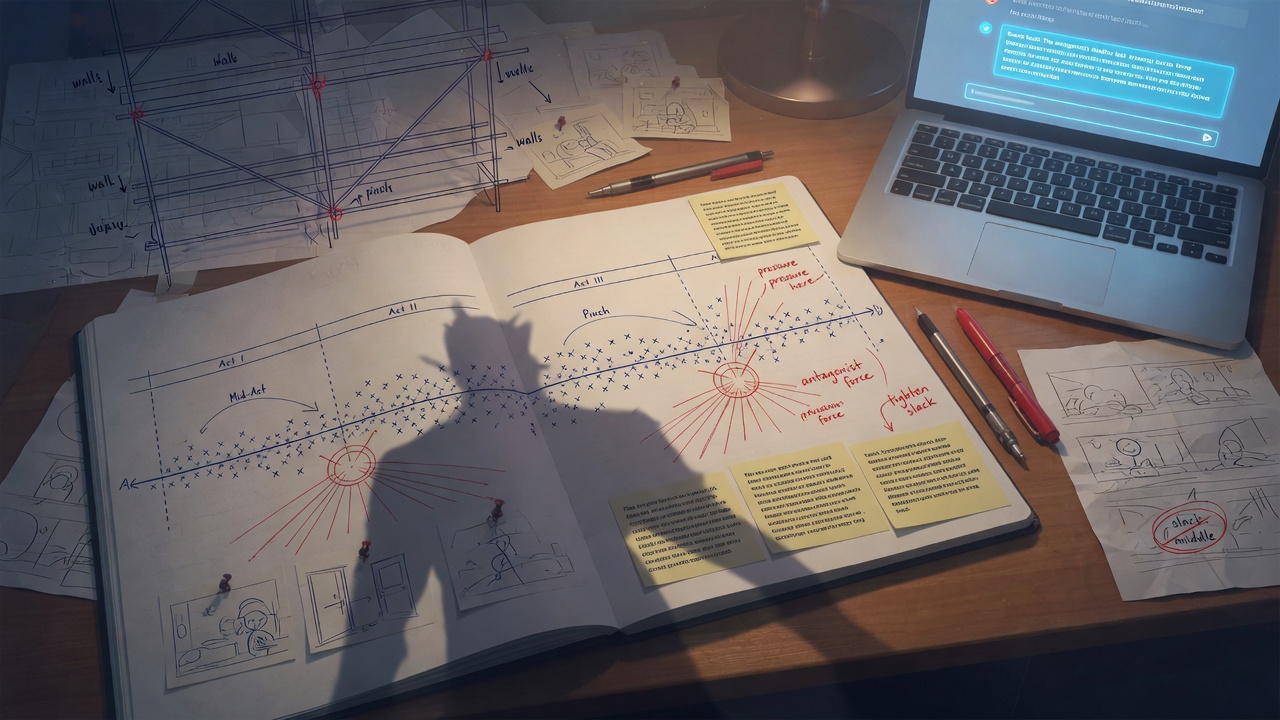
The output from this prompt does something crucial: it gives you a map before you start cutting. Most writers approach synopsis revision by trimming from the edges—removing the subplot here, shortening the description there. But edges aren't the problem. The problem is not knowing which events are holding the weight. When you have the five load-bearing events and the central emotional question in writing, you have a compression framework instead of a compression panic.
Drafts 2 and 3: Cutting Without Killing
Draft 2 addresses secondary characters and subplots. This is where most synopses bloat. You have a best friend who functions as comic relief and occasional exposition delivery. You have a workplace subplot that establishes the protagonist's professional stakes. You have a romantic secondary plot that mirrors the main relationship thematically. All of these matter to the novel. Almost none of them belong in a one-page synopsis—unless they're structural.
The distinction between structural and decorative isn't about whether something is good writing. It's about whether removing it breaks the cause-and-effect chain between your five load-bearing events. A subplot is structural if one of those five events cannot happen without it. A secondary character is structural if the protagonist's motivation at a turning point is only visible through their relationship with that character. Everything else is decorative in synopsis terms, which means it belongs in the novel and not on the page you're sending to agents.
I'm working on a one-page synopsis for my novel. I've identified my five load-bearing plot events and my central emotional question (I'll include them below). Now I have a revised synopsis draft that is still running about two pages. I need to cut secondary characters and subplots, but I'm afraid of cutting something that's actually holding the structure together. Please do two things: First, read through the synopsis and flag each secondary character and subplot thread. For each one, tell me whether it is STRUCTURAL (one of the five load-bearing events cannot logically occur without it) or DECORATIVE (it enriches the novel but the cause-and-effect spine survives without it in the synopsis). Give a one-sentence explanation for each designation. Second, after flagging, rewrite only the sentences that contain DECORATIVE elements—either cutting them entirely or folding the essential information into a sentence that already carries structural weight. Do not touch sentences that are already doing double work. My five load-bearing events: [LIST THEM] My central emotional question: [YOUR QUESTION] [PASTE YOUR DRAFT 2 SYNOPSIS HERE]
After the secondary character pass, Draft 3 addresses sentence-level compression. By this point you should be close to one page, but close isn't done. Draft 3 is a line-level audit with a specific constraint: every sentence must carry both plot information and emotional weight. If a sentence tells the reader what happened but not why the protagonist cared, it's doing half its job.
I have a near-final synopsis draft that is slightly over one page. I need every sentence to do double work: carry plot information AND reveal something about the protagonist's emotional state, motivation, or internal conflict. Please go through the synopsis sentence by sentence. For each sentence, identify whether it is carrying: - PLOT ONLY (what happened, but not why the protagonist felt it) - EMOTION ONLY (interiority without a clear plot function) - BOTH (doing its full job) For every sentence labeled PLOT ONLY or EMOTION ONLY, offer a revised version that carries both without adding length. The goal is not to make every sentence explicitly emotional, but to ensure that protagonist interiority is never invisible for more than one sentence at a time. [PASTE YOUR DRAFT 3 SYNOPSIS HERE]
Draft 4: The Agent-Eye Audit
By Draft 4, your synopsis is probably at or near one page, and it probably feels tighter than anything you've written before. This is exactly when to distrust it. You've been inside this manuscript long enough that your eye automatically fills in gaps. You know what the protagonist meant even when the sentence doesn't say it. You know which "she" refers to which character even when the antecedent is three sentences back. An agent reading your synopsis cold will not have those automatic corrections running.
The Draft 4 prompt asks AI to roleplay not as a helpful collaborator but as a skeptical first reader—specifically, as a querying agent who has read forty synopses today and has a low tolerance for confusion.
I want you to read the following synopsis as a literary agent who has been reading query submissions all day. You are knowledgeable, a little tired, and you will not make charitable assumptions to fill in gaps the writer has left open. Read the synopsis once and flag every instance of: 1. CONFUSING ANTECEDENTS — any "she," "he," "they," or "this" where it's not immediately clear which character or event is being referenced 2. PASSIVE CAUSALITY — any moment where something happens to the protagonist without a clear reason why, or where the plot advances because of circumstance rather than because of a choice the protagonist made 3. INVISIBLE MOTIVATION — any turning point where the protagonist makes a decision or takes an action but the reader cannot see what internal logic or emotional state drove that decision 4. UNRESOLVED LOGIC — any moment where you, as a reader, had to backtrack or re-read to understand how we got from one event to the next For each flag, quote the specific sentence or phrase, name the problem type, and explain in one sentence what information is missing. Do not rewrite yet—only diagnose. [PASTE YOUR DRAFT 4 SYNOPSIS HERE]
The passive causality flag is especially important and often surprises writers. Passive causality is when the plot moves forward because something happens rather than because the protagonist chose something. "She loses her job" is passive causality. "She quits her job rather than lie for her boss, even though she can't afford to" is active causality with visible motivation. Agents reading synopses are tracking whether the protagonist is the engine of their own story or a passenger in it. Passive causality makes protagonists look like passengers.
Draft 5: The Emotional Core Stress Test
The final draft isn't about cutting anymore. It's about rebuilding from the inside out. By this point you have a clean, tight, logically coherent synopsis. What you need to verify is that the emotional core—the feeling that drove you to write this novel in the first place—is actually audible on the page, not just implied by the events.
The Draft 5 prompt does something slightly counterintuitive: it asks the AI to extract the emotional core sentence first, before touching the synopsis. This sentence has a specific structure—it names what the protagonist loses, what they choose, and what they become by the end. Then the synopsis gets rebuilt outward from that sentence, not edited around it.
I have a polished one-page synopsis that is logically clean but I want to verify that the emotional core is actually present and not just implied. Please do this in two steps: STEP ONE: Read the synopsis and extract the single sentence that captures the protagonist's complete emotional arc. This sentence must name three things: - What the protagonist loses (or risks losing) in order for the story to matter - What the protagonist chooses at the story's critical decision point - What the protagonist becomes by the end that they couldn't have been at the beginning Write this sentence, then explain how confident you are (on a scale of 1-5) that the current synopsis actually supports all three elements. If any of the three is implied but not stated, tell me which one and where in the synopsis it goes silent. STEP TWO: If the confidence score is below 4, take the emotional core sentence you've just written and identify the three moments in the existing synopsis where that sentence should be most audible—the opening, the midpoint turn, and the final beat. For each of those three moments, suggest one small revision (a phrase, a clause, an added sentence of interiority) that would make the emotional core visible without expanding the synopsis beyond one page. [PASTE YOUR DRAFT 5 SYNOPSIS HERE]
The confidence score is a useful forcing mechanism. A score of 5 means the emotional arc is fully supported by the text as written. A score of 3 or below usually means one of the three elements—loss, choice, or transformation—is doing its work in the novel but never made it onto the synopsis page. Writers almost always underwrite the loss and overwrite the plot events. What the protagonist stands to lose is the thing that makes the reader care whether the plot events go one way or another, and it's consistently the first thing to disappear under compression pressure.
What You Have After Five Drafts
At the end of this workflow, you have something most synopses aren't: a document that reads like a compressed version of the emotional experience of the novel rather than an inventory of its events. The five load-bearing events are present and causally connected. The protagonist is visibly motivated at every turning point. Secondary characters appear only when they're structural. Every sentence carries both plot weight and emotional weight. The antecedents are clear. The causality is active. And somewhere near the beginning, middle, and end of the page, the emotional core sentence is audible.
That's what agents mean when they say a synopsis is "compelling." They don't mean it made them feel everything the novel made them feel. They mean it made them believe the author knows what the novel is about—not just what happens in it, but why it matters, what the protagonist is really fighting for, and what the reader will walk away carrying. A one-page synopsis can do that. It just needs the right questions asked at each stage of compression, and the discipline to keep asking them until the feeling survives.


No comments yet. Be the first to comment!