
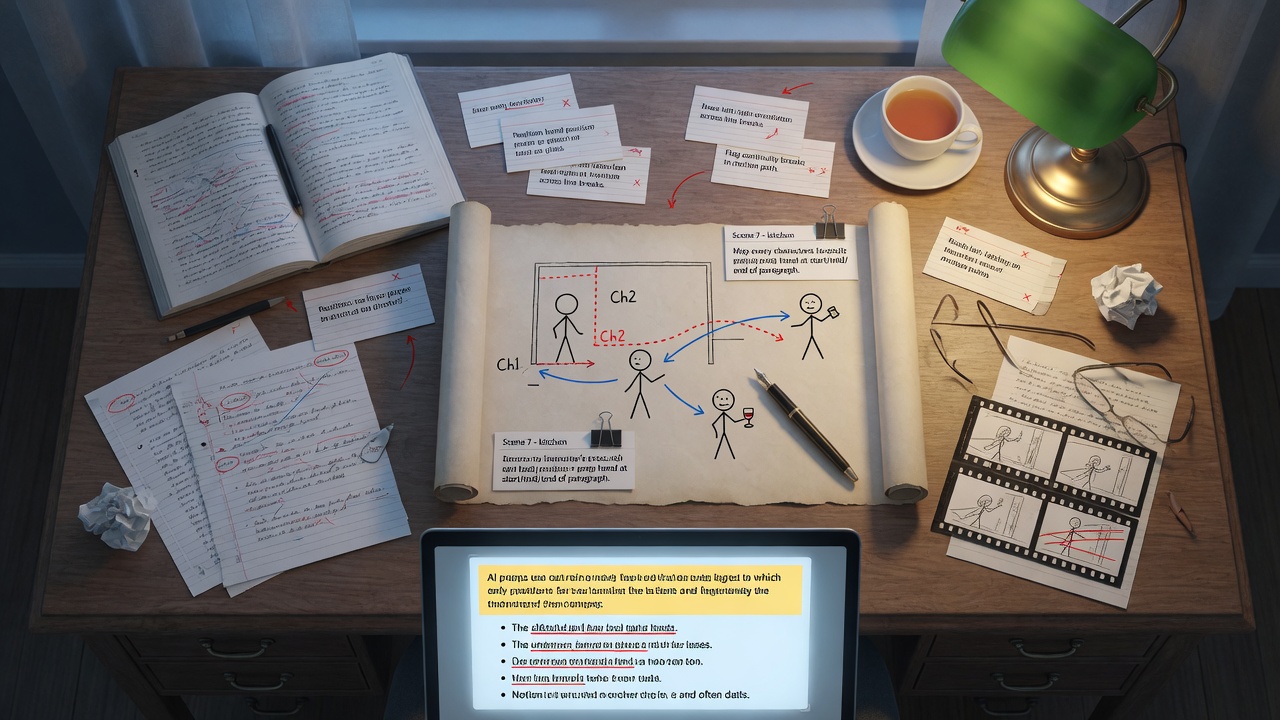
Every novelist has had the moment: a beta reader points out that a character who was described as pacing the room three lines earlier is now, apparently, sitting in a chair with no acknowledgment of how they got there. Or worse, a character is holding a wine glass in one paragraph, gesturing emphatically with both hands in the next, and then takes a sip a few lines later. These aren't plot holes. They're blocking errors—small failures of physical continuity that happen entirely within a single scene, sometimes within a single page. They're embarrassing precisely because of how minor they are, and how avoidable they should have been.
Blocking audits are a revision technique borrowed loosely from theater and film, where "blocking" refers to the physical arrangement and movement of actors on a stage or set. In prose, blocking is invisible infrastructure. Readers don't consciously track it, but they feel it when it breaks. A blocking error doesn't confuse readers the way a plot inconsistency does—it just makes them trip, however briefly, over something that doesn't quite compute. That micro-stumble is enough to pull a reader out of a scene's emotional current, and it's exactly the kind of thing AI is well-suited to catch, because unlike a human writer mid-draft, it isn't burning cognitive resources on dialogue rhythm and emotional subtext at the same time.
Why Blocking Errors Slip Past Even Careful Writers
Writing a scene well requires holding an enormous number of variables in your head simultaneously: what each character wants in the moment, how the dialogue should sound, where the emotional temperature needs to land by the end, what information needs to be revealed or withheld, and the sentence-level craft of making all of that readable. Physical positioning—who's standing where, what's in whose hands, how bodies move through space—is almost always the lowest-priority variable in that mental juggling act. It gets tracked provisionally, then forgotten the moment attention shifts to the next line of dialogue.
This is why blocking errors cluster in emotionally charged or dialogue-heavy scenes. The more a writer is focused on getting a confrontation or a confession right, the less bandwidth is left for remembering that Character A sat down two paragraphs ago and can't logically be described as "turning to leave" without first standing up. Action scenes have a parallel problem: fast-cut prose meant to convey urgency often loses track of which hand is holding the gun, which character is behind cover, and how much distance separates two people who are suddenly grappling.
The fix isn't to slow down while drafting—that would kill the very momentum that makes those scenes work. The fix is a dedicated revision pass, after the scene exists, specifically designed to check physical continuity without the writer having to hold the whole scene's choreography in working memory at once. This is where AI becomes genuinely useful for book-length work: not for generating prose, but for doing the tedious, detail-oriented tracking that human attention is bad at sustaining over a 2,000-word scene.
Building a Beat-by-Beat Physical Map
The first and most foundational prompt is essentially asking AI to do what a script supervisor does on a film set: track continuity, beat by beat, and flag anything that doesn't add up. This works best when you feed in a single scene at a time—not a whole chapter, and definitely not a whole manuscript. Blocking errors are local; the audit should be too.
I'm going to paste a single scene from my novel. I need you to act as a continuity script supervisor, not an editor for prose style or dialogue. Build a beat-by-beat physical map of the scene that tracks, for each character present: - Their body position (standing, sitting, leaning, etc.) at the start of the scene and every time it changes - What is in each of their hands at any given moment - Their approximate location relative to other characters and key objects in the space (door, table, window, etc.) Present this as a simple list or table that updates chronologically as the scene progresses. Then, in a separate section, flag every instance where the physical state is unclear, contradictory, or requires an action that was never described (for example: a character speaking after they were last described leaving the room, or a character gesturing with a hand that was last described holding an object). Do not comment on dialogue quality, pacing, or emotional content—only physical continuity. If something is ambiguous but not necessarily wrong, note it as "ambiguous" rather than "error." Here is the scene: [paste scene]
The instruction to separate "ambiguous" from "error" matters more than it might seem. Without it, AI models tend to flag every unstated detail as a problem, which produces a report so noisy it's useless. You want the model discriminating between genuine contradictions and simply unspecified details—prose doesn't need to account for every micro-movement, and asking it to will bury real errors in false positives.
Tracing a Single Prop Through the Scene
Props cause a disproportionate share of blocking errors because they're small, mobile, and easy to lose track of across a scene's duration. A coffee cup, a phone, a weapon, a photograph being handed back and forth—these are exactly the kind of detail a writer introduces deliberately, then forgets to account for as the scene's attention moves elsewhere. The second prompt narrows the audit to a single object, which produces a much more precise and actionable report than trying to track everything at once.
I want you to trace a single object through this scene and report on its location and status at every point where it's relevant. The object is: [e.g., "the pocketknife" / "Elena's phone" / "the glass of scotch"] For this object, tell me: - The first moment it appears or is mentioned - Every subsequent moment where its location, or who is holding it, could reasonably be inferred from the text - Any point where the object should logically still be present or relevant, but the text goes silent on it (for example, a character who was holding a phone mid-conversation and later uses both hands for something else with no acknowledgment of what happened to the phone) - Any point where the object reappears in a hand or location that contradicts where it was last placed Flag each issue with the approximate location in the text (quote a short fragment so I can find it) and a one-sentence description of the inconsistency. Don't suggest fixes yet—just give me the map of where the object goes missing or reappears illogically. Here is the scene: [paste scene]
This prompt is particularly effective for action sequences and scenes involving physical confrontation, where props like weapons carry narrative weight and a continuity slip is more likely to be noticed by attentive readers. It's also useful for scenes built around a symbolic object—a wedding ring being turned over in someone's fingers, a letter being read and reread—where the object's physical status often carries emotional subtext that gets muddled if the blocking is inconsistent.
Checking Spatial Logic in Multi-Character Scenes
Scenes with three or more characters introduce a different category of blocking problem: spatial logic. Can the character by the window actually hear a whispered aside across the room? Can someone described as standing in a doorway also be described as reaching for something on a table on the far side of the space? These errors are harder to catch than simple posture contradictions because they require reasoning about the room itself—its size, its layout, the sightlines and distances involved—which most scenes never explicitly diagram. Writers hold a rough mental image of the space, but that image often shifts subtly as the scene progresses, and the prose ends up making spatial claims the room can't actually support.
Read this scene and reconstruct the physical layout of the space as best you can from the details given—room size, furniture, doors, windows, and where each character is positioned relative to these elements. Once you have that layout, check the following for logical consistency: - Can every character who is described as speaking to another character plausibly hear them, given their stated positions and any noted obstacles or distance? - Can every character who reacts to a visual cue (a glance, a facial expression, a gesture) plausibly see it from where they're positioned? - Can every character who reaches for, hands over, or touches an object plausibly do so given the distance implied between them and that object? Flag anything that seems spatially implausible, and briefly explain your reasoning (for example: "Character X is described as being by the door, roughly 15+ feet from the table based on earlier description, but then reads a note left on the table without being described as moving closer"). If the room's layout is too vague to assess a claim one way or another, say so explicitly rather than guessing. Here is the scene: [paste scene]
The instruction to admit uncertainty rather than guess is important here. Spatial reasoning from prose is inherently probabilistic—AI is inferring a room's geometry from scattered descriptive fragments, and it will sometimes flag something as implausible that a more generous reading would resolve, or vice versa. Treating the output as a set of hypotheses to check against your own mental image of the scene, rather than a verdict, keeps this prompt useful instead of misleading.
Separating Real Errors From Deliberate Ambiguity
Not every unspecified detail is a mistake. Skilled prose often leaves blocking loose on purpose—a tense confrontation might not need to specify exactly where each character is standing if the scene's power comes from dialogue and interiority rather than choreography. Over-correcting every ambiguity flagged by an audit risks turning a scene that was appropriately spare into one cluttered with stage directions nobody asked for. The fourth prompt is designed to help distinguish the two categories before you touch a single sentence.
I've run a blocking audit on this scene and gotten a list of flagged issues (pasted below). For each flagged issue, I want you to make a judgment call: is this likely a genuine continuity error a reader would notice, or is it ambiguity that's serving the scene's pacing and tone and doesn't need to be resolved? Consider: - Would a careful reader actually notice this, or does it only surface under this kind of line-by-line audit? - Does resolving the ambiguity require adding description that would slow the scene's momentum or shift its register toward something more procedural? - Is the ambiguity load-bearing—does the vagueness allow the reader to stay focused on dialogue or emotional beats rather than physical detail? For each item, give me a recommendation: "fix" (genuine error, needs a small correction), "leave" (intentional or harmless ambiguity), or "reader's call" (could go either way, explain the tradeoff briefly). Here is the flagged list: [paste audit output] Here is the original scene for reference: [paste scene]
This step turns the audit from a mechanical error-catcher into an actual editorial tool. Not every "leave" recommendation will be right, and the final call should always be the writer's—but having the ambiguous cases separated from the clear contradictions saves considerable revision time and prevents the common mistake of over-specifying a scene into stiffness.
Fixing Errors Without Flattening the Prose
Once genuine blocking errors are identified, the temptation is to fix them with explicit stage directions: "She set down her wine glass and stood." This works, but overused, it turns prose into something closer to a screenplay, heavy with mechanical action beats that slow the scene's rhythm and dilute its voice. The better fix usually folds the correction into something the scene already needs—a beat of characterization, a small piece of sensory detail, or a line that does double duty by advancing tone while quietly resolving the physical contradiction.
If a character needs to have put down a prop before a gesture makes sense, look for a place to do that within an existing beat rather than inserting a new one—a pause in dialogue, a reaction shot, a moment where the prop's absence can be folded into subtext rather than announced as pure mechanics. The goal of a blocking audit isn't to make your prose more procedural. It's to make the physical world of the scene internally consistent enough that readers never have to think about it at all—which, done well, is exactly how blocking should function: invisible, until it's wrong.

No comments yet. Be the first to comment!