

Why Most Novels Die Before Chapter One
The conventional wisdom about novel failure puts execution at the center of every postmortem. The prose wasn't sharp enough. The pacing dragged. The dialogue felt wooden. These are real problems, but they're downstream of a more fundamental issue that most authors never name clearly: the premise didn't have enough structural weight to hold 80,000 words.
Discovery happens at different points for different writers. Some figure it out at chapter twelve, when they realize the central conflict has already resolved itself and there are fifty thousand words left to fill. Others reach the midpoint and find their protagonist has no meaningful decisions left to make because the premise never built in enough competing pressures. A smaller, unluckier group finishes a complete draft before recognizing that the story concept was always a short story wearing a novel's clothes.
The cost isn't just time. It's the specific kind of creative exhaustion that comes from building something large and then watching it fail at the foundation level. Writers who experience this once often overcorrect—they plan obsessively, or they abandon planning entirely, or they start querying before the structural problem has been solved.
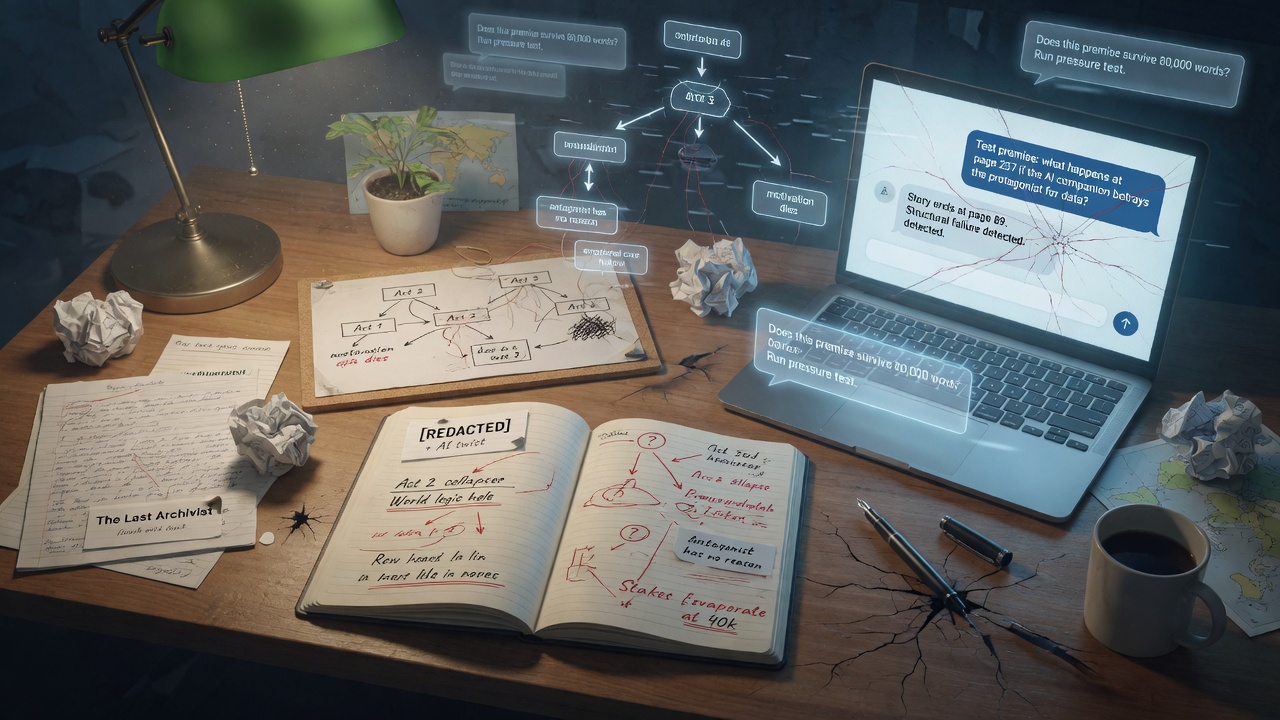
There's a better option available now, and it involves treating AI not as a writing assistant but as an adversarial pressure-tester. The goal is to break your premise before you invest in it—to find every load-bearing weakness while you can still change the architecture rather than the furniture.
The Five Pressure Points Every Premise Must Survive
Before introducing specific prompts, it's worth naming the five structural tests a premise needs to pass. These aren't arbitrary quality metrics—they're the dimensions along which most novel concepts quietly fail.
- Conflict sustainability: Can the central tension generate fresh complications across three acts without requiring you to introduce entirely new conflicts to rescue a stalled story?
- Character-premise fit: Does your protagonist have the specific psychological architecture that makes this particular conflict genuinely difficult for them, rather than difficult for anyone?
- Genre promise alignment: Does your premise deliver what readers of your target genre arrive expecting, or does it quietly violate the implicit contract?
- Originality vs. marketability tension: Is your concept distinct enough to feel fresh while remaining recognizable enough to find its audience?
- Thematic load-bearing capacity: Can the premise support the themes you intend to explore, or will those themes feel grafted on rather than generated by the story itself?
AI can stress-test all five of these, but it requires precise, adversarial prompting. Generic requests produce generic feedback. The prompts below are designed to put your concept under genuine pressure.
Prompt Set 1: The Conflict Sustainability Test
The first pressure point is the most fundamental. A premise that can generate ten distinct, logically necessary scenes from its own internal logic is a premise with structural legs. A premise that can generate three scenes and then requires external invention to keep moving is a premise with a sustainability problem.
Feed your premise to an AI model and use a prompt built around this specific challenge. Don't ask it to evaluate your idea—ask it to stress the concept by generating what it logically demands.
I'm developing a novel premise and need you to act as a structural stress-tester, not a cheerleader. Here is my premise: [Paste your premise here — 2 to 4 sentences describing the core concept, protagonist, central conflict, and stakes] Your task: Generate 10 scenes that this premise logically demands exist. These should be scenes that emerge directly from the premise's internal conflict—not scenes I'd have to invent to rescue a stalling story, but scenes the concept itself makes inevitable or near-inevitable. For each scene, identify: 1. What conflict drives it 2. What decision or revelation it forces on the protagonist 3. Whether it escalates or complicates the central premise tension After the 10 scenes, give me an honest assessment: Do these scenes feel like they cover a full novel's worth of dramatic territory, or do they cluster in the first half and then thin out? Where does the premise start requiring external invention to keep generating conflict?What you're auditing when you review the AI's output isn't just whether the scenes exist—it's whether they're scenes you actually want to write. A premise can be structurally sustainable and still be wrong for you as the author. If the AI generates ten logical scenes and you feel neutral or mildly resistant about eight of them, that's important information about fit, not just about structure.
Prompt Set 2: The "What Stops This From Being a Short Story" Challenge
This is the test most authors skip, and skipping it is expensive. Many concepts that feel novel-sized are actually short story ideas—elegant, complete, and genuinely powerful at five thousand words. Stretching them to eighty thousand words requires padding that erodes everything that made them compelling in the first place.
The question isn't whether your idea is good. It's whether the idea requires novel-length treatment to be fully itself, or whether it merely tolerates that length.
I need you to challenge my premise as a structural critic, not help me develop it. Here is my concept: [Paste your premise] Make the strongest possible case that this premise is actually a short story or novella in disguise. Argue specifically: 1. What single scene or moment represents the true emotional and narrative climax of this concept? 2. What does a novel-length treatment add beyond that climax—genuine complication, or extended setup and aftermath? 3. What would be lost by resolving the central conflict in 8,000 words rather than 80,000? 4. Does the premise require a protagonist's sustained internal transformation (a novel's core engine), or does it require a single external event and its immediate consequences (a short story's core engine)? Then—only if your analysis suggests the premise does have novel-length requirements—identify the specific structural elements that demand the longer form. Be specific. "It's complex" is not an answer.If the AI struggles to make the case that your premise needs novel-length treatment, take that seriously. It doesn't necessarily mean you abandon the concept—it might mean you need to layer in a second storyline, deepen the internal transformation arc, or reframe what the novel is actually about. But it's far better to make that discovery in a prompt session than at the forty-thousand-word mark.
Prompt Set 3: The Genre Promise Audit
Every genre carries an implicit contract with its readers. Thriller readers arrive expecting escalating threat and a protagonist under mounting external pressure. Literary fiction readers arrive expecting interiority and thematic density. Romance readers arrive expecting a clear emotional journey toward a satisfying relationship resolution. Violating these contracts doesn't automatically mean failure—but it means you're working against reader expectation, and you should know you're doing it before you start, not after you're on submission.
I'm writing a [genre] novel and need you to audit whether my premise fulfills the implicit contract that genre makes with readers. Here is my premise: [Paste your premise] Please do the following: 1. Describe the specific promises a [genre] novel makes to its readers— the emotional experience they're buying, the narrative beats they expect, the type of protagonist they're prepared to follow, and the tone they're anticipating. 2. Map my premise against those promises. Where does my concept clearly deliver on the genre contract? Where does it fall short or actively undercut genre expectations? 3. Identify any elements of my premise that might signal a different genre to readers—places where the concept is actually making promises that belong to [adjacent genre] rather than [intended genre]. 4. Flag any genre conventions my premise ignores that could create reader disappointment, and any places where my premise might be overcomplicating what the genre traditionally keeps simple. Be direct. I'm not looking for encouragement—I'm looking for a clear picture of the gap between what my concept promises and what my target readership expects.The genre audit is particularly useful for authors writing at genre boundaries—literary thrillers, romantic fantasy, upmarket women's fiction. These hybrid positions can be commercially strong, but they require deliberate management of two sets of reader expectations simultaneously. This prompt forces that conversation into the open before you've committed to a structure that serves one genre at the expense of the other.
Prompt Set 4: The Antagonist Pressure Test
A premise that can only be told from one perspective is a premise with a structural weakness at its center. Strong novel concepts generate genuine conflict—meaning both sides of the central tension have coherent logic, legitimate stakes, and defensible positions. When antagonists are simply wrong, or simply evil, or simply obstacles, the conflict collapses into a series of complications rather than a true dramatic argument.
I need you to argue my novel's central conflict from the antagonist's perspective, and to do it as compellingly as possible. Here is my premise: [Paste your premise, including who the antagonist is and what they want] Your task: Make the strongest possible case for the antagonist's position. Specifically: 1. What does the antagonist believe they are doing, and why do they believe they are right? (Avoid "they're just evil" framings—give them a coherent worldview.) 2. What does the antagonist stand to lose if the protagonist succeeds? Make these stakes feel as real and as sympathetic as possible. 3. From the antagonist's perspective, what is wrong with the protagonist's position? What does the protagonist not understand, ignore, or refuse to see? 4. Is there any version of events in which the antagonist winning would represent a defensible outcome—not a good one, but a coherent one? After making that case, assess: Does this premise support a genuine two-sided conflict, or does one side clearly lack the structural weight to sustain dramatic tension across a full novel?If the AI can't make a compelling case for your antagonist, your conflict isn't genuinely two-sided—and that's a premise problem, not a character problem. The fix isn't to write a more sympathetic villain. It's to examine whether the central conflict actually has competing legitimate interests at its core, or whether you've built a story around an obstacle rather than an argument.
How to Read AI Pushback Without Surrendering Your Vision
Working through these prompts will generate criticism of your concept. Some of that criticism will be accurate and important. Some of it will reflect AI conservatism—a tendency toward genre convention, marketability, and narrative familiarity that can work against genuinely original concepts.
The skill is distinguishing between the two, and it requires honest self-interrogation rather than defensive reaction.
Genuine premise weakness tends to show up consistently across multiple pressure tests. If the conflict sustainability test, the short story challenge, and the antagonist pressure test all flag the same structural gap, that gap is real. If only one test produces concerning output, examine whether the prompt itself was the problem before concluding the premise is.
AI conservatism tends to show up as resistance to subverting genre expectations, discomfort with ambiguous antagonists, and a preference for tidy thematic resolution. These are tendencies to notice and discount when they conflict with your deliberate artistic choices. The genre audit telling you that your literary thriller has too much interiority for the genre is useful information. It doesn't mean you have to remove the interiority—it means you need to know you're making an intentional choice and you should be prepared for the reader-expectation management that choice requires.
The most useful stance is treating AI output as a rigorous first reader with strong conventional instincts and no emotional investment in your success. That combination is actually rare and valuable. Use it to surface problems. Then decide, with full information, which problems are yours to fix and which are yours to own.
Before Page One
The writers who get the most out of this process are the ones who approach it with genuine willingness to be wrong about their own concept. That's harder than it sounds. A premise you've been thinking about for months carries emotional weight that makes adversarial testing feel threatening rather than useful.
The reframe that tends to help: finding a fatal flaw at the premise stage costs you an afternoon. Finding it at chapter twelve costs you months. Finding it after a full draft costs you everything you invested in the wrong structure—plus the time and psychological weight of either revising from the foundation up or starting over.
AI pressure-testing isn't about lowering your ambitions for the concept. It's about knowing what you're actually building before you start laying bricks.
No comments yet. Be the first to comment!