

Why Macro Ticking Clocks Fail Without Scene-Level Urgency
Most thriller writers understand the ticking clock as a structural device. You establish a deadline early — the assassin reaches the target in seventy-two hours, the virus spreads past containment at dawn, the evidence gets destroyed before the trial — and that macro-deadline supposedly keeps the engine running. The problem is that a premise-level countdown is a concept, not an experience. Readers feel it intellectually in chapter one and then slowly stop feeling it at all as they move through scenes where nothing is actually expiring.
Think about what makes a reader physically reluctant to put a book down. It is almost never the awareness that a large deadline exists somewhere in the future. It is the sensation that stopping reading right now, at this sentence, means abandoning a character inside a shrinking window. That sensation requires pressure that operates at the scene level, the page level, sometimes the paragraph level. The macro clock tells readers what is at stake. The micro clocks make them feel it in their bodies.
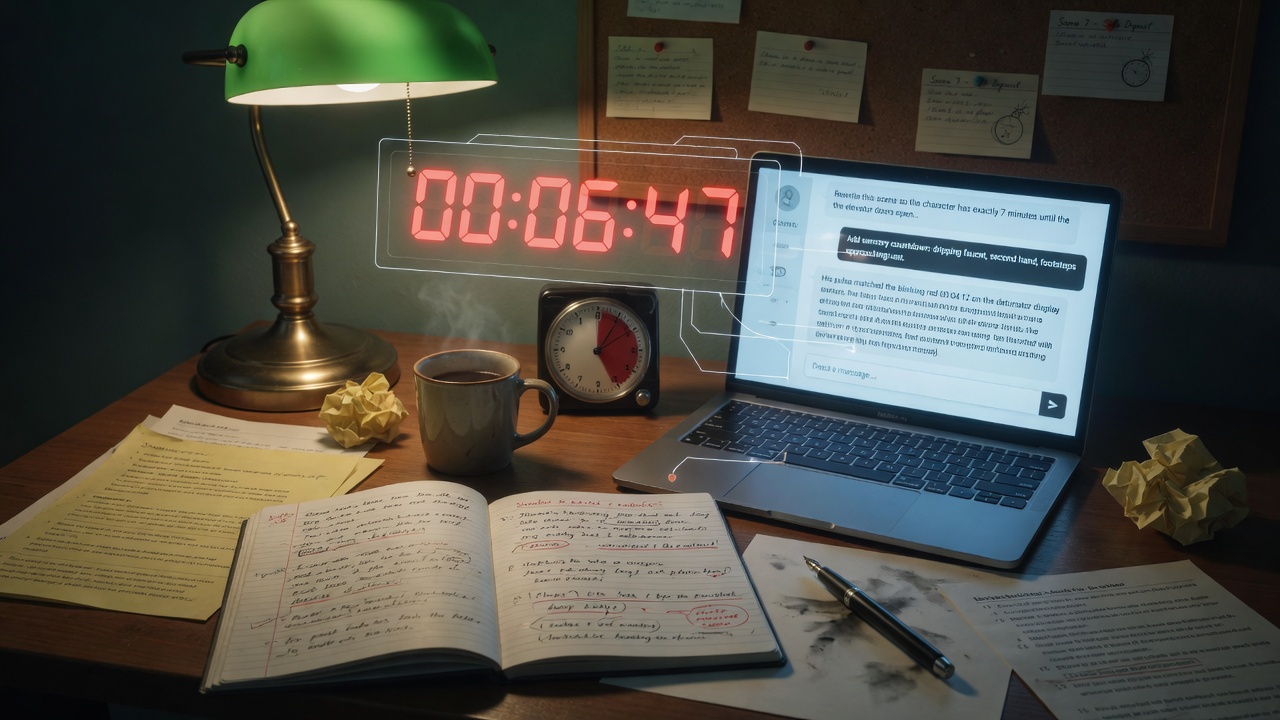
The fracturing of countdown pressure down through the architecture of a thriller is one of the craft elements most writers learn by instinct over years of writing and revision. A character is waiting for a callback that has to come before the contact goes dark — that is a scene-level clock. The callback is taking too long, and meanwhile someone is walking toward the door who cannot see our protagonist on the phone — that is a paragraph-level clock nested inside it. The contact who might call is connected to the larger conspiracy that will resolve or collapse at the macro deadline — that is the chain that links micro to macro. When these nested deadlines are working, readers do not experience a ticking clock as a plot device. They experience it as dread that accumulates.
Where AI becomes genuinely useful for thriller writers is in the diagnostic and engineering work. Identifying dormant time pressure in an existing scene, building chains of compounding micro-deadlines, and calibrating how much countdown the reader should feel versus what the protagonist knows — these are analytical tasks that benefit from an outside perspective on your manuscript. A well-constructed prompt gives you that perspective at scale.
Auditing Existing Chapters for Dormant Time Pressure
Many thriller scenes contain the bones of a ticking clock that the author simply has not activated on the page. A character is waiting for test results and meanwhile conducting an interview — the results create an implicit deadline that is never foregrounded. A meeting is happening in a building where security changes shifts at a specific time — the shift change is mentioned once and then forgotten. These dormant pressures are often more valuable than invented ones because they already belong to the logic of your story. Activating them requires diagnosis before it requires drafting.
When you bring a scene to an AI system for this kind of audit, you want to resist the temptation to ask a general question like "how can I make this more tense?" That prompt produces generic advice. Instead, you want the AI to perform a specific analytical task: identify every element in the scene that has a temporal dimension — anything that expires, closes, changes state, or becomes irrelevant after a period of time — and then evaluate whether each element is currently doing work on the page or sitting inert.
I am going to paste a scene from my thriller manuscript. Your task is a temporal audit, not a general critique. Read the scene and identify every element that contains latent time pressure — anything that expires, closes, changes, or becomes irrelevant as time passes, whether or not the scene currently draws attention to it. For each element you identify, tell me: (1) what the implicit deadline is, (2) whether the scene is currently activating that pressure on the page or leaving it dormant, and (3) one specific sentence or moment in the scene where that pressure could be surfaced without adding new plot information. Do not suggest new plot elements. Work only with what is already in the scene. [PASTE SCENE HERE]
The instruction to work only with what is already in the scene is important. It forces the response to engage with your actual material rather than offering generic thriller advice dressed up as feedback. After running this audit, you will typically find two or three pressures you either forgot about or never consciously recognized were there. The revision work that follows is usually not about adding new material — it is about surfacing what was already present.
Engineering Micro-Deadlines That Compound
The difference between tension that accumulates and tension that resets is compounding. When a micro-deadline expires and is simply replaced by a different micro-deadline, the reader's anxiety level stays roughly constant or even drops slightly as one pressure resolves. When a micro-deadline's expiration creates a new, tighter constraint that is also linked to the deadline above it, tension multiplies. Engineering that compounding effect deliberately is one of the harder craft problems in thriller writing, and it is where AI prompting can do some of its most useful work.
The key is asking the AI to think in chains rather than individual moments. You are not looking for one good scene-level clock. You are building a sequence where each expiration worsens the conditions for the next window, and where the accumulated cost of expired micro-deadlines is legible to the reader as mounting damage against the protagonist's position.
I am working on a sequence of three to five scenes in my thriller that needs to carry compounding time pressure across chapters [X through Y]. The macro deadline is [describe your large deadline: e.g., "the protagonist must expose the conspiracy before the senate hearing at 9 a.m. on Friday"]. Here is a summary of what happens in each scene: [paste summaries]. Your task is to design a chain of micro-deadlines that nest inside this macro deadline and compound rather than reset. Each micro-deadline's expiration should worsen the conditions for the next one — meaning the protagonist loses something concrete (an option, an ally, a piece of information, access to a location) that makes the following window tighter or more dangerous. For each micro-deadline, specify: (1) what expires and when, (2) what the protagonist loses when it expires, (3) how that loss directly tightens or complicates the next micro-deadline in the chain, and (4) whether the expiration should happen on-page or off-page between scenes. Do not suggest deadlines that require adding new subplots. Build from the scene summaries I have provided.
Pay close attention to the fourth specification in that prompt. Whether a micro-deadline expires on-page or between scenes is a significant craft decision. An on-page expiration gives readers the visceral experience of watching a window close. An off-page expiration, where the protagonist arrives in the next scene to discover something has already changed, creates a different kind of dread — the sense that the situation kept deteriorating while the reader wasn't watching. Both are useful. The AI's suggestions on placement can help you think about pacing across the chapter sequence rather than within individual scenes.
Calibrating Reader Awareness Versus Character Awareness
One of the most powerful tools available to thriller writers is the information gap between what readers know and what the protagonist knows about how much time is actually left. This gap operates in two directions, and each creates a different emotional experience.
When readers know more than the protagonist — they have seen the antagonist set the clock, they understand what the ticking sound means even though the character doesn't — the result is dramatic irony that produces anticipatory dread. Readers feel the pressure even as the protagonist moves through scenes without adequate urgency. Done well, this is almost unbearable. Done poorly, it makes the protagonist seem incompetent and frustrates rather than grips.
When the protagonist knows more than readers — they are racing against a deadline readers cannot fully see — the result is a different kind of tension, closer to anxiety than dread. Readers feel the urgency through the character's behavior but cannot fully calculate the stakes. This works particularly well in first-person or close third, where readers are inside a mind that is managing fear without fully articulating it.
I am revising a sequence in my thriller and need to calibrate the information gap between reader awareness and protagonist awareness of the countdown. Here is the relevant context: [describe the macro deadline, what the protagonist knows about it, and what readers have been shown that the protagonist does not know — or vice versa]. Analyze the gap as I have described it and tell me: (1) whether the current gap is most likely producing dramatic irony, anxiety, or dread in the reader, and why; (2) at what points in the sequence the gap should widen versus narrow to maximize sustained tension rather than releasing it prematurely; (3) one specific moment in each scene where I could adjust a detail — a piece of information revealed to the reader, withheld from the protagonist, or vice versa — to sharpen the gap's emotional effect; and (4) any point where the gap risks crossing into reader frustration rather than productive tension, and what would cause that shift.
The final specification in this prompt — identifying where the gap risks producing frustration rather than tension — is worth emphasizing. Readers will tolerate a protagonist who doesn't know what they know, but only as long as the protagonist's ignorance is plausible and their behavior under that ignorance is compelling. The moment readers feel the protagonist should have figured something out and hasn't, the information gap stops generating dread and starts generating impatience. Having an AI flag these risk points during revision gives you an early warning before your beta readers hit the same wall.
A Fourth Prompt for Drafting New Scenes Under Pressure
The three prompts above are primarily revision tools. When you are drafting a new scene from scratch and need it to carry a specific quantity of time pressure at a specific position in the compounding chain, a different kind of prompt is useful — one that asks the AI to help you draft with the countdown architecture already built in.
I need to draft a scene for my thriller that carries scene-level time pressure and connects to the larger countdown structure of the novel. Here is the context: [describe the macro deadline, where this scene falls in the chapter sequence, what micro-deadline is active in this scene, and what the protagonist loses if it expires]. Draft an opening paragraph and a closing paragraph for this scene that bracket the micro-deadline without stating it explicitly. The opening should establish the ticking pressure through situation and sensory detail, not through the protagonist thinking about the deadline. The closing should either show the expiration of the window and its immediate cost, or end at the last possible moment before expiration in a way that makes stopping reading feel like abandoning a character in danger. Use the physical environment and the protagonist's body — not their internal monologue — as the primary vehicles for the reader's sense of time running out.
The instruction to use physical environment and the protagonist's body rather than internal monologue is doing significant work here. Internal monologue that explains a countdown ("she had eight minutes, maybe less") is technically functional but experientially weak. Readers process it as information. A hand that won't stop shaking, a corridor that seems to have gotten longer, a sound from the floor above that means someone is already moving — these land as sensation, and sensation is what produces the physical reluctance to put the book down that distinguishes a thriller that works from one that merely has a ticking clock somewhere in its premise.
Building the Habit Into Your Process
These prompts are most effective when they become part of your revision passes rather than emergency interventions late in the drafting process. A useful workflow is to run the temporal audit prompt on each chapter as you finish a complete draft, identify which scenes have dormant pressure and which have none, and then use the micro-deadline chain prompt to design the compounding architecture before you begin scene-level revision.
- Run the temporal audit on completed chapters before revising individual scenes
- Design compounding micro-deadline chains at the sequence level before scene-level revision
- Use the information gap calibration prompt during a dedicated tension pass, separate from prose revision
- Apply the drafting prompt only when a scene is genuinely new, not when revision of existing material would serve better
The macro ticking clock earns its place in your thriller's premise. But the reading experience — the pages that feel physically impossible to set down — lives in the scene-level architecture, in the nested and compounding windows that fracture the large countdown into dozens of smaller ones. AI can help you see that architecture clearly and build it deliberately, which is most of what revision is anyway: seeing what is actually on the page rather than what you intended to put there, and closing the distance between the two.


No comments yet. Be the first to comment!