
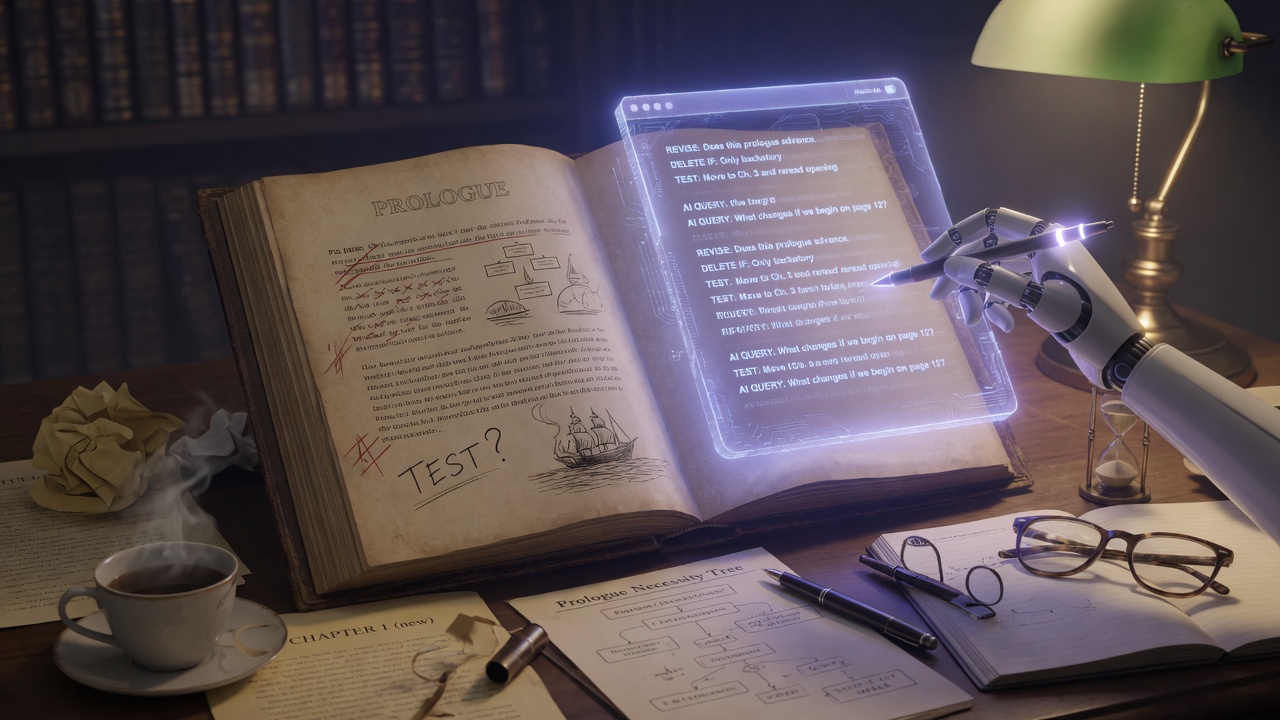
Every prologue you've ever written felt necessary the day you wrote it. That's the problem. Prologues get drafted in a moment of enthusiasm—you wanted to show the dragon attack before the slow-burn court politics, or you wanted readers to meet the killer before they meet the detective, or you had backstory that felt too good to compress into dialogue. None of that enthusiasm tells you whether the prologue is doing structural work six months later when you're staring at a manuscript that opens twice.
The honest test isn't "do I like this scene." It's "does the story lose something measurable if I delete it." Most writers can't answer that objectively about their own opening pages, because they already know what's coming in Chapter One and can't unknow it. This is exactly the kind of controlled, repeatable diagnostic AI is suited for—not to write your prologue, but to interrogate whether it deserves to exist.
Why Prologues Fail: Four Unearned Reasons Writers Keep Them
Before running any diagnostics, it helps to know what you're diagnosing for. Almost every unnecessary prologue falls into one of four categories.
The Info Dump in a Trench Coat
This is worldbuilding or backstory that felt too big to slip into scene, so it got its own chapter with a fancy label. The tell: if you removed all the proper nouns and history, there's no dramatic question being asked, just information being delivered.
The Cool Scene That Doesn't Belong Yet
Often the villain's origin, a battle, a murder—something visually striking that the writer loves and doesn't want to cut. The tell: it could be moved almost anywhere else in the book (flashback, chapter break, epilogue) without losing anything, which means its current position is arbitrary rather than earned.
Tonal or Genre Mismatch
The prologue is written in a different register than the rest of the book—more lyrical, more violent, more distant—because it's serving a different job (hook the reader) than the rest of the manuscript (tell the story). Readers feel this whiplash even when they can't name it.
Redundant With Chapter One
The prologue establishes stakes, tone, or character that Chapter One re-establishes anyway within the first few pages. It's insurance the manuscript didn't need to buy.
Knowing the failure mode you suspect helps you interpret the AI's output. Now the actual workflow.
Prompt 1: Isolate What the Prologue Actually Delivers
Start by feeding the model both the prologue and Chapter One in full, and ask it to separate what's unique to the prologue from what gets restated.
I'm going to give you my prologue and Chapter One in full. Do not summarize the plot back to me. Instead, produce two lists: LIST A: Information, emotional beats, or character insights that appear ONLY in the prologue and are not restated, implied, or covered anywhere in Chapter One. LIST B: Information, emotional beats, or character insights that appear in the prologue AND are also established in Chapter One (even if the phrasing or scene is different). For each item in List A, rate its narrative importance: - CRITICAL: the reader needs this before Chapter One ends, or later scenes won't make sense or won't land emotionally - USEFUL: it adds texture, dramatic irony, or color but the story is comprehensible without it - DECORATIVE: it exists but doesn't affect comprehension, stakes, or emotional investment in anything that follows Here is the prologue: [PASTE PROLOGUE] Here is Chapter One: [PASTE CHAPTER ONE]
What you're looking for in the output is simple: how long is List A, and how many items in it land as CRITICAL. If List A is short and mostly USEFUL or DECORATIVE, you already have your answer—the prologue is doing very little that Chapter One doesn't already handle. If List B is long, you've confirmed redundancy. Writers are frequently surprised here; they remember the prologue as essential because they wrote it first, but the model has no such attachment and will tell you plainly when Chapter One already re-establishes the stakes on its own.
Prompt 2: Simulate the Reader Who Skips It
The next test is behavioral rather than structural. Some prologues fail the "unique information" test but still feel important—so test them against an actual reading experience instead.
Act as a first-time reader of this manuscript who skips the prologue entirely and starts reading at Chapter One. You have no knowledge of anything in the prologue. Read the chapters I give you in order and, after each one, tell me: 1. Is there any moment where you feel confused, missing context, or unsure why something matters, that a reader WITH the prologue would not feel? 2. Is there any moment where dramatic irony, suspense, or stakes are weaker because you don't have information the prologue would have given you? 3. At what specific page or scene, if any, does the absence of the prologue become a real problem rather than a minor curiosity? Be skeptical of your own answers — don't invent confusion to be agreeable. If the story reads cleanly without the prologue, say so directly. Here are the chapters, in order, up through the midpoint of the manuscript: [PASTE CHAPTERS 1 THROUGH MIDPOINT]
This prompt matters because it forces the AI to commit to a specific breaking point rather than giving you a vague "it might be helpful." If it can't identify a concrete scene where the missing prologue causes real confusion by the midpoint, that's a strong signal the prologue is front-loading anxiety insurance rather than solving an actual comprehension problem. If it does identify a specific breaking point, you've located exactly where the missing information needs to surface—which sets up the next prompt.
Prompt 3: Test Relocation Before You Test Deletion
Cutting a prologue outright is often the wrong binary. Sometimes the material is good, just misplaced. Before you commit to deletion, ask the model to test alternative placements.
Here is a scene currently functioning as my prologue, along with a summary of my full manuscript structure (chapter list with one-line descriptions). Evaluate four possible placements for this material and argue for or against each one specifically, citing where in my chapter list it would land and what effect it would have: 1. DELETE ENTIRELY — the information can be cut or handled in a single line of dialogue/narration elsewhere. Tell me where. 2. LATE FLASHBACK — moved to appear as a flashback chapter at the point where the reader most needs this context (name the chapter). 3. EPIGRAPH OR FRAGMENT — condensed into a short epigraph, document excerpt, or interstitial fragment rather than a full scene. 4. KEEP AS PROLOGUE — but only if you can name the specific structural job it's doing that nothing else in the manuscript can do as well. For each option, tell me what the manuscript gains and loses. End with a clear recommendation, not a hedge. Prologue text: [PASTE PROLOGUE] Manuscript chapter list: [PASTE CHAPTER-BY-CHAPTER SUMMARY]
This is the prompt that produces the most useful surprises. Villain-POV prologues, in particular, often work better as a flashback dropped at the 40% mark, right when the reader is hungry for the antagonist's motivation instead of receiving it cold before they have any reason to care. Worldbuilding prologues frequently compress beautifully into a one-paragraph epigraph or found document, keeping the flavor without the runtime cost. Forcing the model to argue for all four options, rather than just yes/no, prevents you from getting a lazy answer.
Prompt 4: Audit the Tonal and POV Whiplash
Even a prologue that clears the information tests can still hurt the book if it promises a different reading experience than the manuscript delivers. This is subtle and writers often can't feel it in their own prose because they know both pieces intend to serve the same story.
Compare the prologue and Chapter One below purely on craft and tonal grounds, not plot content. Answer each of these directly: 1. VOICE: Are these written in a consistent narrative voice (sentence rhythm, vocabulary level, level of interiority)? If not, describe the specific difference. 2. POV DISTANCE: Is the emotional/psychological distance from the POV character similar in both, or does one feel more intimate or more removed than the other? 3. GENRE SIGNALING: If a reader had only the prologue to go on, what genre and tone would they expect the book to be? Does that match what Chapter One actually delivers? 4. PACING: Compare sentence length and scene length. Does the prologue set an expectation for pacing that the rest of the opening chapters don't sustain? Give me a whiplash severity rating from 1 (seamless) to 5 (reader will feel actively misled about what kind of book this is), and justify the number. Prologue: [PASTE PROLOGUE] Chapter One: [PASTE CHAPTER ONE]
A severity rating of 4 or 5 here is a red flag independent of whatever the information audits told you. A reader who opens a moody, violent prologue and lands in a wisecracking cozy-mystery Chapter One is going to feel bait-and-switched regardless of how much plot-critical information that prologue contained. Sometimes the fix isn't cutting the prologue but rewriting it to match the voice you actually settled into by the time you finished the manuscript—which is common, since prologues are often drafted first, before your narrative voice has fully found itself.
Building Your Keep/Cut/Relocate Matrix
Once you have output from all four prompts, the decision usually sorts itself. Lay it out plainly:
- Keep as-is: List A had multiple CRITICAL items, the skip-test identified a real confusion point, relocation options were all weaker than the original placement, and whiplash severity was 1–2.
- Cut entirely: List A was short and mostly DECORATIVE, the skip-test found no real confusion through the midpoint, and the relocation prompt recommended deletion or a single line elsewhere.
- Relocate: The information mattered (CRITICAL items exist) but the skip-test showed the confusion point occurs well past Chapter One, meaning the material is needed later, not now. Move it.
- Revise in place: The information audit and skip-test supported keeping it, but whiplash severity was 4–5. Rewrite the prologue in the voice of the rest of the book rather than cutting it.
Genre expectations should weigh into how strict you are with this matrix. Epic fantasy and thrillers have trained readers to tolerate, even expect, prologues that jump POV or timeline—a prologue showing the antagonist's crime or the ancient prophecy being set is a genre convention, not automatically a flaw. Literary fiction and contemporary commercial fiction have much less tolerance; readers expect to meet their protagonist on page one, and a prologue reads as throat-clearing more often than not. Adjust your bar for "CRITICAL" accordingly—a fantasy prologue setting up a magic system's cost might justify itself where an equivalent info-dump in a contemporary domestic drama would not.
The point of running all four prompts isn't to outsource the decision. It's to force yourself to see the prologue the way a reader will—without your foreknowledge, without your attachment to the scene you liked writing, and without the assumption that because you wrote it first, it belongs first.

No comments yet. Be the first to comment!