

Why the First Line of a Query Letter Works Differently Than the First Line of Your Novel
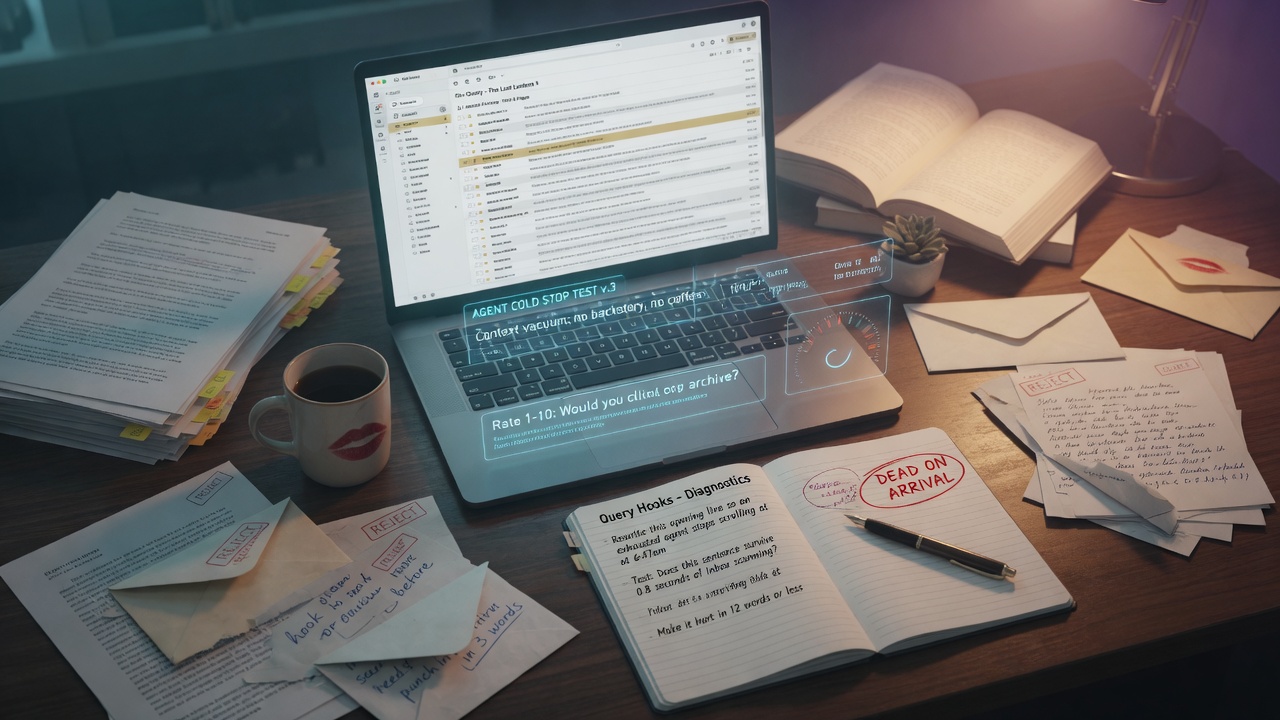
Your novel's opening line earns its power through context—a reader has chosen the book, settled in, and granted it time. Your query letter's opening line operates under entirely different conditions. An agent opens your email alongside forty others that morning. They are not in reading mode. They are in sorting mode.
That distinction matters more than most novelists realize. When agents describe what they're looking for in a query hook, they rarely use words like "beautiful" or "surprising." They use words like "clear," "specific," and "immediate." The query hook isn't asking an agent to feel something—not yet. It's asking them to understand, in under ten seconds, whether this manuscript belongs in the category of things worth their attention today.
What agents are actually scanning for in those first twenty-five words breaks down into three rapid assessments: genre orientation (does this feel like something I represent?), premise clarity (do I understand what this story is fundamentally about?), and differentiation (have I seen this exact configuration before?). These aren't sequential evaluations. They happen simultaneously, in the same glance a diagnostician uses reading an intake form. The hook either confirms all three or it doesn't, and if it doesn't, the rest of your letter—no matter how polished—is fighting uphill.
This is why novelists who write exceptionally well often write weak query hooks. The skills are genuinely different. A novelist trained to create layered meaning and resist explanation will instinctively write hooks that withhold too much or gesture at theme rather than premise. The query hook requires something closer to the discipline of a logline: compression without vagueness, intrigue without mystery about what kind of story this actually is.
The Four Query Hook Failure Modes
Before you can fix your hook, you need to accurately diagnose what's wrong with it. In practice, nearly every underperforming query hook falls into one of four categories.
- Premise dump: The hook tries to establish too much world, backstory, or context before arriving at the actual story problem. It reads like a summary rather than an entry point.
- Stakes burial: The interesting thing—what the protagonist stands to lose, what the conflict actually costs—appears at the end of the paragraph or not at all in the hook. The agent reads setup without ever encountering urgency.
- Vague intrigue: The hook gestures at something mysterious or emotionally resonant without grounding it in specific story detail. Phrases like "one woman's journey to discover the truth" or "a secret that will change everything" trigger this failure. The hook sounds like a hook but contains no actual information.
- Genre mismatch: The language, tone, or structural signals of the hook don't match the genre conventions agents use to categorize submissions. A thriller written with literary fiction's reflective interiority. A romance that opens on geopolitical stakes. The agent's mental filing system can't place the book, and confusion defaults to a pass.
AI is genuinely useful here because it can evaluate your hook against a defined framework without the social friction that makes honest feedback hard to get from human readers. You can ask it to render a verdict directly.
I'm writing a query letter for a [GENRE] novel with comp titles [COMP 1] and [COMP 2]. My manuscript is approximately [WORD COUNT] words. Here is my current query hook—the first one to three sentences of my query letter: [PASTE YOUR CURRENT HOOK HERE] Please evaluate this hook against the following four failure modes and tell me which one I'm primarily committing, or whether I'm committing more than one: 1. Premise dump: Too much context before the story problem 2. Stakes burial: The cost or conflict appears too late or not at all 3. Vague intrigue: Emotionally gestural but lacking specific story detail 4. Genre mismatch: Language or tone signals don't match genre conventions For the failure mode you identify, explain specifically which words or phrases are causing the problem. If my hook avoids all four failure modes, tell me that and explain what's working. Do not suggest rewrites yet— focus only on diagnosis.The instruction to withhold rewrites is deliberate. When AI jumps immediately to alternatives, authors often adopt the first option that sounds better rather than understanding why the original failed. Diagnosis first forces you to understand the problem before you start solving it.
Generating Ranked Alternative Opening Lines
Once you have a clear diagnosis, you're ready to generate alternatives—but the quality of what you get back depends entirely on what you feed in. A prompt that simply asks for "better hooks" will return generic improvements. The prompt that generates genuinely useful alternatives gives the AI your genre conventions, your comp titles, and critically, your protagonist's central wound.
The central wound is the detail most novelists omit because it feels too interior for a hook. But the protagonist's wound—what they're carrying before the story begins, the unresolved damage that the plot will exploit—is often the element that transforms a premise statement into a hook. It's the difference between "a woman discovers her husband is lying" and "a woman whose mother vanished without explanation discovers her husband has been living under a false name for their entire marriage." The wound is the reason the external conflict hits as hard as it does.
I need five distinct opening lines for a query letter for my novel. Please generate ranked alternatives based on the following information: GENRE: [Your genre, e.g., "psychological thriller"] WORD COUNT: [e.g., "92,000 words"] COMP TITLES: [e.g., "Verity by Colleen Hoover and The Silent Patient by Alex Michaelides"] TARGET AGENTS: [Optional: e.g., "agents who represent domestic suspense and unreliable narrator thrillers"] PREMISE IN ONE SENTENCE: [Write your logline here—what happens, to whom, and what's at stake] PROTAGONIST'S CENTRAL WOUND: [Describe the unresolved damage your protagonist carries before page one—the psychological or emotional vulnerability the plot will exploit. Be specific.] THE EXTERNAL CONFLICT: [What event or discovery sets the plot in motion] THE CORE TENSION: [What opposing forces or impossible choices define the story] Generate five distinct hook variations, each leading with a different story element: (1) the protagonist's wound, (2) the inciting incident, (3) the central tension or impossible choice, (4) the stakes if the protagonist fails, and (5) a comparison or contrast construction using the comp titles as tonal anchors. After presenting all five, rank them from most to least likely to stop an agent who represents this genre, and explain your ranking in one sentence per variation.The ranking request is important. Without it, you receive five options and face the same evaluative problem you started with. When AI explains its ranking rationale—even briefly—you can interrogate whether that reasoning matches what you know about your specific agents' stated preferences, which you've researched.
The Cold-Reading Agent Role-Play: Finding Where Momentum Stalls
There's a particular kind of feedback that's almost impossible to get from workshop peers or writing group members: the experience of reading your query completely cold, with no investment in you or your work, and reporting the precise moment attention begins to slip. Human readers who know you can't fully simulate this. AI can, with the right framing.
The most common problem in query first paragraphs isn't a bad hook—it's what happens after the hook. Authors write a serviceable opening line and then immediately introduce a clause, a character name, a world detail, or a qualification that bleeds the momentum the hook just created. This is sometimes called synopsis creep: the paragraph begins functioning as plot summary rather than persuasion, and the agent's attention, briefly captured, releases.
I want you to role-play as a literary agent who has just opened a query letter submission. You represent [GENRE] fiction and have a strong preference for [describe the tonal or structural qualities your target agents have listed in their MSWL or interviews]. You are reading cold— you know nothing about this author or this book. Here is the first paragraph of my query letter: [PASTE YOUR COMPLETE QUERY FIRST PARAGRAPH HERE] As you read, track your attention as honestly as possible. Report: 1. The exact word or phrase where you felt forward momentum begin to stall—where the paragraph started to feel like summary rather than persuasion. Quote it directly. 2. Whether the opening line successfully established genre orientation. If not, what genre did it signal instead, or did it fail to signal any genre? 3. Whether you understood, by the end of the paragraph, what this protagonist fundamentally wants and what's preventing them from getting it. 4. Whether the stakes—what the protagonist stands to lose—appeared in the paragraph. If they did, did they arrive in time to sustain momentum, or did they arrive too late? Do not rewrite the paragraph. Report your reading experience as specifically as possible, quoting the text where relevant.The instruction to quote the stall point directly is what makes this prompt useful rather than vague. "The paragraph loses momentum" is not actionable. "The paragraph loses momentum at 'having grown up in a small town where secrets travel fast'—this clause introduces backstory that interrupts the forward pull of the inciting incident" gives you something to fix.
How the Same Premise Produces Wildly Different Hooks
Here's where the diagnostic work becomes most instructive. Take a single manuscript premise—ninety thousand words, fully drafted—and observe what happens when you lead with different story elements. The hook you choose is not just a stylistic preference. It's a signal about which reader you're targeting and what experience you're promising.
Consider a novel with this premise: A forensic accountant with a history of dissociative episodes discovers that the firm she's been auditing has been laundering money for a trafficking network—and that her own financial records suggest she may have known for years.
Leading with the protagonist's wound produces: "Elena has learned to trust her records more than her memory—a sensible policy, until her records begin to implicate her in crimes she can't remember committing."
Leading with the inciting incident produces: "When forensic accountant Elena Marsh discovers her client has been laundering money for a trafficking network, the more urgent problem is what she finds when she audits her own accounts."
Leading with the impossible choice produces: "Elena Marsh can expose a trafficking network or protect herself from evidence she may have created—but the trail she's following is written in her own handwriting."
Three hooks. Same manuscript. The first signals a psychological thriller with an unreliable narrator emphasis. The second signals a procedural with a discovery-driven plot. The third signals a moral dilemma story with thriller pacing. An agent who loves Tana French reads the first differently than an agent who loves Harlan Coben. The hook you choose is a form of matchmaking.
This is why generating multiple variations before selecting isn't a sign of uncertainty about your book—it's a sign of strategic clarity about your submission. You're not changing your story. You're identifying which angle of entry best matches each agent's stated preferences, then drafting variations accordingly.
Building a Hook Testing Practice Into Your Query Process
The practical workflow that emerges from all of this is straightforward. Before you send a single query, run your hook through the diagnostic prompt to identify failure mode. Fix the identified problem, then run the variation-generation prompt to produce five alternatives. Take those five alternatives and run each through the cold-reading agent prompt for momentum analysis. At the end of this process, you will have a ranked set of hooks with documented reasoning for the ranking, plus specific intelligence about where each one stalls.
This is not the same as outsourcing your query letter to AI. The AI has no knowledge of your specific manuscript's texture, your prose voice, or the particular resonance of your characters. What it can do is apply consistent diagnostic pressure to the structure and function of your hook—the mechanical question of whether it's doing its job—while you retain full authority over what the hook actually says about your book.
The goal is not a perfect first line. It's a first line that accomplishes the narrow, specific task it exists to accomplish: confirming genre, establishing premise, and creating enough forward pull that an agent reads the second sentence. Everything else—the voice, the stakes, the emotional depth of the story you spent years writing—lives in what comes after. But only if the hook does its job first.
Query letters fail at the hook with remarkable consistency, not because novelists lack craft, but because the hook demands a different kind of craft than the one they've spent years developing. AI diagnostic prompts don't replace that craft—they stress-test it under conditions that approximate the actual reading situation your query will face, before the submission goes out and the feedback loop closes.


No comments yet. Be the first to comment!