
Third-Person Drift: AI Prompts That Catch When Your Narrator Slides Out of a Character's Head
Why Third-Person Limited Breaks Without Warning
Third-person limited is the dominant point of view in commercial and literary fiction for good reason. It offers the intimacy of first person—access to a single character's thoughts, sensory data, and interpretive filters—while preserving the flexibility of a slightly external narrative voice. The problem is that it fails silently. Unlike first person, where a breach is immediately obvious ("I walked into the room, not knowing that Sarah was furious" is clearly impossible), third-person limited drift can sit in a paragraph for years without a reader consciously naming it. They simply feel less engaged, less anchored, less certain whose experience they're inhabiting.
AI writing assistants make this problem significantly worse before they can make it better. Large language models are trained on enormous quantities of omniscient narration—nineteenth-century fiction, third-person omniscient bestsellers, Wikipedia-style expository prose—and they default toward that mode under pressure. When you ask an AI to continue a chapter or fill in a scene, it will frequently slide the camera back, narrating the room rather than the room as your character perceives it. The result is prose that reads smoothly but has quietly lost its center of gravity.
Three specific failure modes account for most third-person limited drift:
- Omniscient intrusion: The narrator makes a claim no single character could make—a judgment about what "everyone in the room" felt, a statement about historical context the POV character doesn't consciously know, a bird's-eye description of a setting the character can't see from where they're standing.
- Outside-body description: The POV character is described from the outside—their own face flushing, their own eyes going wide, the way they "looked" to others—without the mediation of a mirror, another character's dialogue, or a clearly signaled imaginative act.
- Inaccessible emotional reporting: The narrative attributes specific emotions to characters other than the POV character as flat declarations rather than inferences. "Marcus was jealous." "She felt betrayed." These may be true, but the POV character can only observe behavior and infer feeling—they can't read minds, and the narration shouldn't either.
Each of these can be addressed systematically with targeted AI prompts. The key is knowing exactly what to ask for.
The Camera Test: Prompting AI to Flag Where the Eye Leaves the Skull
The most useful foundational audit you can run is what I call the camera test. The metaphor is simple: in a properly maintained third-person limited scene, the narrative camera is bolted to the POV character's skull. It sees what they see, from where they are standing, filtered through their interpretive habits and emotional state. The moment the camera floats free—to observe the character from outside, to pan across the room without them, to read another character's interior—you have drift.
The following prompt asks AI to perform this audit sentence by sentence and flag violations explicitly:
You are a point-of-view editor specializing in third-person limited narration. I am going to paste a chapter excerpt. Your task is to perform a "camera test" on every sentence. The camera test works as follows: imagine the narrative camera is physically attached to the POV character's head. It can only see, hear, smell, taste, and feel what that character experiences from their exact physical position. It can only report internal states (thoughts, emotions, memories) that belong to that character. It cannot float above the scene, describe the character's own face or body from the outside (unless a mirror or reflection is present), or declare the inner states of other characters as facts. For each sentence or clause that fails the camera test, do the following: 1. Quote the exact failing phrase or sentence. 2. Name the failure mode: (a) omniscient intrusion, (b) outside-body description, or (c) inaccessible emotional reporting. 3. Briefly explain why it fails. 4. Suggest a revision that keeps the same narrative information but filters it through the POV character's perception or inference. My POV character in this scene is [CHARACTER NAME]. Here is the excerpt: [PASTE YOUR TEXT]To show this working in practice, consider the following "before" passage with a POV character named Delia:
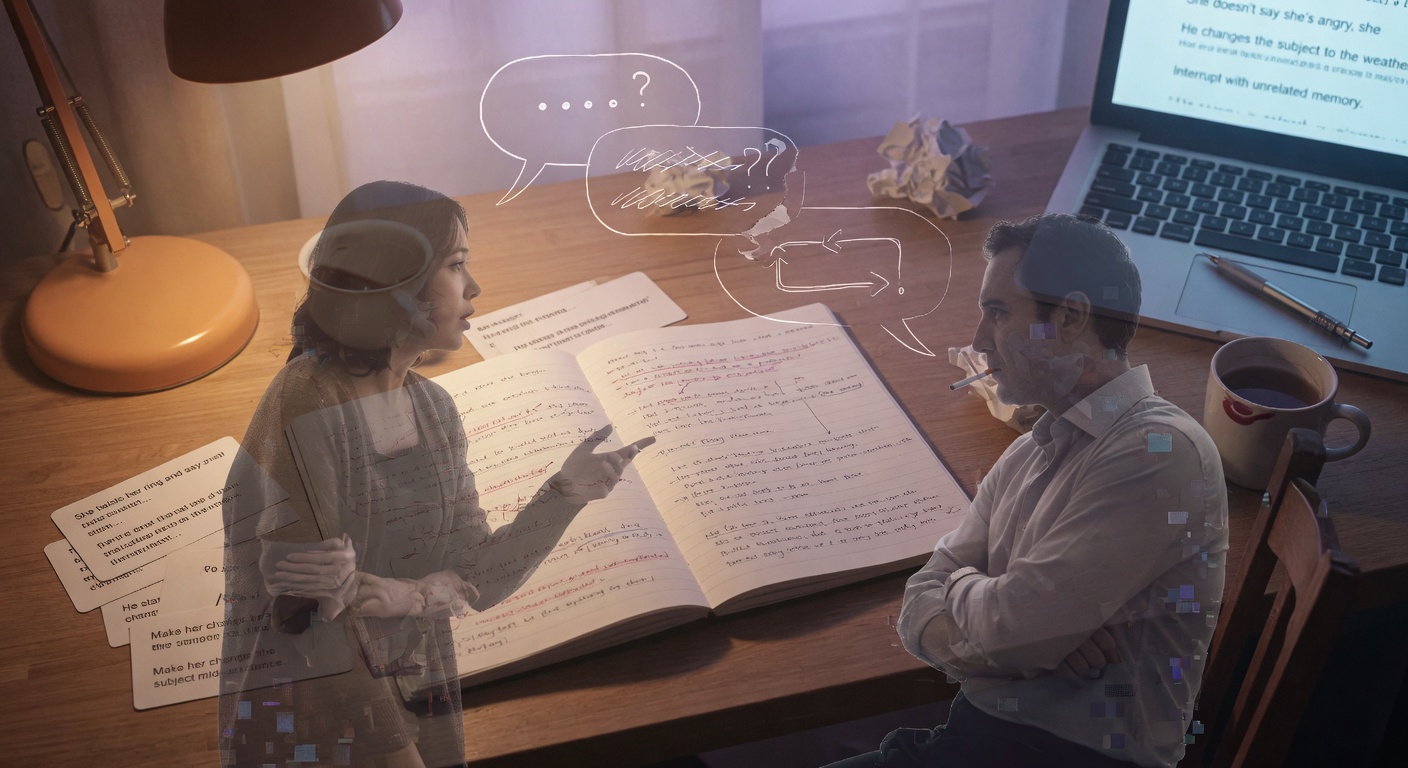
Before: "Delia crossed the lobby, her jaw tight with anxiety. The hotel was grand and old-fashioned, the kind of place her mother would have approved of. At the front desk, the clerk, whose name was Brendan according to his badge, felt a flicker of irritation at her arrival—guests like her always made the shift harder. She looked nervous, though she didn't realize it."A camera test audit flags three violations: "her jaw tight" is outside-body description (Delia doesn't feel her jaw as external observers see it), "Brendan... felt a flicker of irritation" is inaccessible emotional reporting, and "She looked nervous, though she didn't realize it" is both outside-body and an omniscient intrusion that directly contradicts the premise of limited POV.
After: "Delia crossed the lobby, teeth clenched, the tension in her jaw something she'd been carrying since the taxi. The hotel was grand and old-fashioned—her mother would have approved, she thought, and wasn't sure whether that made it better or worse. The clerk at the front desk, Brendan according to his badge, didn't smile when he saw her. His eyes dropped to his computer screen a beat too quickly."The information content is nearly identical. The felt experience is entirely different.
Catching Inaccessible Knowledge: What Your POV Character Can't Actually Know
Omniscient intrusion often appears not as a dramatic camera pullback but as a small, casual fact—a piece of information slipped into the narration that the POV character has no way of possessing at that scene moment. This is especially common in AI-assisted drafts, where the model draws on its full knowledge of the story's context rather than restricting itself to what the character would know right now, in this room, at this point in time.
The audit for inaccessible knowledge requires a slightly different framing than the camera test, because some of these violations involve inference and probability rather than pure sensory access:
You are a continuity editor for a novel written in strict third-person limited POV. I will provide you with a scene excerpt and a brief description of what the POV character knows at this exact moment in the story. Your task is to identify every piece of information in the excerpt that the POV character could NOT know through: - Direct sensory observation (what they can currently see, hear, smell, touch, taste) - Reasonable inference from observable evidence - Prior established knowledge (memories, things they've been told before this scene) For each violation, quote the exact phrase, explain what information channel it would require (e.g., "requires knowing what happened in a different room," "requires reading another character's mind," "requires knowledge the character hasn't acquired yet in the story"), and suggest how to either remove the information, delay it to a moment when the character could access it, or reframe it as speculation or inference. POV character: What this character knows at the start of this scene: [BRIEF SUMMARY] Excerpt: [PASTE YOUR TEXT]This prompt is particularly valuable for chapters written out of sequence, or for scenes where you've revised the story's timeline and certain revelations now come earlier or later than they once did. Knowledge contamination accumulates invisibly across revision cycles, and this prompt surfaces it reliably.
Restoring Intimacy: Rewriting Drift Back Into Filtered Perception
Flagging violations is only half the work. The harder task is restoring intimacy without flattening the prose—without replacing a graceful but technically wrong observation with something clunky and over-qualified. The goal is filtered perception, not constant hedging. "She thought his eyes looked kind, but she wasn't sure" is accurate but exhausting as a habitual construction. "His eyes had that particular warmth she'd learned not to trust" filters the same observation through character without announcing itself as filtered.
The following prompt is designed to rewrite flagged passages back into close third while preserving the author's stylistic register:
You are a prose editor helping a novelist restore third-person limited intimacy to flagged passages. I will give you: 1. The original passage with drift violations marked in [brackets]. 2. A brief description of the POV character's personality, voice, and emotional state in this scene. 3. Two or three sentences from an earlier scene in the same chapter that represent the target prose style and POV depth. Your task is to rewrite each flagged passage so that: - All information passes through the POV character's sensory experience, inference, memory, or interiority - Other characters' emotions are rendered as observable behavior that the POV character interprets, not as declared internal states - The POV character is never described from the outside unless a physical reflection or another character's explicit verbal observation is present - The prose style, rhythm, and diction match the anchor sentences I've provided Do not over-qualify. Do not add constant "she thought" tags. Use the character's interpretive lens and sensory grounding to do the work instead. POV character description: [BRIEF DESCRIPTION] Emotional state in this scene: [BRIEF DESCRIPTION] Anchor sentences for style: [PASTE 2-3 SENTENCES] Flagged passage: [PASTE PASSAGE WITH VIOLATIONS MARKED]The anchor sentences instruction is worth emphasizing. One of the most common problems with AI revision assistance is stylistic flattening—the rewrite is technically correct but loses the author's voice. Providing model sentences from the same manuscript gives the AI a target register and dramatically improves output quality.
Four Copy-Paste Prompt Templates for Chapter-by-Chapter Auditing
The prompts above can be assembled into a repeatable workflow. Below are four templates designed to be used in sequence for any chapter audit, including a comparative prompt that checks consistency against a reference chapter you've already polished.
Template 1: Full Camera Test Audit
Use this first, on the raw chapter text, to generate a complete violation inventory.
Perform a full camera test audit on the following chapter excerpt. The POV character is Treat the narrative camera as physically fixed to this character's skull. Identify every sentence or clause where the camera leaves that position—including outside-body descriptions, omniscient observations, and declarations of other characters' internal states. Quote each violation, name its type, and suggest a corrected version. Do not rewrite the whole passage; audit sentence by sentence. [PASTE CHAPTER]Template 2: Inaccessible Knowledge Scan
Run this second, using the violation inventory from Template 1 as context.
Scan the following excerpt for knowledge the POV character could not possess at this point in the scene. The character's established prior knowledge includes: [BRIEF SUMMARY]. Flag each instance where the narration draws on information outside direct observation, reasonable inference, or established memory. For each flag, suggest how to handle it: remove, defer, or reframe as inference. [PASTE CHAPTER]Template 3: Intimacy Restoration Rewrite
Use this on the specific passages flagged in Templates 1 and 2.
Rewrite the following flagged passages to restore third-person limited intimacy. All information should pass through the POV character's sensory experience, memory, or interiority. Do not over-qualify; use the character's interpretive lens to do the work. Match the style and rhythm of these anchor sentences from the same manuscript: [PASTE ANCHOR SENTENCES]. Passages to revise: [PASTE FLAGGED PASSAGES]Template 4: Comparative POV Consistency Audit
This is the most powerful prompt for writers who are mid-revision or working with AI-drafted material across multiple chapters. It checks the current chapter's POV depth against an anchor chapter you've already polished to your satisfaction.
I am going to give you two chapter excerpts from the same novel. Chapter A is my reference chapter—it represents the level of POV intimacy and close-third consistency I want throughout the book. Chapter B is the chapter I am currently revising. Compare the two chapters for POV consistency. Specifically: 1. How does Chapter B's average distance from the POV character's interiority compare to Chapter A's? 2. Are there patterns of drift in Chapter B that do not appear in Chapter A (e.g., more outside-body descriptions, more omniscient observations, more declared emotions in secondary characters)? 3. Identify the three to five moments in Chapter B where the POV distance most noticeably exceeds what Chapter A establishes as the norm. 4. For each of those moments, suggest a revision strategy that would bring Chapter B's intimacy level into alignment with Chapter A. Chapter A (reference): [PASTE REFERENCE CHAPTER EXCERPT] Chapter B (under revision): [PASTE CURRENT CHAPTER EXCERPT]Building the Habit: POV Auditing as Part of Revision Workflow
The most productive way to use these prompts is not as a panic response to a chapter that feels wrong, but as a standard revision pass that happens after every significant draft or AI collaboration session. Third-person limited drift accumulates incrementally—a sentence here, a paragraph there—and the comparative audit prompt in particular is designed to catch that accumulation before it calcifies into your manuscript's default register.
One practical recommendation: designate a single chapter early in your novel as your POV reference standard. It should be a chapter you've revised by hand, that you feel represents the intimacy and filter depth you want throughout the book. Keep it in a document you can paste from quickly. Every AI-assisted chapter that follows gets checked against it using Template 4. The drift will show up. When it does, Templates 1 through 3 give you the surgical tools to correct it without dismantling what's working.
Close third-person narration is one of fiction's most powerful instruments precisely because it disappears when it's working—readers stop seeing the technique and start inhabiting the character. These prompts are tools for making that disappearance deliberate.
No comments yet. Be the first to comment!