
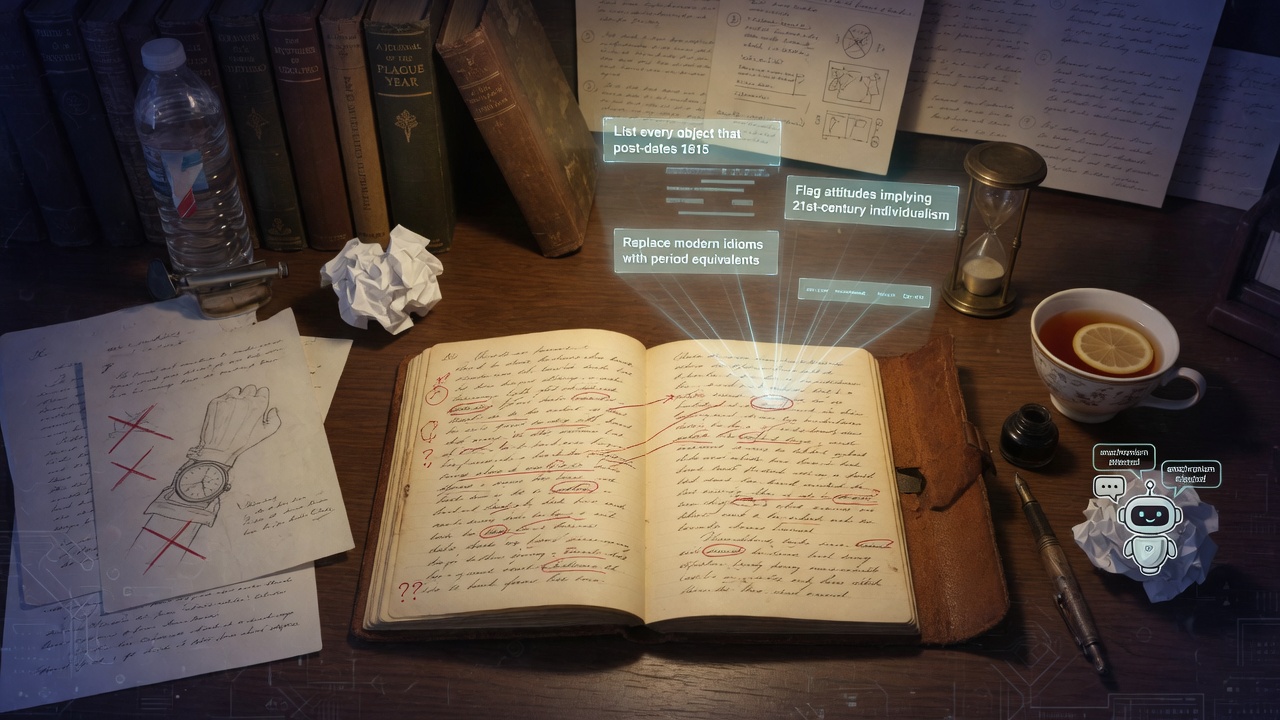
Every writer who has drafted a historical novel has had the same experience: you're two hundred pages in, feeling good about the voice, and then a beta reader circles a sentence and writes "would a Victorian miner really say this?" You look at it and your stomach drops, because they're right. Somewhere between your outline and your keyboard, a piece of 2024 leaked into 1887.
This isn't a research failure. It's a language failure, and it happens to careful, well-read writers just as often as sloppy ones. The fix isn't more research—it's a systematic sweep of the manuscript you've already written, using AI as a pattern-matcher rather than a fact generator. That distinction matters more than anything else in this piece, so hold onto it.
Why anachronisms sneak in without you noticing
Anachronisms hide in four different layers, and they get progressively harder to catch as you go down the list.
The first layer is vocabulary—words and idioms that didn't exist yet, or existed but meant something different. "Okay" wasn't in casual use before the 1830s. "Teenager" is a mid-20th-century word. These are the easiest to catch because a quick search resolves them.
The second layer is objects and technology. A character can't glance at a wristwatch in 1750 or refer to a "photograph" before 1839. These slip in because we describe the world the way we perceive it, automatically reaching for the nearest concrete noun.
The third layer is measurement and systemic detail—metric units in a pre-metric setting, calendar assumptions, currency that doesn't match the period's actual denominations. Writers research the big historical facts and forget the small systemic ones.
The fourth layer is the hardest: attitude anachronism. A character in 1820 who reasons about class, gender, race, or medicine with a fundamentally modern framework, even while using period-appropriate vocabulary. This is invisible because it's not about words at all—it's about the internal logic of how a character thinks. A protagonist who intuitively understands germ theory before Pasteur, or who processes a marriage proposal with contemporary ideas about romantic autonomy that wouldn't have occurred to someone of their class and era—these read as "off" to knowledgeable readers even when every individual sentence is grammatically clean.
The reason these sneak past your own editing is simple: you're a person living now, and your unconscious linguistic and cognitive defaults are all modern. You literally cannot self-edit for your own blind spots using the same brain that produced them. This is exactly the kind of pattern-detection problem AI is well suited for—not because it "knows history" reliably, but because it can hold your entire vocabulary and phrasing against known period markers far more exhaustively than a tired human eye on a fourth revision pass.
Building a categorized sweep instead of one vague pass
The mistake most writers make when they first try this is asking something like "check this chapter for anachronisms." That prompt is too broad. The model will catch the obvious stuff—a mention of "email" in 1600—and miss the subtler layers because it doesn't know which lens to apply.
The fix is to force separation by category, chapter by chapter. This also makes the output far easier to act on, because you're not scrolling through a jumbled list trying to figure out which flags matter.
I'm auditing a historical novel set in [specific year/decade and location] for anachronisms. Below is Chapter [X]. Do not invent or assume historical facts you're not confident about—flag items for me to verify rather than stating them as settled. Go through the chapter and produce FOUR separate lists: 1. VOCABULARY & IDIOM — any word, phrase, or figure of speech that may not have existed or been in common use in this specific setting. Include the exact quote and its location (paragraph number or nearby dialogue tag). 2. OBJECTS & TECHNOLOGY — any physical item, invention, material, or technology referenced that may postdate the setting, including things characters interact with casually (furniture, tools, fabrics, foods, transportation, medicine). 3. UNITS & SYSTEMS — any measurement, currency, calendar reference, or naming convention that may not match the systems in use in this specific place and time. 4. ATTITUDE & REASONING — any moment where a character's internal logic, assumptions, or social reasoning (about gender, class, medicine, race, religion, law) reflects modern framing rather than what would be plausible for someone of their background in this era. Describe the specific line of reasoning, not just the topic. For each flagged item, note which character or narrator voice it came from, since some anachronisms are more forgivable in close narration reflecting a naive character than in omniscient narration. Do not fix anything yet. Just flag and quote. Chapter text follows: [paste chapter]
Notice this prompt does three things a vague pass won't: it forces category separation, it asks for exact quotes and locations (so you're not left guessing where the problem lives), and it explicitly tells the model not to fix anything yet. That last instruction matters more than it looks—if you let the model start rewriting mid-sweep, you'll get confident-sounding "corrected" period language that may itself be wrong, and you'll have lost your clean audit trail.
Running it chapter by chapter, not manuscript-wide
It's tempting to dump the whole manuscript in at once. Resist this. Long-context passes tend to get shallower—the model catches the obvious flags and quietly skips subtler ones once it's processing tens of thousands of words. A chapter-by-chapter sweep, even though it's slower, produces a much higher hit rate. Treat it like a proofreading pass, not a one-shot verdict.
Confidence-tiering: the step that keeps you from trusting a guess
Here's the part that separates a useful sweep from a dangerous one. Language models are pattern-matchers trained on text, not historians with verified sources. They will sometimes flag something confidently that's actually fine, and—more dangerously—they'll sometimes state a "fact" about word origins or period objects that sounds authoritative and is simply wrong. Etymology in particular is a weak spot; models frequently get first-recorded-use dates wrong by decades or centuries in either direction.
The solution isn't to distrust the tool entirely. It's to make the tool label its own certainty, so you know exactly which flags need a five-second gut check and which need an actual trip to a dictionary with etymology citations (the Oxford English Dictionary's dated quotations remain the gold standard here) or a primary-source check.
For the anachronism list you just generated, re-sort every flagged item into one of three confidence tiers. Be honest about uncertainty rather than defaulting to a confident tone. TIER 1 — CONFIRMED ANACHRONISM: You are highly confident this word, object, unit, or attitude did not exist or would not have been plausible in this setting, based on well-established historical knowledge you're certain of. TIER 2 — LIKELY BUT VERIFY: You believe this is probably anachronistic but you're not fully certain of the exact date, regional variation, or class-specific usage. Explain what specifically makes you uncertain (e.g., "first recorded use is disputed" or "may have existed among educated speakers earlier than common usage"). TIER 3 — UNCERTAIN, CHECK PRIMARY SOURCE: You genuinely don't have reliable information on this one and it needs to be checked against a dictionary, period text, or subject-matter reference before any decision is made. For every item, do not state a specific date, source, or "fact" I should treat as verified. Instead describe what kind of source I should check to confirm it myself (etymology dictionary, period cookbook, medical history text, etc.).
This second pass changes your relationship to the output entirely. Instead of a flat list you either trust wholesale or dismiss wholesale, you get a triage system. Tier 1 items you can usually fix on sight, using your own judgment. Tier 2 items get a quick search—most resolve in under a minute with a dictionary that includes dated quotations. Tier 3 items are the ones you genuinely don't know, and pretending otherwise is how writers end up with confidently wrong author's notes. The point of this exercise is not to make AI your historical authority. It's to make AI very good at telling you where to look, and refusing to let it pretend it already knows.
The idiom sweep deserves its own pass
Idioms and figures of speech are the single hardest anachronism category because they don't look like anachronisms—they look like natural, invisible connective tissue in dialogue and narration. "We're on the same page." "That reset the clock for me." "Let's circle back." None of these contain an obviously modern noun. They just encode modern metaphorical thinking (pagination consistency, mechanical timekeeping as emotional reset, meeting-culture deferral) that wouldn't have occurred to a period speaker, even if every individual word in the phrase existed at the time.
Because these are metaphor-based rather than vocabulary-based, they slide past a general anachronism sweep more often than you'd expect. They deserve a dedicated pass, ideally run separately from the four-category sweep above.
Reread this chapter specifically for idioms, figures of speech, and metaphorical expressions that may be anachronistic even if the individual words are period-appropriate. I'm not asking about vocabulary alone—I'm asking about phrases whose underlying metaphor or reference point (mechanical, technological, bureaucratic, medical, sports-based) may not have existed as a way of thinking in [year/decade, location]. For each phrase found: - Quote it exactly - Explain what modern concept or system the metaphor is drawing on - Suggest the general category of alternative phrasing that might fit the period (do not invent a specific historical idiom as fact—suggest categories like "period letter-writing conventions" or "period agricultural metaphor" that I should verify separately) Flag dialogue and narration separately, since narration in a close third-person or first-person voice may carry different tolerance for period-authentic thought than an omniscient narrator would.
Note again the instruction not to invent a specific replacement idiom as settled fact. It's very easy for a model to suggest something that sounds convincingly antique and is itself invented or misattributed. Ask for direction, not for finished period phrases you paste in unverified.
Turning flags into a running lexicon so mistakes don't recur
The most efficient part of this entire system isn't the sweep itself—it's what you do with the output afterward. Every anachronism you catch and fix in Chapter 4 is one you're statistically likely to repeat unconsciously in Chapter 11, because the underlying blind spot that produced it hasn't gone anywhere. The fix is to build a lexicon document as you go, and feed it back into every future sweep.
Based on everything flagged and confirmed so far in this manuscript, generate a running "period lexicon" reference document with two sections: FORBIDDEN — words, idioms, and reasoning patterns confirmed anachronistic for this setting, with a one-line note on why, so I recognize them fast in future drafting. VERIFIED SAFE — words or phrases I questioned that turned out to check out as period-appropriate, so I stop flagging them unnecessarily in future passes. Format this as a plain list I can paste at the top of future chapter-sweep prompts as context, so future sweeps of this manuscript are informed by decisions already made.
Paste this lexicon at the top of every subsequent chapter prompt, and the sweep gets sharper with every pass—not because the model is learning anything permanently, but because you're feeding it your own accumulated decisions instead of starting from zero each time. By the back half of a manuscript, this document often catches issues faster than the categorized sweep does, simply because it's full of your specific book's specific blind spots rather than generic historical trivia.
None of this replaces a subject-matter proofreader or a genuinely deep research pass before you draft. What it does is catch the unconscious slippage that happens during fast drafting, when you're thinking about plot and voice and simply forget, mid-sentence, what century you're standing in. Used this way—as a detector you verify, not an oracle you trust—AI earns a permanent place in the revision stack of anyone writing period fiction.
No comments yet. Be the first to comment!