




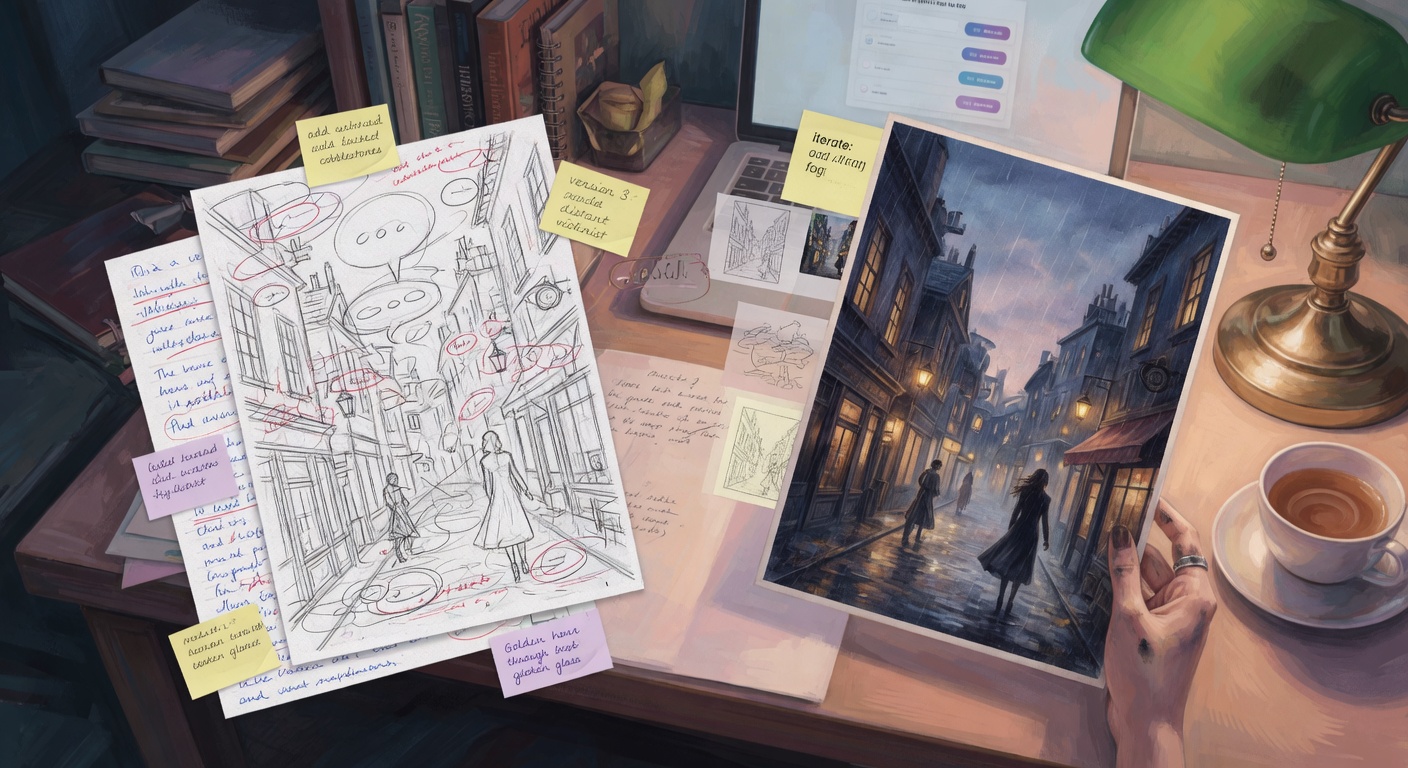
Many writers begin with a jumble of notes that capture the core of a story or essay but lack order. An outline might list events in fragments, note character reactions in passing, or mix research points with emotional beats. The goal is to move from that raw material into connected scenes without forcing a rigid structure too soon. Iterative prompts let you feed the outline to an AI model in stages, requesting one focused expansion at a time so you retain control over the direction.
Start by copying your outline into a single block and asking the model to identify the strongest thread. This first pass surfaces what already feels alive. From there, request a short scene that dramatizes one listed moment, keeping the output under four hundred words so you can review it quickly. If a line of dialogue feels flat, follow up with a revision prompt that supplies context about the speaker's background. Each cycle adds texture while you decide what stays or shifts. The process works because the model responds to narrow requests rather than open-ended ones, and you supply the judgment on tone and accuracy.
Developing a Step-by-Step Workflow
A reliable workflow begins with a clean copy of the outline and proceeds through three or four targeted exchanges. First, ask the model to reorder the points into a loose sequence that respects cause and effect. Next, request a scene that renders one sequence item in sensory detail. After you receive the draft, paste it back with a note on what feels missing, such as a shift in setting or an internal reaction. The third step often involves tightening voice or adding a secondary character's perspective. Because each prompt stays narrow, the output remains easy to edit by hand afterward.
Adapt the same workflow for poetry by asking the model to convert outline phrases into lineated images rather than paragraphs. For memoir, request reflective asides that connect the listed event to a present-day insight. Fiction writers can emphasize action beats, while essayists can request transitional sentences that link research facts to personal observation. In every case, review the result for factual slips or tonal drift before accepting any sentence into your draft.
Use this prompt when your outline is still a list of events and you need an initial sequence suggestion.
Use this prompt when you have chosen one reordered item and want a brief scene draft.
Use this prompt when the scene draft needs a stronger sense of the main character's background.
Prompt Exercises for Scene Expansion
Once the first scene exists, further prompts can add layers without overwriting what you already like. One useful exercise asks the model to insert a secondary character's line that complicates the central choice. Another requests a change in setting detail that alters the mood while preserving the plot point. A third exercise focuses on compression: the model shortens a passage by removing abstract statements and replacing them with concrete images. Running these exercises in separate chats keeps each change isolated so you can compare versions side by side.
Poets can adapt the same exercises by requesting line breaks and sound patterns instead of paragraphs. Memoir writers might ask for an added memory that deepens the current reflection. Fiction writers often use the compression exercise to trim exposition. Across genres, the key is to paste the exact previous output into the prompt so the model works from your chosen text rather than its own memory.
Use this prompt when a finished scene lacks tension from another perspective.
Use this prompt when you want to test a different physical setting for the same action.
Use this prompt when the prose feels wordy and you need a tighter version.
After several cycles the accumulated scenes begin to suggest larger patterns. You can then feed two completed scenes back to the model and ask for a short synopsis that highlights the through-line. This synopsis becomes the seed for the next outline section. Throughout, remember that the model supplies possibilities rather than final text; your ear for rhythm and your knowledge of the material remain the deciding factors. Fact-check any historical or technical detail the model introduces, and rewrite any phrase that does not sound like your own voice. The result is a set of scenes that grew from your outline yet carry the coherence that iterative shaping provides.
No comments yet. Be the first to comment!