




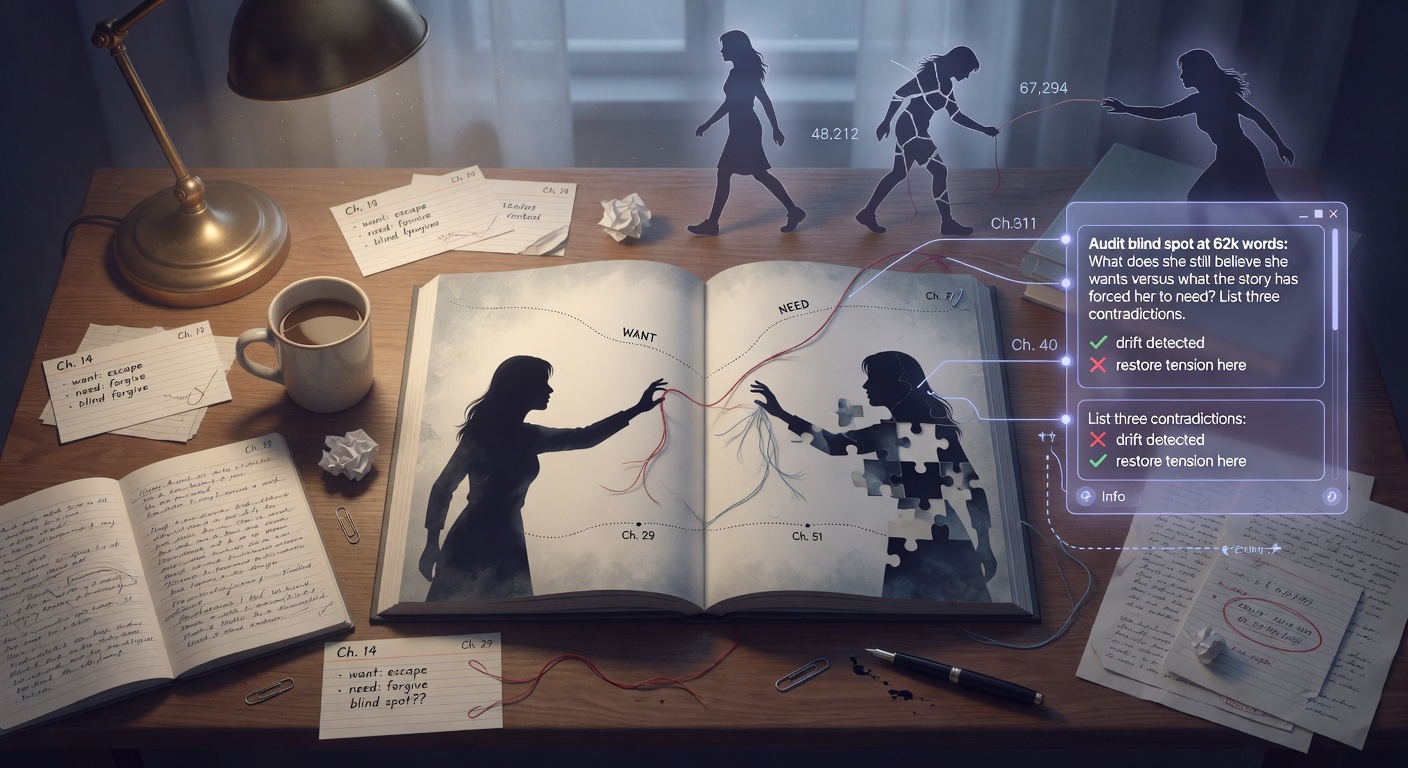
Why the Want/Need Gap Collapses in Long Fiction
Every novelist who has pushed past the 50,000-word mark knows the feeling: somewhere around chapter fourteen, your protagonist stopped being one person and quietly became another. Not through earned transformation — through drift. The want/need gap, that productive contradiction at the heart of every compelling character arc, has a way of dissolving in long fiction not because writers forget it exists, but because the daily pressure of generating pages pulls attention toward plot mechanics. You're solving the scene in front of you. The character's deeper psychology becomes background noise.
The want/need gap, for anyone who learned craft theory under different terminology, is the distance between what a protagonist consciously believes they're pursuing and what they actually require to become a fully realized version of themselves. In Chinatown, Jake Gittes wants to solve the case and wants to trust his own competence. What he needs is to accept that he cannot control outcomes in a corrupt world — a need he cannot see and will never metabolize. In Pride and Prejudice, Elizabeth Bennet wants an equal partner who won't condescend to her. What she needs is to interrogate her own pride before she can recognize that partner when he's standing in front of her. The gap between these two positions is where character lives. It's also where most novels quietly fall apart.
AI, used thoughtfully, functions as an exceptionally useful mirror for this specific problem. It holds no stake in your plot. It doesn't feel the relief you felt when you finally got through a difficult scene. Feed it the right prompts and it will reflect back to you, with uncomfortable clarity, whether your protagonist's psychology is tracking or whether the blind spot has already healed itself three chapters before you intended it to.
This article treats AI as a structural thinking partner, not a prose generator. None of what follows is about having a model write your character. It's about using targeted prompts to audit, stress-test, and track the want/need gap across the long haul of a manuscript.
Establishing the Gap in Chapter One
Before you can track the gap, you have to define it with enough precision that it survives contact with 80,000 words. Vague articulations don't survive. "She wants love but needs to learn to love herself" will evaporate by chapter six because it contains no contradiction specific enough to create friction. The gap has to be taut — the want and the need should not merely diverge, they should actively undermine each other.
The most productive early-draft prompt forces you to articulate both poles and then demonstrate how pursuing the want makes achieving the need harder. This is the diagnostic test. If your character's conscious pursuit doesn't interfere with their unconscious requirement, you don't have a gap — you have two parallel desires that will eventually harmonize without generating drama.
I'm developing a protagonist for a literary novel of approximately 80,000 words. I need to establish a want/need gap that will sustain a full three-act arc. Here is what I currently understand about my character: [Paste a 2-3 paragraph description of your protagonist, including their backstory, the situation they're in at chapter one, and what they think they're trying to accomplish in the story's opening movement.] Please do the following: 1. Identify the most specific version of this character's conscious want — not the thematic want, but the concrete, scene-level thing they are actively pursuing. 2. Identify what this character is unconsciously avoiding. Not what they "need to learn," but what truth or experience they are structuring their behavior to stay away from. Make this as concrete and behavioral as possible. 3. Explain precisely how pursuing the want makes encountering the need less likely. The two should be in active conflict. If they aren't, tell me that and suggest what would need to change. 4. Write two sentences this character would use to explain their own behavior — sentences that reveal the want without any awareness of the need. These will help me write their internal voice consistently. 5. Flag any aspect of the gap as I've described it that feels thematically generic or that you've seen collapse in long-form fiction, and explain why.
The output from this prompt gives you a working document — not a final answer, but a reference text you can return to at every act break. The two sentences the model generates for your character's self-justifying voice are particularly useful. Print them out. They are the sound of the blind spot, and you'll need to hear it clearly to keep it consistent across months of drafting.
Mapping Transformation Beats Across Act Breaks
A character's blind spot doesn't disappear all at once. It erodes through pressure, or it calcifies under pressure, but either way the process should be legible at each major structural hinge point. Act breaks exist, in part, to mark where the gap has meaningfully shifted. The problem is that writers often feel a scene is emotionally significant without being able to verify that it has done specific psychological work on the gap itself.
The following prompt is designed to be used four times across your manuscript — once at each of the major structural moments. It asks the model to audit a specific scene rather than make general observations, which keeps the feedback actionable.
I'm auditing a key structural scene in my novel-in-progress for its effect on my protagonist's want/need gap. Please treat this as a precise craft analysis, not general feedback. My protagonist's want (as established): [one sentence] My protagonist's need (as established): [one sentence] The active interference between them: [one sentence describing how the want blocks the need] The scene I'm examining is: [briefly identify — "the Act 1 exit scene," "the midpoint reversal," etc.] Here is the scene: [paste scene text] Please analyze the following: 1. WANT PRESSURE: Does this scene apply meaningful pressure to the conscious want? Does the character's pursuit of what they think they're after become more complicated, more costly, or more clearly insufficient — or does the scene leave the want undisturbed? 2. NEED PROXIMITY: Does anything in this scene bring the character into brief, uncomfortable proximity with their need? This doesn't require recognition — only exposure. Does it happen here, and if so, how does the character deflect? 3. GAP MOVEMENT: Based on this scene alone, would you say the gap has widened, narrowed, or shifted laterally? Explain specifically what in the text supports your reading. 4. DEFLECTION LANGUAGE: Identify any moment where the character's internal voice or dialogue reveals the self-deception operating. Quote it directly and explain what it's protecting them from seeing. 5. MISSED OPPORTUNITY: Is there a moment in the scene where the gap could have moved but didn't? Identify the line or beat and describe what would have needed to happen for the gap to shift.
Running this prompt at the Act 1 exit, the midpoint, the Act 2 exit, and the climax gives you a comparative picture across four data points. If three of those four scenes return the same answer — "gap undisturbed" — you have identified the flat stretch where your protagonist's psychology stopped moving. That's fixable. What's harder to fix is a gap that closes at the midpoint, meaning the character has effectively resolved their internal conflict before the story is half over. This prompt will catch that problem too.
The Blind-Spot Consistency Check
Here is a technical problem that almost no craft book addresses: scenes written in January and scenes written in October sound like they were written by two different characters, even when the plot is continuous. This happens because writers grow and change during the drafting of a long manuscript. Your intuitions about the character in October are sharper, more nuanced — which means your October protagonist is subtly more self-aware than your January protagonist was. The blind spot has started healing on the page before the story asks it to.
This is not a writing quality problem. It's a continuity problem. And it requires a different kind of audit.
I need to check whether my protagonist's self-deception reads consistently across scenes written at different points in my drafting process. The risk I'm checking for is accidental early epiphany — moments where the character displays more self-awareness than they should have at that point in the arc. My protagonist's blind spot (the specific thing they cannot see): [one sentence] The approximate story position where they begin to genuinely confront this: [act and chapter, e.g., "Act 3, chapter 22"] Below I'm pasting three scenes — one from early in the manuscript, one from the middle, and one from near the end. Please treat each as written by the same character, and analyze: EARLY SCENE [paste]: MIDDLE SCENE [paste]: LATE SCENE [paste]: For each scene: 1. Does the character's internal voice or dialogue contain any phrasing that implies awareness of their blind spot beyond what their current position in the arc permits? Quote any suspicious lines directly. 2. Does the character's behavior in the scene contradict the blind spot — meaning, do they act with more wisdom or self-knowledge than someone who cannot yet see what they cannot see? 3. Assign the scene a rough "self-awareness level" on a scale where 1 = completely defended, 5 = beginning to crack, 10 = full recognition. Then tell me whether that level is consistent with the scene's position in the sequence I've described. After analyzing all three: does the self-awareness level progress logically, or does it spike early and then artificially reset? If it resets, identify exactly where and what was likely causing the inconsistency.
What this prompt often reveals is that the early scene is the most psychologically honest and the middle scene is where the drift begins — because that's typically where the writer has started to feel the pull of the ending and unconsciously tilts the character toward it. The output doesn't tell you how to fix the problem. It tells you precisely where and what the problem is, which is the harder diagnostic work.
Running a Gap Audit on a Completed Draft
Building the Map Before the Revision
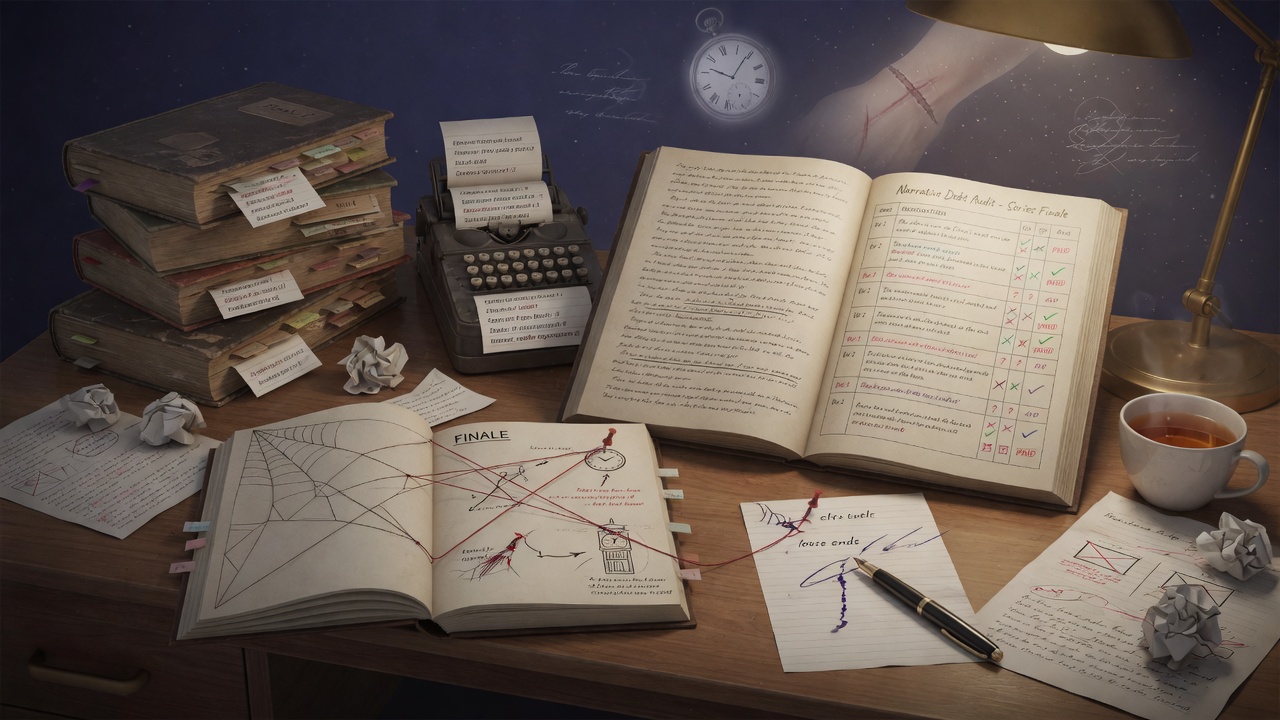
The most comprehensive use of AI for want/need tracking happens at the end of a complete draft, when you have the full evidence in front of you. A gap audit at this stage works like a structural X-ray: you're not reading for prose quality or plot logic, you're tracing a single psychological thread across the entire manuscript to see whether it holds.
The practical workflow runs as follows. First, identify your eight to twelve most psychologically significant scenes — the scenes where the protagonist makes a choice, faces a consequence, encounters another character who mirrors or challenges their blind spot, or reaches a structural hinge. You don't need the whole manuscript for this audit. You need the scenes where the gap should be visibly operating.
Then you feed those scenes to the model sequentially, with consistent framing that allows it to build a comparative picture. The output you're looking for is not "here is the arc" in general terms — you want specific identification of flat stretches, inconsistent voice markers, and places where the gap moved without sufficient cause.
I'm conducting a gap audit on a completed manuscript draft. I'll be feeding you a sequence of key scenes from across the novel. For each scene, I want you to track two things simultaneously: what the protagonist explicitly states or pursues (the want) and what their behavior or subtext reveals about what they're actually avoiding (the need). My protagonist's want (established definition): [one sentence] My protagonist's need (established definition): [one sentence] After each scene I paste, please provide: - STATED WANT in this scene: What does the character believe they are doing and why? - REVEALED NEED: What does the character's behavior, word choice, or avoidance suggest they are actually protecting themselves from? - GAP STATUS: Widening / Narrowing / Stable / Inconsistent. One word plus one sentence of evidence. - SELF-DECEPTION MARKERS: Any specific lines, decisions, or behavioral patterns that show the blind spot operating. I'll paste scenes one at a time and label them by chapter number. After I've submitted all scenes, I'll ask you to synthesize the progression into a chronological map that identifies: (a) where the gap moves most significantly, (b) where it remains flat for too long, and (c) any scene where the gap appears to move backward without a credible cause. Ready to begin? I'll paste Scene 1 now.
Reading the Output Critically
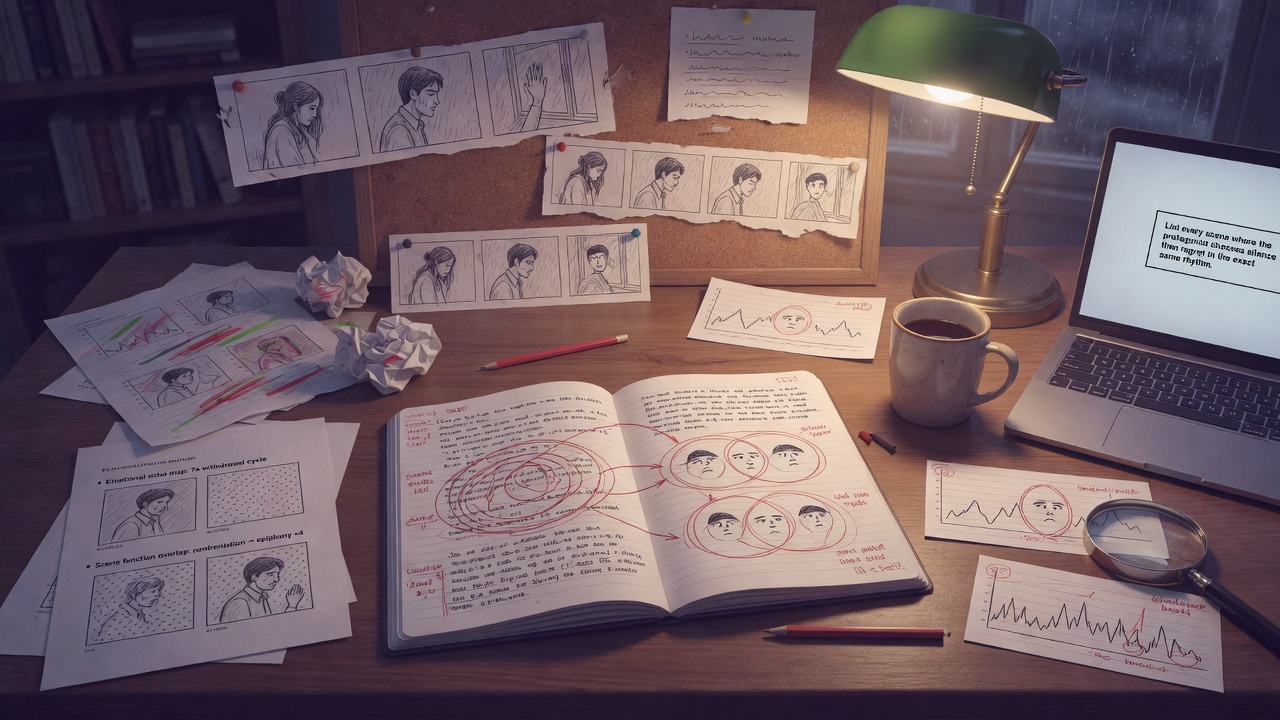
The map this process generates will show you things a close read doesn't. Flat stretches become visible as clusters of "Stable" gap status across three or four consecutive scenes — a sign that your middle act has plot movement but no psychological movement. Backward movement without cause is often a sign of a scene that was written to serve plot convenience rather than character logic.
One important caveat: the model will sometimes misread irony, particularly in close third-person narration where the gap between what the character thinks and what the reader understands is doing deliberate work. When you see a gap-status reading that surprises you, check whether the scene is operating ironically before you revise it. The audit is a tool for generating questions, not delivering verdicts.
The want/need gap is what makes a protagonist someone a reader can love without fully trusting — someone who is wrong about themselves in recognizable, human ways. Keeping that gap visible and structurally honest across the full length of a novel is one of the hardest sustained craft problems in fiction. AI, used as a precise analytical mirror rather than a creative surrogate, is genuinely useful here — not because it understands your character better than you do, but because it can hold the definition you gave it with a consistency that even the most disciplined writer struggles to maintain across months of drafting.



No comments yet. Be the first to comment!