


The Echo Chamber Problem: Using AI to Hunt Repetition Across Your Novel
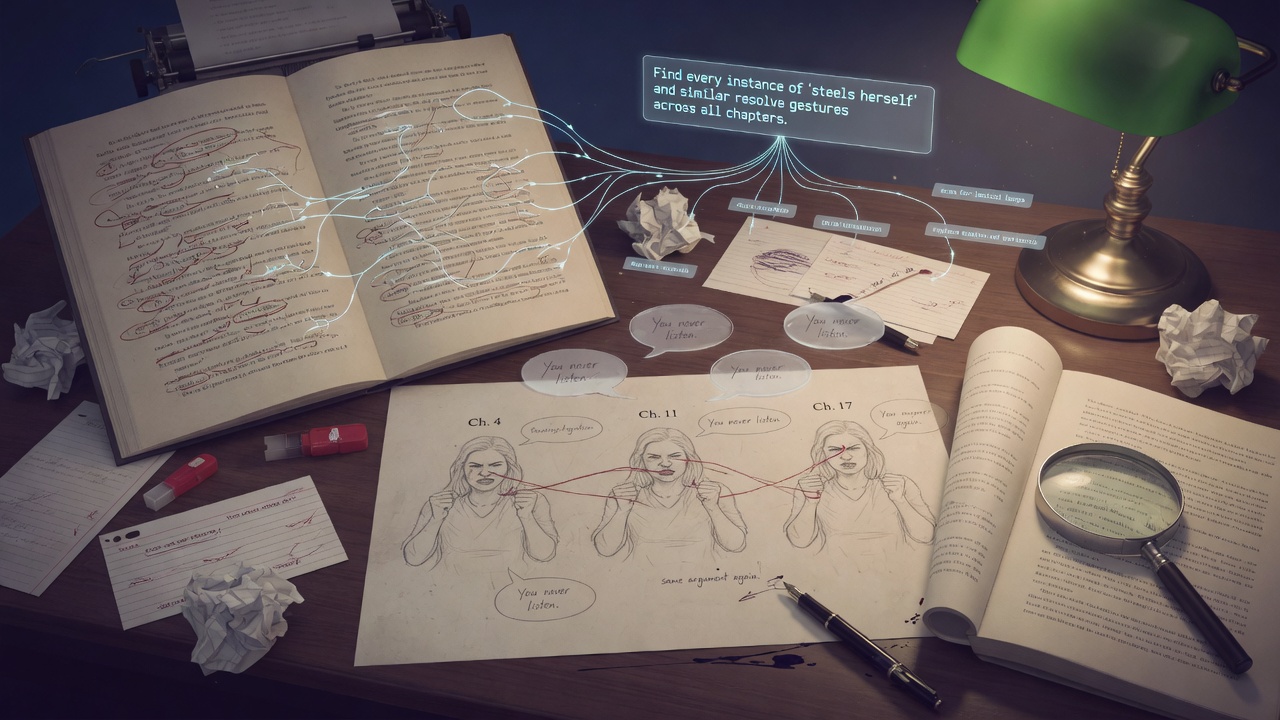
Every novelist who has read their completed manuscript aloud knows the sinking feeling: the same word appearing three times in a paragraph, two characters having what is essentially the same argument in chapters four and eleven, a protagonist who "steels herself" so many times it stops meaning anything. Repetition is the invisible tax on long-form fiction, and the human brain—particularly the brain of the person who wrote every sentence—is spectacularly bad at catching it.
This is not a personal failing. It is a cognitive one. When you read your own work, you are reading memory as much as text. Your brain fills in what you intended, smooths over the rhythms you have unconsciously established, and recognizes emotional beats it already processed during drafting. AI has none of that baggage. It reads what is actually on the page, at scale, without fatigue, and it can be prompted to look at three distinct categories of repetition that require completely different diagnostic approaches.
Three Separate Problems That Happen to Share a Name
Novelists tend to lump "repetition" into a single category when they think about self-editing. In practice, it operates at three distinct levels, and conflating them leads to incomplete revision.
Lexical repetition is what most writers mean when they say they repeat themselves: overused words, signature phrases that appear too frequently, pet constructions that cluster around moments of high emotion or action. These are visible with the right tools, but most writers only notice the ones their copyeditor circled. Structural repetition is subtler and rarer to diagnose. It is not about which words you use but about how you build sentences. An author who reaches for the em-dash under pressure, who constructs subordinate clauses in the same sequence during fight scenes, or who defaults to fragments whenever a character is frightened—that author has a rhythm fingerprint that, when it clusters, starts to feel mechanical to readers even if they cannot articulate why. Conceptual repetition is the hardest and the most damaging. This is where two characters have the same argument twice, where a protagonist draws the same emotional conclusion in three separate chapters, where the thematic statement of the book gets made explicitly in chapter two and again, almost verbatim in its content, in chapter fourteen. This kind of repetition does not show up in any word-frequency tool. It requires someone to understand what each scene is actually doing—its emotional and narrative payload—and then compare those payloads across the whole manuscript.AI is capable of all three audits when given the right scope and the right instructions. What follows is how to run each one.
Running a Lexical Audit: Beyond the Word Counter
The basic word-frequency scan—the kind any writing software can produce—is nearly useless for fiction because it will tell you that "the" appears eight hundred times and "said" appears four hundred times. Neither of those facts matters. What you need is a ranked frequency list of non-functional words: the content words, emotion words, and descriptive modifiers that carry meaning and therefore lose power through overuse.
Paste a chapter into your AI tool and use a prompt structured around three instructions: exclude functional words, rank by frequency, and flag any phrase (not just single word) that appears more than twice. The phrase detection is essential. Many writers do not repeat single words obsessively but do repeat two- and three-word constructions that register as tics to readers.
You are editing a chapter of literary fiction for lexical repetition. I am going to paste the full text of the chapter below. Please do the following: 1. Identify all non-functional content words (nouns, verbs, adjectives, adverbs) that appear three or more times and rank them by frequency. Exclude articles, prepositions, conjunctions, and common auxiliary verbs. 2. Identify any two- or three-word phrases that appear more than twice, including variations (e.g., "looked away" and "looked back" both count as instances of the "looked [direction]" pattern). 3. For each flagged word or phrase, list the sentences in which it appears so I can see the clustering in context. 4. Do not suggest replacements yet. I want the diagnostic list first. The POV character in this chapter is [character name], and their narrative voice is [brief description: e.g., "sardonic, observational, tends toward understatement"]. Keep this voice in mind because in a follow-up prompt I will ask you to generate replacements that match it. [PASTE CHAPTER TEXT HERE]
The follow-up prompt matters as much as the diagnostic. Generic synonym suggestions will flatten your prose into something that reads like a thesaurus entry. The replacement prompt needs to be anchored to character voice, to the emotional register of the specific scene, and to the surrounding sentences that establish context.
When you receive the diagnostic list, select the three to five most problematic instances and run them through a targeted replacement prompt that includes at least two sentences of surrounding context and an explicit instruction to match the existing sentence's rhythm, not just its meaning.
Detecting Structural Echoes: The Rhythm Problem
Sentence-level rhythm repetition is the category most writers discover only when someone else reads their work aloud. An author under deadline will reach for the same construction repeatedly—the mid-sentence em-dash pause, the "it was X that" cleft sentence for emphasis, the participial phrase opening that clusters in action sequences. None of these are errors in isolation. All of them become visible as mechanical habit when they cluster within a few pages.
To prompt AI to catch structural echoes, you cannot simply ask for word repetition. You need to ask it to categorize sentences by their syntactic architecture and then identify which architectures are overrepresented.
I am going to paste a chapter of my novel. I want you to analyze sentence structure and rhythm, not word choice. Specifically: 1. Identify the five most frequently used sentence constructions in this chapter. Examples of constructions to look for include: sentences beginning with a participial phrase ("Running toward the door, she..."), sentences using an em-dash for a mid-sentence interruption or amplification, sentences using "it was [X] that" or "what [X] was" as emphasis structures, sentences beginning with a single-word fragment followed by a longer sentence, and sentences using "she noticed," "she realized," "she understood," or equivalent interiority markers. 2. Flag any construction that appears more than four times in the chapter and show me the clustered examples together, not scattered throughout your response. 3. Identify any two-page stretch where more than three sentences share the same opening structure (e.g., three consecutive or near-consecutive sentences beginning with a pronoun-verb pattern). 4. Do not rewrite anything yet. I want to understand my structural habits before I revise. [PASTE CHAPTER TEXT HERE]
What you are looking for in the output is clusters, not isolated instances. One em-dash interruption per page is a stylistic choice. Four in a single scene is a tic. The AI's job is to show you the clustering so you can decide whether the repetition is working or simply habitual.
Surfacing Conceptual Repetition: The Hardest Audit
This is where most AI-assisted editing stops short, because most writers do not realize they can ask for it. Conceptual repetition—characters having the same argument twice, protagonists arriving at the same emotional realization, thematic statements being made explicitly in multiple scenes—requires the AI to understand what scenes are about, not just what words they contain.
The approach is a two-step process. First, you generate scene summaries that capture emotional payload rather than plot events. Then you ask AI to map those summaries for duplication.
I am going to paste summaries of ten scenes from my novel. These summaries describe the emotional and thematic content of each scene—what the character wants, what they feel, what they conclude or fail to conclude, and what argument or conflict the scene enacts. After I paste the summaries, I want you to do the following: 1. Identify any scenes where the emotional payload appears to be substantially similar—where the protagonist reaches the same conclusion, experiences the same emotional arc (e.g., hope followed by deflation), or has an argument with another character that follows the same shape (e.g., accusation, defense, withdrawal without resolution). 2. Distinguish between two categories of repetition: INTENTIONAL RESONANCE (the repetition appears to be building a pattern—escalating intensity, returning motif, deliberate echo) and ACCIDENTAL RECYCLING (the repetition appears to be covering the same ground without progression or variation). 3. For each instance of apparent accidental recycling, note which scene is doing the weaker version of the emotional work and suggest what function that scene could serve instead, given what surrounds it. 4. Do not invent story content. Work only from what I have provided. [PASTE SCENE SUMMARIES HERE] Format for each summary I will provide: Scene [number] — Chapter [X]: [2-4 sentences describing emotional content, character want, conflict shape, and outcome]
Writing the scene summaries yourself is not extra work—it is a revision tool in its own right. The act of reducing each scene to its emotional payload will often surface the repetition before you even run the AI prompt. When you cannot distinguish two summaries from each other without checking your chapter numbers, you have found your problem.
The Two-Pass Revision Workflow
All of the prompts above are diagnostic. They tell you where the problems are. The second pass is where you actually fix them, and it requires a different kind of prompt—one that gives AI enough context to rewrite with precision rather than generic correctness.
The cardinal rule of AI rewriting for fiction is this: never paste a flagged sentence in isolation and ask for a replacement. That produces technically adequate prose that sounds like nobody in particular. Instead, paste the flagged sentence with at least the full paragraph before and after it, include a description of the character's voice and emotional state in the scene, and—critically—include one or two examples of sentences from the same chapter that you consider representative of your voice at its best. Give the AI a target to match, not just a problem to solve.
I am revising a passage from my novel to eliminate a structural tic I have overused. The tic is: [describe the construction, e.g., "opening sentences with a participial phrase during moments of physical action"]. Below I will provide: — The flagged passage (3-5 sentences that need revision) — The paragraph immediately before the passage for context — The paragraph immediately after the passage for context — Two example sentences from elsewhere in the chapter that I consider representative of my prose style at its best — A brief description of the POV character's voice and emotional state in this scene Please rewrite only the flagged sentences. Do not touch the context paragraphs. Your goal is to eliminate the repeated construction while preserving the rhythm, specificity, and voice of the surrounding prose. Generate three versions of the rewrite so I can choose or combine elements. Do not simplify the syntax in the name of clarity. This is literary fiction and some complexity is intentional. FLAGGED PASSAGE: [paste here] PRECEDING PARAGRAPH: [paste here] FOLLOWING PARAGRAPH: [paste here] EXAMPLE SENTENCES FROM MY VOICE: [paste 2 sentences] CHARACTER VOICE AND EMOTIONAL STATE: [2-3 sentences]
Using AI Output as a Checklist, Not a Transplant
The most important discipline in AI-assisted revision is treating everything the tool produces as a draft for your consideration, not a solution to be pasted. This is especially true for rewrite prompts. What AI generates will often be technically correct, rhythmically adequate, and completely missing something that you will recognize immediately when you read it: the small word choice, the hesitation, the compression that makes a sentence yours rather than functional.
Use the three-version output as a checklist. Version one might have the right sentence structure. Version two might have the specific verb you needed. Version three might accidentally suggest a phrase that triggers your own better version. The output is raw material for your revision, not a finished product.
For the conceptual repetition audit, the AI's output is a map, not a verdict. When it tells you that scenes six and twelve have the same emotional shape, it is correct that you need to look at both. It is not correct about which one to cut or how to restructure the weaker one—that requires your knowledge of the larger arc, the characters' histories, and where the story needs to arrive.
What This Process Actually Trains
Novelists who run these audits once tend to run them every draft after that. Not because AI becomes indispensable, but because the process trains attention. Once you have seen your own lexical tics listed and ranked, you start catching them during drafting. Once you have written scene summaries for an AI audit and discovered that three of them describe the same emotional argument, you start thinking in terms of emotional payload when you plan new scenes.
The prompts here are not a shortcut to a cleaner manuscript. They are a mirror that shows you patterns you cannot see from inside your own writing, offered at a scale and speed that no human editor working within normal constraints can match. What you do with that reflection is still entirely yours.
No comments yet. Be the first to comment!