

Every experienced mystery writer has had this moment: a beta reader finishes the manuscript, flips back forty pages, and asks "wait, was this ever mentioned?" You know it was. You wrote it. It's right there on page 112. But it didn't register, and now your fair-play mystery has a credibility problem that no amount of clever plotting can fix after the fact.
This is the gap between clues that exist and clues that function. A clue existing in your manuscript means you typed the sentence. A clue functioning means an attentive reader, reading at normal pace and not rereading with a highlighter, actually absorbed it as information worth carrying forward. Most craft advice about mystery writing focuses on red herrings — how to plant false trails convincingly. That's a real skill, but it's a different problem from the one that sinks more fair-play mysteries: clue distribution across the manuscript's actual page count and chapter rhythm.
Why distribution matters more than existence
The fair-play contract, going back to Knox's Decalogue and the Golden Age detective tradition, isn't just "don't cheat the reader with information you withheld." It's "give the reader a genuine chance to solve this themselves." That second clause is about pacing as much as content. A clue dropped once, in a subordinate clause, in chapter four of a twenty-eight chapter book, technically exists — but if your reader's brain didn't flag it as significant, and nothing later reinforces it, you've satisfied the letter of fair play while violating its spirit.
The problem is that writers are terrible at auditing their own clue distribution because we already know the solution. We can't read our manuscript the way a first-time reader does — every clue looks obvious to us because we planted it on purpose. This is exactly the kind of structural, pattern-recognition audit that AI tools handle well, provided you give them the right task. Not "is this a good mystery" (too vague, too subjective) but specific, mechanical questions about where evidence sits in your text and how visible it is without the answer key.
What follows are four prompts built for this specific audit, plus the failure patterns they tend to surface.
Prompt 1: Build a chapter-by-chapter clue inventory
The first step is getting an outside accounting of what's actually on the page, chapter by chapter, stripped of your authorial knowledge of what matters. You want the AI to treat every chapter as a flat list of revealed information, then rate how prominent each item is — not how important you know it to be.
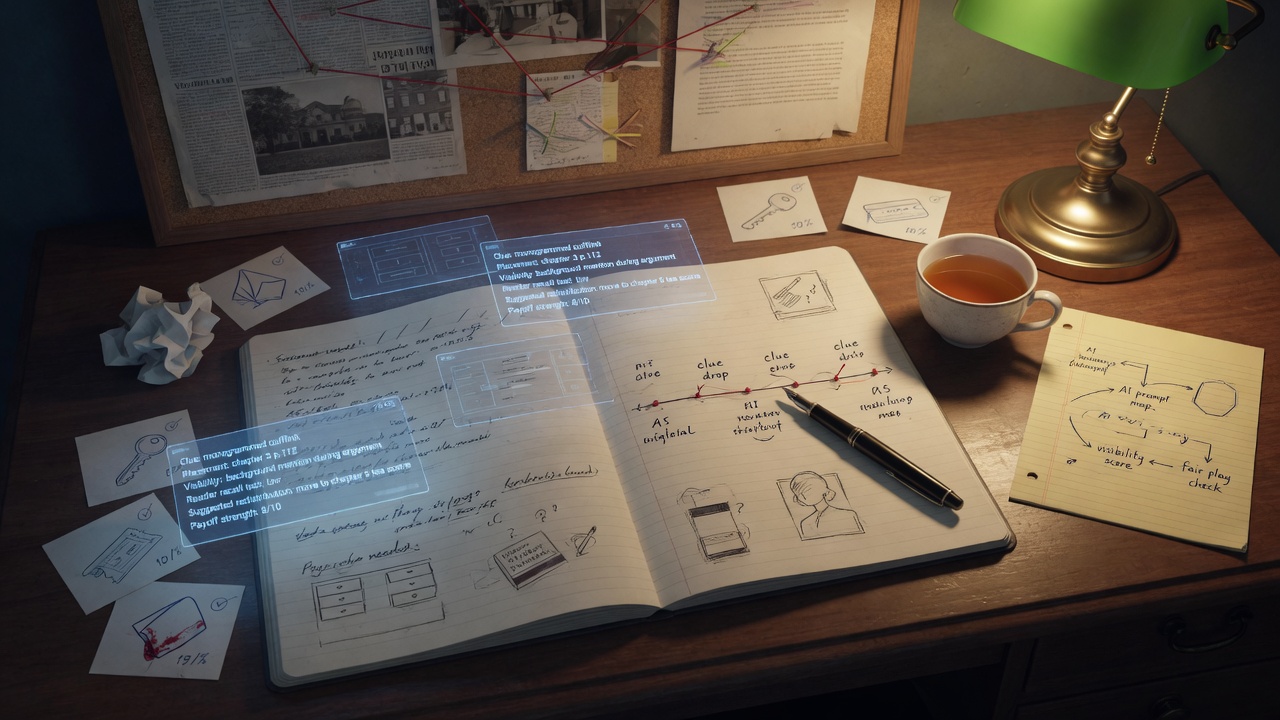
I'm going to paste my manuscript chapter by chapter (or you can work from the full text if it fits in context). For each chapter, generate a clue inventory table with these columns: 1. Clue/detail revealed (quote or closely paraphrase the actual text) 2. Page/chapter location 3. Type: physical evidence, dialogue admission, behavioral tell, timeline detail, or background/setting detail 4. Visibility rating (1-5): how prominent is this within the scene? 1 = buried in a list or aside, easy to skim past 5 = highlighted through character reaction, repetition, or scene climax 5. Does this appear only once, or is it reinforced/referenced again later? If reinforced, note where. Do NOT rely on your knowledge of the eventual solution to decide what counts as a "clue" — include anything a careful reader might plausibly register as evidence-relevant, even if it turns out to be a red herring or a non-clue. I want the raw inventory first; we'll cross-reference against the solution afterward. Here is Chapter [X]: [paste text]
Run this across every chapter, ideally in a fresh conversation or with the AI's memory cleared between books so it isn't inferring significance from later context. What you get at the end is a spreadsheet-style map of your entire evidentiary trail — not your intentions, but what's actually observable in the prose. This inventory is the raw material for everything that follows.
What to look for in the output
Two things tend to jump out immediately. First, clues you thought were prominent often get a visibility rating of 2 or 3, because you wrote them efficiently and moved on — a habit that serves prose economy but undercuts fair play. Second, you'll notice which clues got reinforced and which appeared exactly once, never to be mentioned again. A single-appearance clue with a low visibility score is functionally invisible to most readers, no matter how clearly you remember writing it.
Prompt 2: Flag the dead chapters
Once you have the inventory, the next audit is structural: which chapters contain zero forward-facing evidence toward the actual solution. These are chapters that might be doing real work — building character, escalating tension, deepening the setting — but are investigatively inert. In a fair-play mystery, too many consecutive dead chapters break the reader's sense that the puzzle is actively being assembled, even if the book still reads as "engaging" scene by scene.
Using the clue inventory we built, and knowing that the solution to this mystery is: [describe the actual solution — who did it, how, and the key mechanism/motive, in full detail, no need to hide anything from you]. Go chapter by chapter and classify each one: - FORWARD: contains at least one clue (of any visibility rating) that points toward the actual solution, either directly or as a piece the reader would need to assemble it - NEUTRAL: contains red herrings or investigative activity, but nothing that actually points toward the true solution - DEAD: contains no clues, red herrings, or investigative content related to the central mystery at all — pure subplot, character work, or worldbuilding For any stretch of two or more consecutive DEAD or NEUTRAL chapters, flag it explicitly and tell me how many pages/chapters the reader goes without new solution-relevant information. Then suggest, for each flagged stretch, one plausible existing scene beat in that stretch where a clue could be folded in without requiring new scenes — something already happening in that chapter that could carry an additional piece of evidence.
This prompt does two jobs at once. It finds your investigative dead zones, and it suggests low-disruption fixes — folding clues into existing scenes rather than forcing you to invent new ones. That second part matters practically: most writers, on discovering a 40-page dead stretch two weeks before deadline, don't want to write three new chapters. They want to know which existing scene could absorb one more sentence of consequence.
The subplot trap
Dead chapters cluster most often around subplots — the detective's strained marriage, a secondary character's arc, world detail that supports atmosphere but not deduction. None of that is wrong to include. The problem is only when several of these chapters stack consecutively with no evidentiary content threaded through them, because the reader's sense of "the case is moving" goes quiet exactly when it shouldn't.
Prompt 3: Reverse-map the solution against the inventory
This is the prompt that actually tests fair play in the strict sense. It's not enough that clues exist somewhere in the book — every deduction step the detective (or reader) makes at the reveal needs a corresponding entry in your inventory. If the solution requires a logical leap that isn't supported by anything on the page, you've written a mystery that's clever but not fair.
Here is the full clue inventory from the manuscript audit, and here is the complete solution and the detective's reasoning chain at the reveal (the specific sequence of deductions, in order, that leads from evidence to conclusion): [paste both] Walk through the detective's reasoning chain step by step. For each individual deduction: 1. Identify exactly which clue(s) from the inventory support this step 2. Rate the strength of support: DIRECT (the clue states or strongly implies this specific conclusion), INFERENTIAL (the clue supports it only in combination with outside/specialized knowledge or a chain of assumptions), or UNSUPPORTED (no clue in the inventory backs this step at all) 3. For any INFERENTIAL or UNSUPPORTED step, explain precisely what additional clue or reinforcement would be needed for an attentive reader to make this leap using only information already in the text 4. Separately, flag any deduction that depends on specialized knowledge the average reader wouldn't have (technical, medical, legal, procedural) unless that knowledge was explicitly explained somewhere earlier in the manuscript — tell me where, if it was, or confirm it wasn't Give me the final verdict: is this solution fairly deducible from the text alone, or does it rely at any point on information withheld from or unexplained to the reader?
This is the prompt that will hurt the most, because it will almost certainly surface at least one UNSUPPORTED step — the moment where you, as the author, know the answer so completely that you forgot to actually put the connective tissue on the page. Writers do this constantly with specialized knowledge in particular: a detail about blood spatter, poison timelines, or financial fraud mechanics that lives clearly in your research notes but never made it into the manuscript in a form the reader could use.
Prompt 4: Run a clue camouflage pass
Once the inventory is complete and the solution checks out logically, there's a final calibration problem: are your real clues sufficiently disguised among red herrings and ordinary detail, or do they stick out precisely because you followed the advice above and made them more visible? Fair play requires clues to be findable, not obvious. This prompt is a check on the opposite failure — overcorrection.
Using the clue inventory, identify every clue marked as directly relevant to the true solution (cross-reference against the reasoning chain from the previous audit). For each one: 1. Assess how it currently reads in context — does it stand out stylistically or structurally from the surrounding non-clue material (unusual sentence length, character reaction, narrative emphasis, placement at a scene's end/beginning)? 2. Compare its treatment to at least one nearby red herring or neutral detail in the same chapter. Is the real clue getting notably more or less narrative weight than the decoy information around it? 3. Suggest a specific rewrite of the sentence or passage that would let the clue keep its information content while reducing its structural prominence — folding it into a longer sentence, attaching it to an unrelated action, or placing it mid-paragraph rather than at a dramatic beat 4. Flag any clue that, after these adjustments, would become genuinely undetectable rather than merely subtle — I want camouflage, not erasure
This prompt works best after the first three, because you now know exactly which clues are load-bearing and can afford to make surgical changes rather than blanket ones. The goal isn't to hide clues from the reader; it's to make them findable at the same difficulty level as everything else in the scene, so the solution feels earned rather than telegraphed or smuggled.
Common failure patterns worth watching for
Across manuscripts run through this kind of audit, a few patterns show up repeatedly, and it's worth naming them so you know what to expect in your own results.
- Clue clustering near the reveal. Writers often plant most of their real evidence in the final third of the book, out of an instinct to build momentum toward the climax. The inventory will often show a visible density spike in the last few chapters and thin coverage everywhere before it — technically present, but arriving too late for the reader to do anything with the information except watch the detective use it.
- Solutions that depend on off-page knowledge. This is the most common finding from the reverse-mapping prompt: a deduction that requires understanding something — a poison's effects, a legal loophole, a technical process — that the author researched deeply but never actually explained on the page. The reader isn't unintelligent; they simply weren't given the same research file you were.
- Clues that only work in hindsight. These are details that read as neutral or purely atmospheric on first pass and only become "clues" once you already know the answer. The inventory prompt catches these because the AI, working without foreknowledge of the solution during the first pass, will rate them as low-visibility background detail — exactly how a first-time reader would experience them, and exactly why they don't count as fair-play evidence no matter how satisfying they feel to you as the author.
None of these audits replace an actual human reader — a sharp editor or a genre-savvy beta reader will still catch things no prompt will. But most writers only get that kind of read once, late in the process, when structural fixes are expensive. Running your manuscript through a clue distribution audit before that stage means the human read is confirming a fair-play structure you've already verified, rather than discovering for the first time that the solution was never quite there to find.
No comments yet. Be the first to comment!