

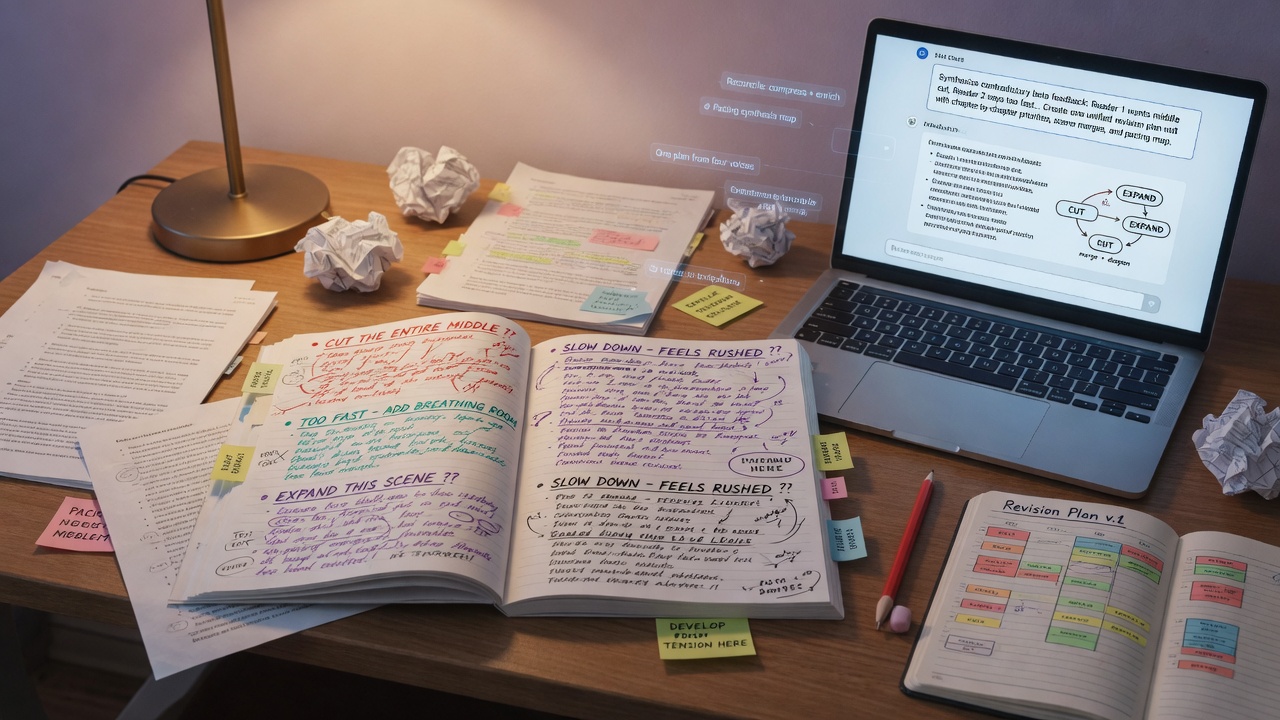
Every novelist who has run a manuscript through more than two beta readers has hit the same wall: Reader A says the middle sags and needs cutting. Reader B says the middle moves too fast and they felt whiplash. Reader C adores your villain's cold, clipped dialogue. Reader D says he reads like a cardboard cutout. You're left holding four sets of notes that cancel each other out, and no clear sense of what to actually fix.
This is not a sign that beta reading is broken. It's a sign that beta readers are humans with different reading histories, genre expectations, and tolerances, and none of them are wrong about their own experience. The problem isn't the contradiction — it's that most writers have no system for sorting signal from noise inside that contradiction. AI is unusually good at this specific job: not generating opinions, but organizing and cross-referencing the opinions you already have so a coherent revision plan falls out the other side.
Why Beta Readers Disagree in the First Place
Before you can reconcile contradictory notes, it helps to understand where the contradictions come from. They generally fall into three buckets.
Reading Lens
A beta reader who reads primarily literary fiction will flag your genre-standard action beats as "unnecessary." A beta reader who reads thrillers exclusively will flag your interiority as "slow." Neither is lying about their experience. They're reporting friction that comes from the gap between what they usually read and what you wrote.
Genre Familiarity
A superfan of your genre has absorbed hundreds of examples of how your tropes usually resolve. They'll clock a twist as predictable that a casual reader finds shocking. This isn't a craft problem — it's a calibration problem, and it matters enormously which reader you're writing for.
Personal Taste vs. Actual Craft Issues
This is the one that trips writers up most. "I didn't like the villain" can mean the villain is underwritten (a craft issue) or it can mean the reader simply doesn't enjoy villains who monologue, regardless of execution (a taste issue). The words on the feedback page look identical. The underlying cause is not. Confusing these two is how writers end up flattening a deliberately stylized character because one reader's personal preference got treated as universal truth.
The fix isn't to average your beta notes or default to majority rule. It's to build a structure that separates lens from craft, and taste from technique, before you touch your manuscript again.
Step One: Simulate Distinct Beta Personas Before You Even Look at Real Notes
One of the most useful things you can do with AI is generate a set of deliberately different reader personas and have each one review the same chapter independently, in its own voice, before comparing anything. This does two things. First, it gives you a clean baseline to compare your real beta notes against — if your actual readers' contradictions map onto the same lens differences the AI predicted, you know you're dealing with taste, not a craft failure. Second, it surfaces problems your real beta readers might have missed or been too polite to name.
Act as four distinct beta readers evaluating the same chapter I'm about to paste. Each reader has a different profile. Review the chapter FOUR separate times, once fully in character as each reader, without letting one review bleed into another. Do not soften or average opinions across readers — each one should sound like a real, distinct person with real reactions. READER 1 — Genre Superfan: Reads 40+ books a year exclusively in this genre [SPECIFY GENRE]. Highly attuned to tropes, pacing conventions, and whether twists feel earned or derivative. Judges against the best examples of the genre. READER 2 — Craft-Focused Writer: A working novelist/editor who reads analytically. Notices sentence-level issues, structural problems, POV consistency, and whether scenes are doing enough narrative work. Less concerned with genre conventions, more concerned with technique. READER 3 — Casual/Airport Reader: Reads occasionally, wants to be entertained without much analysis. Will say plainly if they were bored, confused, or couldn't put it down. Doesn't diagnose why — just reports the experience. READER 4 — Target-Demographic Reader: [DESCRIBE YOUR ACTUAL IDEAL READER — age range, what else they read, what they're looking for in a book like this]. Reviews specifically against what this exact reader wants and expects. For each reader, provide: - Their overall gut reaction (2-3 sentences, in their voice) - Three specific things that worked for them - Three specific things that didn't work, with the exact line or moment that triggered the reaction - One prediction: would they keep reading past this chapter? Why or why not? Here is the chapter: [PASTE CHAPTER]
Run this before you send the chapter to real humans, and again after you get their notes back. The comparison is often revealing — if your AI-simulated genre superfan and your real genre-reading beta reader flag the exact same pacing issue independently, that's no longer a taste preference. That's a structural problem wearing a taste costume.
Step Two: Cross-Reference Every Note to Find Agreement Clusters
Once you have real feedback — from actual humans, simulated personas, or both — the next move is not to read through it linearly and react to each note as you hit it. That's how writers end up whiplashed, chasing the most recent or most emotionally charged comment instead of the most substantiated one. Instead, feed everything into AI at once and ask it to map where independent readers agree versus where only one voice is raising a flag.
Agreement across readers with different lenses is the single strongest signal you have that something is a genuine craft issue rather than an individual preference. If your casual reader and your craft-focused writer both stumble on the same scene for different stated reasons, that scene has a real problem, even if they can't articulate it the same way.
I'm going to give you feedback from multiple beta readers on the same manuscript/chapter. Your job is to cross-reference their notes, not summarize them individually. I already have each reader's full notes below. For each distinct piece of feedback across all readers, do the following: 1. CLUSTER: Group notes that point at the same underlying issue, even if readers used different language or pointed at different symptoms. Label each cluster with a short name (e.g., "Villain lacks clear motivation," "Act 2 pacing drags between chapters 14-19"). 2. FOR EACH CLUSTER, tell me: - How many readers flagged something related to this issue, and which ones - Whether their complaints reinforce each other or actually point at different root causes that happen to look similar on the surface - Your assessment: does this look like a genuine craft/structural issue (multiple readers, different lenses, same friction point) or does it look like it might be one reader's personal taste (isolated, tied to a stated preference rather than a described experience) 3. FLAG CONTRADICTIONS explicitly: if two readers gave opposite notes on the same scene or element, name the contradiction directly and hypothesize why — is it a genre-familiarity gap, a taste difference, or are they actually both right about different parts of the same scene? 4. Do NOT try to resolve the contradictions yet or tell me what to do. Just map the terrain clearly so I can see where readers agree, where they genuinely conflict, and why. Reader 1 (Genre Superfan) notes: [PASTE] Reader 2 (Craft-Focused Writer) notes: [PASTE] Reader 3 (Casual Reader) notes: [PASTE] Reader 4 (Target-Demographic Reader) notes: [PASTE]
Notice the instruction not to resolve anything yet. This matters. If you ask AI to jump straight to recommendations, it will often default to democratic averaging — treating four notes as more important than one, regardless of who's talking or why. Mapping the terrain first, cleanly and without judgment, keeps you from prematurely collapsing real distinctions.
Step Three: Weight Notes by Relevance to Your Actual Reader, Not by Volume
Here's the part most writers skip, and it's the single highest-leverage move in this whole process: not all beta readers are equally important to your revision. If you're writing genre fiction and your casual reader found the worldbuilding confusing but your genre superfan and target-demographic reader followed it fine, that's not a 2-1 majority against the casual reader — it's a signal that the casual reader simply isn't your audience for this particular element, and their confusion is expected, not diagnostic.
This is where writers most often go wrong when reconciling feedback: they treat every voice as equally weighted and end up revising toward the lowest common denominator, sanding off everything that made the book distinctive in the first place. A deliberate stylistic choice that delights your target reader and confuses your casual reader is not a problem to fix. It's a decision to keep.
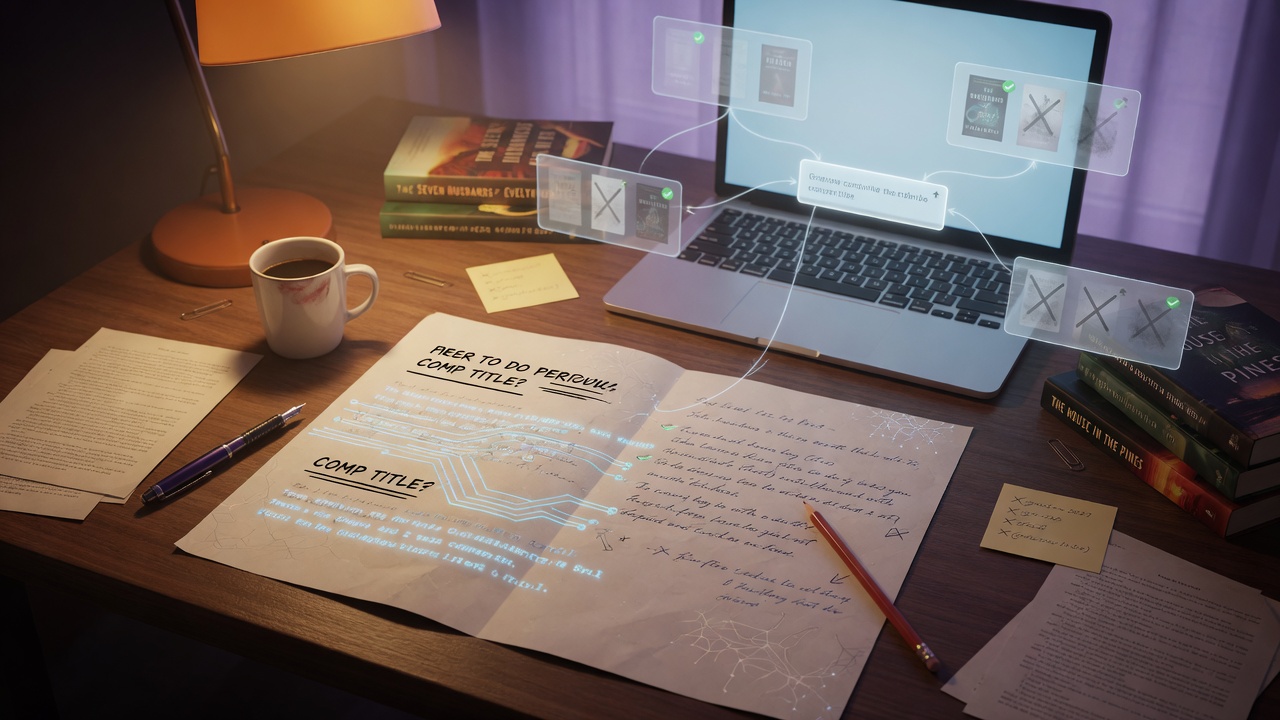
Below is the mapped feedback from four beta reader personas, organized into agreement clusters and flagged contradictions from our previous step. My actual target reader for this book is: [DESCRIBE — genre, age range, what comp titles they read, what they want from a book like this, e.g. "adult readers of upmarket book club fiction who loved Where the Crawdads Sing and The Seven Husbands of Evelyn Hugo, want emotional depth and strong voice, are not looking for fast-paced plot"] For each cluster and each flagged contradiction, do the following: 1. Identify which reader persona(s) most closely resemble my actual target reader, and weight their notes more heavily. Say explicitly when you're doing this and why. 2. For contradictions specifically: tell me which side of the contradiction I should trust MORE based on target-reader alignment, not based on how many readers said it. If my casual reader and genre superfan disagree, and my target reader is closer to the genre superfan, explain that the superfan's note should carry more weight even if it's a single voice against two. 3. Flag any note — even from my target-demographic reader — that seems to be pure personal taste rather than a reaction most readers like them would share. Distinguish "this reader didn't like X" from "readers like this typically don't like X." 4. Rank all clusters and resolved contradictions from HIGHEST revision priority (strong agreement + high target-reader relevance) to LOWEST (isolated, low target-reader relevance, likely safe to ignore). Here is the mapped feedback: [PASTE OUTPUT FROM PREVIOUS PROMPT]
This step is what turns a pile of contradictory sticky notes into an actual hierarchy. It also protects you from the instinct to chase every complaint equally, which is one of the fastest ways to revise the voice out of a manuscript.
Step Four: Convert the Reconciled Feedback Into One Defensible Revision Plan
The final move is to turn the ranked, weighted analysis into something you can actually execute against — a revision plan with rationale attached to every decision, including the decisions to ignore feedback. This last part matters more than writers expect. Six months from now, when you've forgotten why you didn't fix the thing Reader 3 complained about, you want a written reason sitting right there, not a vague memory of "I think that was just personal taste."
Using the weighted and ranked feedback below, build me a single, complete revision plan for this manuscript/chapter. Structure it as follows: FOR EACH ITEM, ranked from highest to lowest priority: - The issue, stated in one clear sentence - Which readers flagged it and how it was weighted - A specific, concrete revision action (not vague advice — tell me exactly what kind of change would address this: cut X, add a scene showing Y, rewrite this dialogue to reveal Z, restructure the chapter order, etc.) - Estimated effort level: quick fix, moderate revision, or structural rework THEN, a separate section titled "Notes I'm Deliberately Overriding": list every piece of feedback we decided NOT to act on, and give the specific rationale — e.g., "isolated to one reader outside target demographic," "reflects personal taste rather than a described craft problem," "conflicts with an intentional stylistic choice I'm keeping." Be specific enough that future-me, reading this in six months, understands exactly why this note was set aside rather than just seeing it was ignored. Finally, give me a suggested revision ORDER — which items to tackle first given that some structural fixes will likely resolve smaller notes automatically once addressed. Weighted feedback: [PASTE OUTPUT FROM PREVIOUS PROMPT]
What you get from this final step isn't just a to-do list — it's a document you can return to defend your choices, whether to yourself mid-revision when doubt creeps in, or to an editor or agent who asks why you made a particular call. "I weighed conflicting beta feedback and prioritized based on target-reader alignment" is a far stronger answer than "one reader liked it and one didn't so I just left it."
The Real Value Isn't Resolving Every Contradiction
It's worth naming what this system doesn't do: it doesn't make every contradiction disappear, and it shouldn't. Some notes will remain genuinely unresolved judgment calls where you have to trust your own instincts about the book you're writing. What this process does is strip away the false contradictions — the ones that are actually just different readers experiencing your genre-lens or taste differences — so the real, hard calls are the only ones left standing. That's a much smaller, much more manageable pile to work through, and it's one you can approach with actual confidence instead of paralysis.
No comments yet. Be the first to comment!