


Open any dialogue scene you've written and count the lines. If both characters are speaking in roughly equal measure, asking and answering in a tidy back-and-forth, you've probably written an information exchange instead of a power struggle. This is one of the most common invisible flaws in novel dialogue: it reads as "fine" line by line, but the scene never accumulates tension because nobody is actually fighting for control of it.
Real conversations, especially the ones that matter in fiction, are rarely balanced. Someone is steering. Someone is dodging. Someone names the terms of what's being discussed, and someone else is stuck responding to those terms. The imbalance is where the drama lives. When you flatten that imbalance in service of "natural" back-and-forth dialogue, you lose the mechanism that makes readers feel a relationship shift happening in real time.
AI is useful here not because it can tell you what "good dialogue" sounds like in the abstract, but because it can do something you can't easily do by eye: tag every line in a scene by its conversational function and hand you a ratio. That ratio either matches the stakes of the scene or it doesn't, and once you see the mismatch in numbers, it's hard to unsee it in the prose.
The Balanced Dialogue Problem
Balanced dialogue happens for an understandable reason. Writers draft scenes to move plot information from character A to character B, and the instinct is to make sure each character gets their say. Question, answer, question, answer. Nobody wants to be accused of writing one-sided scenes where a character just talks at another person, so the pendulum swings the other way into a kind of scripted fairness.
The problem is that fairness isn't how power works between people who want different things. In a scene where one character has leverage and the other doesn't, the leverage should show up in the shape of the exchange itself: shorter or longer lines, who gets interrupted, who has to repeat themselves, who can change the subject and get away with it. When you write dialogue where both people get equal room to make their case regardless of who actually holds power in that moment, readers feel a flatness they usually can't articulate. They just say the scene "didn't land," or that the confrontation "felt like nothing happened."
This is worth auditing scene by scene, particularly at the moments in your outline where you know a relationship is supposed to tip—an interrogation, a negotiation, a breakup, a job offer that's really a threat. If you're not sure whether your dialogue is doing the balance-versus-imbalance work correctly, that's exactly what a structured AI pass can check.
Mapping Who's Steering the Scene
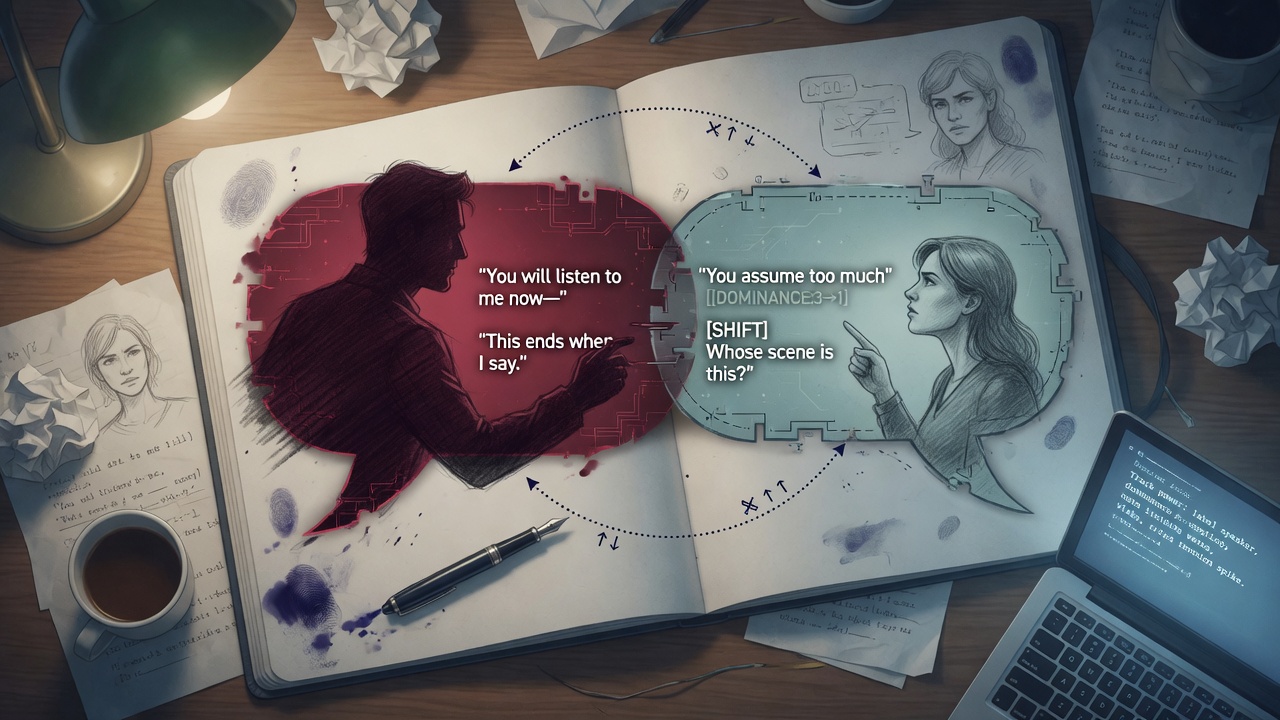
The first practical step is tagging function, not content. Every line in a dialogue exchange is doing something beyond conveying information: it's asking, deflecting, commanding, conceding, or changing the subject. Once you tag a scene this way, you can generate a rough control ratio—how many lines each character uses to set terms versus how many lines they use responding to terms already set.
I'm going to paste a dialogue scene from my manuscript below. I want you to: 1. Go line by line and tag each line of dialogue with its primary function: QUESTION, ANSWER, DEFLECTION, COMMAND, CONCESSION, TOPIC-CHANGE, or CHALLENGE. If a line does two things, tag the dominant one. 2. For each character, tally how many lines fall into each category. 3. Calculate a rough "control ratio" — lines where the character is setting terms (COMMAND, TOPIC-CHANGE, CHALLENGE, QUESTION) versus lines where they're responding to terms already set (ANSWER, DEFLECTION, CONCESSION). 4. Tell me, based on the ratio, which character appears to be steering this conversation. 5. Here is the context for the scene: [explain what's actually at stake — who has leverage, what each character wants, what the reader should sense about who's in control]. Does the control ratio you found match what the stakes of the scene demand? If there's a mismatch, point to the specific lines where the mismatch shows up most clearly. Do not rewrite anything yet. I want the diagnostic first. [PASTE SCENE]
What you're looking for isn't a "correct" ratio in some universal sense—it's whether the ratio matches your intent. If your antagonist is supposed to hold all the leverage in a scene, but the tagging comes back nearly even, or worse, tilted toward your protagonist, you've found a real problem, not a stylistic quibble. The scene is telling readers something different than what your outline says should be happening.
Engineering the Moment Control Flips
Most scenes worth writing aren't static in their power balance—they turn. A confession changes who has something to lose. A threat changes who's answering to whom. The turn is often the entire point of the scene, but it's easy to write the turn as a stated event ("and in that moment, she realized she had the upper hand") rather than something felt through the actual mechanics of who talks, who interrupts, who goes quiet.
Once you know where a scene's power shift is supposed to happen—because you wrote it into your outline, or because the plot logic demands it—you can ask AI to locate the exact line where the shift should be occurring, and then help you rebuild the dialogue around that hinge point using rhythm and interruption rather than narration.
Below is a dialogue scene. Structurally, the power should flip midway through: [Character A] starts the scene in control (they know something Character B doesn't, they set the agenda, they can walk away), but by the end, [Character B] has taken control because [describe the specific turn — a reveal, an admission, a threat that lands, evidence produced]. 1. Identify the single line or exchange where this flip should occur based on the story logic I've given you. Tell me if the current draft places the flip too early, too late, or doesn't earn it at all. 2. Rewrite the ten lines before and after that flip point. Do NOT have either character state that something has changed. Show the flip through: who interrupts whom, whether a question gets answered or dodged, whether a line gets cut short, whether someone goes quiet instead of responding, and changes in sentence length. 3. After the rewrite, give me a one-paragraph explanation of exactly which dialogue mechanics you used to signal the shift, so I can apply the same techniques elsewhere in the manuscript. [PASTE SCENE]
The value of asking for the explanation isn't just for this one scene—it's to build your own working vocabulary of tactics (interruption, delayed response, one-word answers, sudden politeness from a previously hostile character) that you can deploy deliberately in other scenes without needing AI every time. You're using the tool to teach you the pattern, not just to patch the current draft.
Auditing Status Across an Entire Relationship Arc
Single-scene audits catch local problems, but power dynamics in a novel usually need to evolve across dozens of scenes between the same two characters. A mentor who starts the book in complete control needs to lose some of that control by the midpoint if your arc is about the protagonist growing into their own authority. A villain who seems untouchable in chapter three needs to show the first cracks somewhere before the climax, or the eventual confrontation won't feel earned.
The trouble is that these shifts happen slowly, scene by scene, and it's easy to lose track of the trajectory across a 100,000-word manuscript. You might unconsciously let a subordinate character hold their own in a scene meant to reinforce their subordination, simply because you wrote sharp dialogue for them and it felt satisfying on the page. Satisfying isn't the same as correct for where that relationship needs to be.
I'm going to give you every scene of direct dialogue between [Character A] and [Character B] across the manuscript, in chapter order. Here is the relationship arc I'm building: [describe the starting power balance, the ending power balance, and roughly where the major shifts should occur — e.g., "A holds total authority over B until chapter 14, where B's refusal to comply starts eroding that authority, culminating in B taking control outright by chapter 22"]. For each scene: 1. Give me a one-line summary of who controls the conversation and how that shows up in the dialogue (not just "A is stronger" — point to specific tactics: interruptions, commands, deflections, silence). 2. Rate the scene on a rough scale of who holds more control: "A firmly," "A slightly," "roughly even," "B slightly," "B firmly." Then, plot this across all the scenes and tell me: - Whether the control ratings move in the direction my arc requires, or whether there are scenes that contradict the trajectory - Any scene where the subordinate character is holding power they haven't earned yet according to the arc - Any scene where the trajectory stalls for too long without progression [PASTE SCENES IN ORDER, LABELED BY CHAPTER]
This kind of audit is where AI earns its keep on a full manuscript. Finding a stalled arc or a premature power shift by memory alone, across dozens of scenes spread over months of drafting, is genuinely difficult. Having every instance laid out side by side with a control rating attached to each one turns a vague sense of "something's off with these two" into a concrete list of scenes to revise.
Building a Tactics Library: Interruption, Silence, Misdirection
Once you understand power dynamics as something constructed from specific dialogue tactics rather than an abstract quality, it becomes useful to test tactics against each other for a given scene. Should your character regain control by interrupting? By going silent and forcing the other person to fill the space? By answering a question that wasn't asked, redirecting the entire conversation onto their own terms? Different tactics suit different characters and different stakes, and it's often not obvious which one will work best until you see it on the page.
Here is a dialogue scene where [Character] needs to take control of the conversation away from [Other Character]. I want to test three different tactics for how they do it. Using the same scene setup and stakes, give me three separate versions: VERSION 1 — Interruption: [Character] repeatedly cuts off [Other Character] before they finish their point, escalating in frequency as the scene progresses. VERSION 2 — Non-answer: [Character] never directly answers what's asked of them. Instead they answer an adjacent or deflecting question, forcing [Other Character] to either accept the deflection or push harder, which itself becomes a power move. VERSION 3 — Silence: [Character] goes quiet at a key moment instead of responding at all, using the silence itself as pressure, until [Other Character] is forced to fill the gap or change their approach. After all three versions, tell me which tactic best fits [Character]'s established voice and which one creates the most tension given that [describe the stakes — what's being risked, what each character wants]. [PASTE SCENE SETUP]
Running the same stakes through three tactics side by side does something a single draft can't: it shows you the texture each choice creates. Interruption tends to read as aggressive and immediate. Non-answers read as evasive and can build a slow-burn frustration in the reader. Silence often reads as the most powerful of the three precisely because it withholds the thing dialogue usually provides—words—and that withholding becomes its own kind of pressure.
None of these prompts write the scene for you in any final sense. What they do is force a level of interrogation that's easy to skip when you're deep in a draft and just trying to get characters through a necessary conversation. Dialogue that reads as "fine" is common. Dialogue that makes a reader feel a relationship tilt without being told it happened is rarer, and it's built from choices about control that are specific enough to tag, measure, and revise.

No comments yet. Be the first to comment!