




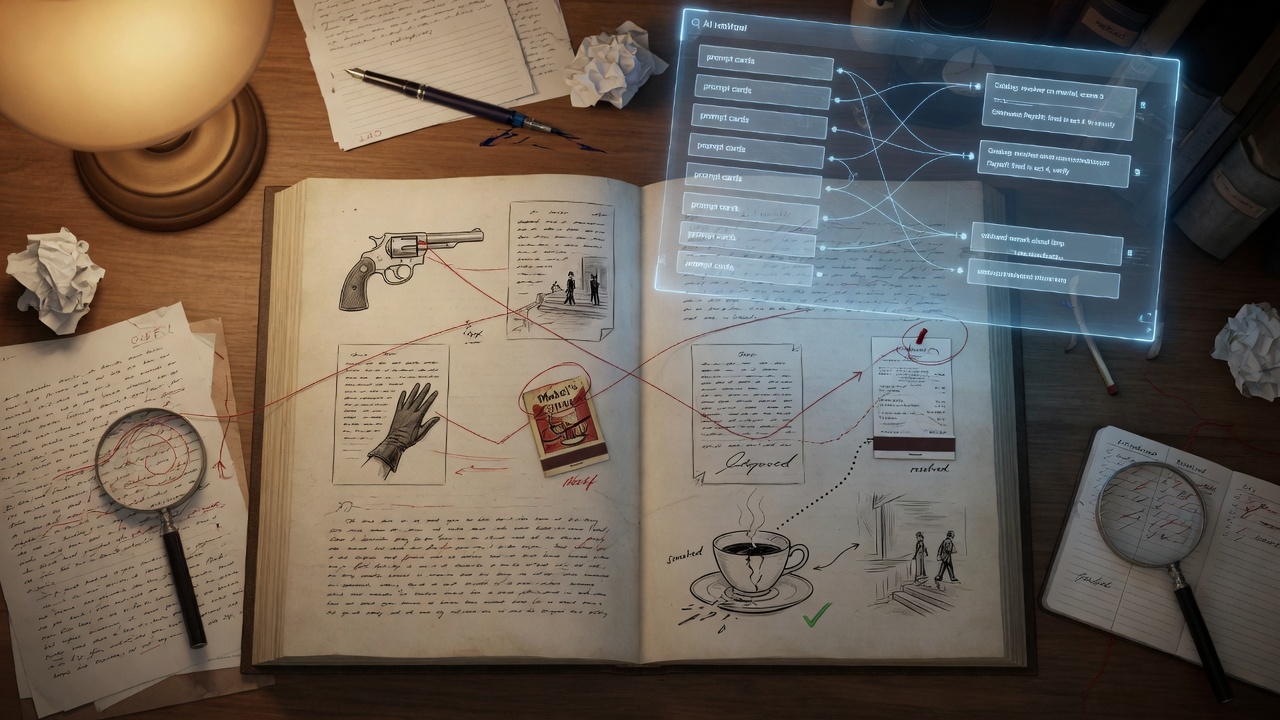
Every novelist knows Chekhov's rule in theory: if you show a gun in act one, it needs to fire by act three. What's harder to track is that the rule applies to far more than literal weapons. It applies to the locket a character keeps touching, the unopened letter on the kitchen table, the scar someone mentions once, the specific brand of car a suspect drives. Readers register these details as promises, even when writers introduce them without fully meaning to make one.
The problem isn't remembering to plant Chekhov's guns. Most writers do that instinctively. The problem is tracking what you've already planted across 90,000 words written over eight months, especially after three rounds of revision moved chapters around and cut scenes you forgot existed. This is exactly the kind of bookkeeping task AI handles well, provided you give it a structured job instead of a vague one. Below is a workflow for building a full object inventory, classifying each item's narrative weight, and catching the ones that got dropped.
Why Objects Create Promises the Same Way Plot Does
Readers build expectation through pattern recognition, not just through explicit plot statements. When a narrator lingers on an object, describes it with unusual specificity, or has a character react to it emotionally, the reader files that object as significant. This happens below the level of conscious plot tracking. A reader might not be able to articulate "I expect the wedding ring in the desk drawer to matter later," but they'll feel a small dissonance if it never comes up again.
This is different from a scene-level plot promise, like a character vowing revenge. Object promises are quieter and easier for a writer to lose track of because:
- They're often introduced through description rather than dialogue or action, so they don't feel like "plot points" when you're drafting.
- The same object might appear in multiple chapters with different levels of emphasis, and it's easy to lose the thread of whether the emphasis is escalating or just repeating.
- Revision tends to move or cut scenes without anyone auditing whether an object's setup and payoff got separated in the process.
- Writers frequently introduce objects for atmosphere or characterization, not realizing the specificity itself reads as a setup cue.
The fix isn't to stop writing evocative detail. It's to periodically inventory what you've planted and make a deliberate decision about each item: pay it off, downgrade it, or cut it. AI is useful here specifically because it can hold and cross-reference hundreds of small details across a full manuscript without fatigue, something human proofreading passes are bad at precisely because objects don't announce themselves as important the way character names or plot beats do.
Building the Object Inventory
The first pass is pure extraction. You want AI to comb the manuscript and produce a flat list of every notable physical object, with enough context to locate it again. Resist the urge to ask for interpretation at this stage. Interpretation comes later, once you have the raw list in front of you. If you ask for classification and extraction simultaneously, the model tends to under-report, quietly filtering out items it decides aren't important before you've had a chance to see them.
Feed this prompt one section or a few chapters at a time if your manuscript is long enough that context limits become an issue. For most novel lengths run through a capable model with a large context window, you can do this in two or three passes.
You are helping me build a complete inventory of physical objects, props, and items mentioned in this manuscript excerpt. I need this for Chekhov's Gun tracking, so be exhaustive rather than selective — do not pre-filter for importance. For every physical object, weapon, letter, document, garment, vehicle, or distinctive item mentioned, list: 1. Object name/description (as written in the text) 2. Chapter and approximate location (scene description, e.g. "Chapter 4, opening scene at the diner") 3. The exact sentence or short passage where it's introduced 4. Who introduces it or interacts with it first 5. Any descriptive emphasis used (unusual detail, repeated mention, emotional reaction from a character, slow-motion description, etc.) Include background/set-dressing objects too (e.g. "a chipped mug," "a rusted mailbox") — I will filter for significance myself in a later pass. Do not skip items just because they seem minor. Output as a table with columns: Object | Chapter/Location | Introduction Text | First Interaction | Emphasis Notes. Manuscript excerpt follows: [PASTE CHAPTER TEXT]Run this across your full draft and stitch the resulting tables together. Yes, this produces a long, unwieldy document. That's the point. You're building a raw ledger before you start deciding what matters. Trying to skip straight to "just tell me what's important" defeats the purpose, because the model's judgment about importance is exactly what you're trying to check against your own authorial intent, not substitute for it.
Classifying Objects by Narrative Weight
Once you have the full inventory, the next job is sorting items into three tiers:
- Decorative detail — set dressing that grounds a scene but carries no narrative weight. A character's coffee mug doesn't need to matter later unless you made it matter through emphasis.
- Planted setup — an object introduced with enough specificity or emotional charge that readers will expect it to return, even if you haven't decided exactly how yet.
- Active Chekhov's gun — an object you've deliberately planted with the clear intention of a specific payoff already in mind, often tied directly to plot mechanics (a weapon, a key, a piece of evidence).
The tricky category is the middle one, because it's often unintentional. A description you wrote for texture or characterization can read, to a reader, exactly like a plant. This is where AI is genuinely useful as a second opinion, since it doesn't know your intentions and will flag things based purely on how the prose reads, which is a decent proxy for how a first-time reader will experience it.
Using the object inventory table below, classify each object into one of three tiers based on how a first-time reader would likely interpret its narrative weight: TIER 1 — Decorative detail: grounds the scene, no reader expectation of return. TIER 2 — Planted setup: described with enough specificity, repetition, or emotional charge that a reader would expect it to matter again, even if the payoff mechanism isn't obvious yet. TIER 3 — Active Chekhov's gun: clearly positioned as plot-relevant (weapon, evidence, key, document tied directly to the central conflict). For each object, give: - Tier assignment - One-sentence justification based on the emphasis language used in the introduction (quote the specific words that create the expectation, if any) - A confidence rating (High/Medium/Low) — flag Medium/Low confidence cases separately, since these are judgment calls I should review myself Be conservative about Tier 1. If there's any repeated mention, unusual specificity, or emotional beat attached to an object, lean toward Tier 2 rather than defaulting it to decorative. Object inventory: [PASTE TABLE FROM PREVIOUS STEP]The output from this step becomes your working map. In practice, most manuscripts turn out to have far more Tier 2 objects than writers expect. This is normal. It reflects how much unconscious pattern-building happens during drafting. Your job now is deciding, item by item, whether that pattern-building was intentional.
What to Do With the Medium/Low Confidence Flags
These are the interesting cases. A Medium confidence Tier 2 classification usually means the model detected some emphasis language but isn't sure whether it rises to the level of a genuine reader expectation. Read these yourself rather than trusting the automated tier assignment blindly. Sometimes the "emphasis" the model flagged was just good, specific prose that doesn't actually create an expectation of payoff, in which case you can downgrade it manually. Other times you'll realize, reading it back, that you did plant something without meaning to, and now you have a decision to make.
Flagging Objects That Never Get a Payoff
With your Tier 2 and Tier 3 objects identified, the next pass checks whether each one actually gets referenced again later in the manuscript. This requires feeding the model both the object list and either the full manuscript or, more practically, a chapter-by-chapter summary you've already generated for tracking other continuity elements. If you don't already have chapter summaries, generate a quick set before running this prompt, since asking the model to search a full 300-page manuscript for a passing mention of "the brass key" in one pass is asking a lot of both context handling and recall accuracy.
I'm checking whether objects classified as Tier 2 (planted setup) or Tier 3 (active Chekhov's gun) actually get referenced again later in the manuscript, and whether that later reference constitutes a genuine payoff or just an incidental mention. Below is my list of Tier 2/3 objects with their introduction chapter, followed by chapter-by-chapter summaries covering the rest of the manuscript. For each object, tell me: 1. Does it reappear later? If yes, in which chapter(s)? 2. Is the reappearance a genuine payoff (the object's significance is resolved, used, or explained) or just an incidental mention (the object is referenced without its earlier setup being addressed)? 3. If it never reappears, confirm this explicitly and flag it as UNRESOLVED. 4. For objects that do get a payoff, rate whether the payoff feels proportional to the setup's emphasis (Strong / Adequate / Underwhelming). List UNRESOLVED and Underwhelming items in a separate summary section at the end so I can address them first. Tier 2/3 object list: [PASTE CLASSIFIED LIST] Chapter-by-chapter summaries: [PASTE SUMMARIES]The UNRESOLVED and Underwhelming categories are where the real editing work happens. Everything else on the list, you can set aside with confidence that it's functioning correctly.
Deciding the Fix: Cut, Downgrade, or Write the Payoff
For each flagged object, you have three legitimate paths, and the right choice depends on the object's role in the story rather than a fixed rule.
Cut the object entirely. If an unresolved item isn't load-bearing for character or atmosphere, sometimes the cleanest fix is removing the introduction altogether, or trimming the specific language that created the false expectation in the first place. A locket described once, briefly, without emotional weight, probably doesn't need a payoff if you strip out the line that gave it emphasis. Downgrade the introduction. If the object serves a purpose in its original scene (characterization, mood, texture) but doesn't need to pay off later, you can rewrite the introduction to lower its perceived significance. This usually means removing repetition, cutting a character's emotional reaction to it, or trimming the sensory specificity that made it feel planted. Write the missing payoff. If the object is genuinely useful to the plot, or cutting its setup would weaken an otherwise strong scene, write the scene where it returns. This is often the better choice for objects tied to theme or character arc, since removing them just to avoid the workload of a payoff scene tends to leave the manuscript thinner.For the downgrade path specifically, AI can help you see exactly which words are doing the work of raising expectation, so you know what to cut without gutting the whole passage.
Here is the original introduction passage for an object I've decided not to pay off later in the manuscript. I want to keep the object in the scene for atmosphere/characterization, but rewrite the passage so it no longer reads as a planted setup to an attentive reader. Specifically: - Identify which words or sentences currently create the "this will matter later" signal (repetition, unusual specificity, character's emotional reaction, slow pacing around the description, etc.) - Rewrite the passage keeping the object present and the scene's mood/function intact, but reduce or remove the emphasis language that creates reader expectation of payoff - Keep the new version close in length and voice to the original — I don't want a shorter, flatter version, just a de-emphasized one - After the rewrite, briefly explain what you changed and why it reduces the "planted" feeling Original passage: [PASTE PASSAGE]Run this pass on each object you've decided to downgrade rather than cut or pay off. It tends to produce more usable results than a blanket "remove the foreshadowing" instruction, because it forces the model to isolate the specific mechanism creating the expectation instead of just trimming description indiscriminately.
Making This Part of Your Revision Cycle
This whole workflow is most useful as a discrete pass late in revision, after your plot structure and character arcs have stabilized but before line editing. Running it too early wastes effort on objects tied to scenes you'll cut anyway. Running it after copyediting means you're re-touching prose you've already polished.
Object tracking doesn't replace an editor's eye or a sharp beta reader who happens to notice the gun that never fired. What it does is catch the volume problem: the dozens of small props scattered across a full manuscript that no single reader, including you, can hold in memory all at once. Treat the inventory as a checklist you run once per major draft, not a constraint you think about while drafting. The goal is confidence that when a reader notices something you put on the page, the story eventually tells them why it was there.

No comments yet. Be the first to comment!